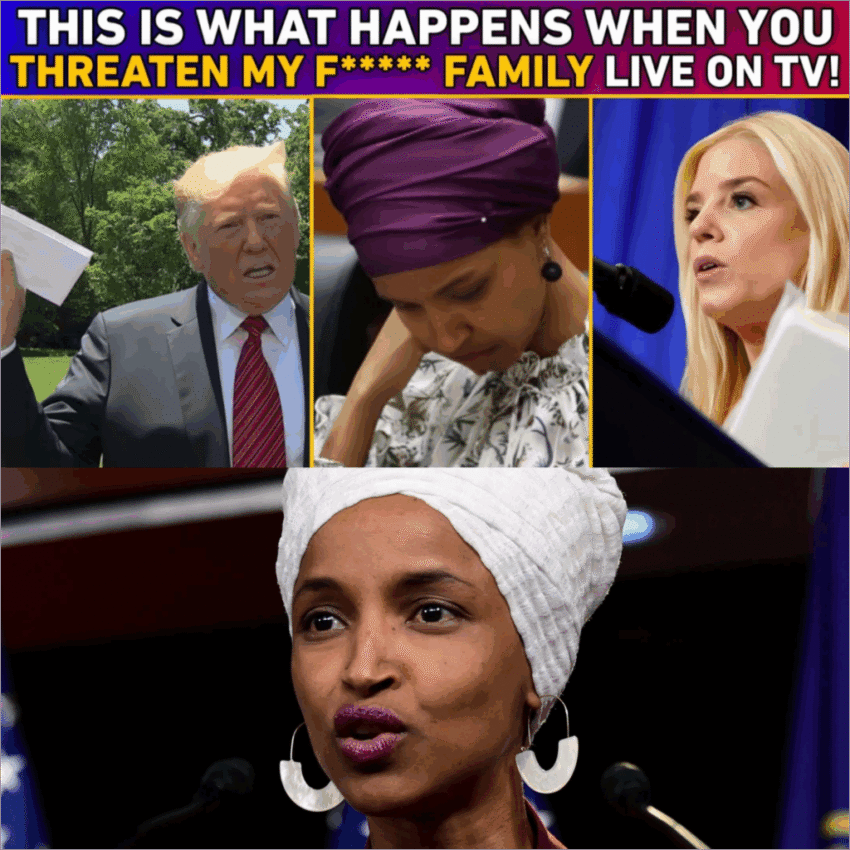
The political feud surrounding Representative Ilhan Omar (D-MN)
This latest surge in controversy was sparked by a video where Omar reportedly expressed deep feelings for her ancestral home (13:18–13:23), which critics interpreted as a stark expression of disloyalty to the United States. The situation is further inflamed by aggressive public statements, the resurfacing of long-debunked allegations of financial fraud, and unverified claims of election manipulation, all framed by the conservative media as evidence that Omar is fundamentally unfit to serve in Congress.
The core catalyst for the current storm is the continued insistence by Donald Trump and his allies that Ilhan Omar, a naturalized U.S. citizen and Congresswoman, should
Trump’s Stance: The former President has repeatedly made this demand, an action which her supporters condemn as racist and xenophobic, but which her critics see as a necessary response to her perceived anti-American rhetoric.
The host echoed this sentiment forcefully throughout the segment, repeatedly telling Omar to leave if she finds fault with America: “Bro, go, bro. I truly promise you… you are free to go”
A significant portion of the recent scrutiny has focused on the financial disclosures of Omar and her husband, Tim Mynett, alleging an unprecedented and suspicious surge in their net worth.
Citing reports, the host detailed that Omar’s net worth allegedly soared to a range between $6 million and $30 million, a purported
3,500% increase
This disclosure stands in stark contrast to Omar’s own public statements made earlier this year (c. February 2025 in the clip timeline), where she explicitly denied being a millionaire:
Omar’s Earlier Denial: “My salary is $174,000 before taxes. I don’t have stock or own a home, and I’m still paying off my student debt… I barely have thousands, let alone millions.”
Omar attempted to refute the millionaire claims by pointing to the complexity of the financial disclosure documents, arguing that the reported asset ranges did not equate to liquid income (1:22–1:43). However, critics dismissed her defense as insufficient, viewing the financial leap as evidence of potential corruption and illicit gain, particularly given her prominent political role (3:46–3:53).
The final, and most explosive, set of claims focused on alleged voter fraud schemes in Minnesota’s Somali community purportedly linked to Omar’s allies.
The host referenced an investigative video from the conservative activist group Project Veritas (6:05–6:32), which claimed to have exposed “alleged ballot harvesting by supporters of Democrat Representative Ilhan Omar and her allies in Minnesota”
The Allegation: The video allegedly showed an operative bragging about illegally collecting “hundreds of ballots” from elderly Somali immigrants and claiming that individuals linked to Omar’s campaign pay money to the voters (6:28–7:02).
Calls for Action: The host stressed that while the county attorney stated that “ballot harvesting” is illegal and is being investigated, more “action” is needed (9:41–9:47). This claim is consistent with other reports that have raised concerns about voter fraud in the Somali-American community in Minnesota, though conclusive evidence tying it directly to Omar has historically been lacking or challenged.
The campaign to remove Ilhan Omar from Congress and potentially strip her of citizenship is driven by a deep ideological conflict and supported by a cascade of serious but often unverified allegations.
For her critics, Omar’s political dissent, combined with her cultural background and the unproven claims of financial and electoral fraud, confirms a belief that she is fundamentally an internal threat. The repeated demand for her to “go back” is a clear expression that they view her as an outsider whose loyalties lie elsewhere.
Conversely, Omar and her defenders view these continuous, aggressive attacks—which often rely on xenophobic and Islamophobic tropes (10:07–10:13)—as an assault on her identity and an attempt to silence a powerful progressive voice of color through denaturalization threats and endless investigation.
This controversy highlights the severe polarization in U.S. politics, where political disagreement is often elevated to questions of fundamental loyalty and citizenship, creating a highly volatile environment for elected officials like Ilhan Omar.
.
Rep. Maxine Waters has once again made headlines, but this time her remarks have ignited intense debate about her political consistency and priorities.
On a recent appearance on MSNBC, Waters called for the removal of President Donald Trump, citing his firing of a Federal Reserve governor as grounds for invoking the 25th Amendment.
Waters’ call for a cabinet evaluation of Trump’s fitness for office comes after years of political turbulence under former President Joe Biden, during which Waters remained largely silent on Biden’s cognitive health. Her selective outrage towards Trump, while ignoring growing concerns over Biden’s mental fitness, has led many to question her sincerity and political motivations.
Waters’ criticism of Trump is not new, and it is clear that she views him as a serious threat to democracy. In her latest remarks, Waters emphasized that Trump’s actions as president—particularly his firing of Federal Reserve Governor Jerome Powell—warranted a re-evaluation of his fitness for office.
According to Waters, this action was not just a political misstep but a clear example of how Trump put the country’s stability at risk. She took to MSNBC, demanding that the cabinet invoke the 25th Amendment to assess whether Trump was still mentally fit to lead the country.
“We have to call for Article 25 of the Constitution of the United States of America to determine his unfitness,” Waters declared emphatically. For her, this was not just about the political ramifications of Trump’s actions but about the existential threat she believes he posed to American democracy.
Waters’ rhetoric, as it often does, conveyed a sense of urgency and alarm, reflecting her long-held belief that Trump was a dangerous president.
Yet, Waters’ vocal calls for Trump’s removal by invoking the 25th Amendment are not the only thing causing a stir. What many critics have pointed out is the glaring discrepancy between her calls for Trump’s removal and her silence on similar concerns regarding former President Biden’s cognitive health.
The questions about Biden’s mental acuity have been growing for some time, especially as he has struggled with public speaking gaffes, moments of confusion, and an increasingly disoriented appearance during public events.
In a recent analysis, a CNN data reporter suggested that Democrats are currently facing approval ratings that mirror the backlash to Cracker Barrel’s controversial logo change.
The report highlights growing concerns within the party as public sentiment continues to slide ahead of the upcoming election cycle. “If you want a cultural comparison, Democrats right now are polling about as poorly as Cracker Barrel did when it tried to refresh its longtime logo,” the reporter noted.
Cracker Barrel’s decision to alter its familiar branding sparked widespread criticism from customers who saw the change as unnecessary and even alienating. Similarly, Democrats are grappling with internal divisions, declining enthusiasm among their base, and strong opposition from independents.
Political strategists warn that unless the party can reconnect with voters on key issues such as the economy, healthcare, and national security, it risks further erosion of support. “The backlash to the Cracker Barrel logo may sound trivial,” one analyst commented, “but it reflects how quickly people can turn against something familiar when it no longer feels authentic. Democrats are in danger of facing the same reaction.”
The comparison underscores the broader challenges Democrats face in an increasingly polarized climate—where even something as small as a logo change can become a symbol of deeper dissatisfaction.