
3I/ATLAS Caught: The “Interstellar Comet” Video That Came from a Drop of Water
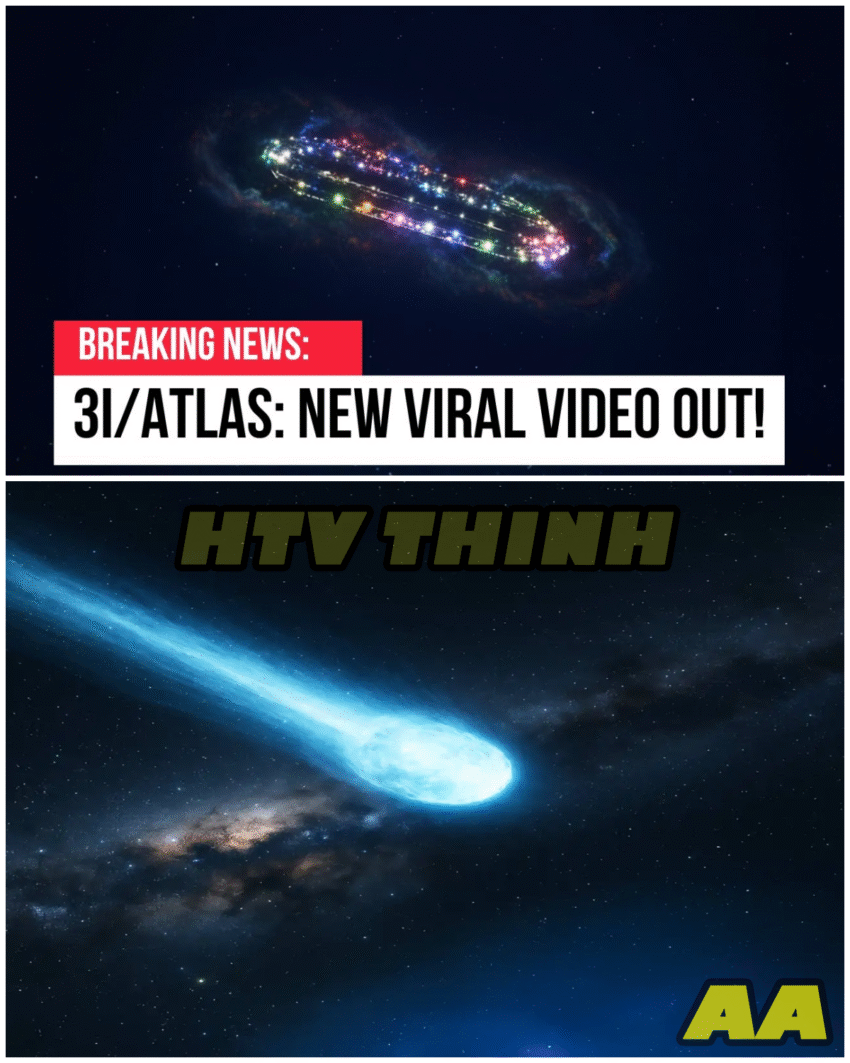
On October 27, 2025, a video swept across social media, claiming to showcase the interstellar comet 3I/ATLAS in stunning detail.
The clip, hailed as a breakthrough in astronomy, featured a glowing object gliding smoothly through a dark void.
However, experts quickly raised red flags.
The absence of stars, the unnatural lighting, and the lack of any signature cometary features pointed to one conclusion: this was no cosmic phenomenon.
What millions believed to be a glimpse of the universe’s mysteries turned out to be something far more mundane—a microorganism filmed under a microscope.
Astronomers were the first to spot the inconsistencies.
Real deep-space images are filled with stars, faint glimmers, and occasional quirks like sensor noise or cosmic ray streaks.
The viral video, however, was suspiciously clean.
Its background was a blank void, devoid of constellations or even the faintest traces of light pollution.
The object itself lacked a coma—the fuzzy halo of gas and dust that surrounds real comets—and there was no tail, no indication of material being ejected into space.
Even the lighting was off; instead of the steady glow of sunlight, the object’s brightness pulsed and shifted, more akin to a laboratory lamp than a distant star.
The digital trail of the video only deepened the mystery.
A reverse image search found no matches in any astronomical databases, and the metadata of the file was suspiciously stripped of key details like camera make, model, and GPS coordinates.
The earliest version of the video appeared on a social media account known for sharing AI-generated content, and from there, it spread like wildfire.
Each repost stripped away more context, until the original educational caption was replaced with sensational claims like “Real 3I/ATLAS footage—closest ever!” By the time it went viral, the clip was entirely disconnected from its true origins.
The breakthrough came not from astronomers but from a microbiologist.
Upon reviewing the footage, they immediately recognized the object as Paramecium caudatum, a common single-celled organism found in freshwater.
The organism’s body, less than a third of a millimeter long, is covered in tiny hair-like structures called cilia.
These cilia beat in synchronized waves, propelling the cell forward in a smooth, gliding motion.
Under a phase-contrast microscope, the edges of the cell appear to glow, creating a halo effect that mimics the appearance of a comet.
Cropping the field of view and adjusting the contrast further exaggerated this illusion, stripping away any sense of scale or context.
The video’s journey from a classroom demonstration to a viral sensation highlights the pitfalls of the digital age.
The original footage, likely recorded as part of a biology lesson, was uploaded to an open-access platform with clear labeling.
But as it was shared and reshared, crucial details were lost.
Automated content tools and AI-driven algorithms amplified the clip, pairing it with cosmic-sounding captions and hashtags that made it irresistible to viewers.
The resemblance to a comet, though superficial, was enough to fool millions.
Meanwhile, the real 3I/ATLAS, discovered on July 1, 2025, is a genuine interstellar visitor.
It is only the third confirmed object from beyond our solar system, following 1I/‘Oumuamua in 2017 and 2I/Borisov in 2019.
Unlike the viral video, this comet was identified through rigorous observation and analysis.
Its hyperbolic trajectory, which will carry it out of the solar system forever, confirms its alien origins.
Telescopes around the world, including the James Webb Space Telescope, have been tracking its faint motion, revealing a subtle coma and an unusual composition rich in carbon dioxide.
The discovery of 3I/ATLAS is a rare opportunity for scientists to study material from another star system.
Its high ratio of carbon dioxide to water suggests it may have formed in a colder, older region of the galaxy, possibly in the thick disk of the Milky Way.
This makes it a potential time capsule, carrying clues about the early stages of planetary formation.
Observations are ongoing, with researchers eager to learn as much as possible before the comet disappears into the depths of space.
The contrast between the viral video and the real 3I/ATLAS serves as a cautionary tale.
Social media platforms prioritize engagement over accuracy, allowing sensational claims to overshadow scientific truth.
A 2023 study by MIT found that viral science hoaxes are shared up to 70% more than legitimate discoveries, thanks to algorithms that reward strong emotional reactions.
In this environment, even a drop of water can become an “interstellar comet.”
However, the same technology that spreads misinformation can also help combat it.
Amateur astronomers and skeptics alike can use tools like reverse image searches, metadata analysis, and plate-solving software to verify claims.
Authentic astronomical discoveries are always accompanied by raw data, such as FITS files with embedded telescope details, and are confirmed by multiple independent observers.
The absence of these elements in the viral video was a clear sign that something was amiss.
The story of the “interstellar comet” video is a reminder that appearance is not evidence.
In science, context and provenance are everything.
The real 3I/ATLAS, with its faint coma and unique chemical signature, is a testament to the power of careful observation and collaboration.
It is a messenger from another world, offering a fleeting glimpse into the mysteries of the cosmos.
But to appreciate such discoveries, we must remain vigilant against the allure of viral misinformation.
Curiosity may drive us, but only evidence can guide us to the truth.
A Heartfelt Gesture: Free Metal Roof for a Family in Need In an age where community spirit often feels overshadowed…
Solar Storms or Cosmic Conspiracy? The Mystery of 3I/ATLAS Unravels! The scientific community is abuzz with excitement and…
From Hero to Zero: The Shocking Truth Behind Dillon Gabriel’s Leaked Clip! In recent days, Dillon Gabriel, the…
A Header to Remember: Casemiro’s Brilliance or Nottingham’s Blunder? On a chilly evening at the City Ground, Manchester…
Phil X Opens Up About Replacing Richie Sambora and Talks Bon Jovi’s ‘Forever Tour’: “I’m honored” Phil X,…
KISS rocker Ace Frehley Funeral, Paul Stanley Tribute Is STUNNING! The rock world has been shaken by the…
End of content
No more pages to load
Next page