The corruption investigation that has ensnared Los Angeles City Councilman Curren Price represents one of the most complex and financially significant cases of municipal fraud in recent California history. The Los Angeles District Attorney’s office filed two additional charges against the Democratic councilman this week, bringing the total scope of alleged criminal activity to over $800,000 in misappropriated public funds and questionable financial arrangements.
Price, who has served as the Los Angeles City Councilmember for the Ninth District since 2013, now faces an expanded criminal case that prosecutors describe as a systematic abuse of public office for personal financial gain spanning multiple years and involving numerous city agencies and contractors.
“Embezzling public funds and awarding contracts for your own financial gain is the antithesis of public service,” Los Angeles County District Attorney Nathan Hochman declared in announcing the additional charges. “Our communities expect and deserve better from their public officials.”
The district attorney’s strong language reflects the severity of the allegations and the broader implications for public trust in municipal government. Hochman continued: “I thank our investigative team and prosecutors in the Public Integrity Division for diligently pursuing every lead and holding elected officials accountable. Self-dealing and pay-to-play politics will not be tolerated in Los Angeles County.”
This commitment to accountability comes as prosecutors have uncovered what they describe as a sophisticated scheme involving multiple agencies, fake relationships, and systematic conflicts of interest that allegedly enriched Price and his associates at taxpayer expense.
The most financially significant aspect of the corruption case involves allegations that Price orchestrated a complex scheme whereby city agencies paid his wife’s company more than $800,000 while he simultaneously voted to award those same agencies multimillion-dollar contracts—a clear violation of conflict-of-interest laws and ethical standards.
According to prosecutors, the Los Angeles County Housing Authority and LA Metro paid Price’s wife, Delbra Pettice Richardson, through her company Del Richardson & Associates, more than $800,000 total at the same time Price was voting to approve massive funding allocations for these agencies.
The Housing Authority component of the scheme was particularly brazen. Between October 22, 2019, and June 30, 2020, the Housing Authority of the City of Los Angeles allegedly paid Del Richardson & Associates approximately $609,600. During that exact same period, Curren Price voted to approve a $35 million federal grant and supported a $252 million state grant application for the agency.
The timing and amounts involved suggest a coordinated effort to extract maximum financial benefit from Price’s official position while he was simultaneously making decisions that would benefit the agencies providing payments to his wife’s company. The fact that his staff had flagged the potential conflict of interest beforehand indicates that Price was aware of the ethical violations but chose to proceed anyway.
The LA Metro component of the scheme followed a similar pattern. From October 27, 2020, to October 20, 2021, LA Metro reportedly paid Del Richardson & Associates approximately $219,500. During that same timeframe, Price introduced and voted in favor of a motion to allocate $30 million to LA Metro, despite his staff having again flagged the conflict prior to the votes.
These allegations reveal a systematic pattern where Price’s official votes and advocacy directly benefited agencies that were simultaneously paying substantial sums to his wife’s business, creating what prosecutors characterize as a clear pay-to-play arrangement that enriched the councilman’s household while violating his fiduciary duties to taxpayers.
Beyond the contract steering allegations, Price faces charges related to an even more personally damaging scheme involving healthcare fraud based on a fake marriage claim that allowed him to embezzle city funds for personal medical benefits.
Price is accused of embezzling approximately $33,800 in city funds from 2013-2017 to pay for medical benefits for Richardson, whom he falsely claimed was his wife while still being legally married to Lynn Suzette Price. This deception allowed him to obtain spousal healthcare benefits for Richardson at taxpayer expense while maintaining his actual marriage to another woman.
This aspect of the case reveals not only financial fraud but personal dishonesty that undermines Price’s credibility and demonstrates a willingness to lie about fundamental personal relationships to obtain financial benefits. The multi-year duration of this fraud suggests systematic planning and ongoing deception rather than a momentary lapse in judgment.
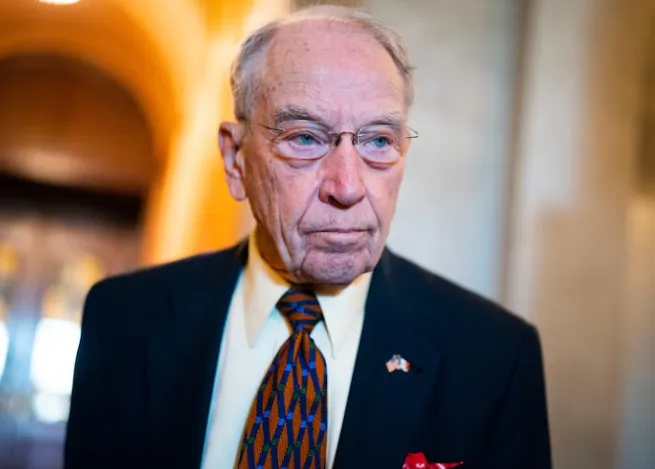
President Donald Trump is once again upping the pressure on Senate Judiciary Committee Chairman Chuck Grassley to do away with a century-old Senate tradition that places some constraints on the president’s authority to appoint judicial nominees.
Trump is targeting the Senate’s “blue slip” tradition, a time-honored Senate process that gives senators the right to approve or object to nominees nominated to serve as federal judges or U.S. attorneys in their home states.
Senators approve of a nominee by returning their blue slip to the Judiciary Committee Chairman. If a senator does not return their blue slip or returns it with objections, the nominee does not advance. In blue states like New York, some of Trump’s judicial nominees have stalled out because Democratic senators have not returned blue slips.
In a post on his social media platform on Sunday evening, Trump made his continued displeasure with this Senate tradition known.
I have a Constitutional Right to appoint Judges and U.S. Attorneys, but that RIGHT has been completely taken away from me in States that have just one Democrat United States Senator,” Trump said. “This is because of an old and outdated “custom” known as a BLUE SLIP, that Senator Chuck Grassley, of the Great State of Iowa, refuses to overturn, even though the Democrats, including Crooked Joe Biden (Twice!), have done so on numerous occasions.”
This isn’t the first time that Trump has gone after blue slips and Grassley. But Grassley has consistently committed to maintaining the Senate tradition.
In a post on X on Monday, Grassley once again defended the Senate process.
“A U.S. Atty/district judge nominee without a blue slip does not hv the votes to get confirmed on the Senate floor & they don’t hv the votes to get out of cmte,” Grassley posted. “As chairman I set Pres Trump noms up for SUCCESS NOT FAILUREThe 100 yr old “blue slip” allows home state senators 2 hv input on US attys & district court judges In Biden admin Republicans kept 30 LIBERALS OFF BENCH THAT PRES TRUMP CAN NOW FILL W CONSERVATIVES.”
But Grassley’s pushback has not dissuaded Trump from trying to force modifications to the process.
While speaking with reporters in the Oval Office on Monday, Trump doubled down, saying he would file a lawsuit to challenge the use of blue slips, though he did not say who he intended to file suit against. He then blamed Grassley for a lag in the advancement of his appointees to be judges and U.S. attorneys.
“It’s a gentlemen’s agreement that’s about 100 years old, where if you have a president like a Republican, and if you have a Democrat senator, that senator can stop you from appointing a judge or or U.S. attorney in particular,” Trump said. “And this is based on an old custom. It’s not based on a law … And I think it’s unconstitutional. And I’ll probably be filing a suit on that pretty soon.”
The Senate has the authority to govern itself and typically retains authority to make its own rules and traditions. Blue slips are not codified in the Senate rules, but are rather a courtesy observed by the committee chairman.
The blue slip process goes back to at least 1917, according to the Congressional Research Service. Since the use of blue slips is not codified or in the committee’s rules, the chair has the discretion to determine whether a home state senator’s negative or withheld blue slip stops a judicial nomination from receiving consideration by the committee and whether it reaches the Senate floor.
Trump explicitly expressed his desire to advance nominees like Jay Clayton, who was appointed to serve as U.S. attorney for the Southern District of New York by Manhattan federal judges earlier this month despite his nomination being stalled in the Senate by Minority Leader Chuck Schumer’s refusal to return a blue slip on the nominee.
“That’s the only way you get by. But generally speaking, you can’t do that because you’ll have judges from the other party. So, so Jay Clayton just got approved and he’s in, but he didn’t get approved by the senators, Trump said.
Trump said the blue slip process was a barrier for him to get any Republican judges through — that he can now “only get a Democrat U.S. attorney.”
“The only person that I can get approved are Democrats or maybe weak Republicans. But we don’t want that. But the only person I will be able to get approved in any of those states where you have a Democrat will I can’t get a U.S. attorney. I can only get a Democrat U.S. attorney,” Trump said.
Still, Senate Republicans are generally opposed to modifying the tradition.
Sen. Thom Tillis, R-N.C., who serves on the Judiciary Committee and announced earlier this year he wouldn’t seek re-election next year, said in a post on X Monday that getting rid of the blue slip is “short-sighted.”
“Chairman Grassley is a principled conservative who wants to keep radical liberals off the bench. Getting rid of the blue slip is a terrible, short-sighted ploy that paves the path for Democrats to ram through extremist liberal judges in red states over the long-term,” Tillis posted. “It’s why radical liberal groups have been pushing to get rid of the blue slip for years — Republicans shouldn’t fall for it.”
A number of Senate Republicans spoke out when Trump last called for changes to the Senate process in July.
At the time, Majority Leader John Thune expressed little interest in making modifications.
“I think that the blue slip process is something that’s been used for a long time by both sides, and neither side has violated its usage in the past,” Thune said in July. “So my view on it is and I’m happy to hear what Sen. Grassley and some of my colleagues say, “but no, I don’t think there’s any strong interest in changing that up here.
In a single night, the mythos surrounding Barack Obama’s legacy was shattered. The headlines read, “It’s Done! Obama’s LAST Move CRUMBLES Instantly — Patel & Bongino Drop Explosive Truth!” But the reality inside the steel vault beneath Martha’s Vineyard was far more chilling—a reckoning decades in the making, where the ghosts of power, money, and silence finally met daylight.
Friday night was not just another evening on Martha’s Vineyard. As storm winds lashed the coast, a team of FBI agents converged on Obama’s sprawling estate, led by Cash Patel—the razor-sharp investigator—and Dan Bongino, the former Secret Service agent turned truth-seeker. Their mission was clear: breach the vault rumored to hold not mere presidential memorabilia, but the black heart of a shadow empire.
The biometric vault, hidden beneath the estate, was no ordinary wine cellar. Steel plates, thick enough to shrug off a missile, guarded its secrets. The air inside was colder than the Atlantic wind—a tomb, not for the dead, but for the truth. Patel’s hand pressed against the icy steel, listening to the faint hum of gears. Bongino whispered, “This isn’t a wine cellar, Cash. It’s a tomb.”
.
For years, Washington insiders had whispered about unexplained deaths, mysterious overdoses, and suicides among those who threatened to expose secrets. Journalists who swore they had the goods on the Obamas were suddenly silenced. Witnesses drowned, overdosed, or vanished with wounds no coroner could explain. The numbers haunted the press: over 50 dead witnesses, $2 billion in unexplained foreign transfers, and a steel vault beneath Obama’s mansion.
At the center of the storm was not just paperwork, but a program of silence. The vault was said to contain ledgers of payoffs, dossiers of leverage, contracts that tethered American policy to foreign regimes, and evidence of those eliminated to keep those files sealed.
As the agents prepared to open the vault, Obama himself appeared—a figure upright, unhurried, his smile measured. “You bring justice into my home, or just Trump’s to-do list with a badge stapled to it?” he asked, his voice dripping with both confidence and warning.
Patel responded, “We don’t serve people. We serve the Constitution. Our oath isn’t seasonal. And it didn’t end with your administration.”
Obama’s reply was sharp: “The Constitution,” he repeated, “Please don’t dress politics in Sunday clothes. I’ve watched this game longer than you’ve been allowed on the field.” But the room was no longer bending to his presence.
Bongino, ever the tactician, said, “This place looks like a palace, mister president. But every palace has a dungeon. Some people build cellars for Cabernet. You built one for leverage.”
The vault’s biometric scanner pulsed red, steel plates groaned, and the door retracted with cold deliberation. Inside, drawers labeled with names and dates waited to be exposed. Patel reached for the top left drawer. One folder lay inside, gray, stamped in red ink: Larry Sinclair.