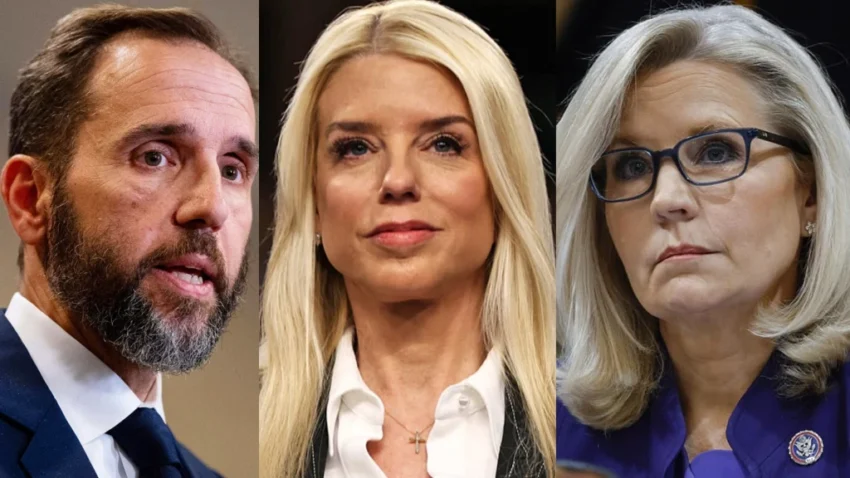
Newly unearthed congressional letters have confirmed the worst fears of Trump supporters — that the January 6th Committee was never about “defending democracy” but about weaponizing government power to destroy President Donald J. Trump.
The shocking letters, released by congressional investigators, show direct coordination between disgraced former Rep. Liz Cheney (R-Wyo.) and Special Counsel Jack Smith, the Biden Justice Department’s top political hitman.
Authored by Cheney and then–Committee Chair Rep. Bennie Thompson (D-Miss.), the two documents reveal that the anti-Trump duo quietly handed over materials from their so-called investigation before Republicans took back the House in 2023.
The letters, dated December 2022, confirm that the Jan. 6 panel transferred at least 16 interviews and deposition transcripts to Smith’s office. These included attached exhibits, text messages, and even spreadsheets detailing Trump administration communications.
One of the letters explicitly stated the committee’s intention to make all gathered evidence “available to the Department of Justice.” That statement alone shatters any illusion of separation between the congressional probe and Smith’s ongoing witch hunt.
Within just four days, Cheney and Thompson wrote again to Smith, this time proudly announcing they had sent text messages from Trump’s then–Chief of Staff Mark Meadows and confidential documents from attorney John Eastman.
“Along with the latter, we are producing a staff-created spreadsheet of the Meadows texts that contain additional information from privilege logs,” they bragged, showing a complete disregard for privacy and executive privilege.
The pair even promised to send “additional evidence on a rolling basis,” effectively making the Jan. 6 Committee an unofficial branch of the Biden Department of Justice.
According to the House Judiciary Committee, these newly revealed communications prove that the partisan panel worked “hand-in-hand” with Smith to politically target Trump and his associates.
Smith, who was personally appointed by Attorney General Merrick Garland, would go on to indict Trump twice — once over a records dispute with the National Archives, and again over Trump’s challenge to the 2020 election results.
The collusion between Cheney’s committee and Smith’s prosecutors shows that the Jan. 6 operation was part of a coordinated effort to criminalize political opposition.
It also raises serious questions about the ethics of lawmakers sharing privileged materials with a prosecutor before their own investigation had even formally concluded.
Many Republicans are now calling it one of the most blatant abuses of congressional power in modern American history.
Rep. Barry Loudermilk (R-Ga.), who is leading the current probe into the Jan. 6 Committee’s activities, says the revelations confirm that the previous panel may have engaged in “criminal or unethical behavior.”
Loudermilk’s new investigation is focused on allegations that the committee deleted files, manipulated evidence, and conducted itself as an arm of the Democratic Party rather than a neutral fact-finding body.
Adding to the outrage, both Cheney and Thompson reportedly received preemptive pardons from President Joe Biden for any actions tied to the Jan. 6 investigation.
That revelation has sparked fury among conservatives, who view the pardons as a blatant attempt to shield political allies from accountability.
The original Jan. 6 Committee was hand-selected by then–Speaker Nancy Pelosi, who barred pro-Trump lawmakers from serving on it — ensuring the panel’s conclusions were politically one-sided from the start.
Cheney, who lost her seat in a landslide after turning on Trump, used her position to promote the Democrat narrative that the former president was responsible for the Capitol riot.
Meanwhile, Thompson oversaw the committee’s public hearings, which featured selectively edited footage, staged testimony, and heavily scripted “evidence” designed to manipulate public opinion.
Now, the release of these letters confirms that behind the scenes, the same individuals who claimed to be seeking “truth” were secretly feeding information to federal prosecutors.
Even worse, that information would later form the backbone of Smith’s politically motivated indictments against President Trump.
The entire saga paints a disturbing picture of government collusion — where congressional Democrats, anti-Trump Republicans, and DOJ officials conspired to weaponize the legal system against a sitting and future president.
For millions of Americans, these revelations only reaffirm what they have long believed: that the Jan. 6 investigation was a partisan hit job masquerading as justice.
The Supreme Court delivered a strong and necessary rebuke to judicial overreach this week, siding with the Trump administration in its battle to uphold fiscal responsibility during the government shutdown.
In a move that protected the separation of powers, the High Court temporarily blocked a lower court’s outrageous attempt to force the Trump administration to pay full Supplemental Nutrition Assistance Program (SNAP) benefits despite the absence of appropriated funds.
This was not just a legal victory—it was a constitutional one. President Donald Trump’s administration correctly argued that it cannot spend what Congress has not authorized, and the Court agreed.
At issue was a Rhode Island judge’s demand that the administration raid limited contingency funds to provide full SNAP benefits in the middle of a government shutdown that Democrats have prolonged.
That judge’s order would have set a dangerous precedent: allowing the judiciary to force the executive branch to fund entitlements beyond what Congress appropriates. Trump’s team rightly challenged it.
The administration stood firm. It refused to play into Democrat theatrics and declared that SNAP would be funded based on what legally exists—not what progressive judges or left-wing activists wish for.
This is what real leadership looks like. Trump’s America First agenda does not bend the knee to judicial activism or budgetary blackmail.
Despite liberal outrage, Justice Ketanji Brown Jackson issued an administrative stay on the lower court’s order—confirming that the administration has the right to appeal and pause unlawful mandates.
The Supreme Court’s move ensures that unelected judges cannot usurp Congress’s power of the purse by forcing emergency expenditures that have no basis in law.
For weeks, Democrats have weaponized government shutdown politics, using essential services like SNAP as political hostages to demand concessions on unrelated spending.
The Trump administration has offered commonsense solutions. Fund critical programs through proper channels, reopen government, and stop holding the American people hostage.
Instead, left-wing courts tried to shame the administration into unlawfully raiding contingency funds. That is not governance — that is economic sabotage.
This administration is protecting taxpayers, defending constitutional limits, and ensuring programs like SNAP are funded through legitimate appropriations — not judicial diktats.
President Trump has shown time and again that his administration won’t be bullied into lawlessness, even when Democrats and their judicial allies demand it.
Let’s not forget: this crisis was caused by congressional Democrats who refused to pass a clean funding bill. They chose shutdown over compromise.
Now, they want to blame Trump for their failure to govern? That’s not just dishonest — it’s disgraceful.
The USDA had already begun working to distribute partial SNAP payments using what limited resources were available, showing the administration’s commitment to support struggling families within the law.
But Democrats don’t want solutions. They want spectacles. They’d rather stir outrage than engage in serious governance.
States like Pennsylvania, Oregon, and California rushed to comply with the judge’s ruling — not because they had to, but because they wanted to score political points against the administration.
Yet Trump held the line. His administration’s appeal to the Supreme Court was not about denying aid — it was about defending the rule of law.
And once again, Trump was right. The Court understood that real leadership means respecting constitutional boundaries, not rewriting them from the bench.
Justice Jackson’s stay gives the administration breathing room to make its case, and protects the executive branch from being railroaded by a hyper-political lower court.
This moment highlights exactly why Trump’s judicial appointments mattered—because constitutional sanity must prevail when government overreach runs wild.
In a heated and dramatic House Judiciary Committee hearing, Republican Congressman Jim Jordan made explosive allegations against former House Intelligence Committee Chairman Adam Schiff, claiming that Schiff leaked classified information to harm former President Donald Trump. This revelation came during a session focused on oversight of the Federal Bureau of Investigation (FBI) and highlighted the ongoing political tensions surrounding the agency and its leadership.
The hearing began with a moment of reflection as Chairman Jim Jordan acknowledged the tragic death of conservative activist Charlie Kirk, who was recently assassinated. Jordan praised Kirk for his commitment to defending the First Amendment and his fight for American values. He invoked the scripture from 2 Timothy 4:7, emphasizing Kirk’s dedication to “fight the good fight, finish the course, keep the faith.”
Jordan’s somber remarks set the tone for the hearing, which quickly shifted to the serious allegations against Schiff. Ranking member of the committee also expressed horror at Kirk’s assassination, highlighting the need for unity against political violence in America. The committee’s shared grief underscored the gravity of the discussions that would follow.
As the hearing progressed, Jim Jordan introduced a whistleblower with 23 years of experience in the intelligence community. This whistleblower, a Democrat staffer, alleged that Schiff pressured them to leak classified information. Jordan raised critical questions about why the head of the intelligence committee would encourage the leaking of such sensitive material.
According to the whistleblower, the leaked information was intended to be used to indict President Trump. This revelation prompted Jordan to draw parallels between Schiff’s actions and those of former FBI Director James Comey, who had also been accused of leaking classified information. Jordan cited an inspector general’s report that claimed Comey violated FBI policy by disclosing classified information, suggesting that both Schiff and Comey were motivated by a desire to undermine Trump’s presidency.
Jordan’s accusations did not stop there. He delved into the origins of the intelligence community’s assessment regarding Russian interference in the 2016 election, claiming that it was manipulated to fit a particular narrative. He pointed to a meeting at the White House on December 9, 2016, where officials decided to change the assessment from stating that Russia did not impact the election vote count to claiming that Russia was attempting to influence the election.
He presented emails from Admiral Mike Rogers, then head of the NSA, expressing concerns about the intelligence assessment. In response, Jordan highlighted an email from James Clapper, then Director of National Intelligence, urging his colleagues to “be on the same page” and emphasizing the need to support the report, even if it meant compromising their normal procedures.
Jordan asserted that the discredited Steele dossier, funded by the Clinton campaign, played a significant role in shaping the intelligence community’s narrative about Russian interference. He accused Schiff and others of using this dubious information to further their political agenda, thereby undermining the legitimacy of Trump’s presidency.
The hearing took a dramatic turn as Jordan recounted the events of January 6, 2017, when Comey and other intelligence officials briefed then-President-elect Trump about the discredited dossier. Jordan argued that this briefing was intended to give credibility to the false information and set the stage for further investigations into Trump’s ties to Russia.
He accused Comey of immediately leaking details of the briefing to the press, further perpetuating the narrative that Trump was compromised. According to Jordan, this was part of a broader scheme involving high-ranking officials within the FBI and intelligence community to sabotage Trump’s first term.
Amidst the accusations, Jordan praised the current FBI Director, Kash Patel, for his leadership and efforts to restore integrity to the bureau. He highlighted Patel’s achievements, including the removal of 21,000 violent criminals from the streets and the rescue of 4,000 children from predatory situations. Jordan claimed that Patel’s focus on law enforcement rather than political maneuvering marked a significant shift in the FBI’s priorities.
Jordan emphasized that under Patel’s leadership, the FBI had ceased its surveillance of concerned parents at school board meetings and ended the pre-dawn raids on pro-life activists. He argued that Patel was committed to transparency and accountability, contrasting his approach with that of former Director Christopher Wray.
Jordan’s remarks underscored the importance of accountability within the FBI and the need for transparency in government operations. He pointed out that Patel had provided information that Wray had previously withheld from Congress, including details about confidential human sources present at the Capitol on January 6, 2021. Jordan accused Wray of failing to disclose that some of these sources had entered restricted areas without facing any consequences.
The congressman also referenced the Richmond field office memorandum, which targeted pro-life Catholics, asserting that Patel had revealed the extent of the FBI’s surveillance activities. Jordan claimed that this demonstrated a pattern of political bias within the agency, raising concerns about the FBI’s commitment to impartiality.
In addition to his critiques of the FBI’s past actions, Jordan praised Patel for saving taxpayer money by opting to keep the FBI’s headquarters in Washington, D.C., rather than pursuing a costly relocation. He argued that Patel’s decisions reflected a commitment to fiscal responsibility and effective governance.
Jordan concluded his opening statement by expressing his belief that the Democrats would continue to focus on undermining Trump rather than acknowledging the positive changes Patel had implemented within the FBI. He urged his colleagues to prioritize accountability and transparency over political agendas.
As the hearing progressed, it became evident that the political divide within Congress remains deeply entrenched. Jordan’s allegations against Schiff and the broader implications for the FBI’s integrity sparked intense debate among lawmakers. The session highlighted the ongoing struggle between accountability and political maneuvering, as both parties sought to shape the narrative surrounding the FBI and its role in American democracy.
With the hearing drawing national attention, it is clear that the fallout from these allegations will continue to reverberate throughout Washington. As the investigation into the alleged leaks and misconduct unfolds, the American public remains watchful, eager for transparency and accountability in their government. The stakes are high, and the implications of these revelations could have lasting effects on the political landscape in the years to come.
In a move that is already reverberating throughout the entertainment industry, three of Hollywood’s most recognizable figures—Kurt Russell, Roseanne Barr, and Tim Allen—have officially announced the formation of the Non-Woke Actors’ Alliance. This bold new initiative is designed to challenge what its founders call the “ideological monoculture” of Hollywood, and to create a space for artists, writers, and performers who feel their voices have been marginalized by the dominance of progressive values in the industry.
The Alliance, which champions traditional values, creative freedom, and ideological diversity, is being hailed by supporters as a necessary corrective to what they see as Hollywood’s increasing intolerance for dissenting viewpoints. Critics, meanwhile, worry that the movement could roll back hard-won gains for inclusivity and social justice. Regardless of which side of the debate one falls on, it’s clear that the Non-Woke Actors’ Alliance is poised to become a major flashpoint in the ongoing culture wars that have come to define American media and entertainment.
The seeds of the Alliance were planted during private conversations between Roseanne Barr and Tim Allen, two stars whose conservative views have often put them at odds with the prevailing sentiments in Hollywood.
Barr, who was famously fired from her own show in 2018 after a controversial tweet, has long argued that the industry is hostile to those who don’t toe the progressive line. Allen, whose sitcom Last Man Standing faced repeated cancellations despite solid ratings, shares similar frustrations about what he describes as a lack of ideological balance in the entertainment world.
Both actors felt that Hollywood had become an echo chamber, celebrating only one viewpoint while silencing or ostracizing others. Their shared vision was to create a platform for those who felt unseen or unheard—a place where creative freedom and respect for differing opinions would be the rule rather than the exception.
The addition of Kurt Russell, a respected veteran whose career spans more than five decades, has given the Alliance a significant boost in credibility and visibility. Known for roles in classics like Escape from New York, The Thing, and Guardians of the Galaxy Vol. 2, Russell has long been admired for his independent spirit and willingness to speak his mind.
His decision to join the Alliance signals that the discontent with Hollywood’s current climate is not limited to a fringe group, but is shared by some of its most established talents.
The founders of the Non-Woke Actors’ Alliance are quick to clarify that their mission is not to attack progressive ideologies or undermine the fight for social justice.
Instead, they say, their goal is to restore true diversity of thought to Hollywood, and to ensure that a wide range of stories and perspectives can find a home in mainstream entertainment.
“We’re not trying to fight against progressivism,” Tim Allen recently explained. “We’re just trying to create space for the other side of the conversation. Hollywood can’t truly be inclusive if it only listens to one perspective. There’s room for all voices.”
The Alliance’s core values include personal responsibility, traditional values, freedom of expression, and patriotism—principles its founders believe are underrepresented in today’s media landscape. By promoting these ideals, they hope to rebalance an industry they see as increasingly polarized and politically charged.
The Non-Woke Actors’ Alliance is wasting no time in turning its vision into reality. Several projects are already in development, each designed to showcase the kind of creative freedom and ideological diversity the founders want to see more of in Hollywood.
Among the most anticipated is a new sitcom led by Tim Allen, which promises to blend his trademark humor with social commentary rooted in conservative values. The show will tackle topics like family, personal responsibility, and individual freedoms—issues that Allen says are too often ignored or caricatured in mainstream media.
Roseanne Barr, known for her fearless comedic style, is preparing a stand-up special that will confront hot-button issues such as cancel culture, free speech, and the current political climate.
“I’m going to talk about the things people are too afraid to say,” Barr teased in a recent interview. “Comedy is supposed to challenge us, not just make us comfortable.”
Kurt Russell, meanwhile, is developing a feature film that will explore themes of liberty, integrity, and resilience in the face of political upheaval. The film aims to offer a nuanced look at American values and the challenges facing individuals in a divided society.
In addition to these high-profile projects, the Alliance is planning workshops and mentorship programs for emerging artists who feel alienated by Hollywood’s prevailing norms. These initiatives will provide resources and support for creators who want to tell stories outside the mainstream narrative.
Unsurprisingly, the launch of the Non-Woke Actors’ Alliance has sparked fierce debate within Hollywood and beyond. Supporters argue that the movement is a much-needed antidote to an industry that has become too ideologically homogeneous.
They believe that by making room for a broader range of perspectives, the Alliance will foster greater creativity and more authentic storytelling.
Critics, however, worry that the Alliance’s embrace of “traditional values” is simply a coded way of resisting progress on issues like race, gender, and inclusion. Some fear that the movement could embolden regressive attitudes and undermine efforts to make Hollywood more equitable and representative.
Despite the controversy, the involvement of such high-profile figures ensures that the Alliance cannot be easily dismissed. As one industry insider put it, “Whether you agree with them or not, Russell, Barr, and Allen have opened up a conversation that Hollywood can’t ignore.”
The Non-Woke Actors’ Alliance arrives at a moment when the entertainment industry—and American society as a whole—is grappling with questions of identity, inclusion, and free expression.
As the culture wars rage on, Hollywood has increasingly become a battleground for competing visions of what America should look like.
For the founders of the Alliance, the hope is that their movement will help bridge the growing divide by creating a space where all viewpoints can be heard and respected. “We’re not trying to create division,” Kurt Russell said.
“We’re trying to open a space for a wider range of opinions to be heard. Entertainment should reflect the diversity of thought, not just one side.”
It remains to be seen whether the Non-Woke Actors’ Alliance will succeed in reshaping the entertainment industry, or whether it will remain a niche movement. What is clear is that its formation marks a significant moment in Hollywood’s ongoing evolution—a reminder that the battle over who gets to tell America’s stories is far from over.
As new projects roll out and more artists join the conversation, the industry—and its audiences—will be watching closely. Whether the Alliance can fulfill its promise of restoring creative freedom and ideological diversity to Hollywood may ultimately depend on whether it can inspire not just controversy, but real change.