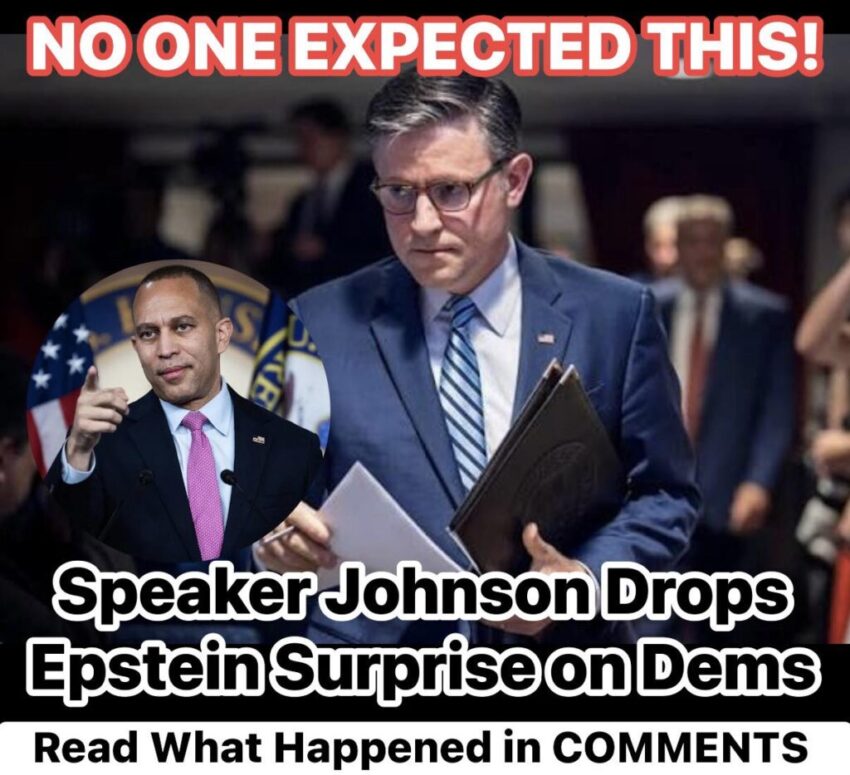
House Speaker Mike Johnson stepped before reporters on Tuesday determined to deliver a clear message: the long-awaited release of the Epstein files must be handled with precision, honesty, and respect for the victims — not turned into a political weapon.
For months, intense public pressure has built around the documents connected to Jeffrey Epstein, the disgraced financier whose criminal network and powerful associates remain the subject of intense national scrutiny. Recently, a group of House Democrats launched an aggressive push demanding immediate public release of the full archive. But to Johnson, their sudden enthusiasm rings hollow — even suspicious.
In a disciplined but forceful press conference, the Speaker accused Democrats of engaging in “a politically timed awakening” designed to reshape public opinion rather than uncover truth or bring justice to victims. Johnson argued that the party had possession — and oversight — of the same Epstein files for four years under the Biden administration but never showed even minimal urgency until now.
“Let’s start with a simple reality,” Johnson told reporters. “Every single document these Democrats are demanding was already in the hands of the Biden Department of Justice. They had the files for four long years. And during those years, not one of these lawmakers held a press conference, called for transparency, or urged action. Not one. There wasn’t even a whisper.”
That point became the cornerstone of Johnson’s argument: the sudden pivot from silence to outrage isn’t rooted in a desire for truth — it’s political calculation.
A Pattern Johnson Says America Has Seen Before
Johnson added that the same lawmakers now claiming to champion transparency displayed the opposite approach on almost every major issue during the previous administration.
“For four years,” he said, “these Democrats insisted there was no border crisis — even as millions poured across. They dismissed soaring inflation as ‘transitory.’ They insisted the public ignore what we could all plainly see — the physical and cognitive decline of President Biden.”
According to Johnson, the pattern is clear: dismiss or deny problems when politically convenient, then weaponize selective outrage when political tides shift.
“And now,” he continued, “almost overnight, these same individuals have discovered an ‘urgent crisis’ surrounding Epstein — a crisis they ignored for nearly half a decade. So the question is simple: why now?”
He paused, letting the question sink in — a tactic Johnson has used often in high-profile exchanges.
“The American people can connect the dots,” he added.
Johnson Says Republicans Want Transparency — But Responsible Transparency
While Johnson criticized Democrats for what he called opportunistic outrage, he emphasized repeatedly that Republicans are actively working to deliver what the public wants: transparency and accountability. But he said the release must be done responsibly — especially because the files contain sensitive information about victims, classified details, and ongoing investigative material.
“This is one of the most devastating criminal scandals in modern American history,” Johnson said. “These victims have endured enough, and we have an obligation to ensure nothing we do now retraumatizes them or jeopardizes any remaining investigations.”
Unlike the rhetoric coming from Democratic lawmakers, Johnson stressed that the process must be careful, methodical, and lawful.
“That’s not obstruction,” he said. “That’s responsible governance.”
In fact, Johnson highlighted that House Republicans — working through the Oversight Committee and other investigative panels — have already released more Epstein-related material than the newly introduced Democrat “discharge petition” even demands.
“We’re ahead of them,” he said. “That’s the truth they don’t want to admit.”
A Sudden Democrat Frenzy That Raises Questions
Johnson’s skepticism centers on what he described as a coordinated messaging shift among Democrats who had previously paid little attention to the Epstein network.
“So why the rush now?” he asked again. “Why the sudden panic? Why the dramatic public pressure when they had control of every lever of government and chose to do nothing?”
According to Johnson, the answer is not principle — but politics.
He argued that with Democrats struggling to defend their record on the border, inflation, energy, and foreign policy, they have now latched onto the Epstein documents as a political escape hatch — one that allows them to posture as crusaders for justice while attempting to paint Republicans as hesitant or obstructive.
But Johnson pushed back hard: “Republicans aren’t protecting anyone. We’re protecting the truth — and the victims. What we refuse to do is use this tragedy for political theatre.”
A Bipartisan Failure — But Not One Republicans Are Trying to Hide
Although Johnson aimed most of his criticisms at what he called Democrats’ “manufactured urgency,” he acknowledged that the Epstein case spans multiple presidential administrations, multiple attorneys general, and both political parties.
Epstein’s network touched powerful figures across business, academia, entertainment, and government — spanning decades. Johnson insisted this is precisely why the process must be done correctly, not rushed out to score headlines or damage political rivals.
“The American people deserve transparency,” he said. “But they also deserve accuracy.”
He argued that selective leaks, sloppy handling of evidence, or irresponsible public releases could destroy legitimate cases, misidentify innocent individuals, or violate the privacy of survivors.
“This is not reality television,” Johnson said. “It’s real life. These are real victims.”
Republicans Claim Democrats Ignored Red Flags for Four Years
Johnson highlighted additional inconsistencies in Democrats’ new messaging push. For example:
“They didn’t lift a finger,” Johnson repeated. “Not one. And now? They’re acting as though Republicans somehow prevented them from acting. It’s nonsense.”
The Victims Are the Centerpiece — Not the Politics
Johnson closed his remarks by turning toward the survivors — the individuals whose lives were permanently damaged by Epstein’s trafficking network.
“This is about them,” he said firmly. “Not Democrats. Not Republicans. Not elections. The victims deserve justice — which has been delayed for far too long.”
He reaffirmed that Republicans are committed to a process that reveals the truth while preserving evidence for any additional prosecutions and protecting victims from further harm.
“This isn’t a game,” Johnson concluded. “We’re going to finish this — and we’re going to do it the right way.”
A Political Fight That Will Only Grow More Intense
With the Epstein documents now at the center of a national political storm, the Speaker’s broader message was clear: Republicans believe Democrats are trying to weaponize a tragedy they neglected for years — and they’re determined not to let the issue become another political football.
As more batches of documents are reviewed and released, the country is bracing for revelations that could reshape political narratives on both sides.
And Johnson seems prepared for the fight ahead.
Explosive exchange rocks live town hall as Rubio’s unfiltered rebuttal stuns crowd and sends shockwaves through the political landscape
In a moment that’s being hailed as one of the most viral political clashes of the year, Florida Senator Marco Rubio stunned a packed auditorium in Los Angeles by delivering a fiery, no-holds-barred response to California Governor Gavin Newsom, after Newsom dismissed conservative views with the jab:
“This is California, not MAGA Land.”
The off-the-cuff remark came during a heated panel on immigration reform and state-federal policy disputes. Governor Newsom, addressing growing criticism over California’s handling of border policy, turned to the crowd and said, “Let’s be clear. This is California — not MAGA Land. We don’t traffic in fear, hate, or backward politics.”
The room — filled with activists, state leaders, and press — erupted in applause.
But the moment didn’t last long.
Without missing a beat, Marco Rubio — a surprise guest at the forum — stood up, asked for the mic, and calmly addressed the governor’s jab.
“What you just said,” Rubio began, “is exactly what’s wrong with the state of political discourse in America today.”
The audience quieted.
“You stand on this stage and preach tolerance, yet you mock the millions of Americans who disagree with you — people who love this country, work hard, pay taxes, and want their voices heard. This isn’t about MAGA. This is about real people.”
Then, in a voice that grew sharper with each word, Rubio launched into a blistering critique of Newsom’s record on immigration, public safety, and homelessness.
“Your sanctuary policies have failed,” he said. “Your crime rates are up. Your housing crisis is out of control. And you call that progress? You don’t get to silence half the country by calling them names.”
Rubio’s most cutting line came moments later:
“This may be California, Governor — but it’s still America.”
The effect was instant. Cheers erupted from parts of the audience. Others sat stunned in silence. Even some political opponents reportedly admitted they were caught off guard by Rubio’s calm but cutting delivery.
Governor Newsom, clearly not expecting the rebuttal, responded briefly, saying, “Senator Rubio is entitled to his opinion — but I stand by California values.”
Rubio shot back: “If by values, you mean crushing dissent and hiding failure behind slogans — then yes, you’ve made that clear.”
Moderators quickly stepped in to cool the exchange, calling for a return to policy discussion. But the moment had already taken on a life of its own.
Within hours, clips of the showdown dominated social media, with the hashtag #RubioVsNewsom trending across X (formerly Twitter), Instagram, and TikTok. Political commentators from both ends of the spectrum chimed in.
Fox News hailed Rubio’s “masterclass in leadership,” while even some moderate voices on CNN acknowledged the “effectiveness and precision” of Rubio’s takedown.
One viral post read: “Rubio just turned a mic drop into a sledgehammer.”
Another user commented: “Gavin Newsom wasn’t ready. That wasn’t a rebuttal — that was a reality check.”
Political strategists are now dissecting the impact of the moment. Many see it as a strategic win for Rubio, who is rumored to be considering another run at national office or a future cabinet role.
“He positioned himself as calm, focused, and willing to challenge the progressive echo chamber — right in the heart of it,” said political analyst Karen Ellison. “And he did it without theatrics. Just facts and firmness.”
As for Newsom, some say the quip may have backfired. “It played well to his base,” Ellison added, “but it gave Rubio a perfect opening to shift the spotlight — and he took full advantage.”
As town halls and political forums increasingly become the stage for unscripted fireworks, this moment between Rubio and Newsom serves as a reminder: the culture war is far from over — and so is the battle over who defines the American narrative.
Whether you agree with Marco Rubio or not, one thing is certain: he didn’t just respond — he flipped the script. And the nation is still talking about it.