Senate Republicans voted Tuesday evening to confirm over 100 of President Donald Trump’s nominees, clearing the backlog of pending appointments in a single move.The confirmations came after the Senate GOP changed its rules last month to allow most executive branch nominees to be approved as a group rather than individually. The change does not apply to Cabinet secretaries or judicial nominees, Politico reported.The move represents the largest block of confirmations since the rule change took effect. Among those approved were former Republican Senate candidate Herschel Walker, who will serve as ambassador to the Bahamas, and Sergio Gor, former director of the White House Presidential Personnel Office, who will serve as ambassador to India.
Republicans invoked the so-called “nuclear option” — a party-line rules change — to speed up the confirmation process after months of Democratic opposition had slowed it to a crawl.
Some Republicans briefly considered allowing President Trump to make recess appointments, which would enable him to fill positions while the Senate was not in session. However, GOP leaders ultimately rejected that idea, citing concerns that it could backfire when their party is next in the minority.
The mass confirmation marks a major victory for Trump as his administration continues to fill key posts across the federal government amid ongoing partisan gridlock.
In September, Senate Republicans weighed changes to the chamber’s confirmation process as they faced a backlog of judicial nominations due to stall tactics by minority Democrats.
President Donald Trump had criticized Judiciary Committee Chairman Chuck Grassley (R-Iowa) for preserving the Senate’s “blue slip” tradition, which allowed home-state senators to weigh in on nominees and could effectively block their confirmation if the slips were withheld.
GOP lawmakers considered several proposals before a Wednesday meeting to speed up confirmations. According to The Hill, the leading option mirrored a Democratic plan floated two years earlier that would have permitted a single vote on as many as 10 nominees. Other ideas included sharply reducing debate time, making some nominations nondebatable, and cutting the required procedural votes.
Because rule changes required only a simple majority, Republicans could have acted without Democratic support. But such a move—described as a “nuclear option”—would have underscored the partisan nature of the fight. A GOP working group was tasked with hammering out the details, according to the report.
“Everybody had been talking through various options,” Alabama GOP Sen. Katie Britt, the leader of the group, said. “One of the things that that process did was empower the committee process.”
Britt mentioned she had been collaborating with Democrats to develop a suitable rules change. The group worked through some of the August recess to find a path forward for the remaining nominations.
Early last month, ahead of scheduled summer recesses, Senate Majority Leader John Thune (R-S.D.) announced he would keep the chamber in session for a weekend to push through some of Trump’s outstanding nominees, as Senate Democrats continued to stall the confirmation process.
The Senate had been scheduled to begin its traditional August recess on the 4th, but that plan was thrown into uncertainty as Democrats demanded roll call votes on even the most routine nominees. Trump had urged senators to delay their break, warning that his nominees should not be “forced to wait” any longer, Just The News reported.
The Senate did confirm one of the more high-profile nominees on the calendar — Jeanine Pirro, Trump’s pick to serve as Washington D.C.’s top prosecutor. The onetime New York judge, prosecutor, and Fox News host was one of more than 150 pending confirmations.
Pirro’s approval came just hours before the Senate left town, as negotiations to move a broader slate of nominees fell apart.
Lawmakers confirmed only seven of Trump’s picks before heading home for the remainder of August. A deal that would have allowed dozens more confirmations collapsed after talks between Senate Republicans, the White House, and Senate Minority Leader Chuck Schumer broke down.
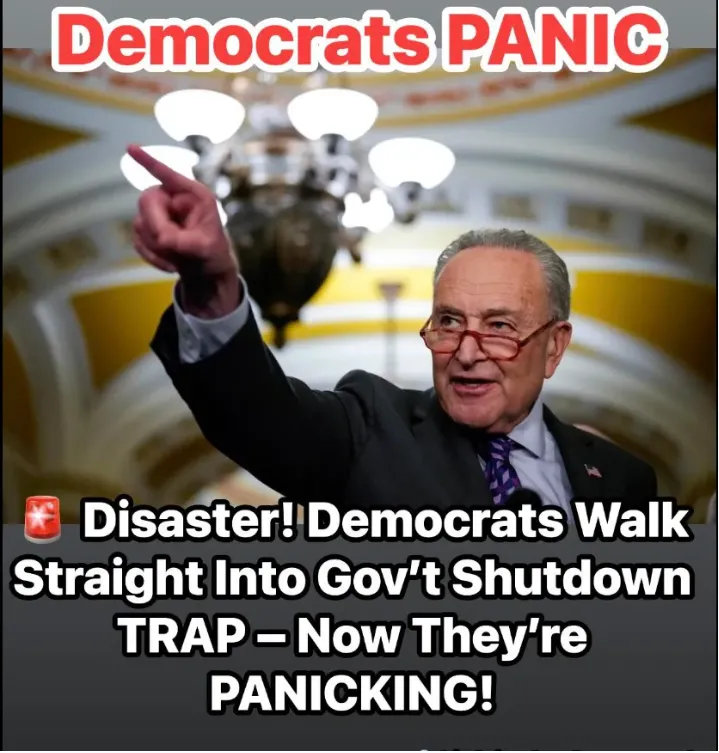
Well, here we are. Despite President Donald Trump practically waving a neon warning sign that a shutdown would blow up in their faces, Democrats marched straight into the trap and hit the shutdown button anyway. Brilliant strategy, right?
So how’s the messaging holding up? To put it kindly—it’s a disaster. Even their usual cheerleaders in the press can’t spin this mess into anything but political self-sabotage.
House Minority Leader Hakeem Jeffries (D-NY) tried to seize the narrative with a “Stop the Republican Shutdown” livestream overnight. The problem? Virtually nobody tuned in. It may go down as one of the least-watched political events in recent memory—a perfect metaphor for Democrats’ flailing messaging on the shutdown.
By morning, the livestream had been rebranded as “Stop the Republican Shutdown Pt. 2,” featuring a revolving door of Democrats railing against the GOP. At one point, when Rep. Sarah McBride (D-DE) took the podium, the viewership tally hovered at just 38 people—hardly the groundswell of grassroots energy Democrats were hoping to project.
In a nation of 320 million people, pulling in a livestream audience that couldn’t even fill a high school gym is, to put it mildly, less than ideal. But honestly, it’s not surprising.
That’s because Democrats simply don’t have a case to make. There’s no rational argument that Republicans are to blame for this shutdown. The House already passed a clean continuing resolution—no cuts, no gimmicks—and it was Democrats in the Senate who chose to block it. Two of their own even broke ranks to side with the GOP. Had Democrats not filibustered, the government would be open today.
That’s as straightforward as it gets. The chain of responsibility is crystal clear, and Americans aren’t buying the spin. The reason Jeffries’ livestream drew fewer viewers than a backyard barbecue is simple: people aren’t interested in watching Democrats twist themselves into rhetorical pretzels trying to pin this on Republicans.
It was obvious from the start: if a shutdown hit, President Trump would seize the opportunity to go after the bloated federal bureaucracies. Now that it’s here, hundreds of thousands of government workers—overwhelmingly Democrats—are at risk of losing their jobs with little recourse. And the impact on ordinary Americans? Practically none, beyond a few shuttered bathrooms and unpaid interns. That leaves Republicans with zero incentive to cave.
The real damage is political, and it’s all landing on Democrats. They’re losing the narrative so badly that even The New York Times is pointing the finger at them. When the paper of record can’t spin the blame away, you know just how lopsided the fight has become:
Maybe Democrats think there’s some master strategy at play here, but from where I’m sitting this looks like one giant self-own. At the end of the day, they’re not going to win their pet priorities—NPR bailouts or healthcare for illegal immigrants—but they could end up sacrificing a large chunk of their bureaucratic power base.
And for what? So Hakeem Jeffries and his crew can rant into a YouTube livestream with an audience smaller than a church bingo night.
FBI Director Kash Patel isn’t buying the outrage. He’s practically laughing off the pearl-clutchers who claim the Justice Department’s indictment of Dirty Cop James Comey is some kind of political stunt.
Patel says it’s simple: break the law, face the consequences. Period. And honestly, he’s right. For years, Comey strutted around D.C. like the untouchable sheriff of Swamp Town — leaking, lying, and playing politics while pretending he was “above it all.” Now the script has flipped, and suddenly the deep state swamp creatures who desperately tried to jail President Trump are crying foul.
In an X post, Patel emphasized that “Career FBI agents, intel analysts, and staff led the investigation into Comey and others” and “called the balls and strikes and will continue to do so.”
“The wildly false accusations attacking this FBI for the politicization of law enforcement comes from the same bankrupt media that sold the world on Russia Gate- it’s hypocrisy on steroids,” he added. “Their baseless objections tell us now, more than ever, that we are precisely over the target and will remain on mission until completion.”
In a previous post, Patel said “previous corrupt leadership and their enablers weaponized federal law enforcement, damaging once proud institutions and severely eroding public trust.”
Patel continued, “Nowhere was this politicization of law enforcement more blatant than during the Russiagate hoax, a disgraceful chapter in history we continue to investigate and expose.”
James Comey is now staring down two felony charges, according to the indictment. Prosecutors say the disgraced former FBI director lied under oath during a Senate Judiciary Committee hearing on Sept. 30, 2020.
Comey allegedly told lawmakers he had never “authorized someone else at the FBI to be an anonymous source in news reports” tied to a major investigation. Prosecutors insist that claim was flat-out false.
Critics want to call it “political.” No, what’s political is letting the establishment skate for decades while average Americans would’ve been hauled off in handcuffs. Patel knows it, President Trump knows it, and deep down, Comey knows it too.
The bottom line? This isn’t politics — it’s justice catching up with a man who thought he was untouchable.