Getty
(Photo by Chris Unger/Getty Images)
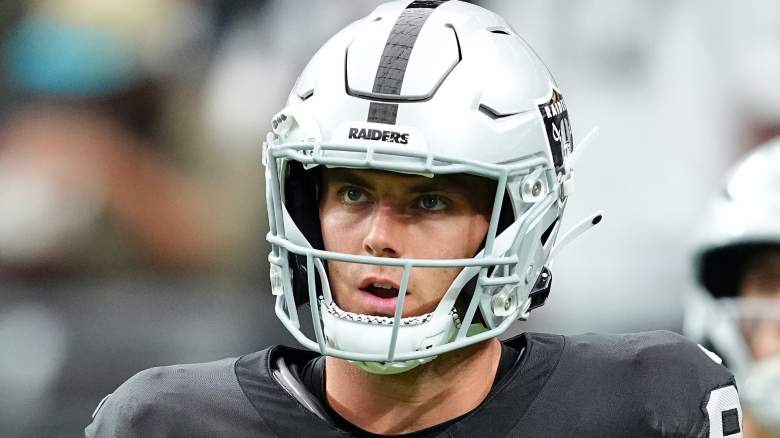
In the Week 10 loss to the Denver Broncos, Las Vegas Raiders offensive coordinator Chip Kelly faced criticism for not using Brock Bowers enough. The Raiders star had three targets and one reception for 31 receiving yards, so to beat the Dallas Cowboys,
that needs to improve.
Moreover, in his first game back returning from injury in Week 9 against the Jacksonville Jaguars, the Silver and Black saw how big a menace Bowers can be for the opposing defense. The young tight end recorded 127 receiving yards on 12 receptions while registering three touchdowns.
As a result, it was surprising to see Bowers have little impact in the contest against the Broncos. Ahead of the Week 11 game against the Cowboys, Raiders offensive coordinator Chip Kelly spoke about increasing Bowers’ involvement and avoiding a repeat of what happened in Week 10.
“We have to get him involved; he’s obviously our No. 1 threat out there,” Kelly told reporters on November 14. “We’ve got to continue to get him involved in what we do. In Jacksonville, we did a good job. I did a good job in the Denver game. A lot of those plays that were supposed to go to him, we got sacked on. Part of that was the protection and what Denver could do defensively going
in.
“We knew they had a great pass rush, so we were in a little more maximum protection. Now, sometimes they’re not able to uncover them. That allows them to double them and do other things. Part of their scheme allows them to do that, too. But we’re really conscious of who we have available this week [and] how we have to get the ball to those guys.”
As Kelly figures out a way to get Bowers more involved, he will also have to worry about new additions to the Dallas defense. The Cowboys made a pair of moves to bolster their defense before the NFL trade deadline, bringing in Quinnen Williams from the New York Jets and former Cincinnati Bengals linebacker Logan Wilson.
With these arrivals, Dallas aim to raise the performance level of its defensive unit. Ahead of “Monday Night Football,” Raiders quarterback Geno Smith shared his thoughts on facing the Cowboys’ revamped defense.
“I mean, you start with what the Cowboys do in their scheme,” Smith told reporters on November 13 when talking about facing the new faces on the Dallas defense. “They’ve got a lot of other players that we’ve got to make sure that we have an eye out for.
“But yeah, Logan Wilson, they just acquired Quinnen Williams, a guy who I’ve played against a bunch and a great defensive tackle in this league. He’s been a perennial All-Pro, perennial Pro Bowler.
“For those guys, of course, I’m going to watch the Cowboys, but I’m also going to go back and watch what they’ve done in the past and just try to see how they can fit into the scheme. Again, we’ll have to see on game day what it is, but I think we have a good idea of what they’ll be in.”
Alongside Smith and Bowers, Ashton Jeanty will also be aiming to exploit the opportunities presented by the Dallas defense.
“Yeah, [the Cowboys] got some great players,”
Jeanty said on November 11. “They just added Quinnen Williams in the interior. So, I’m sure that’ll level up their front. And, just a good all-around team. But,
there’s definitely places where we can attack them and make great plays…
“[Williams is] another guy in the interior to be disruptive. I mean, he’s a game wrecker. So, we got to be ready for him. We just prepping kind of for whoever’s going to be out there. Obviously, they’ve made some changes, so we’ll just prepare for that.”
Green Bay, Wisconsin — After another intense showdown that left the Packers frustrated and the referee crew under fire, Micah Parsons stood before the cameras in his locker-room gear and didn’t hold back. He had been simmering for weeks, but this time, his words cut sharp and clear: he accused the officiating of more than just mistakes. He called it bias. He called it unfair. He called it a betrayal of the sport.
Parsons’ exact words sent shockwaves:
“Let’s stop pretending this is football when one side gets the calls and the other side gets the doubts. We deserve a fair game.”
Parsons isn’t just another player complaining about refs. He’s one of the most dominant defensive forces in the NFL, and he’s new to Green Bay — traded from the Dallas Cowboys in a blockbuster deal earlier this year.
Sources inside the Packers’ locker room say Parsons’ remarks didn’t surprise his teammates — they’d heard the grumbling, saw the missed calls live, and felt the momentum shift. One veteran said, “We all know when we’re getting the short end. When our best player says it out loud — the rest of us listen.”
In the recent road game in Philadelphia, the Packers lost by a narrow margin. But what stung more than the loss was a sequence of plays late in the game:
A defensive stop that was reversed because of a penalty flag many felt didn’t make sense.
A running play that seemed to push the pocket, no call.
A fourth-quarter drive for the Packers that stalled after a holding call against Green Bay, which looked weak even on replay.
The accumulated effect, according to Packers commentary, was that the margin of fairness had tilted.
Parsons addressed this directly: “It’s not about one call. It’s about the message those calls send.”
The NFL has faced officiating controversies for decades. But a high-profile player like Parsons going public adds weight. Analysts suggest that if enough credible voices speak, the league may feel pressure to review calls, adjust training, or increase transparency.
Parsons’ 11-word line — which he paused to let sink in — continues to echo:
“We deserve better than this. A fair game for every team.”
Those words are replayed on highlight reels, in fan posts, and inside sports radio studios across the country.