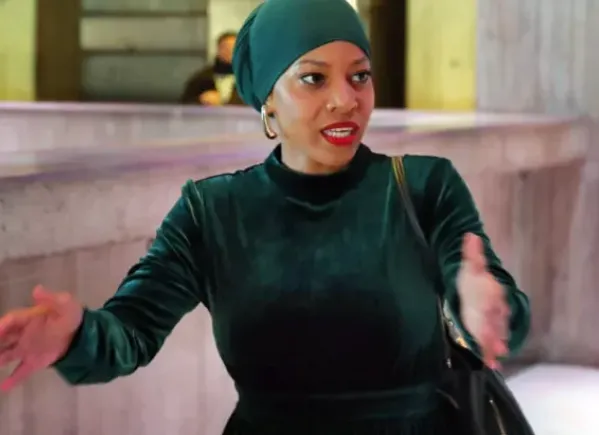
President Donald Trump on Saturday went after Rep. Ilhan Omar (D-Minn.), again invoking her Somali heritage and urging her to “go back,” a line he has used several times since taking office.“She should go back!” Trump said on Truth Social, alongside a video clip of Omar speaking to a crowd in which she said her allegiance would always be with her native country.
It was not immediately clear when the video was recorded, but the footage has circulated for weeks on conservative-leaning social media accounts.Omar was born in Somalia and fled the country’s civil war at age 8, later spending four years in a Kenyan refugee camp before coming to the United States in 1995.She became an American citizen in 2000 and has served in Congress since 2019.Trump’s latest post quickly gained traction online, with supporters including conservative activist Laura Loomer amplifying it across social media platforms.
The former president’s comments come amid renewed scrutiny of Omar’s record in Congress and her frequent clashes with House Republicans.It is not the first time in recent months that Trump has suggested Omar should be removed from the country.
“You know, I met the head of Somalia, did you know that?” Trump told reporters in the Oval Office in September.
“And I suggested that maybe he’d like to take her back,” Trump said. “He said, ‘I don’t want her.’”
exchange echoed comments Trump made during his first term, when he accused Omar and other members of the so-called “Squad” of “telling us how to run our country.”
Omar has often been one of Trump’s most frequent critics, accusing him of using race and religion as political weapons.
Her office did not immediately respond to a request for comment on the latest remarks.
Speaking Friday on “The Dean Obeidallah Show,” Omar dismissed talk of deportation or citizenship challenges.
“I have no worry,” she said. “I don’t know how they’d take away my citizenship and, like, deport me.”
“But I don’t even know why that’s such a scary threat,” Omar added. “I’m not the 8-year-old who escaped war anymore. I’m grown, my kids are grown. I could go live wherever I want if I wanted to.”
“It’s a weird thing to wake up every single day to bring that into every single conversation — ‘we’re gonna deport Ilhan,’” she said.
Omar faced new calls for her removal from office and even the revocation of her U.S. citizenship last month after she reposted a video online that accused Kirk of denying “the genocide happening in Palestine” and spreading “racist dog whistles.”
In a separate interview with broadcaster Mehdi Hasan, she described herself as “mortified” by Kirk’s murder and expressed empathy for his wife and two children, but also criticized his positions on race relations and gun rights, particularly in the aftermath of George Floyd’s death in Minneapolis.
Her remarks drew immediate backlash from Republicans, who accused Omar of downplaying the tragedy and fueling political division. Rep. Nancy Mace (R-S.C.), whose office is near Omar’s on Capitol Hill, introduced a resolution to censure her and remove her from House committees. That motion failed by a single vote, 214–213, after four Republicans joined Democrats to table it.
Mace has since gone further, suggesting Omar’s U.S. citizenship should be revoked. “We would love to see you deported back to Somalia next,” Mace wrote in a social media post. Others online echoed similar calls, citing longstanding allegations that Omar committed immigration and marriage fraud.
Adding to the controversy is renewed attention to Omar’s late father, Nur Omar Mohamed. Somali-language obituaries described him as a senior officer in the regime of dictator Siad Barre, which ruled Somalia for decades and carried out atrocities against rival ethnic groups.
Fact-checking organizations like Snopes and Politifact disputed those claims in 2019, describing Nur as a “teacher trainer.
In a stunning turn of events, Tania Fernandes Anderson, a former Boston City Councilor and once-prominent progressive figure, has been sentenced to prison after pleading guilty to taking a bribe during her time in office.The case, which has captivated both local and national attention, has cast a dark shadow on her career and raised questions about ethics and accountability in local government.Fernandes Anderson, who made history as the first former illegal immigrant to serve in the Boston City Council, resigned from her post in July after a series of federal investigations uncovered her involvement in a bribery scandal.On Friday, she was sentenced for her role in the corrupt arrangement, which saw her accepting a $7,000 bribe from a former staff member in exchange for securing a large bonus for the individual.Before her arrest, Fernandes Anderson was a rising star in the political world. Known for her outspoken and progressive stances, she earned respect from her supporters for championing policies aimed at helping marginalized communities.But her political career took a sharp turn when she was caught up in the federal probe into corruption at Boston City Hall.Fernandes Anderson, who had served as a city councilor since 2021, was once admired for her boldness and dedication to public service. She became widely recognized when she made history as the first former illegal immigrant to win a seat in the Boston City Council, breaking barriers for others in her community. Her election to office was a triumph for those who saw her as an embodiment of resilience, proving that people from all walks of life could make a difference in the political sphere.However, behind the scenes, Fernandes Anderson’s life was not as rosy as it seemed. According to court documents, she had been struggling financially, despite her $120,000 salary as a city councilor.She had fallen behind on bills, including car payments and rent, which eventually led to her involvement in a bribery scheme. Her financial troubles were the catalyst that prompted her to accept a bribe from a former staff member.The bribery scandal at the heart of the case revolves around a meeting that took place in a bathroom at Boston City Hall in 2023. There, Fernandes Anderson accepted $7,000 from a former staffer in exchange for securing a hefty $10,000 bonus for the individual.The agreement was an arrangement she struck with the staffer to secure financial benefits at the expense of the city’s taxpayers.In addition to the bribery charge, Fernandes Anderson admitted to filing fraudulent tax statements for the years 2021, 2022, and 2023. She had failed to report $11,000 in income she received from a Massachusetts-based corporation and political campaign funds that she used for personal gain.The combination of bribery, tax fraud, and personal enrichment painted a damning portrait of a public servant who had betrayed the trust of the people she was elected to represent.Despite her guilty plea, the sentencing was somewhat lenient. Massachusetts U.S. Attorney Leah Fohey had recommended a one-year prison sentence for Fernandes Anderson. However, the judge ultimately sentenced her to just one month in prison.Along with the prison time, Fernandes Anderson will also be required to serve three years of supervised release and pay $13,000 in restitution to the federal government.Following her sentencing, Fernandes Anderson addressed the media outside the courthouse, expressing her regret and frustration with the entire situation. “I actually don’t like being in the media,” she said, visibly distressed.“It’s just too much, and so can you please, I’m asking you for the love of god, stop talking about me? Just let the story go. It happened, I took responsibility.”The former city councilor’s emotional remarks reflected the toll that the scandal had taken on her personal and professional life.She continued by pointing out the harsh media coverage that had surrounded her case, particularly singling out the Boston Herald, which she accused of misreporting facts and creating negative stories about her.“I’m an introvert, and it hurts when you put me on the news,” she said. “And all the folks who tried to create stories… Try to verify your facts. The reason I don’t talk to you is ’cause you never report accurately on black people. You’re always reporting some kind of trouble.”Her comments about the media raised further questions about the way the press handles stories involving people of color. Fernandes Anderson’s experience in the spotlight has sparked conversations about the treatment of black public figures in the media, especially when it comes to scandal and criminal activity.The public’s reaction to Fernandes Anderson’s sentencing has been mixed. While some have expressed sympathy for her personal struggles, others have been quick to condemn her actions, citing the betrayal of the public’s trust.Her supporters have rallied behind her, noting her previous work in advocating for communities that are often overlooked. However, for many, the crimes she committed have overshadowed her achievements, leaving a stain on her legacy as a public servant.The scandal also raises concerns about corruption in local government. The case has highlighted the vulnerabilities within political institutions, where financial troubles or personal struggles can lead to unethical behavior.The bribery scheme at Boston City Hall serves as a cautionary tale for other politicians, showing that even those with good intentions can fall prey to temptation when faced with financial hardship.As Tania Fernandes Anderson serves out her sentence, the political world in Boston is left to reflect on what led to her downfall. The case has left many wondering how such a respected figure could end up in such a compromising position.While she may have been a trailblazer for some, her actions have now cast a long shadow over her career and her legacy.The city of Boston will undoubtedly feel the effects of the scandal for years to come. As the public grapples with the disappointment of a public servant’s fall from grace, the question remains: how can we ensure that such breaches of trust don’t happen again?This case serves as a reminder that even those who are elected to serve the people can sometimes be driven by their own personal interests, leading them down a dangerous path of corruption.In the end, Tania Fernandes Anderson’s story is one of tragedy and redemption. It is a story of a public figure who rose to prominence, only to see her career and reputation crumble under the weight of her own mistakes.The city of Boston and the nation at large will likely remember her not for her achievements, but for the scandal that ultimately brought her down.