

WASHINGTON, D.C. – A Senate hearing on the surge of anti-Semitism on college campuses erupted into a fiery moral and ideological confrontation this week,
led by Senator John Kennedy (R-LA). Kennedy’s line of questioning, sharp and uncompromising, exposed the perceived moral confusion within academic and progressive circles regarding the Israel-Gaza conflict, all while the political shadow of Representative
Ilhan Omar (D-MN) loomed over the proceedings.
Kennedy did not merely debate policy; he launched a cultural broadside against what he called the teaching of anti-Semitism in American universities, accusing institutional leaders of confusing
“diversity, equity, and inclusion” with “the right to hurt Jews.”
The segment began with a direct and provocative line of inquiry aimed at a witness,
Miss Solomon, who had connected the rise in anti-Semitism to the rhetoric of the previous administration.
Kennedy demanded clarification: “Did I understand you to testify that anti-Semitism is worse under the Trump administration?
“
When the witness confirmed the increase in anti-Semitism since 2017, Kennedy pressed for a causal link: “Has the Trump administration caused that? Is that your testimony?“
The witness confirmed her belief in a causal connection,
arguing that Trump had “highlighted and platformed neo-Nazis and white supremacists.“
Kennedy’s frustration was immediate. He immediately steered the discussion toward practical solutions, challenging the witness’s attempt to shift the focus to federal funding cuts to the Department of Education’s Office for Civil Rights.
“So, you think one way to stop anti-Semitism is to give people more money?” Kennedy pressed, highlighting the common political strategy of addressing crises with increased funding rather than tackling the underlying ideological currents.
The hearing reached its apex as Kennedy cited the chaotic and frequently hateful protests on campuses like Columbia, Berkeley, and UCLA. He refused to allow the witnesses to retreat into bureaucratic language about funding and investigation.
“What’s there to investigate? We see it!” Kennedy snapped, referring to the televised images of anti-Semitic rhetoric and hostile demonstrations.
He then delivered the line that crystallized his outrage over the perceived failure of academic leadership:
“It was clear to me that that the administration at Columbia and most members of the faculty believed passionately in diversity, equity, inclusion, and the right to hurt Jews
.”
Kennedy’s choice of words was deliberate and visceral. He argued that the progressive framework of DEI had been weaponized to provide cover for hostility toward Jewish students under the guise of political protest and social justice activism. This was not a critique of political performance; it was a moral accusation aimed at the heart of America’s elite institutions.
When the witness attempted to defend the actions as merely “protesters for against the war in Gaza and them using some anti-Semitic slogans,” Kennedy refused to be swayed.
“No, don’t get off the subject on me now. You’re telling me that’s not what you saw?” he demanded.
Though Rep. Ilhan Omar was never explicitly named by Kennedy in his most searing accusations, her influence pulsed beneath the entire debate. To her critics, Omar’s unapologetic critiques of Israel, her framing of the Palestinian struggle, and her past controversial statements have provided the ideological spark—and subsequent political cover—for the radicalization seen on campuses.
Kennedy, however, distilled the issue to a simple moral challenge, one that directly confronts the moral relativism often used by Omar’s defenders:
“Let me ask you, let me ask you a question, Miss Kohab. Do you think it’s possible to feel compassionate… for the Palestinian people
This question cut through the political noise, challenging the moral logic underpinning the activist movements. Kennedy’s conviction was clear: in the current ideological climate, the line between advocating for the oppressed and targeting the Jewish community has been dangerously blurred by figures who prioritize performative outrage over moral clarity.
Kennedy’s patience finally snapped when a witness tried to defend the administration at Columbia, prompting one of the most memorable lines of the hearing.
“Are you telling me Colia, the Columbia administration and the faculty was supportive of the Jew?” Kennedy demanded, before delivering his searing indictment of the progressive worldview:
“We need to stop dipping into your ketamine stash… You can try to bubble wrap this, but that’s what I saw… If you want to stop a lot of the anti-semitism, maybe we need to stop teaching kids to be anti-semitic.”
This final charge accused America’s top universities of actively fostering an anti-Semitic environment through ideological bias. Kennedy’s message was unmistakable: When ideology overshadows accountability and moral logic, classrooms risk becoming breeding grounds for hate disguised as activism.
The hearing served as a dramatic cultural call-out, emphasizing that the problem of campus anti-Semitism is not merely a matter of lacking funds for investigation, but a symptom of a deeper moral decay that demands moral clarity and ideological responsibility from elected officials and academic leaders alike.
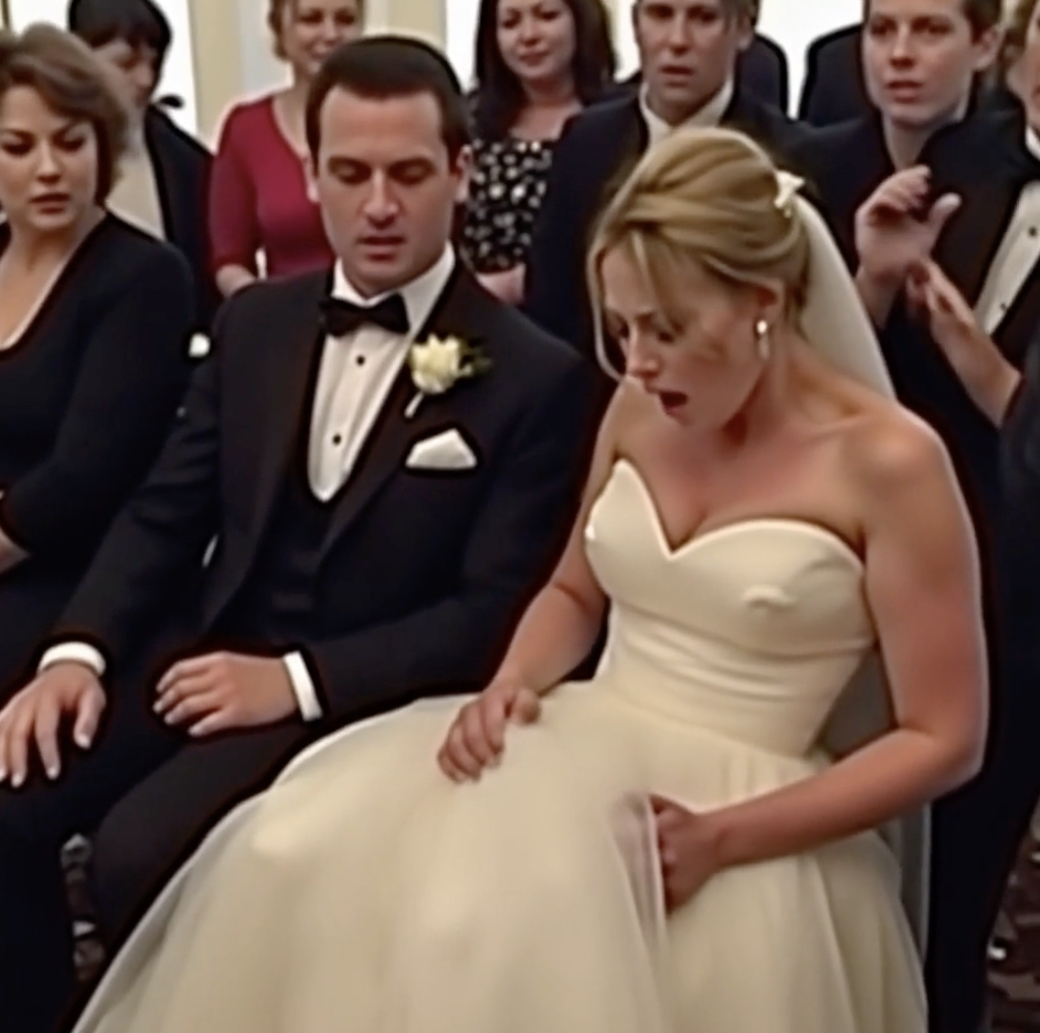 The afternoon sun streamed through the grand cathedral windows, casting colorful reflections on the marble floor as guests filled the pews, eagerly awaiting the ceremony’s commencement. The air was thick with the sweet scent of roses, and the gentle murmur of whispered conversations added to the anticipation. At the altar, the groom, Thomas, stood nervously straightening his tie, his palms slightly clammy with excitement and nerves. His heart raced with love for his soon-to-be wife, Emily, a vision of beauty and grace.
As the organist struck the first chords of the bridal march, the congregation turned expectant eyes toward the entrance. Emily appeared, radiant and ethereal, her ivory gown flowing around her like a cloud. Her father, proud and teary-eyed, walked beside her, guiding her down the aisle towards her future. Thomas’s heart swelled with emotion as he took in her loveliness, but as she drew nearer, his expression shifted from adoration to bewilderment.
Just as Emily reached the midway point, something unusual happened. A ripple seemed to pass through her gown, almost like a wave undulating across the fabric. For a moment, Thomas thought it was a trick of the light, but the movement continued, more pronounced and deliberate. Murmurs rippled through the guests, heads craning to get a better look. Emily, seemingly unaware, maintained her serene smile, her eyes locked with Thomas’s.
As she took another step, the movement became more conspicuous, and a gasp escaped from a nearby guest, quickly spreading through the crowd like wildfire. Thomas’s mind raced, trying to comprehend what he was witnessing. His face turned pale, and he fought the urge to rush forward, unsure of what he might find.
Emily paused, sensing the shift in the room. Her eyes widened slightly as she too became aware of the odd sensation beneath her dress. Her father, oblivious to the commotion, gave her a gentle nudge forward, whispering words of encouragement, but Emily stood rooted to the spot.
The bridal procession halted, and an anxious silence enveloped the room. The guests watched, a collective breath held in anticipation. Emily glanced down, her heart thudding, as the fabric of her gown seemed to contract and expand with a life of its own. A soft rustling sound accompanied the motion, reminiscent of autumn leaves stirred by a gentle breeze.
“Emily!” Thomas finally called out, his voice sharp with concern. Emily looked up, meeting his eyes with a mixture of confusion and amusement. She carefully lifted the hem of her dress, revealing the source of the disturbance.
To everyone’s astonishment, a small tabby kitten, its fur a mottled blend of orange and white, peeked out from beneath the layers of tulle. Its bright eyes blinked at the sudden exposure to light, and it let out a tentative meow, as if to apologize for its unexpected appearance. Laughter erupted throughout the cathedral, the tension dissolving into heartfelt mirth.
Emily’s laughter joined the chorus, her face flushed with a mix of embarrassment and delight. “I told you she was mischievous!” she exclaimed, her voice carrying over the amused chatter. The kitten was none other than Muffin, the stray she had rescued months ago, who had evidently decided that no family event was complete without her presence.
Thomas stepped forward, relief and affection evident in his smile. “Looks like we have an uninvited guest,” he chuckled, bending down to scoop up the wayward feline.
With Muffin safely cradled in Emily’s arms, the ceremony resumed, the unexpected interruption only adding to the day’s charm. As the vows were exchanged and the rings were placed, the kitten nestled comfortably against the bride’s heart, a tiny symbol of the love and surprises that awaited the couple in their life together.