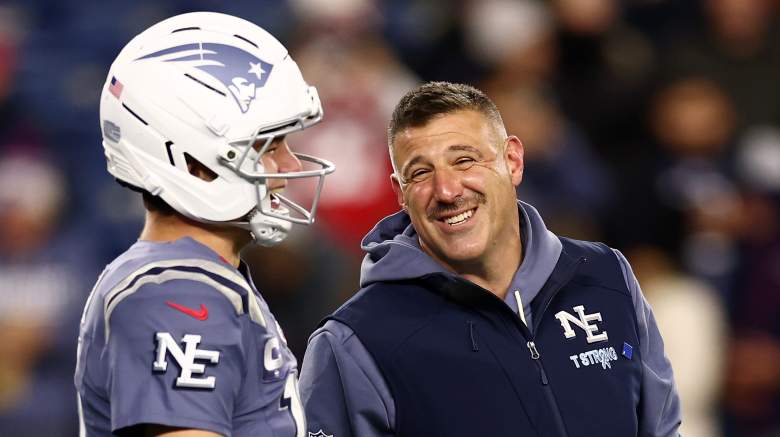
New England Patriots quarterback Drake Maye has with no doubt, won new head coach Mike Vrabel’s confidence, but for Vrabel, it long preceded the 9-2 start.
“I came here because of the familiarity. I came here because of Drake,” Vrabel told the Amazon postgame show crew via NBC Sports Boston. “I knew what he would be, and it was important for me to come here. And that’s someone I wanted to coach. And so building a program is about that. It’s about putting great people around your really good players. That’s what Drake is for us.”
Maye carved up the New York Jets defense in a 27-14 win on Thursday, the team’s eighth-straight. It led to chants of MVP from the crowd, a fan base that once saw Patriots legend Tom Brady dominate the league for two decades and win three regular season MVPs.
Maye was part of that postgame conversation with Amazon, and he expressed his appreciation of Vrabel, who came in and re-tooled the Patriots after back-to-back 4-13 seasons. Vrabel once played for the Patriots during the Brady era, and Vrabel went on to coach the Tennessee Titans before his current position.
“It means the world. It goes both ways,” Maye said. “I can’t thank coach enough for what he’s done, what he’s gonna do for my career, for my life. He brings it every day. He said this, and he’ll text me later tonight about something I could have done better in the game. He’s constant, he’s awesome, and we love playing for him. I love playing for him.”
Maye has taken his game to another level in his second year with Vrabel at the helm in place of former head coach Jerod Mayo. As a rookie, Maye completed 66.6% of his passes for 2,276 yards for 15 touchdowns versus 10 interceptions. This season, Maye has completed 71.9% of his passes for 2,836 yards and 20 touchdowns versus five picks for a 113.2 rating.
“He brings it every day and he cares about us,” Maye continued regarding Vrabel. “He coaches hard, but he cares about us. We love playing for him. I love playing for him. He’s coaching me on different things besides where to throw the ball. I think that’s the biggest thing about him is coaching leadership and coaching me every day.”
“And he says something to me almost after every drive, and I just appreciate what he’s done for me and what he’s done for this football team,” Maye concluded.
Vrabel didn’t go for the MVP chant chatter when talking during the press conference, but he was clear that Maye is making the strides asked of him.
“I would say his performance in general has been what we expect. We have high expectations for Drake,” Vrabel told reporters afterward. “He has high expectations for himself. He’ll continue to improve. I know that he’ll stay humble through this all. Again, as far as the performance tonight, I thought it was, again, in first view, pretty good. It was good enough to win. Took care of the football.”
“We just have to continue to focus on the little things, operation, unforced errors throughout the offense,” Vrabel added. “The only thing that really stops us is us offensively. So continue to do that. Let them enjoy a win on a short week. Like I told them, I’m excited we’re 9-2. I’m excited that I don’t have to see them until Monday.”
BREAKING NEWS: Famous singer Lady Gaga offered to sing a song for the Detroit Lions on the occasion of the 2025 NFL opening game and a sponsorship deal for the Detroit Lions for the 2025 season if the team would make an openly pro-LGBT ad forever, in response, Detroit Lions CEO Sheila Ford Hamp said only 1 sentence that made the entire NFL silent. The story has all the ingredients of modern spectacle—celebrity, sports, culture wars, and the increasingly blurred line between entertainment and professional football. What started as a seemingly extravagant offer from one of the world’s most iconic performers quickly became a lightning rod for controversy, testing not only the Lions’ leadership but also the NFL’s ability to handle cultural pressure from outside the game itself.
Lady Gaga’s proposal shocked both the music and sports industries. Known for her vocal support of LGBTQ+ rights and her ability to command attention on the biggest stages in the world, Gaga reportedly reached out to the Lions with a two-fold offer. First, she would headline the opening game of the 2025 NFL season in Detroit, performing a new song specifically dedicated to the team and the city. Second, she pledged to pour sponsorship money into the Lions’ organization for the entire season, an unprecedented move for a performer of her stature. The only condition? The Lions would have to commit to producing and maintaining a permanent pro-LGBT advertisement campaign as part of their franchise identity, a stance that would essentially intertwine the team’s brand with Gaga’s message of inclusivity indefinitely.
On the surface, it seemed like a bold but enticing opportunity. The Lions, historically overlooked and underestimated, suddenly had a chance to be thrust into the international spotlight with a cultural icon by their side. The idea of Lady Gaga performing in Detroit to kick off the season sounded like a dream scenario—something that could energize the fan base, boost global recognition, and reshape the team’s narrative heading into a year filled with high expectations. Yet the strings attached made it a delicate and divisive proposition. Accepting the offer meant permanently aligning the Lions with a cultural and political stance that not every fan, or even every player, would embrace. Declining it risked accusations of intolerance or backwardness in a league striving to showcase progress.
The weight of the decision ultimately fell to Sheila Ford Hamp. As the team’s CEO, Hamp has already proven herself willing to stand firm under scrutiny, as seen in past controversies. When she finally responded to Gaga’s offer, her words were not long or complicated. They were just one sentence, but the impact was seismic:
The moment those five words leaked, the NFL world stopped. Hamp’s statement was as much a declaration as it was a boundary. She wasn’t rejecting Gaga’s values or message—at least not explicitly—but she was rejecting the idea that the essence of the Lions, or of football itself, could be traded for sponsorship, celebrity, or cultural alignment. Her choice of words carried an old-school weight, a sense that the game, the franchise, and the players’ hard work on the field stood apart from the noise of outside agendas.
Fans erupted in debate. Supporters of Hamp’s decision hailed her as a protector of tradition, arguing that football should remain about grit, talent, and the pursuit of championships—not about politics, endorsements, or external influence. Detroit locals in particular resonated with her defiance, seeing it as a reflection of their own city’s resilience and unwillingness to compromise identity for money or spotlight. “That’s Detroit. We stand our ground,” one fan declared in a viral post.
But critics were equally loud. Advocacy groups accused Hamp of turning her back on inclusivity, framing her statement as a dismissal of an opportunity to promote equality on one of the biggest stages in sports. Social media lit up with fiery commentary, with hashtags both praising and condemning Hamp trending within hours. For many, the controversy wasn’t about Lady Gaga or even the Lions—it was about the larger question of how much cultural messaging should be tied to professional sports, and whether rejecting such offers equates to resistance against progress.
The NFL, for its part, stayed conspicuously quiet. Insiders suggested that league officials were caught off guard by both Gaga’s dramatic offer and Hamp’s even more dramatic response. Some executives reportedly admired Hamp’s stance, seeing it as a refusal to let celebrity influence dictate football decisions. Others worried that the decision could harm the league’s public image, especially with younger audiences who idolize Gaga and see inclusivity as non-negotiable.
Meanwhile, Gaga herself has not publicly lashed out, but those close to her hinted that she was disappointed. Known for her theatrical flair, Gaga thrives on partnerships that blur lines between art, activism, and spectacle, and the Lions’ refusal may have been the first time one of her grand proposals met such blunt resistance. Yet, in typical Gaga fashion, there’s speculation she might channel the controversy into new music or a public statement that further fuels debate.
For the Lions players, the spotlight has been uncomfortable. Coach Dan Campbell deflected questions, emphasizing that the team was focused on training camp, strategy, and winning football games. Amon-Ra St. Brown, Hendon Hooker, and other stars found themselves peppered with questions about Lady Gaga rather than the upcoming season, a distraction that some privately admitted was frustrating. Still, most echoed Hamp’s sentiment in their own way, stressing that their mission was football and nothing else.
What makes this saga so remarkable is the way it reflects the NFL’s larger identity crisis. The league is bigger than ever, drawing billions in revenue and commanding audiences around the globe. Yet it is also increasingly pulled into social and cultural battles that extend far beyond the gridiron. Should the NFL embrace these causes, aligning its brand with celebrity activism? Or should it retreat to its roots, prioritizing the purity of the game itself? Hamp’s six words—“Football is not for sale”—have now become a rallying cry for one side of that debate.
As the dust settles, one thing is certain: the Lions didn’t just decline an offer, they made a statement. Whether that statement strengthens their brand or makes them a target remains to be seen. But for a franchise that has long been overlooked, the Detroit Lions are suddenly at the center of a national conversation, not for their plays on the field but for a single sentence that challenged the merging of football and cultural spectacle.
And perhaps, in the end, that was exactly Hamp’s point.