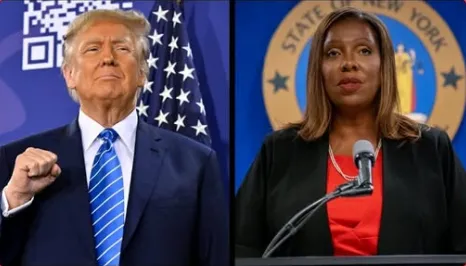
New York Attorney General Letitia James was indicted on federal bank fraud charges after prosecutors alleged she lied on a mortgage application to obtain favorable loan terms on a Virginia property she later rented out.
The indictment, returned by a federal grand jury, centers on a single-family home in Norfolk, Virginia, that James co-purchased in August 2020 for roughly $137,000. Most of the purchase was financed with a $109,600 loan that prohibited the home from being used as a rental or investment property, according to prosecutors.
By misrepresenting the property as a second home, James received a lower interest rate and saved “approximately $18,933 over the life of the loan,” prosecutors said in a five-page filing.
Federal Housing Finance Agency (FHFA) Director William Pulte referred the case to the Department of Justice earlier this year, prompting a criminal probe that led to Thursday’s indictment.
According to financial disclosure forms reviewed by the
“The indicted attorney general also estimated the value of the property anywhere between $150,000 and $200,000,” the Post reported.
Despite the loan’s clear prohibition against rental use, prosecutors allege James used the property as a rental investment and earned thousands of dollars in income that she failed to report on multiple disclosure forms.
In her 2020 disclosure, James did list an “investment real property” in Norfolk that generated between $1,000 and $5,000 in revenue, but it is unclear if that referred to the same home named in the indictment.
According to prosecutors, James agreed to a “Second Home Rider” when taking out the loan, which required her to occupy the home as her secondary residence and forbade any rental or shared ownership arrangement.
“Despite these representations,” the indictment reads, “the Norfolk property was not occupied or used by James as a secondary residence and was instead used as a rental investment property.”
Prosecutors also said James made false statements on her homeowners’ insurance application, claiming the home would be “owner occupied,” and on her federal tax filings, where she classified the house as “rental real estate” and reported “thousand(s) of dollars in rents received.”
The federal indictment charges James with two counts: bank fraud and making false statements to a financial institution. If convicted on both counts, she faces up to 60 years in prison and fines totaling as much as $2 million.
The judge presiding over James’ mortgage fraud case on Friday rejected a motion seeking to compel federal prosecutors to maintain a log of all their communications with the media.
Defense attorney Abbe Lowell had filed the request last week, following James’ arraignment on charges of bank fraud and making false statements. The motion cited a report alleging that U.S. Attorney Lindsey Halligan exchanged a series of encrypted Signal messages with a reporter regarding the case,
“[T]he defendant does not demonstrate that it is necessary for the Court to order the government to track communications with the media in any particular form,” wrote US District Judge Jamar Walker in his six-page order.
“The defendant’s request that the government be required to keep a communication log is DENIED,” the Biden-appointed judge ruled.
Walker further wrote that while Halligan’s Signal chat with Lawfare senior editor Anna Bower earlier this month was “unusual,” he nevertheless declined to offer an opinion “on whether they were improper in any sense, either legal or ethical.”
Halligan’s Signal messages to the reporter were configured to automatically disappear after eight hours, The Post reported.
The judge did not address whether Halligan’s communications — which reportedly disputed a New York Times story revealing that James’ grandniece told a grand jury she had never paid rent on the Norfolk, Va., property at the center of the case — constituted material subject to discovery requirements.
James pleaded not guilty last week to one count of bank fraud and one count of making a false statement to a financial institution.
Newly filed court documents show that former FBI Director James Comey wrote a 2016 note referencing “HRC plans to tie Trump” and “HRC health,” which investigators discovered earlier this year locked inside a long-unused FBI safe.
The handwritten note, dated September 26, 2016, was found by an internal review team in early 2025, according to new evidence in the Justice Department’s criminal case against Comey.
The note, written on FBI letterhead from Comey’s director’s desk, was dated just weeks before the 2016 election and 19 days after the CIA sent Comey an investigative referral regarding intelligence that Hillary Clinton’s campaign had approved a plan to link then-candidate Donald Trump to Russia.
Prosecutors allege that Comey later concealed this referral and other related materials, obstructing internal and congressional investigations.
A federal grand jury in Alexandria, Virginia, indicted Comey on September 25 on one count of making false statements and another of obstruction of justice.
The charges stem from alleged efforts to mislead investigators about the FBI’s handling of politically sensitive probes into both presidential candidates in the final months before the 2016 election.
According to the filings, the note was discovered inside Room 9582, a secure compartmented information facility (SCIF) at FBI headquarters that had not been accessed for years.
The internal team that located it was assigned to reform the bureau’s records and classification procedures following whistleblower complaints in early 2025.
The filing says the room was “seemingly unused” until a sudden burst of activity around the week of President Trump’s January 2025 inauguration.
The discovery of Comey’s note came alongside the original Counterintelligence Operational Lead (CIOL) — the CIA document that alerted the FBI in September 2016 to Clinton’s alleged campaign plan.
The team also recovered access logs showing that Room 9582 experienced an unusual increase in entries and data transfers during the days surrounding the presidential transition, raising questions about who entered the facility and what materials were handled.
The court record includes an internal memo from July 21, 2025, showing that the FBI’s Public Corruption Unit formally requested an investigation into the concealment or removal of documents related to both the Clinton and Trump inquiries.
The memo stated that the missing CIA referral had originally been stored in a filing closet adjacent to the FBI director’s office before being moved to Room 9582.
The documents also contradict Comey’s 2020 Senate testimony, in which he claimed no knowledge of the so-called “Clinton plan intelligence.” During a Judiciary Committee hearing on September 30, 2020, Comey said the allegation “doesn’t ring any bells with me.”
The newly filed exhibits also reference the discovery of five burn bags found on the floor of the same FBI secure facility.
Those bags reportedly contained hundreds of pages of documents related to Crossfire Hurricane, the bureau’s 2016 counterintelligence investigation into alleged Trump-Russia ties.
FBI Director Kash Patel, who ordered the internal review, confirmed the discovery in June and later authorized the declassification of several materials, including the previously unreleased classified appendix of the Durham Special Counsel Report.
The Justice Department filing describes the combination of hidden records, delayed disclosures, and handwritten notes as evidence of “a broader pattern of concealment” by senior FBI officials. It asserts that Comey’s notations “corroborate the existence of contemporaneous awareness of the Clinton plan intelligence and suggest an effort to obscure that awareness from oversight entities.”
Legal analysts say the handwritten note could prove significant in the government’s obstruction case, depending on whether prosecutors can demonstrate intent to conceal or destroy records. The filings suggest investigators are also reviewing whether others within the FBI knowingly participated in removing or sequestering materials related to both the Clinton email probe and the Trump-Russia investigation.
The DOJ filing concludes that “taken together, these records reinforce a fact pattern of alleged obstruction and broader conspiracy” within the upper levels of the FBI during the 2016 election period.