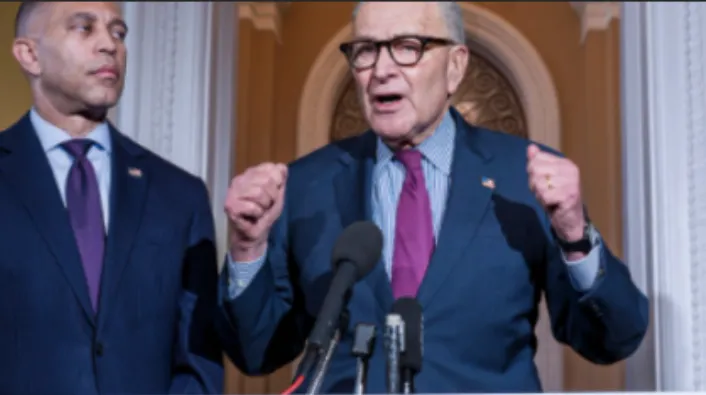
An op-ed published over the weekend painted a bleak political outlook for Democrats heading into next year’s midterms.
The op-ed by conservative commentator and former Wall Street executive follows Democratic Senate Minority Leader Chuck Schumer’s last week to deny Republicans enough votes to keep the government open and funded at current levels.
Writing in The Hill, Peek blamed the shutdown squarely on Schumer, noting that it “highlights three weaknesses undermining the Democratic Party as we head toward next year’s midterm elections.”
For one, she notes, Democratic Party leadership continues to face pressure from its progressive wing, which has gained significant influence over the party’s agenda. Schumer is reportedly wary of a potential primary challenge from New York Representative Alexandria Ocasio-Cortez, a dynamic that observers say may be shaping some of his recent political decisions.
“Second, President Trump has pushed Democrats to burrow into their far-left rabbit holes by occupying the all-powerful center,” Peek added. “Third, Democrats are pushing endlessly to spend more money; voters think that’s a mistake.”
Schumer is facing renewed pressure from within his party following backlash over his decision earlier this year to work with Republicans to avert a government shutdown. The move angered many Democrats, who accused him of conceding too much in negotiations, she says.
In the weeks that followed, some progressive activists and lawmakers called for Ocasio-Cortez (D-N.Y.) to mount a primary challenge against Schumer in the 2028 Senate race, Peek noted.
Polling from the left-leaning firm Data for Progress conducted after the March spending vote indicated growing dissatisfaction among Democratic voters. The survey found that Schumer had the lowest favorability rating among prominent New York Democrats and that he trailed Ocasio-Cortez by 19 points in a hypothetical primary matchup, the conservative analyst went on
Once known for his opposition to government shutdowns, Schumer now appears to be taking a more hardline stance, a shift that some political analysts attribute to pressure from his party’s progressive wing, she noted, adding:
Schumer is not the only moderate Democrat looking over his shoulder. In an August interview with Fox News, former House Speaker Kevin McCarthy (R-Calif.) said, “The only Democrats out there that are resonating and getting money are the socialists.”
He is right. All of the funding, excitement and energy in the Democratic Party is behind progressives. That may work in New York or other deep-blue states, but it’s unlikely to work in swing states like Pennsylvania or Ohio.
Right now, it isn’t even working in Minneapolis, where democratic socialist candidate Omar Fateh is trying to oust incumbent Democratic Mayor Jacob Frey. In a major slap in the face, the Democratic-Farmer-Labor Party, the official Democrat organization in Minnesota, rescinded the city party endorsement of Fateh.
As in New York, it is the young, urban voter driving the leftward push. Minnesota went for Kamala Harris last November by only 4 points, even though her running mate, Tim Walz, is governor of the state. Currently, polls show Fateh trailing Frey by about 13 points.
Young voters have emerged as a key source of support for Democratic Socialist candidate Zohran Mamdani, who is leading the race for mayor in heavily Democratic New York City. Mamdani’s message — focused on “unrealistic promises to make life more affordable,” as well as opposition to Israel’s policies, has resonated strongly with progressive voters, Peek noted.
Polling shows Mamdani ahead of former Governor Andrew Cuomo in the Democratic primary. Campaign finance filings indicate he has raised substantially more money than Cuomo, bolstered by contributions from major donors including philanthropist Elizabeth Simons, daughter of hedge fund founder James Simons, and by groups connected to organizations linked to left-wing financier George Soros.
“Democrats’ leftward lunge may have endeared the party to progressive billionaires, but it’s unlikely to improve the party’s image or win back the White House in 2028. Progressives are notoriously anti-police and anti-ICE; they favor open borders and extending benefits to non-citizens,” writes Peek.
“That is not where the country is.”
Unlikely Senate Duo Crosses The Aisle To Help
Unlikely Senate Duo Crosses The Aisle To Help End Government Shutdown
While it’s true the modern political climate in the United States is heavily divided along party lines, Pennsylvania Senators Dave McCormick (R) and John Fetterman (D) have been bucking the trend by providing an encouraging example of bipartisanship.The two senators recently released a video urging an end to the government shutdown, which is beginning to take a toll on average Americans. The collaboration features Fetterman saying, “Even though we are in a different party, we both want to talk about why we believe it’s so important to reopen this government.”
McCormick shares this sentiment in the video by saying, “23 days, 12 votes, Senator Fetterman and I have both voted to open up the government. We agree on that 100%. It’s really starting to hurt Pennsylvania.”
Some of the folks who are now beginning to feel the pinch from the shutdown include air traffic controllers and border patrol agents who are working to secure the border and keep the country safe. Resources set aside for two million SNAP users are starting to run low, which means those who use the service to support their families during tough economic times could go without the resources they need to get by.
By acknowledging this reality, both senators are demonstrating a commitment that goes beyond party allegiance and addresses their constituents’ concerns and needs.
Both senators have also been deeply involved in efforts to pass bills that would alleviate the suffering caused by the shutdown. They voted in favor of a measure to pay certain federal workers during the deadlock. Unfortunately, these measures did not pass in the Senate.
Many are hoping that the bipartisanship on display between McCormick and Fetterman will rub off on others in the Senate and help heal some of the division that is ripping the country apart and preventing an agreement that will get the government up and running.
Conservatives and even a handful of Democrats are hopeful that seeing these two work together for the betterment of their constituents will lead others to see that collaboration between individuals with different political ideologies is possible when politicians, elected to represent the people, put the needs of others above their own.While there are many different areas of disagreement between Republicans and Democrats concerning the shutdown, providing healthcare for illegal aliens is one of the biggest hurdles to cross. President Donald Trump has made it clear he will not compromise on this issue.
In a stunning turn of events that captivated the nation, Vice President JD Vance intervened in a controversy sparked by Hollywood icon Tom Hanks. The situation escalated after Hanks made a seemingly mocking remark about conservative commentator Charlie Kirk just days after his tragic death. What began as a careless comment quickly transformed into a national debate over decency, grief, and the responsibilities of public figures, with Vance stepping in to defend Kirk’s legacy and challenge Hanks’s insensitivity.
Days after Kirk’s unexpected passing, Hanks took to social media, posting a message that many interpreted as a cruel jab at Kirk. Without mentioning him directly, Hanks suggested that America would heal faster without “loud voices silenced by their own hatred.” The comment ignited a firestorm of backlash, with many feeling that Hanks had taken advantage of Kirk’s death to score political points. For those mourning Kirk, the remark felt like a personal affront, an insult hurled at a man who could no longer defend himself.
The reaction was swift and intense. Hanks’s longtime fans expressed disbelief, while others defended him, claiming his words had been misinterpreted. However, the broader sentiment was clear: what should have been a moment of collective mourning had been turned into a platform for political commentary.
As the outrage grew, commentators began to highlight a perceived double standard in Hollywood. If a conservative actor had made a similar remark about a liberal figure, the backlash would have been relentless, they argued. Major networks would have condemned the remark, and sponsors would have pulled their support. Yet, in this case, the silence from the entertainment industry was deafening.
Among those watching closely was Vice President JD Vance. Known for his unflinching defense of conservative values, Vance recognized Hanks’s comments not merely as an insult to Kirk but as a reflection of the deepening divisions within the country. Kirk was more than just a commentator; he represented a new generation of conservative voices willing to challenge mainstream narratives. Hanks’s words felt like salt in the wound for many who admired Kirk.
Vance waited for the right moment to respond, observing how the public reacted to Hanks’s comments. As hashtags calling for boycotts of Hanks’s films began trending, the pressure mounted on NBC, which had planned for Hanks to host an upcoming episode of Saturday Night Live. Executives debated whether to proceed with the show amid the backlash.
When Vance finally addressed the controversy, he did so with a measured yet powerful message. He articulated not only his defense of Kirk but also a broader call for decency in public discourse. Standing before the press, Vance began by reflecting on loss and the importance of honoring the dead with respect. He emphasized that Hanks’s comments were not just a political misstep but a stain on the fabric of American unity.
“This is not about politics,” Vance stated firmly. “This is about decency.” His words resonated deeply, framing the issue as one of humanity rather than partisanship. Vance’s calm demeanor contrasted sharply with the heated exchanges that had characterized the debate thus far.
Vance’s remarks quickly became a rallying cry for conservatives, who saw him as a voice of reason in a time of division. His assertion that “cruelty disguised as humor is still cruelty” struck a chord, emphasizing the need for compassion, especially in moments of grief. The media caught fire with clips of his speech, and social media buzzed with reactions, many praising Vance for his principled stance.
Meanwhile, Hanks found himself under increasing scrutiny. As the backlash mounted, he faced pressure from fans, colleagues, and sponsors. His representatives fielded calls from journalists seeking clarification, while friends urged him to apologize or at least provide context for his comments. Hanks, however, remained resolute, believing that his words had been misinterpreted and that he would weather the storm.
As the weekend approached, the tension continued to build. The controversy had transcended Hollywood and entered the national consciousness, with discussions taking place in homes, churches, and college campuses across the country. Vance’s words had reframed the conversation, shifting it away from mere political posturing to a fundamental discussion about respect and the responsibilities of public figures.
In an unexpected twist, Hanks agreed to participate in a live-streamed panel discussion that would include Vice President Vance. The announcement sent shockwaves through media circles, as many anticipated a direct confrontation between the two men. The stage was set for a high-stakes exchange that would draw millions of viewers.
As the panel began, the host wasted no time in addressing the controversy. “Mr. Hanks, what did you mean by your remark?” he asked, setting the tone for a candid discussion. Hanks responded carefully, insisting that his comments were not aimed at mocking Kirk but rather intended to highlight the anger and division in the country. However, Vance quickly pushed back, reminding Hanks of the timing of his words and the grief that Kirk’s family and supporters were experiencing.
The tension in the room was palpable as Hanks attempted to defend his position, but Vance’s calm yet firm demeanor cut through the noise. “When you frame a man’s death as a political lesson, you turn grief into a spectacle,” Vance asserted, making it clear that he would not allow Hanks to escape accountability.
As the discussion progressed, Hanks found himself increasingly on the defensive. Vance’s questions were incisive, challenging Hanks to consider the impact of his words on those mourning Kirk. In a pivotal moment, Vance leaned forward and asked, “If it were your loved one who had been taken, would you accept that explanation? Would you?”
The studio fell silent. Hanks opened his mouth to respond but fell short, momentarily speechless under the weight of the question. This moment marked a turning point in the discussion, with viewers recognizing the gravity of the situation. Hanks, usually quick with words, struggled to articulate a defense, and the nation took notice.
In the days that followed, the pressure on Hanks intensified. As public opinion shifted against him, he faced mounting calls for an apology. Finally, after a week of silence, Hanks released a written statement expressing regret for his remarks. “To the family of Charlie Kirk, I want to say clearly and without condition, I am sorry,” he wrote. “My comment was wrong in its timing, wrong in its impact, and wrong in how it was received.”
The apology was significant, marking a departure from his earlier stance. It spread rapidly across news outlets and social media, with many interpreting it as a long-overdue acknowledgment of the harm his words had caused. Vance, for his part, responded positively, stating, “It takes courage to admit fault. I hope this moment can remind all of us that compassion should always come before division.”
The national mood shifted almost immediately. For Kirk’s supporters, Hanks’s apology felt like a validation of their grief and a recognition of the pain caused by Hanks’s earlier comments. For Hanks’s fans, it represented a return to the decency they had long associated with the beloved actor.
The fallout from the controversy served as a reminder of the power of words and the responsibilities that come with public platforms. Hanks’s initial remark, intended as a critique of division, had spiraled into a national debate over respect and compassion. Vance’s calm persistence in calling for accountability resonated with many, reinforcing the idea that public figures must navigate the delicate balance between free speech and the impact of their words.
As the dust settled, the story of Hanks and Vance became more than just a clash between Hollywood and Washington. It evolved into a broader discussion about decency in public discourse, the importance of humility, and the need for compassion, especially in times of grief. The lessons learned from this confrontation will likely echo in future discussions about the role of public figures in shaping national conversations.
In conclusion, the showdown between JD Vance and Tom Hanks was not just a momentary spectacle but a significant event that highlighted the complexities of modern discourse. It reminded Americans that while freedom of speech is a cherished right, the responsibility to use that freedom wisely is equally important. As the nation reflects on this incident, the hope is that it will lead to a more respectful and compassionate public dialogue moving