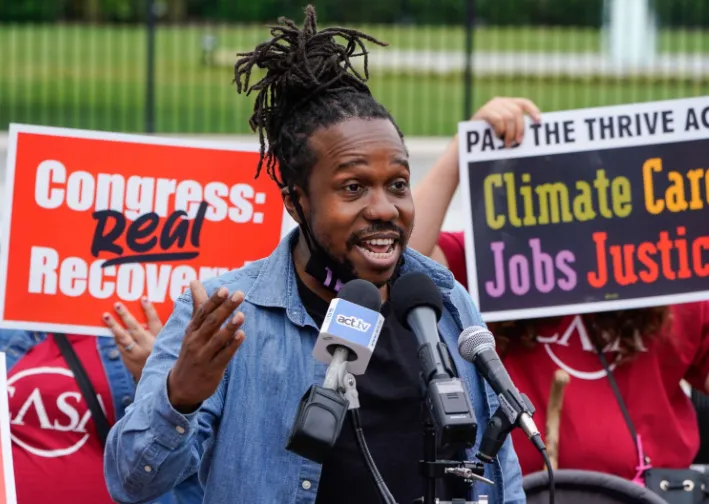
Senate Minority Leader Chuck Schumer has ignited a storm of controversy following remarks in which he appeared to call for a “forceful uprising” against the Trump administration.The statement, delivered during a heated interview, has drawn sharp criticism from conservatives and raised alarm among political observers who warn that such rhetoric could further inflame divisions in an already polarized nation.Schumer’s Fiery RemarksIn the now-viral clip, Schumer accuses the Trump administration of weaponizing the Department of Justice for political purposes — an allegation that has been a rallying cry among Democrats in recent weeks. What set his comments apart, however, was his choice of words.“It is now just a hallmark of tyrannical, autocratic dictatorship societies that they use the prosecutorial department as a political weapon. It is a disgrace and every American should be forcefully rising up against this,” Schumer said, his voice raised with visible anger.For many listeners, the phrase “forcefully rising up” crossed a line from passionate political opposition to a direct call for civil unrest. Critics argue that if a Republican had said something similar during a Democratic administration, the media and law enforcement response would have been swift and severe.Conservative BacklashWithin hours, Schumer’s words had sparked intense backlash across conservative circles. Lawmakers, commentators, and ordinary citizens accused him of hypocrisy and double standards.“The same people who spent four years cheering political prosecutions and weaponizing government now want to talk about tyranny?” one Republican strategist said. “It’s beyond irony — it’s delusion.” Supporters of President Trump were quick to draw comparisons between Schumer’s remarks and previous Democratic actions they consider authoritarian in nature.
Social media erupted with lists highlighting the double standard — citing two impeachment attempts against Trump, alleged surveillance of his campaign, and censorship of conservative voices on major online platforms.The Pattern of Double StandardsSchumer’s remarks have revived a familiar argument among conservatives: that Democrats often accuse others of the very tactics they themselves employ.Critics pointed to the Russia collusion investigation, the impeachment trials, and the January 6 committee hearings as examples of what they view as political persecution disguised as justice.They argue that Schumer’s call to “rise up” is not about defending democracy but about protecting the entrenched establishment from accountability.“The party that spied on a sitting president, censored its citizens, and jailed political opponents now cries about dictatorship,” wrote one commentator on X. “They don’t want justice — they want control.”Others noted that Schumer’s remarks coincided with Trump’s renewed push to overhaul federal institutions and crack down on corruption, suggesting that Democrats are reacting to the fear of losing their grip on power.The “Forceful Uprising” ControversyWhat exactly did Schumer mean by “forcefully rising up”? His office has not issued a formal clarification. Some defenders argue that he meant “politically forceful” action — protests, advocacy, and civic engagement. Critics, however, say the language was reckless and potentially dangerous given the current political climate.Senator Ted Cruz called the remarks “a chilling double standard.” “If a Republican had said those words about a Democratic administration, there would already be calls for arrest,” Cruz told reporters. “But because it’s Schumer, the media gives him a pass.”
A Nation on EdgeThe controversy comes at a time of deep political anxiety in the United States. With tensions running high ahead of the next election, even small statements can quickly spiral into national debates about free speech, accountability, and the limits of political discourse.Public frustration over perceived corruption and bias in federal institutions has created fertile ground for fiery rhetoric on both sides. But many observers warn that Schumer’s choice of words risks further eroding public trust.“Language like this is gasoline on an already burning fire,” said Dr. Rebecca Mallory, a political analyst at the Brookings Institute. “We are at a point where words from national leaders can have real-world consequences. It’s reckless, no matter who says it.”The Hypocrisy QuestionRepublicans were quick to remind the public that Democrats have frequently condemned conservative rhetoric as dangerous or extremist — particularly when used by figures like Donald Trump.“If Trump said this, the FBI would be at his door,” said Congressman Jim Jordan. “But because Schumer did, the press will shrug and move on.”Many pointed out that Democrats have long accused Republicans of inciting violence or undermining democracy, while simultaneously endorsing or excusing aggressive protests when it suits their political goals.The memory of the 2020 riots — where businesses burned and cities faced chaos — remains fresh in many Americans’ minds. For them, the idea of another call to “rise up” sounds like a return to that destructive period.The Broader Political MessageSupporters of Schumer argue that his comments reflect legitimate outrage at what they perceive as political overreach by the Trump administration. They insist that the senator’s words were metaphorical, aimed at encouraging civic engagement rather than physical confrontation.
Still, the optics are difficult to defend. The clip of Schumer’s statement has circulated widely, stripped of context, and replayed across conservative media outlets. For many, it reinforces the perception that Democrats operate under a separate set of rules — one for themselves and another for everyone else.“Every time a Democrat crosses the line, it’s a ‘misunderstanding,’” said conservative radio host Dan Morgan. “But when a Republican raises their voice, it’s ‘incitement.’ That double standard is why Americans are losing faith in our institutions.”The Political FalloutThe fallout from Schumer’s comments may extend well beyond the news cycle. Republican campaign strategists are already preparing to use the clip in upcoming advertisements, framing it as evidence of Democratic hypocrisy and extremism.“It’s a gift,” said one GOP communications director. “You can’t script this kind of arrogance. He literally said the quiet part out loud.”Meanwhile, Democratic aides are reportedly frustrated that Schumer’s language has distracted from other key issues, including economic legislation and judicial nominations. Behind the scenes, some have privately admitted the phrasing was “unhelpful” at best.A Pattern of EscalationPolitical historians note that calls for resistance and “uprising” have become more common in American discourse since 2016. From the “resistance” movement that emerged after Trump’s election to the “stop the steal” protests after 2020, both sides have adopted increasingly combative tones.“The irony is that everyone now accuses everyone else of being authoritarian,” said Dr. Malcolm Reyes, a political historian. “Schumer’s comment fits perfectly into that feedback loop of outrage.”Reyes noted that while past generations of leaders sought compromise, modern politicians often use outrage as a tool to mobilize voters. “The louder the rhetoric, the better it plays on social media,” he said. “Unfortunately, the real cost is national unity.”The Accountability DebateThe controversy also raises deeper questions about accountability in government. Trump’s supporters argue that the prosecutions and investigations targeting the former president represent political revenge. Democrats claim they are legitimate applications of the law.Schumer’s statement, critics argue, is an attempt to reframe that debate — to paint Trump’s enforcement of the law as tyranny while portraying his own party as victims.“They want immunity, not equality under the law,” said political analyst Aaron Blake. “When the system works against them, they cry dictatorship. When it works for them, they call it justice.”The Larger ImplicationAt its core, the Schumer controversy reveals how broken political communication has become. Every word from national leaders is weaponized, amplified, and reframed through partisan media. What might once have been a clumsy expression of anger now serves as a rallying cry — for one side’s outrage and the other’s vindication.“Democrats used to pride themselves on being the party of civility,” said journalist Linda Vaughn. “But the anger has consumed them. When leaders talk about ‘rising up,’ it doesn’t sound like democracy — it sounds like desperation.”Moving ForwardAs calls for clarification mount, Schumer faces growing pressure to explain or retract his words. Whether he chooses to double down or walk them back could define how the controversy unfolds.If he apologizes, it may quell the immediate outrage but risk alienating his base. If he refuses, it could solidify his image as a leader unafraid of confrontation — but at the cost of further dividing the nation.Either way, his remarks have already achieved one thing: reigniting the conversation about hypocrisy, accountability, and the boundaries of political speech in America.
ConclusionChuck Schumer’s “forceful uprising” comment has exposed the widening gulf between words and responsibility in modern politics. To critics, it’s proof of a ruling class unwilling to face consequences. To supporters, it’s righteous anger against perceived injustice.But to millions of Americans caught in the middle, it’s another sign that the people who lead them are more interested in fighting each other than fixing anything.As the dust settles, one truth remains clear — rhetoric has consequences. And in a nation this divided, one careless phrase from a powerful man can echo far longer than he ever intended.
In a seismic development that has reignited one of America’s most polarizing political controversies, Attorney General Pam Bondi has greenlit the release of long-classified documents tied to Hillary Clinton’s private email server, used during her time as Secretary of State from 2009 to 2013. Announced on July 21, 2025, the decision aligns with Senate Judiciary Committee Chairman Chuck Grassley’s relentless push for transparency, a cause he has championed since 2016. Bondi lauded Grassley’s “dogged pursuit of truth,” emphasizing the Department of Justice’s commitment to public accountability. Yet, while the declassification of these documents—particularly a previously unreleased appendix dubbed the “Clinton Annex”—has shed new light on past investigative failures, it is a single, cryptic email buried within the trove that has sent shockwaves through Washington, raising fresh questions and fueling intense speculation.
The Clinton Annex, an addendum to the Justice Department’s 2018 Inspector General report, exposes significant shortcomings in the FBI’s handling of the Clinton email investigation under former Director James Comey. The report details how the FBI failed to fully analyze critical evidence, including thumb drives containing sensitive government communications, some reportedly involving then-President Barack Obama. Grassley, in a fiery statement, called the FBI’s efforts “grossly inadequate,” criticizing Comey, former Deputy Director Andrew McCabe, and ex-FBI Agent Peter Strzok for neglecting key evidence. This revelation has reignited debates over whether political bias influenced the FBI’s 2016 decision to clear Clinton of criminal charges, a move Comey announced before even interviewing her, raising eyebrows about the investigation’s integrity.
While the annex’s findings have sparked outrage, it is a newly uncovered email that has stolen the spotlight. The email, with its sender and recipient still under review for declassification, contains a vague yet provocative reference to a “sensitive operation” involving foreign actors and a senior State Department figure. Dated during Clinton’s tenure, the message hints at coordinated efforts to shield certain activities from public view, though its exact nature remains unclear. Political analysts and lawmakers are now dissecting its potential implications, with some suggesting it could point to undisclosed diplomatic deals or even attempts to influence the 2016 election. The email’s ambiguity has unleashed a torrent of theories, from credible concerns about national security to wild conspiracies circulating online.
Grassley, who has fought for these documents’ release since 2018, praised Bondi and FBI Director Kash Patel for their commitment to openness. “The American people deserve to know the truth, no matter how long it takes,” he declared, calling for further probes into the national security risks posed by the FBI’s lapses. Bondi echoed his resolve, framing the release as a step toward restoring trust in federal institutions. However, skeptics question the timing, noting that Bondi’s decision coincides with scrutiny over her handling of other high-profile cases, including those tied to Jeffrey Epstein. Critics argue the move could be a calculated distraction, dismissing it as “partisan posturing” designed to rehash old controversies.
The resurfacing of Clinton’s email saga, now amplified by this mysterious message, has deepened Washington’s partisan divide. Republicans are seizing on the email as evidence of potential misconduct, demanding renewed investigations, while Democrats decry the release as a political stunt irrelevant to current priorities. The email’s cryptic content ensures it will remain a lightning rod for debate, with its true significance still shrouded in uncertainty. As Washington grapples with this unexpected twist, the Clinton email controversy—once thought relegated to history—proves its enduring power to captivate, divide, and unsettle the political landscape, reminding us that some scandals never truly fade.