

By A. J. Harrison, Senior Economic Correspondent
New York, NY – Just moments after the triumphant cheers for newly elected Assemblyman Zohran Mamdani faded—cheers that heralded a new “democratic socialist revolution” in New York City—the celebratory mood has curdled into widespread anxiety. Mamdani’s flagship campaign promises, most notably the “free bus” program and sweeping plans to “tax the rich,” are now meeting the cold, hard geometry of state budgets and economic accountability. The result is a political and fiscal panic that is causing prominent Democrats, including Governor Kathy Hochul, to execute a startling retreat from the revolutionary promises they once embraced on the rally stage.
What was touted as a socialist utopia is quickly being exposed as an economic disaster waiting to happen, threatening to accelerate the exodus of wealth and businesses from the Empire State. The core fear gripping everyday New Yorkers and corporate boardrooms alike is encapsulated by one phrase:
Mamdani’s campaign was built on accessible, transformative policies, chief among them the promise to make MTA buses free for all New Yorkers. For a city grappling with transportation equity, the concept was certainly electrifying. However, as reality sets in, the plan’s economic foundations are crumbling under scrutiny.
The issue is straightforward: the Metropolitan Transportation Authority (MTA) relies heavily on fare revenue to sustain its massive, aging infrastructure. Mamdani’s own current estimate for replacing the lost fare revenue stands at approximately
But as commentators and interviewers, including traditional liberals like David Pakman, pointed out in the immediate aftermath of the election, the $700 million figure is dangerously incomplete.
The critical flaw, as exposed in a highly circulated interview, is that Mamdani’s figure only accounts for the replacement of the fair revenue itself. It fails to budget for the inevitable, massive consequential costs that any truly “free” and fast bus system would require:
Increased Maintenance and Operations: A free system, designed to increase ridership, immediately puts more stress on the existing bus fleet, necessitating more frequent and costly maintenance.
Expansion of Fleet and Staffing:
If bus ridership doubles or triples due to zero fares, the MTA would need hundreds of new buses and thousands of new drivers, mechanics, and support staff to handle the overwhelming capacity demand. This cost alone could dwarf the $700 million replacement revenue.
Infrastructure Overhaul: Mamdani correctly acknowledges that “free” must also mean “fast.” To achieve this, the city needs a “true reimagination” of bus transit, involving massive investment in busways, dedicated bus lanes, and signal prioritization systems. This capital project would run into the
When pressed on this glaring budget gap, Mamdani’s response during the interview was notably evasive. He failed to confirm if the estimates accounted for new buses, maintenance, or staff. His argument pivoted toward the need for the city to leverage control over its streets to speed up transit—a political solution to a fiscal problem.
This lack of concrete budgetary planning is not merely an academic disagreement; it is the source of the high-level panic that has gripped the state capital. The fear is palpable: this socialist policy is a promissory note that New York’s already strained middle class will ultimately be forced to pay.
The most dramatic fallout from Mamdani’s victory has been the immediate and almost comical public retraction by Governor Kathy Hochul. Despite having shared the stage with the newly elected Assemblyman during the campaign season—a political appeasement to the growing far-left wing of the Democratic party—Hochul is now rapidly distancing herself from the most radical proposals.
Hochul’s public statements reveal a Governor caught in a terrifying bind: she understands the necessity of preserving New York’s status as a capitalist financial hub, but she must simultaneously manage the socialist fervor gripping the city.
In a recent press conference, Hochul was pressed on the free bus initiative and Mamdani’s other economic planks. Her response was clear and definitive: She is currently a “no” on the free bus promise.
The Governor expressed profound concern about removing a core revenue stream from the MTA, a system already teetering on the brink of fiscal stability. Her body language and tone during the discussion hinted at deep frustration, conveying a message that can be summarized bluntly:
“I wear the pants in the state of New York. If you think some slick-talking mayor is going to come in and change that, you’re high. I’ll still listen, but I’m not on board with any of it.”
This striking departure from campaign rhetoric underscores the central problem: socialist ideology, while politically potent in rallies, simply does not compute with the realities of governing a state that relies heavily on a narrow, wealthy tax base.
The panic intensifies when discussing Mamdani’s proposal to finance these socialist programs through aggressive tax increases on high-net-worth individuals, specifically targeting a potential 2% tax on the rich and massive increases in capital gains taxes.
Hochul was equally resolute in rejecting the notion of raising taxes, citing the critical economic risk of capital flight. Her numbers were damning and inescapable:
“One and a half percent of New Yorkers cover about a third of our budget. That’s enormous. I’m concerned about out-migration of people who are the ones who are supporting our budget. I cannot make up for that with middle-class tax increases.”
This is the economic reality that democratic socialism refuses to confront. New York City, by its own Governor’s admission, is a capitalist city, and the state budget is overwhelmingly dependent on a small fraction of its wealthiest residents.
As commentators, including the high-profile Stephen A. Smith, have warned, making the city unattractive for businesses and high earners leads to a predictable chain reaction:
Wealthy Residents Leave: High tax burdens and poor quality of life (crime, poor infrastructure) cause billionaires and high-earning professionals to move their residency to lower-tax states like Florida or Texas.
Businesses Follow: The headquarters and core business operations often follow the leadership and capital, leading to a permanent loss of corporate tax revenue and job creation.
Tax Burden Shifts: The enormous state budget—which funds everything from education to social services—must be covered. The burden inevitably shifts to the already struggling middle and working classes through devastating tax hikes.
The ultimate irony is that policies designed to promote economic equality risk destroying the very tax base that supports the state’s most “generous supportive budget,” thereby hurting the middle and poor classes most profoundly. For many, this trajectory—seizing land from landlords, freezing rents, and taxing producers—is viewed as an inexorable slide towards communism.
Beyond the fiscal chaos, Mamdani’s platform includes other measures that are fueling the deepest anxieties among property owners and law-abiding citizens:
Freezing Rents and Seizing Buildings: The proposal to freeze rents and potentially seize control of buildings from landlords who are deemed inadequate is viewed not as progressive reform, but as a dangerous erosion of private property rights. The everyday New Yorker is terrified that if the state can seize commercial property, their homes and small businesses could be next.
Defunding the Police (The Mental Health Expert Swap): Despite public anxiety over rising crime rates, Mamdani has previously advocated for policies that prioritize “mental health experts” over police presence in the subway system. This approach is fiercely criticized by residents who demand more, not fewer, police officers, believing that mental health support cannot replace law enforcement in active crime situations.
As Stephen A. Smith emphatically stated, “I don’t care about that. I want cops in the subways in New York City where I was born and raised… I don’t want to hear about no damn mental health experts in subways.”
The democratic socialist victory in New York City has provided an immediate, real-world test case for an ideology long confined to college campuses and abstract political theory. The results are already proving disastrous.
The “full-blown socialism” promised by Mamdani—free buses, free grocery stores, and punitive taxes—is being met not by revolutionary fervor, but by the cold, calculated skepticism of the current Democratic establishment. Governor Hochul, representing the institutional guard, is essentially telling the far-left: Your revolution stops at the state budget.
The choice facing New York is stark: maintain its capitalist foundation, which guarantees the tax revenue necessary for its supportive social programs, or pursue a socialist experiment that risks complete economic collapse and capital flight.
As the state teeters on this financial precipice, the core question remains unanswered by the self-proclaimed revolutionaries: If the free bus is the symbol of the revolution, who will be left in New York to pay the fare? The panic is warranted, the political meltdown is justified, and the economic reckoning is inevitable. The Empire State is now engaged in a profound battle for its very soul.
In a scathing and comedic takedown, Jimmy Kimmel and Jim Carrey unleashed a barrage of ridicule against former President Donald Trump during a live television segment that has since gone viral. The duo’s performance, rich with sharp satire and surreal exaggeration, laid bare the absurdity of Trump’s presidency, transforming political commentary into a demolition of ego and incompetence.
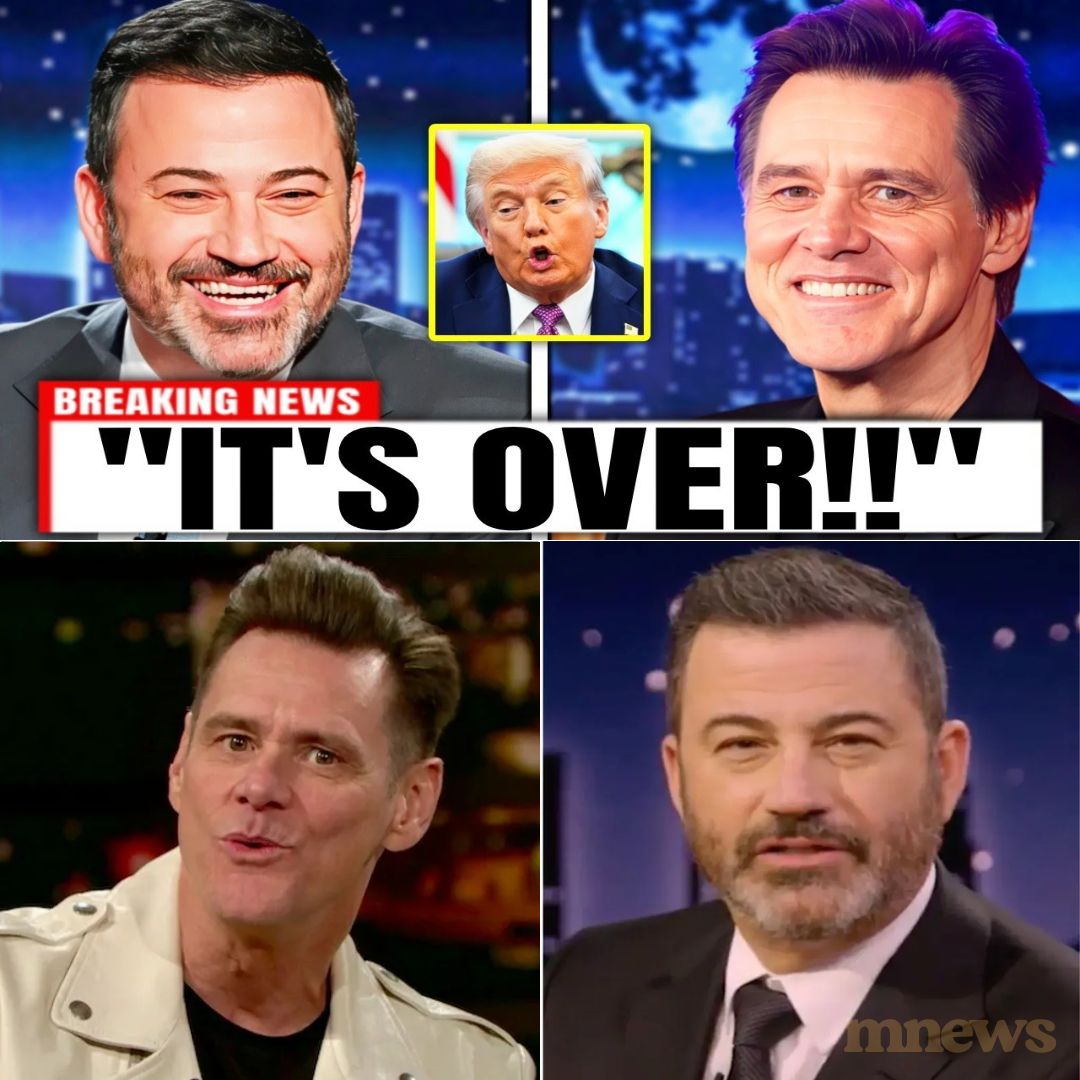
Kimmel opened the segment by highlighting Trump’s recent threats to revoke comedian Rosie O’Donnell’s citizenship, a move he deemed not only impossible but emblematic of Trump’s desperate need for distraction from pressing issues. The former president’s antics, Kimmel argued, have turned the Oval Office into a comedy club where governance is treated like a talent show, and the punchlines write themselves.
Carrey, known for his surreal style, amplified this critique by portraying Trump as a grotesque caricature, suggesting that his leadership resembles a chaotic circus act rather than a serious political administration. The imagery of a president who prioritizes spectacle over substance resonated deeply, as both comedians pointed out how Trump’s obsession with crowd sizes and ratings reduces politics to a popularity contest.
Kimmel’s incisive humor underscored the transformation of political discourse under Trump, where facts became inconvenient obstacles rather than guiding principles. He painted a picture of a leader more concerned with maintaining a facade than addressing real crises, likening Trump’s governance to a reality show filled with plot twists and cliffhangers rather than a functioning democracy.
The segment also delved into the darker implications of Trump’s behavior, with Kimmel and Carrey exposing the narcissism and fragility that underpin his public persona. They highlighted how Trump’s antics, including his obsession with approval ratings, reveal a profound insecurity that undermines his authority and credibility.
As the comedians dismantled Trump’s carefully constructed mythology, they emphasized that satire does not exaggerate but rather reflects the reality of his presidency. Kimmel and Carrey’s combined efforts ensured that Trump’s legacy is not merely a chapter in American history but a cautionary tale of ambition without substance, power without principle, and a mockery of responsibility.
In the end, the laughter generated by Kimmel and Carrey served not just as entertainment but as a critical commentary on the state of American politics. Their performance acted as a mirror reflecting the absurdity of a presidency that many now view as a prolonged comedy skit, leaving audiences to ponder the real tragedy: the nation had to endure the show, and when the curtain finally falls, it will be the comedians who receive the applause for making the experience bearable.
After Donald’s house burned down, he moved in with his son, Peter. Though Peter and his wife treated him kindly, Donald felt like a burden growing heavier each day. Peter’s late nights only deepened his fears, and when his neighbor Mary voiced doubts about family care, Donald’s heart sank.
Slowly, he began researching nursing homes, believing it might be his only option. When Donald first mentioned the idea, Peter dismissed it without a second thought. But months passed, and Donald, clutching brochures, tried again with quiet hope.
This time, Peter didn’t refuse; he promised to take him to see one the very next morning. Donald felt a mix of relief and sadness—was this truly the path ahead? As they drove, Donald scanned the paperwork, unaware of their destination until Peter gently urged him to look up.
They weren’t outside a nursing home—they were standing in front of Donald’s newly rebuilt house. “I had to surprise you,” Peter said softly. “You raised me here.
I couldn’t let this place—or you—go.”
Donald’s breath caught, tears flowing freely as understanding washed over him. The late nights, the quiet work—Peter and Sandra had been rebuilding his home in secret. Sometimes, family means fighting quietly for each other, not giving up.
Let us learn: never let fear or someone else’s experience shadow the love and care we owe our own.
Erika Eleniak, best known for her role as Shauni McClain on Baywatch, was once one of the most recognizable faces on television. With her long blonde hair, sparkling eyes, and radiant California glow, she became an icon of the 1990s, gracing magazine covers and captivating audiences around the world. For many, she embodied the dreamlike spirit of the show: beauty, sun, and surf. Yet, for Eleniak, the fame that came with her role was both a blessing and a burden, one she would spend years learning to navigate.
Born in Glendale, California, in 1969, Eleniak was introduced to Hollywood early. Before her twenties, she appeared in E.T. the Extra-Terrestrial, playing the schoolgirl kissed by Elliott. But it was her casting in
But such intense visibility came with immense pressure. Hollywood has long been a place where beauty is both currency and curse, and Eleniak found herself scrutinized in ways that went far beyond her acting. For her, stepping away from
Behind the scenes, Eleniak grappled with the challenges of body image, typecasting, and the unforgiving expectations of Hollywood. She has been open about these struggles in later years, admitting that navigating fame and personal growth in the public eye was no easy feat. But instead of retreating completely, she began to shift—choosing authenticity over the image others wanted her to maintain.
In more recent years, Eleniak has undergone a striking transformation, one that surprises many who only remember her as the sun-kissed lifeguard. Gone is the blonde bombshell aesthetic of the 1990s. Today, she embraces a more individualistic style—complete with tattoos and a wardrobe that reflects her personality rather than a Hollywood archetype. This was evident when she appeared at the premiere of
The reactions to her evolving image have been mixed. Some fans praise her embrace of individuality and self-expression, calling her a role model for resilience and reinvention. Others cling to nostalgia, expressing a preference for the traditional glamour that first made her famous. Eleniak, however, has made peace with these differing views. She focuses on her own growth, prioritizing inner peace and acceptance over the desire to fit a mold she long ago outgrew.
Aging in Hollywood is rarely easy, especially for women, and Eleniak has never hidden from the subject. Instead, she has spoken openly about both the challenges and the liberation that comes with growing older. She acknowledges that change can be difficult, but she also sees it as a gift: an opportunity to evolve, to reflect, and to embrace authenticity. This candor has resonated with fans who see in her journey a reminder that identity is not fixed, but continually reshaped throughout life.