KATHMANDU: On Tuesday, Nepal’s streets became the stage for an extraordinary upheaval—nearly cinematic in its intensity and devastating in its implications.
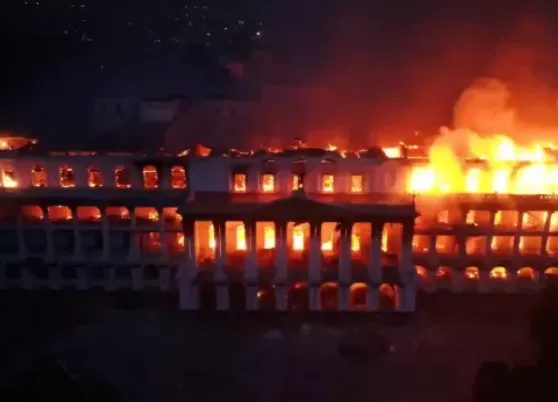
Simultaneously, Singha Durbar, the Supreme Court, Parliament, and even the President’s Office went up in flames. These were not symbolic acts but visceral testaments to a generation’s frustration with institutions that failed them for so long.
Flames lit the sky over Nepal’s power centers, and with the smoke came a clear signal: the old order was burning, and must be rebuilt from its embers.
This uprising, led by Gen Z, began as a stand against a draconian social media ban, targeting platforms like Facebook, X, and YouTube. But it quickly evolved into a rebellion against decades of corruption, stagnation, and elite privilege.
Youth unemployment had hovered around 22%, half the population lived in poverty, and a sense of exclusion had metastasized. The digital shutdown wasn’t merely censorship—it was the spark in a tinderbox of suppressed rage. (reuters.com, politico.com, economictimes.com).
What we saw next was a catastrophe: smoke billowed from halls of power; fire trucks stood idle and overwhelmed; archives—temporal anchors to national memory—went up in flames.
Authorities admitted on Tuesday that without full mobilization, it might take days to stem the flames. Meanwhile, arsonists extended their assault to media houses, police stations, and even homes of influential political families.
Prime Minister KP Sharma Oli’s resignation came in the afternoon—an admission of defeat by a “political survivor” who had once seemed unshakeable. In a brief letter invoking Article 77 of the constitution, Oli bowed to public will, signaling that the moral foundation of his rule had eroded. The moment underscores how protests, sparked by digital repression, can culminate in a revolution that topples a government.
Yet resignation alone won’t reignite national hope. President Ram Chandra Paudel has called for dialogue, stitching urgency with civility. But the call lands on a landscape scorched by fear and disillusionment. Nepalese youth want structures rebuilt, not political recycling.
The Nepali Army’s appeal to protect cultural heritage while extending a hand to calm is commendable, but a society that watches its Supreme Court burn won’t be soothed by rhetoric alone.
This protest’s scale is unprecedented. In a nation where protests already numbered nearly 4,000 over ten months, the normalization of dissent has bred a volatile citizenry conditioned to escalation. But this is different. It’s not just rage—it’s a structure-shaking revolution that burned icons of state power.
At the movement’s heart lies a new energy: social media-savvy, leaderless, insurgent, and digital-first. Slogans like #NepoBabies and videos exposing elite lifestyles went viral. The protest was decentralized, fueled by solidarity, not party lines or ideology.
Even former King Gyanendra urged peace, calling for the movement to remain peaceful and authentic, a rare moment of royal moderation in a crisis of republican legitimacy.
As protests turned destructive, the need for justice, accountability, and democratic reinvention became apparent. Police killed at least 19 protesters, shocking the nation into moral reckoning. Three officers were later killed after surrendering—evidence of total institutional breakdown, as was the mass jail escape in Jaleshwar amid chaos.
Adding to this turmoil, protests spread into rural outposts, social movements grew beyond Kathmandu, and protests intersected with broader societal currents—from anti-Israel rallies to teacher strikes. Nepal’s protest culture had been simmering; now it is volcanic.
Meanwhile, as buildings burned, the real battle became clear—between a future enslaved by nepotism and one drawn by democratic renewal. Balendra (Balen) Shah, Kathmandu’s young mayor, became a fleeting symbol of hope. Protesters carried the anime flag of One Piece’s Straw Hat Pirates—a banner for freedom, not just chaos.
Now Nepal teeters: will it rebuild institutions that ignore its youth, or will it refashion the state into something inclusive and forward-looking? Dialogue must go beyond convening. It must root in constitutional reform, youth inclusion, anti-corruption action, and rejuvenated civil liberties.
Nepalis deserve stability, but not stability of suppression. Rebuilding isn’t slowing down protests—it’s giving them purpose. If future generations can say their voice mattered, then perhaps this uprising will yield not a burnt state, but a reborn republic.
Nepal’s September inferno: The day Kathmandu burned
This piece originally appeared in the DAWN. It is being republished with permission from the DAWN with updates.
KATHMANDU, Nepal–The week of September 8, 2025, was just another week for RC Gautam, an errand boy at Kantipur Television. In two decades of employment at the station, he had seen street protests, dire political situations, a civil war, shootouts, violence and even an attack on the channel’s headquarters. But September 9 panned out differently for him.
“I can’t even begin to tell you how many people stormed our station. It all happened so quickly,” he told me over the phone.
An irate mob rushed into the Kantipur TV building on Tuesday, set fire to three buildings on its premises, and torched two dozen bikes and more than a dozen cars. The station was just one of hundreds of buildings and homes that came under attack in the wake of what is being dubbed the “Gen Z protests” in Nepal, which quickly spiraled out of control September 8.
Triggered by a recent social media ban, demonstrators took to the streets against corruption and nepotism. Every day, about 2,000 Nepalis leave for the Gulf, Malaysia and other countries for work, and while the country runs on a remittance economy, the children of leaders and politicians lead lavish lifestyles — something Gen Z has criticized on social media.
When the protesters first gathered Monday, they expected peace. There was music and dancing, and some local celebrities showed up to support the movement. But things quickly spun out of control when older men in the crowd targeted Parliament. Thus began the rioting.
The Kathmandu chief district officer ordered security forces to open fire, which killed 22 protesters. Some were in school uniforms. By September 12, the death toll had risen to 51. More than 1,000 people injured in the protests were being treated in hospitals, though officials admitted those figures were conservative estimates. Many remain missing and unaccounted for in similar events in other parts of the country.
On September 9, violence escalated as arsonists showed up on the streets, vandalizing and torching private homes of ministers and businesses linked to those in power. Entire ministerial quarters, government buildings, police stations, the Supreme Court and Singha Durbar, the main administrative block, were among those set on fire.
On Tuesday, Kathmandu burned and smelled of rage. The air was so thick, it was choking.
When smoke filled the air in Budanilkantha, north of the capital, where I live, and army choppers circled above me, my instinct as a former reporter was to step out. The home of former Prime Minister Sher Bahadur Deuba and his wife, former Minister Arju Deuba, had been attacked. I watched a plume of smoke rise from their residence and drift toward Shivapur hill. Choppers made several rounds trying to airlift the couple, who had been manhandled by the mob, but failed. Gunshots were heard. Neighbors said two men had died, though their deaths were not verified. The Deubas, injured, were eventually evacuated through the back door.
Across the street from my home, smoke fogged houses — the air stank. When I arrived, the arsonists had just left. The public had open access to the blazing home of former President Bidhya Bhandari. Outside, a crowd lingered and chatted.
What I overheard:
“What did you take?”
“I didn’t really get my hands on anything.”
“There were 240,000 Nepalese rupees, and some USD. Some people took it.”
“Someone took a mattress.”
“I only took a cake.”
On my evening walks past Bhandari’s home, I would often scan the residence, and guards stood armed at security posts. On Tuesday, as the house burned and residents evacuated, the guards remained outside the gate. “This is our duty,” they said.
The scene at Bhandari’s home repeated across Kathmandu as arsonists shifted from neighborhood to neighborhood, torching and looting homes of ministers and administrators, beating and stripping them.
Kathmandu was an inferno on September 9. Fire brigades were forbidden by police to move for security reasons. Even if mobilized, they were unprepared for such scale. No one foresaw violence of this nature.
Most Nepalis have slept poorly since the killings on September 8. Many are seething, grieving, tired and scared. While initial anger was directed at the KP Oli government and ruling coalition for killing unarmed protesters, confusion spread the next day. People no longer knew who was backing the arsonists or why specific homes and establishments were targeted, almost as if by a premeditated list.
Men on motorcycles went door to door, torching homes, leaving behind what sounded like victory cries. Some wielded guns stolen from police stations. In Maharajgunj Chakrapath, where I grew up, a high-ranking policeman was beaten to death by the mob. Some policemen were rescued and airlifted by army choppers on slings. This was the station my family and neighbors once looked to for security.
By the time Gen Z, who launched the protest, called for calm on social media and disavowed responsibility for the riots, too much damage had been done. Their call had been for peaceful protests against corruption, but their movement was hijacked.
When the army chief addressed the nation the evening of September 9, offering security and prohibitory orders, people sensed respite. Army trucks patrolled the city, but residents still spent the night in fear. Unknown groups broke into private homes in some places; looting was reported in others. Prisoners escaped in mass breakouts.
As the mayhem unfolded, I texted a young journalist friend in Kathmandu. She said she felt scared. I told her I would probably sleep with scissors tucked under my pillow, just in case. Rumors spread of rapes, later confirmed by the army.
Smoke rising from former PM Sher Bahadur Deuba’s residence in Budanilkantha, Kathmandu (September 9, 2025) Photo @ Pratibha Tuladhar
During the attack on Kantipur TV, my former colleague Gautam escaped to safety. But with the army clampdown and curfew, he sheltered with an acquaintance instead of returning home.
“What will happen next, didi?” he asked me. “How am I going to feed the kids? How will I educate them? The office I worked at is gone.”
I had no answer. I mourned with him the loss of my former workplace. Kantipur TV, the largest private legacy media, was an institution that stood its ground. While media houses are about owners and advertisers, they are also about journalists — especially the nonpartisan ones who dedicate their lives to high standards.
Kantipur Media Group has had many such journalists over the years. During the April 2006 street protests, hundreds stopped outside its complex in Tinkune to clap and show gratitude for its journalism. Those of us inside looked out the windows, tears streaming down our faces. This week, the same establishment received the opposite treatment.
For many journalists, Kantipur was home — a place to launch treatises, ask difficult questions and urge the Nepali people to think. Its burning marks a troubling point in Nepal’s history, where dedication to journalism has been vilified. Free and fair journalism is the foundation of democracy. Pulling down a media house like Kantipur signals the close of a period that trusted independent media. If one of the demands of this movement is restoring free speech, then attacking a media house is a symbolic contradiction.
Where does Nepal go from here? There’s no clear answer. Are foreign elements at play? Dormant political groups? Who instigated the riots? Who should lead next?
As of September 12, former Chief Justice Sushila Karki accepted Gen Z’s request to lead an interim government, with army backing. Preparations were underway to swear her in as interim prime minister. She would become Nepal’s first woman executive.
Until then, we remain in anticipation. International media and friends flood us with messages of care and curiosity, but people here are too tired. We’ve seen homes burn, loved ones die, colleagues shot and beaten, friends and family robbed. We’ve watched property and institutions destroyed. We’ve seen men brandishing guns and khukuris, threatening innocents.
Who are these men? Who mobilized them? Where have the former ministers fled? Who is being sheltered at army barracks? What will the army’s role morph into? How will an interim government be instated? Will the Constitution be amended? Who will comfort the mothers of the dead? What about the jobs lost because workplaces burned?
Questions abound. But for now, Nepalis need rest, support and strength to rebuild when this chaos ends and the air clears.
Strange Deer Sightings Go Viral
Photos of deer covered in dark, warty “flesh bubbles” have alarmed social media users in Pennsylvania and Wisconsin. One Reddit user wrote: “Not sure what’s wrong with her or how we can help. Gunshot wound? Tumor? Fireworks? Prion disease?”
What’s Really Happening?
Experts say it’s deer fibroma, a skin condition caused by a papillomavirus. According to Maine wildlife officials: “These manifest as firm, warty growths fixed to the skin of a deer… typically dark in color and bare of fur.”
As the last threads of the net fell away, the bear took a few tentative steps back, shaking its massive frame as if shedding the remnants of its captivity. My heart pounded in my chest, unsure of what would happen next. The forest was silent, as if holding its breath along with me. I expected the bear to bolt into the cover of the trees, to flee from the human who had just freed it. But instead, the unexpected happened.
The bear paused, looking directly into my eyes with a gaze that was both profound and unnervingly human. In its amber depths, I sensed a mixture of understanding and gratitude. It was as if time stood still, the world narrowing to just the two of us beside the bustling highway. And then, the bear did something I could never have anticipated: it lowered itself onto its haunches, almost as if bowing, before offering a deep, resonant huff — a sound that reverberated through the air and seemed to say “thank you” in a language older than words.
I stood there, dumbfounded, my hands still clutching the now-useless emergency belt cutter. A sense of awe and connection washed over me, a feeling that transcended the divide between our species. In that moment, I realized the bear understood I meant no harm, and was acknowledging the kindness it had received. It was a humbling experience, one that made me acutely aware of the delicate balance between humans and the wild.
After what felt like an eternity, the bear rose to its full height, glanced one last time in my direction, and turned towards the sanctuary of the forest. It moved with a grace that belied its size, disappearing into the shadows as silently as it had appeared. I watched until it was completely out of sight, the rustling of leaves the only indication of its passage.
Returning to my car, I felt a profound sense of fulfillment, albeit tinged with disbelief. The entire encounter played over and over in my mind, each detail vivid and surreal. The world had resumed its normal pace around me, cars zoomed by once more, oblivious to the extraordinary moment that had just unfolded.
For the rest of the drive, I couldn’t shake the feeling that I had been part of something truly special. The bear’s unexpected gesture had left an indelible mark on my soul, a reminder of the power of empathy and the surprising connections that can be forged in the most unlikely of circumstances. It made me wonder how much more we could achieve if only we paused to help, to understand, to extend a hand — or a paw — in friendship.
As I continued down the highway, past the dark forest, I carried with me a renewed sense of hope and respect for the natural world. And perhaps, somewhere in the depths of that expansive woodland, a bear carried with it a similar sentiment, a memory of the human who had stopped to help when no one else would.
This article may contain commentary which reflects the author’s opinion.
A phone call that lasted just minutes may have set in motion one of the most unconventional political strategies in modern American history. The conversation between two of the most powerful Republicans in Washington has sparked discussions about rewriting the playbook for how political parties approach midterm elections, potentially creating a spectacle that could reshape the entire electoral landscape.
The implications of this strategic shift extend far beyond typical campaign tactics, representing a fundamental reimagining of how political momentum is built and sustained in the modern era. What started as a spontaneous idea during a brief phone conversation could evolve into a game-changing moment that defines not just the 2026 midterms, but the future of American political campaigning itself.
The Genesis of an Unprecedented Idea
House Speaker Mike Johnson found himself in Detroit on what seemed like a routine political trip when his phone rang. On the other end was President Donald Trump, and what followed was a conversation that would soon capture the attention of political strategists, party leaders, and observers across the nation.
“He called me 15 minutes before that Truth and he said, ‘Mike, I’ve got a great idea,’” Johnson recounted during a Fox News interview, his enthusiasm evident as he described the moment that could mark a turning point in Republican political strategy.
The idea Trump proposed was audacious in its simplicity and unprecedented in its scope: hold a presidential-style Republican National Convention before the 2026 midterm elections. Not a rally, not a series of campaign events, but a full-scale national convention designed to generate the kind of energy and media attention typically reserved for presidential nomination contests.
Johnson’s immediate response revealed the kind of political instinct that has made him one of Trump’s most trusted allies in Congress. “Let’s have it. I’m so excited about this. I said, ‘Mr. President, let’s go.’ Because I think that would be such a great rallying point right before the midterm election for us to tout all the great successes we’ve had,” Johnson explained.
The spontaneity of the conversation belies the calculated political thinking behind the concept. Both leaders understand that midterm elections traditionally favor the opposition party, and they’re looking for ways to break that historical pattern through unprecedented means.
A Strategy Born from Success
The confidence behind this ambitious proposal stems from what Republicans view as their comprehensive victory in the 2024 elections. Johnson didn’t hesitate to frame the previous election cycle in the most favorable terms possible, declaring that Republicans won “every aspect” of the 2024 presidential election.
This interpretation of electoral success has become a cornerstone of Republican messaging as they look toward the 2026 midterms. The party’s leadership believes they have found a winning formula that transcends traditional campaign approaches, and they’re eager to replicate and amplify that success.
“The GOP is poised to perform well in next year’s midterms,” Johnson predicted with the confidence of someone who has seen his party’s recent electoral performance and believes the momentum is sustainable.
This optimism isn’t based solely on the 2024 results. Republican leaders point to a series of indicators that suggest their party has achieved something more substantial than a typical electoral victory – they believe they’ve engineered a fundamental shift in American political alignment that will have lasting consequences.
The proposed convention represents an attempt to institutionalize and celebrate this perceived transformation, creating a moment that crystallizes Republican achievements while building energy for future contests.
Trump’s Vision Takes Shape
President Trump’s enthusiasm for the convention concept was evident in his Truth Social post, where he laid out both the rationale for the idea and his assessment of the current political landscape. His message revealed a leader confident in his party’s trajectory and eager to capitalize on what he sees as unprecedented momentum.
“We have raised far more money than the Democrats, and are having a great time fixing all of the Country Destroying mistakes made by the Biden Administration, and watching the USA heal and prosper,” Trump wrote, framing the current moment as both a celebration of Republican governance and a vindication of his political approach.
The former and current president’s emphasis on the novelty of the concept – “It has never been done before” – reveals his continued attraction to breaking political norms and creating spectacles that dominate news cycles. Throughout his political career, Trump has demonstrated an intuitive understanding of how to generate attention and maintain relevance, and this convention idea fits perfectly within that strategic framework.
Trump’s reference to “Millions of people have joined us in our quest to MAKE AMERICA GREAT AGAIN” suggests that the convention would serve multiple purposes: celebrating existing supporters, attracting new ones, and demonstrating the breadth of the Republican coalition.
The “STAY TUNED!!!” conclusion to his post, complete with multiple exclamation points, reveals Trump’s showman instincts and his understanding that political anticipation can be almost as powerful as political action itself.
Johnson’s Enthusiastic Endorsement
Speaker Johnson’s public response to Trump’s proposal was swift and unambiguous. His post on X – “YES, Mr. President! Let’s go!!!!” accompanied by American flag emojis – demonstrated both his political alignment with Trump and his understanding of how to communicate enthusiasm in the social media age.
But Johnson’s support goes beyond simple political loyalty. As Speaker of the House, he has a vested interest in maintaining Republican control of Congress, and he clearly sees the convention as a tool that could help achieve that goal.
“The president loves the idea of it. I do as well. We got to pick the right location,” Johnson explained, revealing that the concept has already moved from abstract possibility to concrete planning considerations.
The mention of location selection indicates that serious discussions about logistics and strategy are already underway. The choice of venue for such a convention would carry significant political and symbolic weight, potentially favoring states that are crucial for midterm success or locations that reinforce key Republican messages.
Johnson’s emphasis on the convention as “such a great rallying point right before the midterm election” reveals the strategic thinking behind the proposal. Rather than relying solely on traditional campaign methods, Republicans are considering creating a single, massive event that could generate sustained media coverage and energize their base at a crucial moment.
The Broader Political Context
The convention proposal comes at a time when Republicans believe they have achieved something unprecedented in modern American politics: a sustained expansion of their electoral coalition that transcends traditional demographic and geographic boundaries.
Recent voter registration data has provided Republicans with additional confidence in their political position. According to New York Times analysis of data from L2, a nonpartisan firm that tracks voter rolls, more new voters registered as Republicans than Democrats for the first time since 2018.
This registration shift represents more than just numbers on a spreadsheet – it suggests a fundamental change in how Americans are aligning themselves politically. The data shows that “of the 30 states that track voter registration by political party, Democrats lost ground to Republicans in every single one between the 2020 and 2024 elections — and often by a lot.”
The scale of this shift is remarkable: a net 4.5 million-voter swing that saw Democrats lose approximately 2.1 million registrants while Republicans gained 2.4 million. These numbers provide the foundation for Republican confidence and help explain why party leaders believe they can break historical patterns that typically favor the opposition party in midterm elections.
Democratic Struggles and Republican Opportunities
The challenges facing the Democratic Party extend beyond simple registration numbers. Michael Pruser, director of data science for Decision Desk HQ, offered a particularly stark assessment of Democratic prospects: “I don’t want to say, ‘The death cycle of the Democratic Party,’ but there seems to be no end to this. There is no silver lining or cavalry coming across the hill. This is month after month, year after year.”
This assessment suggests that Republican gains aren’t simply the result of temporary political cycles or specific electoral circumstances. Instead, they appear to represent sustained trends that could have long-lasting implications for American politics.
The geographic breadth of Republican gains has been particularly noteworthy. Even in states long considered reliably Democratic, the erosion of party registration has been evident. California, despite its reputation as a Democratic stronghold, has seen significant Democratic losses in voter registration.
Meanwhile, crucial swing states have shown Republican advantages in new voter sign-ups. North Carolina, Pennsylvania, Arizona, and Nevada – all states that will be critical in determining control of Congress in 2026 – have reported Republican gains between 2020 and 2024.
The Coalition Expansion Strategy
Republican success has been built on what party strategists describe as a fundamental expansion of their traditional coalition. Trump’s appeal among working-class voters has been complemented by new strength among Latinos and young men, demographics that were not traditionally considered reliable Republican constituencies.
This coalition expansion represents more than just electoral opportunism – it suggests a realignment of American politics that could have implications far beyond any single election cycle. The proposed convention would provide an opportunity to showcase this expanded coalition and demonstrate the breadth of Republican appeal.
The enthusiasm within Trump’s base has provided Republican groups with opportunities to drive growth at the grassroots level. This grassroots energy, combined with the broader demographic gains, has created what Republican leaders believe is a sustainable political advantage.
Strategic Implications and Historical Context
The proposed convention would represent a significant departure from traditional midterm campaign strategies. Historically, midterm elections have been characterized by lower turnout, reduced media attention, and campaigns that focus primarily on local and regional issues rather than national themes.
By proposing a national convention, Republicans are attempting to transform the 2026 midterms into something more resembling a presidential election in terms of energy, attention, and national focus. This strategy reflects a belief that Republican success depends on maintaining the kind of enthusiasm and engagement typically associated with presidential campaigns.
The timing of the convention – “just prior to the Midterms” – would be crucial to its effectiveness. Too early, and the momentum might dissipate before election day. Too late, and there might not be sufficient time to translate convention energy into electoral success.
The logistical challenges of organizing such an event would be substantial. National conventions require months of planning, significant financial resources, and coordination among multiple levels of party organization. The fact that Republican leaders are discussing these challenges seriously suggests they believe the potential benefits justify the considerable investment required.
Media and Messaging Considerations
A midterm convention would create unprecedented opportunities for Republican messaging and media coverage. Traditional midterm campaigns often struggle to maintain national attention, with coverage focusing primarily on individual races and local issues.
A national convention would guarantee sustained media coverage and provide Republicans with a platform to present their message to a national audience. The spectacle of a convention – with its staged events, prominent speakers, and carefully crafted messaging – would create the kind of television-friendly content that generates extensive coverage.
The convention would also provide an opportunity for Republicans to frame the midterm elections within a broader national narrative. Rather than fighting dozens of individual races with varying local dynamics, the convention could help create a unified national message that connects congressional races to larger themes about American governance and policy direction.
Looking Ahead: Challenges and Opportunities
The success of a midterm convention would depend on numerous factors, many of which remain uncertain. The political landscape in 2026 could be significantly different from today’s environment, and strategies that seem promising now might prove less effective as circumstances change.
Opposition from Democrats would be intense, with party leaders likely to criticize the convention as an expensive political stunt that prioritizes spectacle over substance. Republican organizers would need to demonstrate that the convention provides genuine value to voters rather than simply serving as an elaborate campaign event.
The financial costs of organizing a national convention would be substantial, requiring significant fundraising efforts and careful budget management. Republican leaders would need to convince donors that the convention represents a worthwhile investment compared to other potential uses of campaign resources.
The Path Forward
As Republican leaders continue to develop this convention concept, they face numerous decisions about timing, location, format, and messaging. The success of the proposal will depend not just on the enthusiasm of party leaders, but on their ability to translate that enthusiasm into concrete organizational achievements.
The convention represents a bold bet on the continuing strength of Republican political momentum and the effectiveness of unconventional campaign strategies. If successful, it could establish a new model for how political parties approach midterm elections. If it fails to generate the expected enthusiasm or electoral benefits, it could serve as a cautionary tale about the limits of political spectacle.
What began as a spontaneous phone call between two Republican leaders has evolved into a proposal that could reshape American political campaigning. The coming months will reveal whether this ambitious idea can be transformed from concept to reality, and whether it will achieve the electoral success its proponents envision.