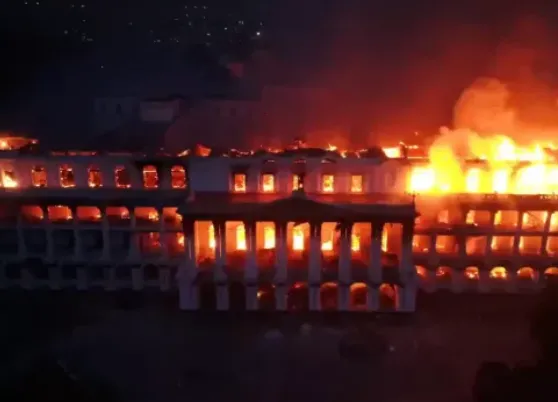
KATHMANDU: On Tuesday, Nepal’s streets became the stage for an extraordinary upheaval—nearly cinematic in its intensity and devastating in its implications.
Simultaneously, Singha Durbar, the Supreme Court, Parliament, and even the President’s Office went up in flames. These were not symbolic acts but visceral testaments to a generation’s frustration with institutions that failed them for so long.
Flames lit the sky over Nepal’s power centers, and with the smoke came a clear signal: the old order was burning, and must be rebuilt from its embers.
This uprising, led by Gen Z, began as a stand against a draconian social media ban, targeting platforms like Facebook, X, and YouTube. But it quickly evolved into a rebellion against decades of corruption, stagnation, and elite privilege.
Youth unemployment had hovered around 22%, half the population lived in poverty, and a sense of exclusion had metastasized. The digital shutdown wasn’t merely censorship—it was the spark in a tinderbox of suppressed rage. (reuters.com, politico.com, economictimes.com).
What we saw next was a catastrophe: smoke billowed from halls of power; fire trucks stood idle and overwhelmed; archives—temporal anchors to national memory—went up in flames.
Authorities admitted on Tuesday that without full mobilization, it might take days to stem the flames. Meanwhile, arsonists extended their assault to media houses, police stations, and even homes of influential political families.
Prime Minister KP Sharma Oli’s resignation came in the afternoon—an admission of defeat by a “political survivor” who had once seemed unshakeable. In a brief letter invoking Article 77 of the constitution, Oli bowed to public will, signaling that the moral foundation of his rule had eroded. The moment underscores how protests, sparked by digital repression, can culminate in a revolution that topples a government.
Yet resignation alone won’t reignite national hope. President Ram Chandra Paudel has called for dialogue, stitching urgency with civility. But the call lands on a landscape scorched by fear and disillusionment. Nepalese youth want structures rebuilt, not political recycling.
The Nepali Army’s appeal to protect cultural heritage while extending a hand to calm is commendable, but a society that watches its Supreme Court burn won’t be soothed by rhetoric alone.
This protest’s scale is unprecedented. In a nation where protests already numbered nearly 4,000 over ten months, the normalization of dissent has bred a volatile citizenry conditioned to escalation. But this is different. It’s not just rage—it’s a structure-shaking revolution that burned icons of state power.
If you thought one-word tweets from Donald Trump couldn’t get any stranger, think again. Over the weekend, President Trump dropped yet another cryptic post on social media: simply “Bela.” That’s it.
No context, no explanation — just the single, mysterious word. Naturally, this didn’t go unnoticed.
If you thought Donald Trump’s social media could get any weirder, enter California Governor Gavin Newsom. Over the past few months, Newsom has gone all-in on an aggressive online strategy, mimicking Trump’s all-caps rants, nicknames, and chaotic style, and the results are hilarious according to many.
Over the weekend, the governor’s social media was on fire, posting several memes that quickly went viral. One featured a seemingly heartfelt (and AI-generated) photo of Hulk Hogan, Kid Rock, and Tucker Carlson praying over him.
Newscom also mocked Trump for copying his signature finger-pointing pose.
And if that wasn’t enough, Newsom’s team dropped a hilarious photoshop of JD Vance on Monday, as the viral Olympic breakdancer Rachael “Raygun” Gunn, turning him into a meme icon overnight.
But the one that really stole the show was Newsom’s take on Donald Trump’s bizarre “Bela” post.
On Sunday, Trump suddenly shared a single-word post: “Bela.” The White House has yet to comment on Trump’s post but social media users quickly pointed out that it fits the pattern of Trump’s recent one-word posts, which many joked “look like he just sat on his phone.”
People online also compared the post to a 2017 tweet on Twitter, now X, where Trump wrote, “Despite the constant negative press covfefe.” He later deleted that tweet and reposted it with a reference to it.
“Who can figure out the true meaning of ‘covfefe’ ???” Trump tweeted. “Enjoy!”
California Governor Gavin Newsom, never one to hold back, of course had a field day after the Bela tweet. His reaction? He started with a simple declaration: “WE BROKE DONALD TRUMP.” But he didn’t stop there.
New emails have surfaced suggesting that Dr. Anthony Fauci, the longtime head of the National Institute of Allergy and Infectious Diseases (NIAID), encouraged federal employees to destroy government records related to the origins of COVID-19.
The revelations come from a series of emails obtained by congressional investigators and highlighted by Senator Rand Paul, who has long pressed for transparency regarding Fauci’s handling of the pandemic.
“We now have clear evidence that Dr. Fauci instructed federal employees to delete official records,” Senator Paul told the New York Post. “This is a violation of federal law and contradicts his sworn testimony.”
One email from February 2020 was particularly damning. It came shortly after a high-level call with virologists about the origins of COVID-19. According to congressional memos, the email included instructions to “delete” messages that discussed the possibility of a lab leak.
The House Select Subcommittee on the Coronavirus Pandemic released a memo describing “serious misconduct and potentially illegal actions” by Fauci’s senior adviser, Dr. David Morens.
“Dr. Morens unlawfully deleted federal COVID-19 records, used a personal email to avoid FOIA, and repeatedly acted unbecoming of a federal employee,” the subcommittee memo stated.
Emails from Morens also appear to implicate Fauci directly. In one exchange, Morens wrote that Fauci “is too smart to have things in writing,” adding that he would help keep certain discussions “off the record.”
Lawmakers say this proves Fauci was aware of efforts to destroy records. “These revelations demonstrate that Dr. Fauci was not only complicit but may have personally directed the destruction of federal records,” Rep. Brad Wenstrup, chair of the subcommittee, said in a press release.
The alleged cover-up centers around the controversial February 2020 paper, The Proximal Origin of SARS-CoV-2, which dismissed the lab leak theory as a conspiracy. Critics argue Fauci’s behind-the-scenes influence shaped that narrative while publicly denying any involvement.
“What we’re seeing now is evidence of deliberate deception,” Paul said. “Fauci told the American people one thing while working behind the scenes to suppress alternative theories.”
The emails also reveal an ongoing effort within the NIH to avoid Freedom of Information Act (FOIA) requests. Morens admitted in one exchange that he would “delete anything” that might be requested by watchdogs.
“I always try to communicate via Gmail because my NIH email is FOIA’d constantly,” Morens wrote in an email subpoenaed by Congress.
Senator Paul blasted this as a clear violation of federal transparency laws. “The law is very clear—federal employees cannot use private emails to conduct official business and then destroy records to avoid oversight,” he said.
In response, Paul sent a letter to the Department of Justice demanding a full investigation into Fauci and Morens. “The DOJ must investigate whether Dr. Fauci and his associates engaged in the unlawful destruction of records,” Paul wrote.
The New York Post reported that Fauci has been called back to Congress for further questioning. Lawmakers want him to explain the newly released emails that appear to contradict his past testimony.
“Fauci testified under oath that he never instructed anyone to delete records,” Wenstrup said. “These emails suggest otherwise, and that raises serious questions about perjury.”
The controversy is not new. In 2022, the National Archives and Records Administration (NARA) warned the NIH about potential violations of federal recordkeeping requirements.
In a letter obtained by archives.gov, NARA said NIH staff had allegedly been ordered to “shred notes and other documents” referencing its work with the Wuhan Institute of Virology.
“If proven true, these are unauthorized dispositions of federal records,” the letter from NARA stated.
Conservative lawmakers say the implications are massive. “If Fauci ordered records destroyed, that is criminal,” Rep. Jim Jordan said in a Fox News interview. “We’re talking about one of the most consequential cover-ups in U.S. history.”
Paul went further, accusing Fauci of intentionally misleading Congress. “This is about accountability,” he said. “No federal employee, no matter how powerful, is above the law.”
Fauci, however, has denied wrongdoing. In past interviews, he insisted he has always complied with federal transparency rules. “I have nothing to hide,” Fauci said in July when asked about earlier reports of email deletions.
Still, lawmakers say his denials don’t match the evidence. “He told us under oath that he never destroyed records,” Wenstrup said. “Now we see emails where his top adviser brags about deleting them on his behalf.”