Most people celebrating their 40th anniversary might opt for a cruise or a beach getaway — but for South African couple Marius and Michelle Nortje, nothing beats a trip to the wild.
Their love story, already four decades strong, was about to take an unforgettable turn deep inside Kruger National Park.
What started as a routine drive turned into a moment the couple — and soon the internet — would never forget.
“We go at least once a year, but sometimes as much as four times,” Marius said in an interview with The Citizen.
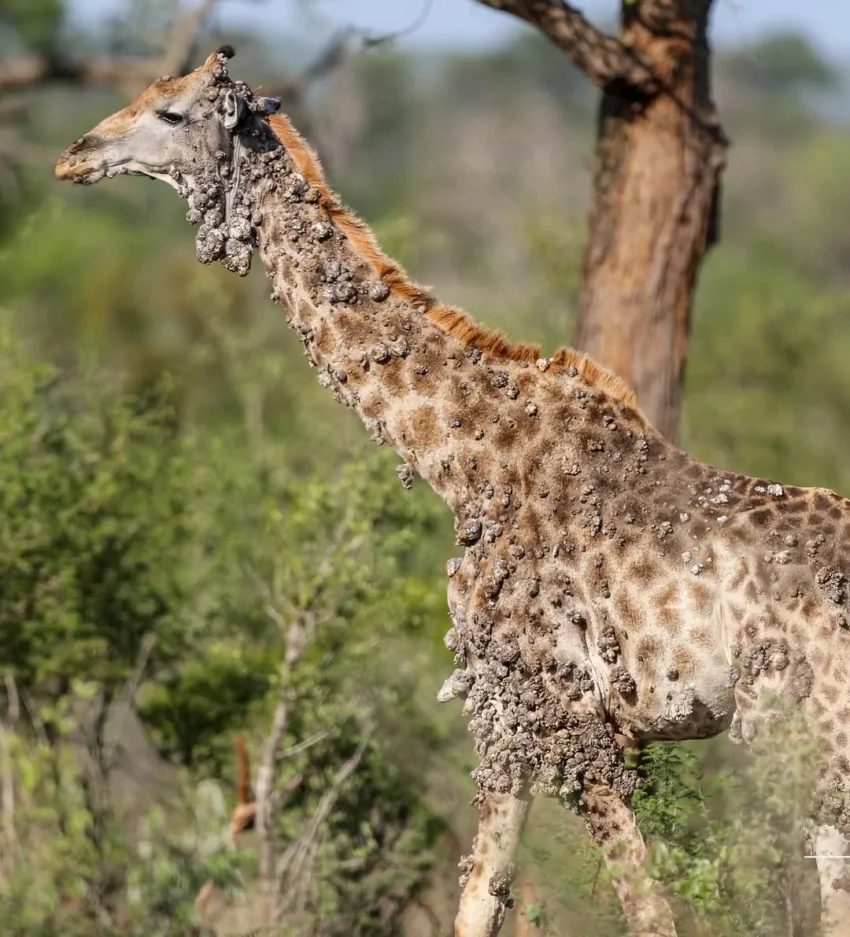
But during their anniversary trip this past December, something extraordinary emerged from the bush: three giraffes. And one of them was unlike anything Marius, a seasoned wildlife photographer, had ever seen.
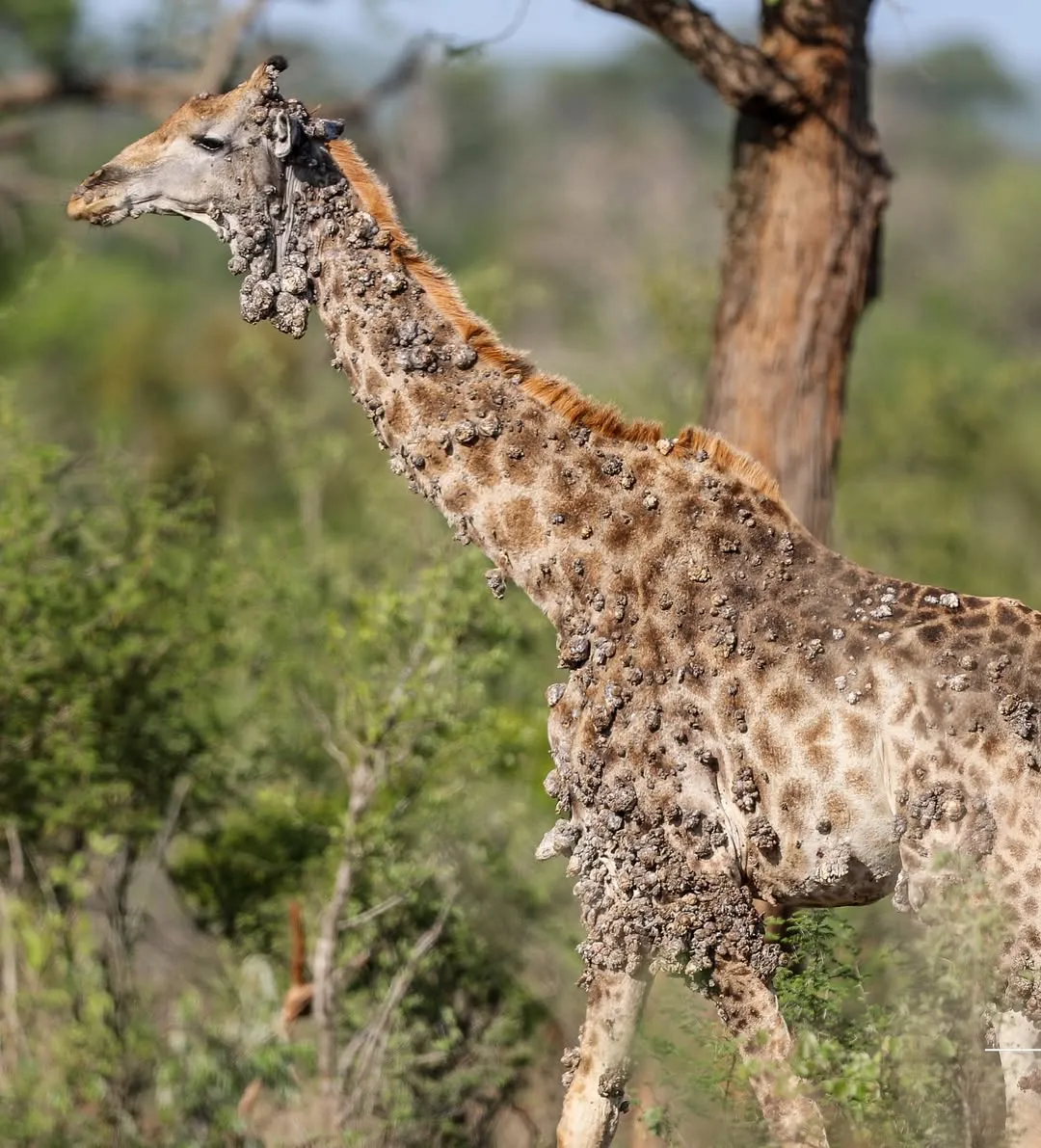
“We couldn’t find [the lions] on the tar road and turned off on a gravel road when we first saw one and then two giraffes emerging from the bush. When the third of the herd became visible, we saw strange growths all over her body,” he recalled.
Acting fast, Marius captured the giraffe on camera and later shared the images on Facebook, where they quickly stirred both curiosity and concern.
“People wondered if she was in pain,” he said. “However, she was grazing peacefully, and it didn’t seem to bother her, although it appeared painful.”
He also tagged the South African National Parks (SANParks) in his post to raise awareness, but as of the time of the interview, hadn’t yet received a response.
The giraffe’s photos gained even more traction after being picked up by WorldWide Vets, an international animal welfare organization. According to Dr. Gemna Campling, founder and director of the organization, the giraffe is suffering from a condition caused by papillomavirus.
“There are many types of papillomavirus, each affecting a specific species. However, the cow variation (Bovine Papillomavirus or BPV) is believed to affect this giraffe,” Dr. Campling explained.
She said the virus is spread through direct contact — in this case, likely via oxpecker birds.
“In this instance, it is assumed that oxpecker birds, landing on the giraffe and pecking at their naturally occurring parasites, spread the disease from one animal to the other. In this case, the whole herd is normal apart from this one animal, as was the case when this disease had been spotted previously.”
While the disease may look shocking, it isn’t deadly.
“Many cases of BPV are self-limiting and can heal with the animal recovering completely,” Dr. Campling said. “There is no treatment for this disease in giraffes, and wildlife vets closely monitor the situation. Thankfully, this version cannot be passed on to people, although the Human Papilloma Virus occurs in humans.”
However, Gemma Camping says: ”Whilst it is not a life threatening disease, it no doubt causes discomfort when the lumps become as advanced as this.”
It’s hard to say exactly how much pain the giraffe was in, but it’s heartbreaking to think she has to live with this. Despite the noticeable lumps, she was calmly grazing — seemingly unaffected by her condition. Still, the photos touched many hearts online, sparking a wave of empathy, wonder, and curiosity from thousands of viewers.
For Marius and Michelle, it was a powerful reminder of why they keep returning to the wild.
Sometimes, the most unforgettable moments come when you’re not looking for them. And sometimes, it takes the lens of one devoted nature lover to remind the world just how resilient — and vulnerable — wildlife can be.
The atmosphere at the Congressional Black Caucus’s 54th anniversary was charged, and Don Lemon wasted no time in diving into the “elephant in the room” with Representative Ilhan Omar.
Their conversation was a raw, wide-ranging discussion that spanned from the perceived threats against Democrats to the thorny issue of U.S. foreign policy and domestic political violence.
The interview began with a discussion of the indictment against former FBI Director James Comey, which Omar immediately characterized as an act of political “revenge” by Donald Trump.
“It is a dangerous moment in our country,
” Omar stated, warning that a president ordering the persecution of his adversaries is a “dangerous territory.“
When asked if she fears being a target herself—given her outspoken position as a member of “The Squad”—Omar acknowledged the threat but remained defiant.
She recounted a list of adversaries, including herself, that Trump has previously targeted, and noted that many members of Congress had immediately thought about getting legal protection the moment Trump was sworn in.
Omar attributed Trump’s particular “bug up his ass” to a deeper prejudice: “I think he has that for Black people,” she asserted, pointing to his attacks on her colleague, Jasmine Crockett. She characterized Trump’s vitriol as a reaction to seeing an intelligent Black woman command respect, but concluded with a powerful counterpoint: “He doesn’t understand that you can’t really like bully a Black woman, right? We’re built different.“
She then laughed off Trump’s recent false claim that the President of Somalia wanted to take her “back” to Somalia, calling it “hilarious” and “disrespectful,” and firmly reminding the former President that she is a “citizen of the United States” and a “member of Congress.”
The conversation shifted to the contentious issue of political violence, where Omar vehemently rejected the right’s narrative that it’s a left-wing problem.
“We know statistically… it is overwhelmingly on the right,” Omar said, citing non-partisan organizations. She pointed out that mass shootings and attacks on churches, mosques, and synagogues have been a “very like white supremist concentrated effort.” She argued that the right pushes the left-wing violence narrative to justify going after progressive organizations.
When asked why Republicans are so hesitant to “face the facts” about the domestic terror threat from white men, Omar suggested it’s an effort to avoid addressing a fundamental problem within their own base. She referenced a comment by the Governor of Utah who had prayed for the perpetrator of a tragedy to be a non-local or a person of color, emphasizing that it’s “hard for them to face the fact that there is something wrong… They rather focus on you.“
Omar was uncompromising in her stance on the Israel-Gaza conflict, declaring it a genocide—a word she said she used early on based on the statements and actions of Benjamin Netanyahu’s cabinet.
She reiterated her long-held belief that the U.S. should stop using tax dollars to send weapons that are used to “kill innocent people” and commit “war crimes.” Furthermore, she slammed the U.S. for providing Israel with “impunity” on the international stage by blocking accountability from the ICC, ICJ, and the UN Security Council.
Omar revealed a “huge huge difference” between what her colleagues say in public and what they admit privately. Many express fear of AIPAC (American Israel Public Affairs Committee), worried about being stripped of funding or being primaried with AIPAC-backed resources. She argued that members should trust their constituents, reminding them that she herself was outspent 4-to-1 in her 2020 primary—the most expensive in Congressional history—but still won by 20 points because her constituents preferred domestic spending on healthcare and education over foreign military aid.
Regarding the inevitable accusation of anti-Semitism for her criticism, Omar strongly denied it, clarifying: “My problem is with the Israeli government and the… occupation, the Nakba, the apartheid, the genocide.”
On the topic of the First Amendment, Omar expressed concern that it is “clearly being threatened,” but also noted that the public lacks a full understanding of what those freedoms mean. She emphasized that the First Amendment protects citizens from the government, not from public pressure.
She voiced her frustration with the government itself overstepping this boundary, citing an instance where the FCC Chair, with direction from the president, threatened to not renew a license unless a broadcaster was taken off the air—a clear First Amendment violation. This concern led her to vote for the creation of a subcommittee to fight the weaponization of government, an idea she fundamentally agreed with.
Play video:
Looking ahead to the potential for a second Trump term, Omar believes he is “much more unhinged” this time, and is surrounded by more “sick fans” willing to carry out his will. When asked if Trump’s behavior is political, she scoffed: “Oh god no… he should have had therapy long ago. Obviously, he’s struggling with a lot of things.”
She ended the interview by affirming her commitment to speaking her truth, a right that is part of the First Amendment, and her refusal to be bullied into “complacency” or to “dishonor who I am and what I stand for” just to make her adversaries comfortable.
The exchange highlights the immense pressure and the moral dilemmas facing progressive members of Congress today. How effective do you think this kind of public pressure and political risk-taking is in shaping U.S. foreign policy over the long term?