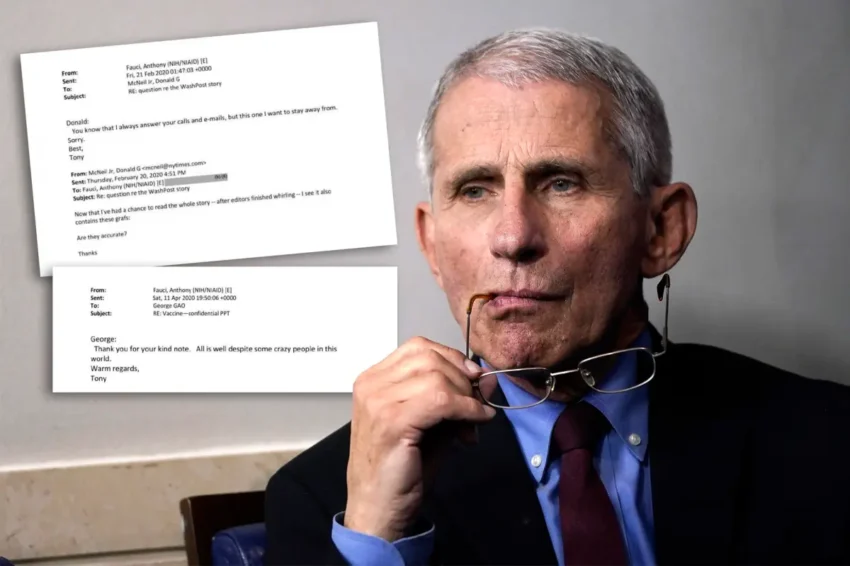
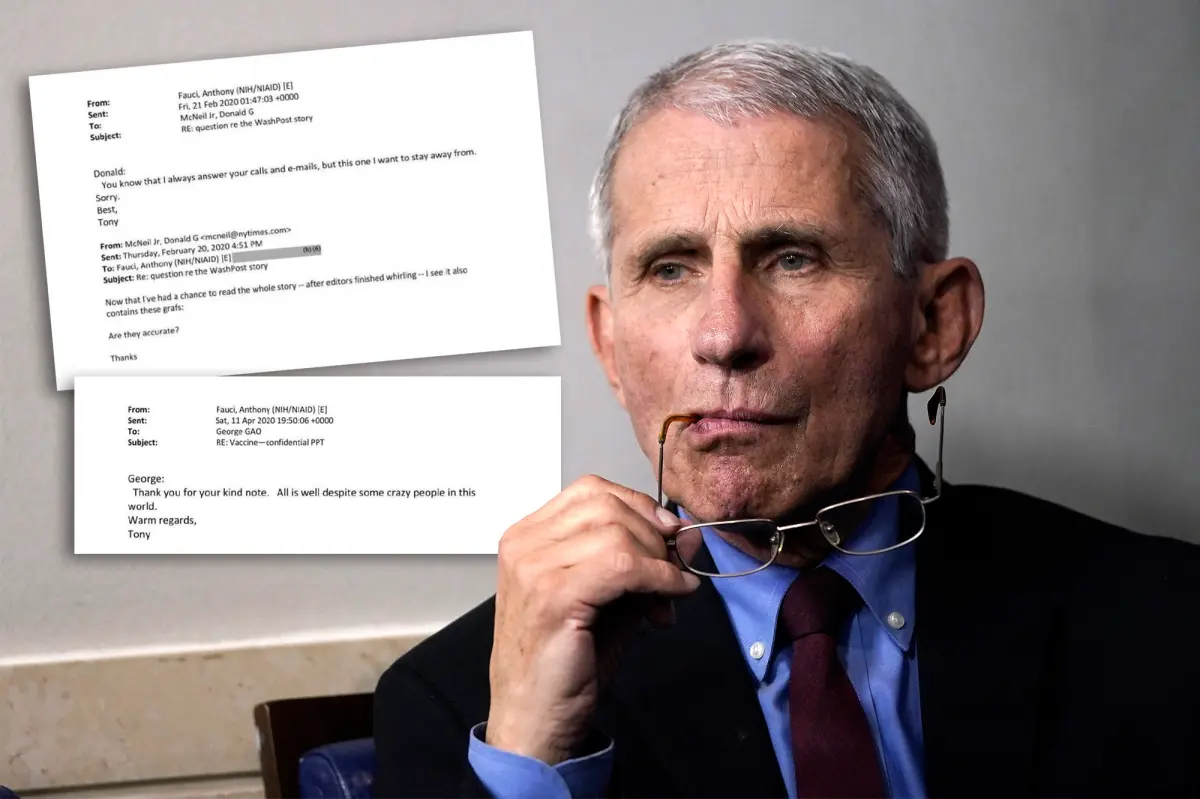
New emails have surfaced suggesting that Dr. Anthony Fauci, the longtime head of the National Institute of Allergy and Infectious Diseases (NIAID), encouraged federal employees to destroy government records related to the origins of COVID-19.
The revelations come from a series of emails obtained by congressional investigators and highlighted by Senator Rand Paul, who has long pressed for transparency regarding Fauci’s handling of the pandemic.
“We now have clear evidence that Dr. Fauci instructed federal employees to delete official records,” Senator Paul told the New York Post. “This is a violation of federal law and contradicts his sworn testimony.”
One email from February 2020 was particularly damning. It came shortly after a high-level call with virologists about the origins of COVID-19. According to congressional memos, the email included instructions to “delete” messages that discussed the possibility of a lab leak.
The House Select Subcommittee on the Coronavirus Pandemic released a memo describing “serious misconduct and potentially illegal actions” by Fauci’s senior adviser, Dr. David Morens.
“Dr. Morens unlawfully deleted federal COVID-19 records, used a personal email to avoid FOIA, and repeatedly acted unbecoming of a federal employee,” the subcommittee memo stated.
Emails from Morens also appear to implicate Fauci directly. In one exchange, Morens wrote that Fauci “is too smart to have things in writing,” adding that he would help keep certain discussions “off the record.”
Lawmakers say this proves Fauci was aware of efforts to destroy records. “These revelations demonstrate that Dr. Fauci was not only complicit but may have personally directed the destruction of federal records,” Rep. Brad Wenstrup, chair of the subcommittee, said in a press release.
The alleged cover-up centers around the controversial February 2020 paper, The Proximal Origin of SARS-CoV-2, which dismissed the lab leak theory as a conspiracy. Critics argue Fauci’s behind-the-scenes influence shaped that narrative while publicly denying any involvement.
What we’re seeing now is evidence of deliberate deception,” Paul said. “Fauci told the American people one thing while working behind the scenes to suppress alternative theories.”
The emails also reveal an ongoing effort within the NIH to avoid Freedom of Information Act (FOIA) requests. Morens admitted in one exchange that he would “delete anything” that might be requested by watchdogs.
“I always try to communicate via Gmail because my NIH email is FOIA’d constantly,” Morens wrote in an email subpoenaed by Congress.
Senator Paul blasted this as a clear violation of federal transparency laws. “The law is very clear—federal employees cannot use private emails to conduct official business and then destroy records to avoid oversight,” he said.
In response, Paul sent a letter to the Department of Justice demanding a full investigation into Fauci and Morens. “The DOJ must investigate whether Dr. Fauci and his associates engaged in the unlawful destruction of records,” Paul wrote.
The New York Post reported that Fauci has been called back to Congress for further questioning. Lawmakers want him to explain the newly released emails that appear to contradict his past testimony.
“Fauci testified under oath that he never instructed anyone to delete records,” Wenstrup said. “These emails suggest otherwise, and that raises serious questions about perjury.”
The controversy is not new. In 2022, the National Archives and Records Administration (NARA) warned the NIH about potential violations of federal recordkeeping requirements.
In a letter obtained by archives.gov, NARA said NIH staff had allegedly been ordered to “shred notes and other documents” referencing its work with the Wuhan Institute of Virology.
“If proven true, these are unauthorized dispositions of federal records,” the letter from NARA stated.
Conservative lawmakers say the implications are massive. “If Fauci ordered records destroyed, that is criminal,” Rep. Jim Jordan said in a Fox News interview. “We’re talking about one of the most consequential cover-ups in U.S. history.”
Paul went further, accusing Fauci of intentionally misleading Congress. “This is about accountability,” he said. “No federal employee, no matter how powerful, is above the law.”
Fauci, however, has denied wrongdoing. In past interviews, he insisted he has always complied with federal transparency rules. “I have nothing to hide,” Fauci said in July when asked about earlier reports of email deletions.
Still, lawmakers say his denials don’t match the evidence. “He told us under oath that he never destroyed records,” Wenstrup said. “Now we see emails where his top adviser brags about deleting them on his behalf.”
In a striking example of the power of celebrity influence — and the cost of polarizing content — recent reports have revealed a staggering financial contrast between two major entertainment figures: Stephen Colbert and Sydney Sweeney.
Stephen Colbert, host of CBS’s The Late Show, is reportedly costing the network up to $50 million annually. The source of the financial strain? His increasingly “woke”-leaning comedic segments, which critics argue have alienated a large portion of the audience. While Colbert remains a high-profile figure in late-night television, ratings have fluctuated, advertisers have pulled back, and CBS is feeling the heat.
Meanwhile, Sydney Sweeney — the rising Hollywood star known for her roles in Euphoria and Anyone But You — made headlines not for controversy, but for denim. In a casual, seemingly effortless campaign with American Eagle, Sweeney sent the brand’s stock soaring by 10%, adding a jaw-dropping $200 million to its market value. All she had to do? Show up in jeans.
The comparison highlights a shifting entertainment and marketing landscape. Colbert’s political and social commentary has its loyal fan base, but it’s also becoming a costly gamble for a traditional network like CBS. On the flip side, Sweeney’s non-political, relatable charm has proven to be a marketing goldmine — particularly with Gen Z and millennial shoppers.
As entertainment executives weigh their options, the question lingers: In today’s cultural economy, is it more profitable to make a statement or just wear the jeans?
In a stunning display of political theater, FBI Director Kash Patel faced off against Congresswoman Ilhan Omar during a House Foreign Affairs Committee hearing that has sent shockwaves through Washington, D.C. The hearing, originally scheduled to discuss FBI counterterrorism policies, quickly escalated into a personal and heated confrontation, with Patel methodically dismantling Omar’s credibility and political career.
The tension in the hearing room was palpable as Omar launched a scathing attack on Patel, accusing him of being a “fascist Trump puppet” who had weaponized the FBI against Muslims and immigrants. Her words echoed through the chamber, drawing gasps from committee members and spectators alike. With her eyes blazing, Omar aimed to portray Patel as a traitor to his own people, referencing his parents’ flight from tyranny in Uganda.
However, what Omar didn’t realize was that Patel had meticulously prepared for this moment. As she unleashed her barrage of personal attacks, Patel remained calm and collected, showcasing the demeanor of a seasoned prosecutor. He organized five Manila folders on the table in front of him, each labeled with damning evidence that would soon unravel Omar’s political ambitions.
As the hearing progressed, Patel finally broke his silence. “Are you finished?” he asked Omar, his calm voice cutting through the tension. This simple question marked a turning point in the proceedings. Omar, visibly shaken, attempted to regain her composure but struggled to maintain her earlier bravado.
Patel then began to unveil the contents of his folders, starting with allegations of campaign finance violations. He revealed documentation showing that Omar’s campaign had paid her boyfriend’s consulting firm while she was still married to another man. The revelation sent shockwaves through the room, with murmurs of disbelief rising from both sides of the aisle.
Patel continued to methodically present evidence, detailing a pattern of financial misconduct that included using campaign funds for personal travel and romantic getaways. The atmosphere in the hearing room shifted dramatically as Patel’s evidence mounted. Several Democratic committee members, who had previously supported Omar, began to distance themselves, clearly uncomfortable with the unfolding drama.
“You were forced to reimburse $3,400 for personal use of campaign funds,” Patel stated, his voice steady. “But that was just the tip of the iceberg, wasn’t it?” Omar’s attempts to deflect the accusations faltered as the evidence became increasingly overwhelming.
As the hearing continued, Patel shifted focus to Omar’s controversial remarks about the September 11 attacks. He played a clip of her infamous statement, “Some people did something,” which she made while speaking at a Council on American-Islamic Relations (CAIR) event. The room fell silent as Patel emphasized the gravity of those words, reminding everyone of the nearly 3,000 lives lost that day.
The emotional weight of the moment was palpable, and several family members of 9/11 victims stood up to share their pain, holding photographs of their loved ones. “They weren’t killed because ‘some people did something,’” one man declared, his voice breaking with emotion. The gallery transformed into a poignant memorial, further intensifying the scrutiny on Omar.
Patel then turned to Omar’s history of anti-Semitic remarks, displaying a timeline of her controversial statements and the backlash they received. He highlighted her tweets that suggested Jewish money controlled American politics, drawing sharp criticism from both sides of the aisle. “When your own party’s Jewish caucus condemns you, maybe the problem isn’t everyone else’s sensitivity,” Patel asserted, firmly establishing the narrative that Omar’s comments were not merely political disagreements but rooted in a troubling pattern of behavior.
As the evidence mounted, Omar’s defense crumbled. She attempted to frame Patel’s actions as an Islamophobic witch hunt, but Patel countered, “I’m conducting oversight because you’re a potentially corrupt public official. Your religion is irrelevant to your bank balance.”
As the hearing neared its conclusion, Patel opened the final folder, detailing ongoing ethics investigations against Omar. He presented findings from the Office of Congressional Ethics, which revealed substantial evidence of campaign finance violations and potential criminal conduct. The atmosphere in the room shifted dramatically as the weight of the evidence became undeniable.
Omar, once a fierce advocate for her constituents, now appeared vulnerable and isolated. She repeatedly invoked her Fifth Amendment rights, a move that signaled her acknowledgment of the severity of the situation. This admission was politically devastating, suggesting that she was aware of the potential legal ramifications of her actions.
In the immediate aftermath of the hearing, the political landscape shifted dramatically. Calls for Omar’s resignation grew louder, with over 100 House Democrats demanding accountability. The Democratic Party, once a staunch ally of Omar, moved swiftly to distance itself from her amid the growing scandal.
As the Department of Justice launched a grand jury investigation into Omar’s activities, her supporters began to dwindle. Community leaders who had once championed her now expressed feelings of betrayal. The Somali-American Community Center, instrumental in her rise to power, unanimously withdrew their support, stating, “She betrayed us.”
The fallout from this hearing extended beyond Omar. It sparked a wave of self-examination within Congress, leading to the passage of new ethics rules aimed at preventing similar scandals in the future. The hearing became a case study in political accountability, illustrating the importance of transparency and integrity in public office.
For Kash Patel, the hearing marked a significant achievement in his role as FBI Director. His calm, methodical approach to exposing corruption became a blueprint for future investigations, inspiring a new generation of law enforcement professionals committed to upholding justice.
As the dust settled, the phrase “pulling an Omar” entered the political lexicon, serving as a cautionary tale for politicians who might consider launching personal attacks without regard for their own vulnerabilities. The dramatic events of that day served as a stark reminder: in America, accountability ultimately prevails, even for those who believe they are untouchable.
The dramatic showdown between Kash Patel and Ilhan Omar will be remembered as a pivotal moment in American politics. It showcased the power of evidence and the necessity for accountability in public service. As the nation reflects on the events of that day, it is clear that the principles of justice and integrity must remain at the forefront of our democratic process. The hearing not only marked the end of Omar’s political career but also reinforced the idea that no one is above the law.