Multiple people were killed in a major crash involving a tour bus on its way to Ohio from New Jersey and three semi-trucks on the Pennsylvania Turnpike early Sunday in the western part of the state that left dozens injured, according to officials.
The “extremely serious” crash happened around 3:40 a.m. Sunday in the highway’s westbound lanes in Mount Pleasant Township, located about 40 miles southeast of downtown Pittsburgh, according to Pennsylvania State Police Trooper Stephen Limani.
Limani said there were five fatalities and about 60 injuries as a result of the crash. Of those injured — ranging in age from 7 to “into their 60’s” — two are listed in critical condition, according to Limani.
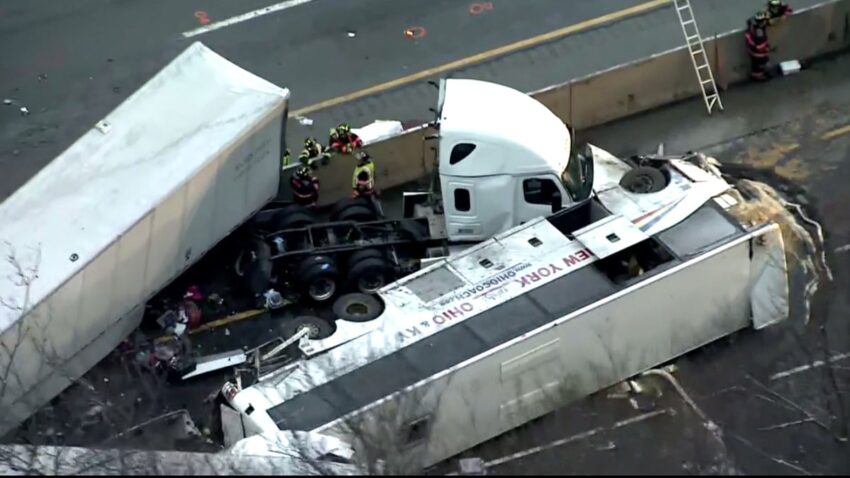
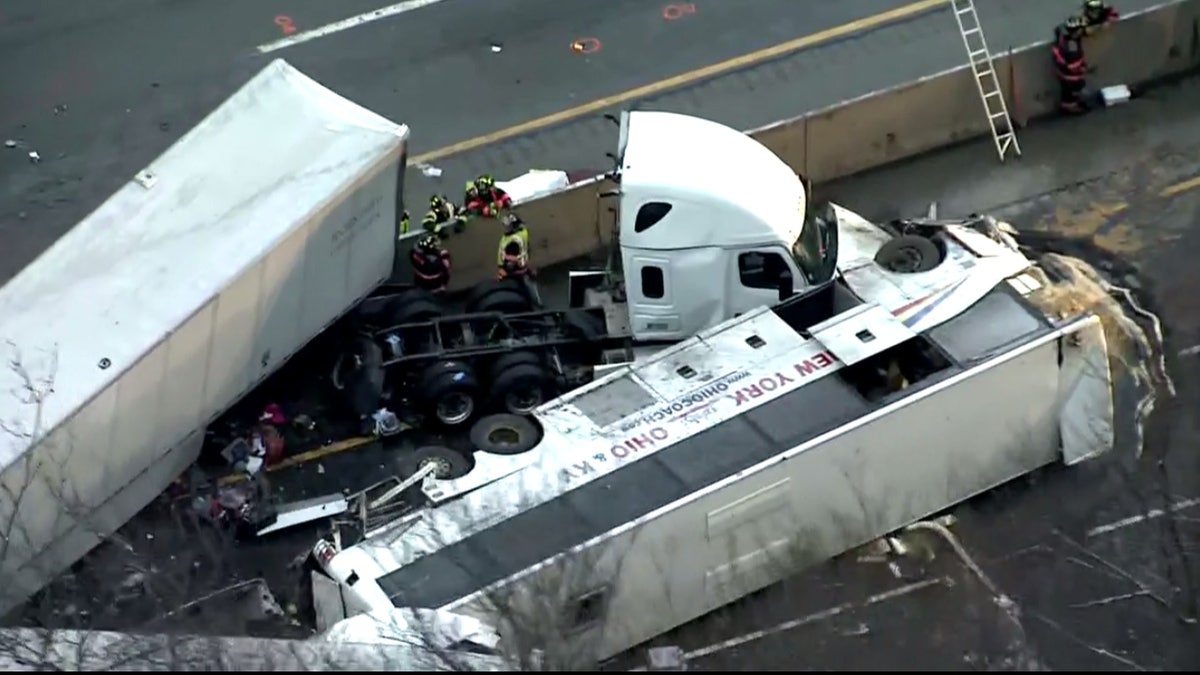
Pennsylvania State Police said the tour bus was traveling westbound on the highway from Rockaway, New Jersey to Cincinnati on a downhill curve when it struck an embankment and rolled over. After the bus rolled over, it was then struck by two semi-trucks before a third truck collided with the two other semis involved in the initial crash. Another vehicle then also became ensnared in the crash site.
A total of six vehicles were involved in the crash, including a tour bus, three semi-trucks loaded with parcels and one private passenger vehicle, according to police.
Multiple people were k.i.l.l.e.d after a major crash on the Pennsylvania Turnpike early Sunday. (KDKA-TV via NNS)
State police said that a total of 39 people were transported to area hospitals, including 28 sent to Frick Hospital in Mount Pleasant and 11 transported to Forbes Hospital in Monroeville.
Images from the scene showed mangled wreckage on the highway. A tour bus could be seen flipped on its side as a result of the crash.
The crash happened on the Pennsylvania Turnpike in Westmoreland County, around 40 miles southeast of Pittsburgh. (KDKA-TV via NNS)
Angela Maynard, a tractor-trailer driver from Kentucky, told the Pittsburgh Tribune-Review she was traveling eastbound with her co-driver on the turnpike around 3:30 a.m. when they came across the crash.
“It was horrible,” she said.
Maynard told the newspaper she saw someone on the ground, while another person was trapped in their truck.
“I walked toward the scene and saw one of the truck drivers laying [sic] near the barrier. I tried to keep him occupied, keep talking, until medical help arrived,” Maynard told the Tribune-Review. “He was in bad shape. He was floating in and out of consciousness.”
The bus, part of Z&D Tours, was filled with passengers mostly from other countries, according to Limani. He said two “most prominent” languages were Japanese or Spanish, but officials are still working on identifying those who were killed or injured due to many having documents and identification that are still at the crash scene.
“It’s just a lot going on when it comes to identifying them and contacting their loved ones,” he told reporters at a news conference Sunday afternoon.
Emergency crews respond to a fatal crash on the Pennsylvania Turnpike in Mount Pleasant Township early Sunday morning, Jan. 5, 2020. (WPIX TV via AP)
Limani said the Red Cross is assisting the victims of the crash, and “doing everything” to make it as comfortable as it can be to those impacted by the incident.
The crash caused all lanes to be closed in both directions on the highway between the Breezewood and New Stanton exits, roughly an 86-mile stretch of roadway.
Motorists traveling east are being urged to use Route 119 south US 40 east to Interstate 68 east (at Cumberland, Maryland) to Interstate 70 west and re-enter the turnpike at the Breezewood Interchange exit 161.
Westbound motorists are urged to use Route 30 west to Interstate 99 north to US Route 22 west to Route 66 south and re-enter the turnpike at exit 75 in at the New Stanton exit, according to KDKA-TV.
The Pennsylvania Turnpike can be seen empty after it was closed in both directions following a major crash early Sunday. (KDKA-TV via NNS)
It was not clear if the weather was a factor in the crash. The National Weather Service forecast for Westmoreland County early Sunday listed light unknown precipitation and an air temperature just below freezing.
“The one thing about traveling through Pennsylvania is that we have change in weather. It could be just because of our mountains, our hills. Just the way that our elevation changes,” Limani told reporters. “We were told that by some of the people that were driving, that the weather did start to change.”
Limani told reporters that weather conditions “could have played a factor” in the crash, but authorities will be able to “get to that answer” as the investigation progresses.
Pennsylvania Turnpike Chief Operating Officer Craig Shuey told reporters at a news conference Sunday afternoon that work crews had been treating the roadway since 9 p.m. due to wintry conditions in the region. Shey added that road crews were cycling treatment using either salt or cinders during the time period before the crash took place.
The National Transportation Safety Board (NTSB) has dispatched a board member and team of 13 people to the scene, according to Limani
One FedEx semi-truck was pictured among the trucks involved in the crash. In a statement to Fox News, a FedEx spokesperson said the company extends “our deepest condolences to the families of the individuals involved in this accident.”
“There is no higher priority for FedEx Ground than safety, and we are cooperating fully with investigating authorities at this time,” the spokesperson added.
The Associated Press contributed to this report.
Politics is often as much about perception as it is about policy. A single move, a careless word, or even the choice of which battles to fight can reshape a politician’s standing in the eyes of the public. Governors especially must walk a fine line: they are expected to manage the day-to-day crises of their own states while also navigating the larger national stage. For California Governor Gavin Newsom, this balance has always been precarious.
Newsom is ambitious. Few would dispute that. His name has been floated in national conversations about the Democratic Party’s future for years. Some even see him as a possible presidential candidate should circumstances align. But ambition comes with risk. And for Newsom, that risk has begun to crystalize in ways that critics argue expose deep flaws in his leadership style.
The California Backdrop
Before digging into Newsom’s latest misstep, it’s important to remember the state he governs. California is both a beacon of opportunity and a cautionary tale. It boasts Silicon Valley, Hollywood, and an economy larger than many countries. Yet at the same time, the state struggles with soaring homelessness, rising crime in major cities, unaffordable housing, and some of the highest taxes in the nation.
Critics often argue that while Newsom relishes high-profile battles with Republican governors and national media appearances, he neglects these festering problems at home. Encampments dot sidewalks in Los Angeles and San Francisco. Middle-class families are squeezed by cost-of-living pressures. Small businesses face a gauntlet of regulations and tax burdens.
In short, while California remains a powerhouse, many residents feel their quality of life is declining. This perception — fair or not — makes every decision Newsom takes outside his state subject to even harsher scrutiny.
Picking National Fights
Rather than focusing solely inward, Newsom has repeatedly sought to position himself as a counterweight to conservative leaders. His favorite sparring partner has been Florida’s Governor Ron DeSantis. The rivalry between the two reached its peak in November 2023, when the two faced off in a nationally televised debate.
What was intended as Newsom’s opportunity to showcase his vision and contrast California’s progressive model with Florida’s conservative approach turned into a widely panned performance. DeSantis, armed with statistics and sharp rebuttals, landed blow after blow. Newsom appeared defensive, at times evasive, and left the stage looking diminished.
Observers noted the awkward moment when Newsom’s wife — who insists on being referred to as “First Partner” — ushered him away almost immediately after his closing remarks. To Democrats, the night was a disappointment. To Republicans, it was proof that Newsom lacked the chops to handle a national platform.
Enter Proposition 50
Instead of recalibrating, Newsom has doubled down on aggressive moves that critics say reek of political opportunism. His latest push, Proposition 50, has stirred particular controversy.
The measure, pitched as a “temporary” adjustment, would effectively dismantle California’s independent redistricting commission. This body, designed to draw fair political maps free from partisan interference, has long been seen as a safeguard against gerrymandering.
But why target it now? Critics believe the timing is no accident. By undercutting the commission, Democrats in California could gain more control over congressional maps at a time when the balance of power in Washington is razor thin.
To Newsom’s detractors, this is nothing less than hypocrisy. For years, Democrats have accused Republicans — especially in states like Texas and North Carolina — of gerrymandering. Now, they argue, Newsom is attempting to do the very same thing under the guise of reform.
Meddling in North Carolina
As if reshaping California’s political landscape weren’t enough, Newsom has also inserted himself into North Carolina’s political drama.
Recently, CBS 17 reported that longtime Republican State Senate leader Phil Berger was allegedly negotiating with former President Donald Trump. The claim? That Berger would receive Trump’s endorsement in a 2026 primary in exchange for agreeing to redraw North Carolina’s congressional maps in a way favorable to Trump.
The story, built on anonymous sources, quickly spread. But critics were quick to note its shaky foundation. The group Carolina Forward, a left-leaning advocacy organization that often presents itself as “non-partisan,” had blasted out talking points on the alleged deal before CBS 17 even went live with the report. To many Republicans, it smelled less like investigative journalism and more like coordinated political theater.
And yet, there was Gavin Newsom, amplifying the allegations, weighing in on another state’s political disputes while his own faces mounting crises.
Berger Fires Back
Phil Berger, not one to shy away from confrontation, swiftly denied the report. He dismissed the idea that he had spoken to Trump about endorsements or cut any sort of quid pro quo deal. But he also took the opportunity to swipe at Newsom.
“If we have to draw one more map this year, we will,” Berger said, referencing the endless lawsuits and court battles over redistricting in North Carolina. “That said, I’ve never spoken to President Trump about this or an endorsement. The Democrats are spreading lies to hurt President Trump.”
Berger’s response was both a denial and a warning. He made it clear that he saw through what he viewed as a Democratic smear campaign — and that if push came to shove, Republicans in North Carolina were ready to hold their ground.
Why This Was a Mistake for Newsom
So why does this matter? Why is Newsom’s involvement in North Carolina being described as a gigantic political mistake?
First, it plays directly into the narrative that he is more interested in national political theater than solving California’s deeply rooted issues. Every time he comments on another state’s affairs, he opens himself up to the charge of hypocrisy: why not fix San Francisco before critiquing Charlotte? Why weigh in on North Carolina maps when Los Angeles residents are fleeing to Texas and Nevada?
Second, his decision to amplify a story built on thin sourcing makes him appear reckless. Politicians are often criticized for jumping on rumors to score quick political points, and in this case, Newsom looks like he was willing to spread an unverified narrative simply because it targeted Republicans. If the story crumbles, so too does his credibility.
Third, Newsom’s moves undermine his standing within his own party. Some Democrats privately groan every time he picks another fight because it distracts from their broader message and risks alienating moderate voters who dislike political grandstanding.
A Media Landscape Under Fire
It’s not just Newsom under the microscope. Outlets like CBS 17 have also faced heavy criticism for running with a story based largely on anonymous whispers. The relationship between politicians and media is always fraught, but in this case, the optics were particularly poor.
By relying on “several sources” that may have effectively boiled down to a single partisan group, the outlet opened itself up to charges of bias. To Republicans, it confirmed what they have long believed: that mainstream outlets are too quick to launder Democratic talking points under the label of journalism.
For Newsom to hitch his credibility to such reporting only magnified the backlash.
What Comes Next
The fallout from Newsom’s latest blunder is still unfolding. His allies will likely defend him, arguing that governors have every right to comment on national political trends. His critics, however, see a pattern — one of ambition overshadowing responsibility, of a leader who prefers national stage lights to the gritty work of fixing his own state’s problems.
Meanwhile, Californians continue to deal with the issues that have defined Newsom’s tenure:
Homelessness that grows despite billions in funding.
Crime that sparks headlines and drives residents to relocate.
Taxes and regulations that push businesses to leave the state.
Each time Newsom diverts his attention elsewhere, these problems serve as a backdrop, reminding voters of what remains unresolved.
Conclusion: The Price of Overreach
For Gavin Newsom, politics has always been about more than California. His aspirations are clear, his national profile undeniable. But ambition is a double-edged sword. By inserting himself into controversies outside his state — from fights with Ron DeSantis to allegations in North Carolina — he risks becoming a caricature: the governor more interested in grandstanding than governing.
The “gigantic mistake” is not a single headline or a fleeting controversy. It is the broader impression being cemented in the public’s mind: that Gavin Newsom is failing the very people who entrusted him with leadership while chasing relevance elsewhere.
And in politics, perception is often reality.