The FBI memo that initiated the Biden-era Arctic Frost investigation into President Donald Trump and hundreds of his allies over their activities related to January 6 lacked substantial evidence and clear legal justification, according to several former prosecutors and FBI agents who reviewed the newly released document and identified multiple deficiencies.The investigation, code-named Arctic Frost, was initially led by an FBI supervisor who had expressed anti-Trump sentiments and was later taken over by Special Counsel Jack Smith.
The probe treated the effort by Trump’s allies to submit alternate electors to Congress during the 2020 election certification as a potential criminal conspiracy — despite similar actions in two prior instances of U.S. history not resulting in prosecution, Just the News reported.
According to the newly released materials, the FBI memo that launched the investigation in spring 2022 — around the same time Trump announced his bid for the presidency — relied heavily on interview clips from CNN as primary evidence “suggesting” Trump’s involvement in the alleged conspiracy, the outlet added.
Arctic Frost investigation was legally flawed and reflected the same politicization and investigative overreach seen in the 2016 Russia collusion probe, code-named “Crossfire Hurricane.”
House Judiciary Committee Chairman Jim Jordan said Wednesday that he believes the FBI memo authorizing the Arctic Frost investigation was legally flawed and reflected the same politicization and investigative overreach seen in the 2016 Russia collusion probe, code-named “Crossfire Hurricane.”
Jordan obtained the document from current FBI Director Kash Patel and told Just the News that both investigations targeted Trump based on weak evidence and partisan motives before ultimately being discredited.
“Sure looks that way. … and it looks like this was just the same old weaponization, same old political focus, focus on politics, going after your political enemies,” Jordan said during a wide-ranging interview on the Just the News, No Noise TV show.
“Same mindset that said we’re going to put the dossier in the intelligence community assessment, even though we know the dossier is garbage, we know there’s no underlying intelligence support,” he continued.
“That same mindset that was there in 2016 is the mindset we see now in 2022 with Arctic Frost, and then as it transformed into Jack Smith, special counsel, later in 2022—same mindset. So yeah, that’s what it sure looks like,” he added.
Smith has denied any wrongdoing and said he intends to present his side of the story. Jordan has invited Smith to testify before the committee, warning that he will issue a subpoena if Smith declines to appear voluntarily.
Documents released in recent weeks by Patel indicate that the Arctic Frost investigation was approved at the highest levels of the Biden administration, including by Attorney General Merrick Garland, Deputy Attorney General Lisa Monaco, and FBI Director Christopher Wray, with assistance from a lawyer in the White House.
The inquiry centered on efforts by Republican officials in several states to submit alternate slates of electors ahead of Congress’s certification of the 2020 presidential election on January 6, 2021.
The probe was later transferred from the FBI to Smith’s office, which issued subpoenas to hundreds of Trump allies.
Senate Judiciary Committee Chairman Chuck Grassley (R-Iowa) on Wednesday released 197 subpoenas that Smith and his Justice Department team issued “as part of the indiscriminate election case against President Trump,” identifying more than 400 Republican groups and individuals whose information was sought.
Separately, the House Judiciary Committee disclosed that more than 160 Republicans — including many closely tied to Trump — were flagged for possible investigation under the Arctic Frost operation.
The opening electronic communication (EC) that launched what became a broad investigation into Trump associates was written and approved in April 2022 under the title “Requests Opening of New Investigation – Arctic Frost.”
The probe, designated as a “Sensitive Investigative Matter” (SIM), was authorized by then–Assistant Special Agent in Charge Timothy Thibault — who later left the FBI after his anti-Trump social media posts came to light — along with other senior bureau officials, including Steve D’Antuono, then the Assistant Director in Charge of the FBI’s Washington Field Office, and Paul Abbate, who was serving as the FBI’s Deputy Director at the time
indicated there was movement near my vacation home. I felt a knot form in my stomach. Had they seriously gone behind my back? My heart pounded in my chest as I clicked on the live feed.
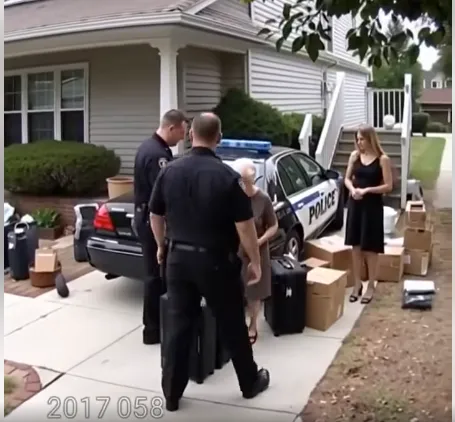
Sure enough, there they were—my parents and Lily, unloading boxes from a moving van. I couldn’t believe the audacity. After all that had been said, they still thought they could walk over me. My hands shook with a mixture of anger and disbelief as I watched them casually move into my space, as if they owned the place.
I decided to leave work early and drive up to the cottage. The two-hour trip felt like a lifetime as I replayed the events of the past weeks in my mind. I tried to concoct various ways to confront them, but nothing seemed right. As the cottage came into view, I pulled over, took a deep breath, and steeled myself for the confrontation.
When I arrived, my mother was in the garden, planting flowers as if she had all the time in the world. My father and Lily were inside, rearranging furniture. I walked up the stone path, my footsteps crunching loudly against the gravel. My mother looked up, seemingly unfazed by my appearance. “Oh, Tessa, you’re here,” she said, wiping her hands on her apron.
I didn’t bother with pleasantries. “What are you doing here?” I demanded, my voice firm.
My father emerged from the house, a sheepish look crossing his face. “We thought we’d help tidy up a bit before moving in,” he said, as if this was a logical explanation.
“Tidy up? You’re moving in without my permission!” I shot back, incredulous.
er sighed, as if I were a stubborn child refusing to share a toy.
“We didn’t think it would be a big deal, dear. You didn’t seem to use it much.”
“That’s not the point, and you know it,” I countered, my voice rising.
“This is about respect and boundaries—something you all clearly lack.”
My father stepped forward, an apologetic look on his face. “We didn’t mean to upset you, Tessa.
We just thought it was a solution to our living situation.”
I took a deep breath, trying to calm the storm inside me.
“The solution is not to steal from your children. I expect you to leave by the end of the day. I’ll be changing the locks.”
Lily opened her mouth, probably to argue more, but I cut her off. “No more discussion.
If you don’t leave, I’ll have to involve the authorities.”
The silence that followed was deafening. My parents exchanged a glance, realizing I was serious.
Lily huffed, clearly unhappy with the resolution, but I didn’t care. I stood my ground, watching as they began to pack their things back into the van.
As they drove away, I felt a mix of relief and sadness. Family ties were important, but not at the cost of my self-respect and peace.
I could only hope this would be a turning point for all of us, a chance to redefine our relationships with fairness and respect at the core.