Democratic-aligned voting rights organizations are bracing for what they describe as a potential crisis if the U.S. Supreme Court moves to weaken a central provision of the Voting Rights Act, one of the nation’s cornerstone civil rights laws.The concern centers on Louisiana v. Callais, a case the justices heard on October 15. The outcome could determine the future of Section 2 of the Voting Rights Act, which prohibits redistricting plans that dilute the voting power of racial minorities.
Two prominent voting rights groups have warned that striking down or narrowing Section 2 would allow Republican-controlled legislatures to redraw as many as 19 congressional districts in their favor, Politico reported.That projection — outlined in a new report from Fair Fight Action and the Black Voters Matter Fund and shared exclusively with POLITICO — suggests that striking down Section 2 of the Voting Rights Act could all but ensure continued Republican control of the House of Representatives.
While a ruling before next year’s midterm elections remains uncertain, the organizations behind the report said it is still possible. In total, the groups identified 27 congressional seats nationwide that could be redrawn to favor Republicans if current legal and political conditions hold — with 19 of those shifts directly tied to the potential elimination of Section 2 protections.Doing so would “clear the path for a one-party system where power serves the powerful and silences the people,” Black Voters Matter Fund co-founder LaTosha Brown claimed, without addressing the constitutional impropriety of drawing congressional districts based solely on race – which is the issue before the high court.
Republicans have for years sought to limit or dismantle Section 2 of the Voting Rights Act, which bars racial discrimination in voting laws and redistricting. They argue that the provision unfairly benefits Democrats by requiring the creation of minority-majority districts that often lean Democratic.
The Supreme Court has previously rejected those arguments, but voting rights advocates fear the upcoming Louisiana v. Callais case could mark a turning point.
Democrats, meanwhile, could also seek to capitalize on any changes to the law by redrawing district lines in deeply Democratic states where VRA protections still apply. However, analysts say such opportunities would be limited compared with the broader redistricting advantages that Republican-controlled legislatures could gain, Politico added.
Under current law, the Voting Rights Act is used in redistricting to prevent racial gerrymandering that weakens the influence of minority voters. States typically comply by drawing districts that give racial and ethnic minority communities a fair opportunity to elect their preferred candidates.
However, many election law experts anticipate that the Supreme Court could narrow the scope of the VRA in its upcoming ruling, potentially triggering significant shifts in congressional representation across the South, noted Politico.
According to the report, such a decision could result in Democratic lawmakers being ousted entirely from states such as Alabama, South Carolina, Tennessee, and Mississippi. Other states — including Louisiana, Georgia, North Carolina, Texas, and Florida — would likely retain at least one Democratic member of Congress, but their overall Democratic representation would shrink considerably.
The report is being released as Republicans undertake a nationwide redistricting push ahead of the midterm elections — a strategy that has received strong backing from the White House and could help the GOP preserve its slim House majority. The mid-cycle redraws, while uncommon, are not without precedent and have already produced six additional Republican-leaning districts across two states.
Several other GOP-led states are expected to follow suit, a number that could grow substantially if key protections under the Voting Rights Act are rolled back.
In response, Fair Fight Action and the Black Voters Matter Fund are urging Democrats to mount an “aggressive and immediate” counterstrategy to combat Republican redistricting maneuvers already in motion.
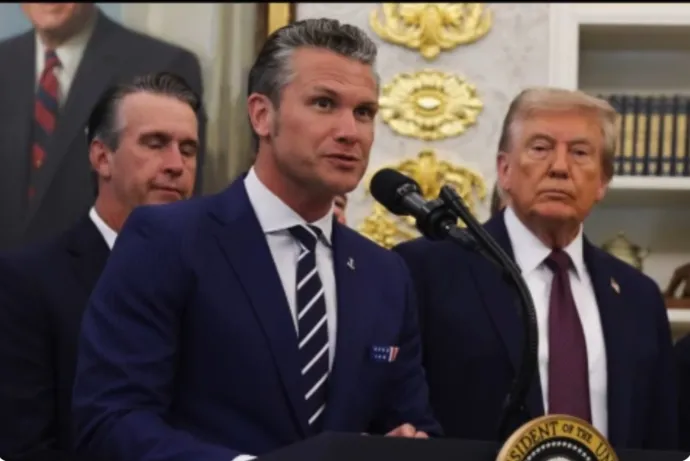
Defense Secretary Pete Hegseth has authorized the temporary deployment of up to 600 military lawyers to assist the Department of Justice by serving as immigration judges. According to an August 27 memo obtained by the Associated Press, the plan involves sending groups of 150 attorneys at a time, both military and civilian, with the first group to be selected and deployed imminently.
This decision aligns with the Trump administration’s broader use of military resources in its immigration crackdown. The military is already involved in various roles, including patrolling the U.S.-Mexico border, supporting immigration enforcement in cities, and using bases and aircraft for deportation operations. The deployment of lawyers aims to alleviate pressure on an immigration court system overwhelmed by a backlog of around 3.5 million cases.
The Justice Department made the formal request for help from the Pentagon. The memo notes that military attorneys may serve for up to 179 days, with the possibility of extension. However, this move has drawn significant criticism from immigration advocates and legal experts concerned about due process and legal qualifications.
100 immigration judges have recently left their positions due to dismissals or resignations. With only about 600 judges remaining, the deployment would effectively double the current workforce. Critics argue that using military lawyers with little to no immigration law experience could lead to unfair rulings and undermine the judicial process.
Ben Johnson, head of the American Immigration Lawyers Association, criticized the move, comparing it to assigning a cardiologist to perform orthopedic surgery. Former supervising judge Jennifer Peyton also questioned whether military attorneys could handle the heavy caseloads and complex legal issues typical of immigration courts.
There are also legal concerns regarding the Posse Comitatus Act, which restricts military involvement in domestic law enforcement. Officials have not clarified how this large-scale reassignment might impact the military justice system or where the attorneys would be sourced from.