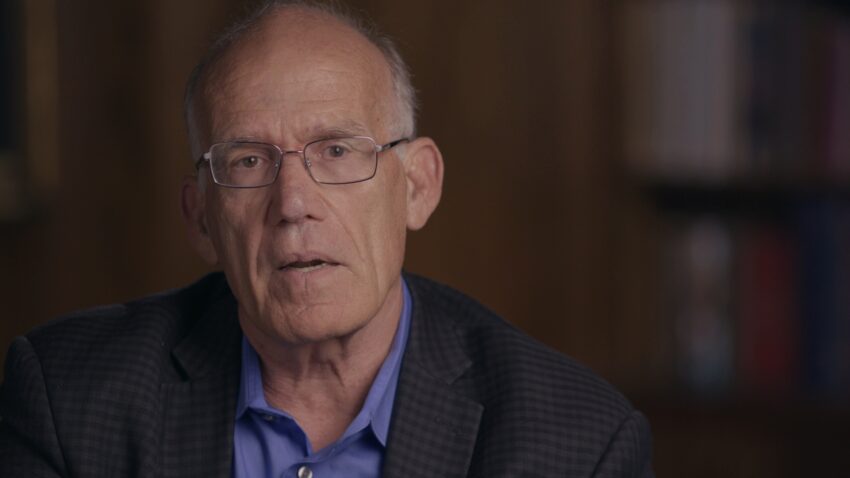
In recent years, historian and political commentator Victor Davis Hanson has argued that the Democratic Party is undergoing a profound collapse—one that, if not reversed, could bring devastating consequences for the
Hanson traces this shift to the Democratic embrace of globalization and technocratic economics. For decades, party leaders supported trade deals and environmental policies that encouraged the outsourcing of manufacturing jobs and the decline of industrial communities. While global corporations, Wall Street financiers, and Silicon Valley innovators profited immensely, traditional working- and middle-class Americans—especially those in the Midwest and South—saw their livelihoods evaporate. Hanson argues that the party’s new priorities created a “two-tiered America,” one in which elites thrive on information and finance, while millions of workers face economic insecurity and social decay.
Compounding this divide, Hanson believes, is the party’s growing commitment to identity politics and cultural radicalism. Rather than uniting Americans around shared values of citizenship and hard work, the Democratic Party increasingly emphasizes race, gender, and sexuality as the primary markers of social identity. In Hanson’s view, this shift alienates the middle class, which values stability, meritocracy, and community over ideological crusades. He warns that the obsession with “diversity, equity, and inclusion” has replaced practical governance with moral signaling, further eroding trust between ordinary citizens and political elites.
Immigration policy, too, serves as a flashpoint in Hanson’s analysis. He argues that the Democrats’ support for open borders and mass immigration has driven down wages for low- and middle-income workers while straining public resources such as housing, healthcare, and education. The traditional Democratic voter—the construction worker, factory employee, or small business owner—now finds himself competing with an influx of cheap labor, while party leaders dismiss his concerns as xenophobic or outdated. This, Hanson claims, represents a fundamental betrayal of the middle-class social contract.
The collapse of the Democratic Party, Hanson concludes, is not merely a partisan event but a national crisis. Without a major party championing middle-class interests—affordable energy, domestic industry, strong families, and secure borders—the economic and cultural foundations of America could unravel. Inflation, housing shortages, and rising crime rates are symptoms, he says, of a deeper sickness: the abandonment of common sense and working-class values in favor of elite ideology.
Ultimately, Hanson’s warning is both historical and moral. Great civilizations, he reminds us, collapse not because they are conquered from without, but because they rot from within. If the Democratic Party continues down its current path—favoring globalism over nationalism, ideology over pragmatism, and elites over the everyday citizen—the
WASHINGTON — The faint hum of Washington’s corridors of power has grown into a roar after what appeared to be a local, low-key congressional race turned into a dramatic flashpoint. In a contest settled by just 2,184 votes, the victory of Zohran Mamdani—once focused on New York politics—has now triggered calls for a federal investigation, raising tough questions about how America votes and why even small margins can deliver major consequences.
The certified totals show Mamdani winning roughly 260,194 ballots to his opponent’s 258,010, out of around 518,000 cast—a margin of just 0.42 percent. With nothing but 0.42 % separating winner from loser, analysts say the contest landed in the territory of “statistically fragile.” A handful of ballots here, a rejected batch there, and the result could have tilted the other way.
Enter John Neely Kennedy, U.S. Senator from Louisiana, who shocked the status quo when he publicly challenged the integrity of the count: “If those ballots were clean — prove it in court.” With that statement he injected federal-level attention into what had been a quiet, razor-thin margin in a largely local arena.
What triggered the alarm bells?
Several factors converged that raised red flags among election watchers:
One district reported unusually high absentee-ballot rejection rates, while later reinstatements wildly skewed in favor of the winner.
A mail-in vote surge arrived late in the count and strongly favored Mamdani.
One tabulation centre experienced a software glitch that delayed results by nearly nine hours.
Individually none of these items prove deliberate wrongdoing — but taken as a bundle, they painted a picture that Senator Kennedy described as failing the smell test.
Experts emphasise that when margins are this slim, even a small error or mis-calculation can flip the outcome. “When you’re dealing with a gap this narrow, a single miscounted precinct—or a handful of absentee ballots verified late—can change everything,” said election statistician Eleanor Shaw.
What happens now?
With the formal request filed for the U.S. Department of Justice and the Federal Election Commission to open an inquiry, the implications could ripple far beyond this one race. Should investigators find irregularities significant enough to affect the outcome, the result could face a recount or even a rerun in key precincts. Such upheaval would be legally and politically explosive.
Mamdani’s camp responded by rejecting the challenge as politically motivated theatre. “We won fair and square,” they asserted, noting the results have already been certified. But behind the public posture, some in his own party express concern about how the optics of a 0.42 % win might affect his early tenure—and what a drawn-out challenge could mean for voter confidence.
Why this matters:
This case isn’t just about one seat. It lands at the intersection of three major fault-lines:
The trustworthiness of mail-in and absentee ballots;
The transparency and reliability of electronic tabulation systems;
The appropriate role of federal oversight in local races.
If a race decided by two thousand votes becomes the national story, the message is loud and clear: democracy’s machinery isn’t just big-picture rhetoric. It spins in the details. If Americans start doubting the count, the consequence isn’t simply one seat lost—it’s a legitimacy deficit that works its way into every election.
Voters on both sides are already reacting. One retired teacher in Louisiana put it simply: “I don’t care who won. I just want to know it was fair.” Meanwhile, supporters in New York rallied behind Mamdani with signs declaring: “Counted. Certified. Closed.” But closed doesn’t always mean resolved.
What lies ahead:
Legal experts say the inquiry could stretch into weeks or months. If misconduct of sufficient magnitude is found, a special judicial panel may order a re-tabulation or even a fresh vote for parts of the district. Even if the certified winner stands, repair work on public faith begins immediately.
“This isn’t just about someone stealing an election,” said political historian James Holloway. “It’s that millions of Americans now believe someone might have—and that’s how democracies start to unravel.”
As night fell over the Capitol, Senator Kennedy walked into the dark without speaking. A reporter shouted after him: “Do you really think the election was stolen?”
Kennedy paused before answering: “I think the truth is out there. And I think it’s our job to find it—before someone buries it.”
Thank you for reading this post, don’t forget to subscribe!
A colossal elevated highway begins to shudder and collapse high above the ground. Concrete cracks thunder through the air as entire sections tilt and break apart. An evacuation team in orange vests and helmets scrambles for their lives—some sprinting across the lower roadway, others dangling from scaffolding and rescue baskets as cranes swing frantically into position. Dust clouds rise, steel bends, and the atmosphere turns chaotic as the towering structure threatens to come crashing down. The scene is filled with panic, urgency, and cinematic disaster intensity.
A major highway under construction shows alarming structural failure. Large cracks appear in the elevated roadway while dust and debris begin to fall. The evacuation team, dressed in orange vests and helmets, immediately begins escaping—workers on the ground run toward safety while those on scaffolding and lifts descend quickly. Cranes and construction equipment stand by as the highway shakes. The scene captures the tense, real-life urgency of trained workers evacuating before a catastrophic collapse.
In this Aug. 5, 2007 photo, vehicles are strewn amongst the wreckage of Interstate 35W bridge which collapsed over the Mississippi River in Minneapolis. Tuesday, Aug. 1, 2017 marks the ten-year anniversary of the disaster killed 13 people and injured 145. (AP Photo/M. Spencer Green, File) (Copyright 2017 The Associated Press. All rights reserved.)
MINNEAPOLIS – Ten years ago Tuesday, a bridge carrying a busy stretch of freeway collapsed without warning into the Mississippi River in downtown Minneapolis during the evening rush hour. Many leaders saw the disaster, which killed 13 people and injured 145, as a wake-up call about the country’s deteriorating infrastructure.
Here’s a look at what happened, what’s changed since then, and how Minnesota is marking the anniversary:
THE COLLAPSE
The Interstate 35W bridge was one of the busiest in Minnesota before it fell Aug. 1, 2007.
First responders scrambled to rescue survivors from the debris, including a school bus carrying 52 students and several adults. Navy divers spent two weeks recovering bodies from dark waters full of sharp steel. Federal investigators stayed for months. A fast-tracked replacement opened less than 14 months later.
The state and two contractors ultimately paid out more than $100 million to survivors and families of the dead. Most used the money to cover medical bills and get on with their lives. One young survivor from the bus used much of his money in 2014 to travel to Turkey and Syria to join the Islamic State group. He’s still believed to be in Syria.
THE CAUSE
While the collapse drew attention to the condition of America’s aging infrastructure, federal investigators said poor maintenance wasn’t the chief cause. They ruled it was a design defect in the bridge, which was built in the 1960s.
The National Transportation Safety Board said that crucial gusset plates that held the bridge’s beams together were only half as thick as they should have been. A contributing factor was the nearly 300 tons of construction materials stockpiled on the deck for renovations.
The 35W bridge had been rated “structurally deficient,” a term that means in need of repair or replacement, before it fell. It was also “fracture critical,” which means bridges at risk of collapse if a single, vital component fails. While neither category means there is an immediate safety threat, they are red flags.
Emergency personnel work at the scene where the Interstate 35W bridge collapses over the Mississippi River in Minneapolis. (AP)
WHAT CHANGED
The American Society of Civil Engineers says the number of structurally deficient bridges nationwide declined from 12 percent in 2007 to 9 percent today. Minnesota improved from 8 percent to 6 percent, according to the group’s latest report card on the country’s infrastructure. The figures ranged from 2 percent in Nevada to 25 percent in Rhode Island. The report card still estimates it would take $123 billion to address the nation’s backlog of bridge rehabilitation needs.
The improvements happened because states stepped up, said Andy Hermann, a former president of the society and one of its experts on bridges. He said federal funding has been “pretty stagnant,” but about 20 states raised taxes to increase their bridge spending.
Minnesota launched a 10-year, $2.5 billion improvement program in 2008 that targeted 172 structurally deficient or fracture-critical bridges. About 120 of them have been replaced or repaired, or will be soon. Another 32 need only routine maintenance. Most of the rest will be repaired or replaced by late 2018. And the state now requires a formal independent peer review during the design phase for major bridges to minimize the risk of critical errors.
The collapse gave added impetus to a nationwide trend of design improvements, Hermann said. Most bridges built in the 1950s and 60s were designed to last around 50 years, he said. Newer bridges are typically designed to last 75 to 100 years, he said. Engineers are also choosing improved materials, he said, such as better steel and concrete.
The collapse also turned a new focus on inspection. Bridges typically are inspected every two years, but Congress has mandated a more data-driven approach that will mean more frequent inspections for some, and longer intervals for others, to focus resources on the biggest risks. That plan is still in rulemaking.
THE FUTURE
It’s unclear whether anything will come from President Donald Trump’s proposal for a $1 trillion overhaul of the country’s roads and bridges. While he held a week of events last month to tout the idea, he has yet to flesh out the details and it hasn’t gained much traction in Congress. His budget proposal calls for $200 billion in tax breaks over nine years that theoretically would leverage $1 trillion worth of construction.
This file photo shows one of the failed gusset plates blamed for the Aug. 1, 2007 collapse of the Interstate 35W Bridge in downtown Minneapolis. (AP)
THE ANNIVERSARY
Minneapolis is taking a low-key approach. Leaders will hold a ceremony for survivors, families and first responders at the city’s Emergency Operations Training Facility, several miles upstream from the collapse site, where a piece of the bridge will be installed permanently outside.
The Hennepin County Sheriff’s Office, which led much of the response, held a wreath-laying ceremony earlier in July on the river with Navy divers who participated in the recovery.
And the Mill City Museum, just a few blocks upstream from the site, opened a display July 28 of one of the failed gusset plates.