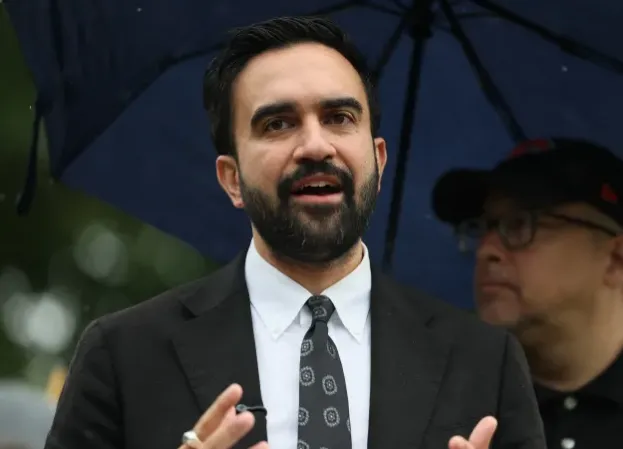
The wheels are coming off the socialist bus.
New York Gov. Kathy Hochul is tapping the brakes on Mayor-elect Zohran Mamdani’s $700 million plan for free city buses, casting early doubt on one of the far-left lawmaker’s biggest campaign promises, The New York Post reported.
Speaking at the SOMOS political retreat in Puerto Rico on Saturday, Hochul said she’s already spent heavily to support the city’s struggling MTA and questioned how much further the state could go.
“I continue to be excited at the work of making the slowest buses in America fast and free,” Mamdani said Monday during an unrelated press conference. “And I appreciate the governor’s continued partnership in delivering on that agenda of affordability.”
But Hochul’s comments in San Juan marked the latest break between the moderate Democratic governor and Mamdani, the Democratic socialist she endorsed just two months ago.
Hochul happily rode Mamdani’s coattails during the campaign as he energized progressives with promises of affordability and social programs, but she has shown far less enthusiasm for actually paying for them.
The governor has rejected several of Mamdani’s cornerstone ideas, including proposals to raise taxes on wealthy New Yorkers to fund $10 billion in new benefits like free child care and fareless transit.
Her caution could create a serious roadblock for the incoming mayor, whose ambitious plans rely on support from Albany to move forward.
The top two Democratic leaders in the state Legislature — Assembly Speaker Carl Heastie and Senate Majority Leader Andrea Stewart-Cousins — have signaled more willingness to help Mamdani pursue his agenda.
That divide leaves Hochul increasingly isolated from the party’s energized left flank, which has been openly pressuring her to embrace higher taxes on the rich.
During recent public appearances, activists have twice interrupted the governor with chants of “Tax the rich,” drawing a sharp rebuke.
“The more you push me, the more I’m not going to do what you want,” Hochul told the SOMOS crowd in response.
Still, Hochul did not fully reject Mamdani’s wish list.
She said she’s open to working with him on expanding free child care, though she made clear it would be an expensive and long-term goal.
“We’ll be on a path to get there, because I’m committed to this as ‘mom governor’ — I get it,” Hochul said.
“But also to do it statewide, right now, it’s about $15 billion — the entire amount of my reserves.”
The cautious tone was a reality check for Mamdani, who has portrayed himself as the champion of “everyday New Yorkers” and promised to make the city more affordable through massive new public spending.
Hochul’s remarks also came as she continues her own political maneuvering ahead of a likely 2026 re-election bid.
After the SOMOS conference, she flew to the Dominican Republic to attend a breakfast celebrating cross-cultural exchange — an event seen as an appeal to one of New York’s largest and most influential immigrant voting blocs.
Hundreds of thousands of New Yorkers trace family roots to the Dominican Republic, making the outreach a politically savvy move for a governor seeking to rebuild her base while keeping the party’s left wing at arm’s length.
Whether Hochul and Mamdani can maintain their uneasy alliance may determine not only the future of free buses and child care, but also the balance of power within the New York Democratic Party.
Supreme Court Justice Elena Kagan, considered one of the Court’s liberal voices, denied an emergency appeal from a Mexican family facing deportation, siding with the Trump administration.
The family, who fled cartel threats in Guerrero, Mexico in 2021, claimed they risk death if forced to return. Despite detailed evidence of cartel violence, immigration courts denied their asylum claim. Kagan declined to block their removal, choosing not to refer the case to the full Court.
Meanwhile, legal analyst Kerri Urbahn criticized Chief Judge James Boasberg’s handling of another deportation case, calling his actions “desperate” after the Supreme Court vacated his order. The case involved a deported MS-13 gang member whose return Boasberg demanded despite the Court ruling it belonged in Texas, not Washington, D.C.
SE E MO RE
In a highly anticipated legal move, President Donald Trump has filed a powerhouse appeal to New York’s Appellate Division, challenging his conviction in the Manhattan District Attorney Alvin Bragg’s case.The appeal comes after months of legal battles and millions in taxpayer dollars spent on prosecuting Trump over thirty-four felony charges related to “falsifying business records,” a case that legal experts from across the political spectrum have repeatedly criticized as weak and politically motivated.Now,
Trump is determined to turn the tables, calling Bragg’s case “the most politically charged prosecution in our Nation’s history.” The appeal, which spans an impressive 111 pages (some reports list it at 96 pages), blasts Bragg’s case as nothing more than “Radical Democrat Lawfare.”Trump’s legal team argues that the entire case, which centers on alleged hush-money payments to a former adult film star, is built on a flawed legal foundation.In the filing, Trump’s legal team insists that the charges should be dismissed, citing the U.S. Supreme Court’s decision on presidential immunity, federal and state constitutional protections, and established legal precedent. The appeal is a direct response to what Trump’s team describes as a politically motivated assault on the President.
“The Supreme Court’s historic decision on Immunity, the Federal and New York State Constitutions, and other established legal precedent mandate that this meritless hoax be immediately overturned and dismissed,” a spokesman for Trump’s legal team said in a statement to Fox News Digital.“President Trump will keep defeating Democrat weaponization at every turn as he focused on his singular mission to Make America Great Again.” The Manhattan DA’s case, which was launched over a year ago, hinges on the payments made during Trump’s 2016 presidential campaign to silence allegations from Stormy Daniels, the adult film actress.
The case, however, has been widely criticized as weak because such financial transactions—while controversial—are far from unusual in the corporate world.Non-disclosure agreements (NDAs) are commonly used in various industries to protect privacy and silence accusations, making it difficult for prosecutors to argue that Trump’s actions were criminal.Despite these facts, Bragg and his office pressed forward, framing the case as one of felony-level criminal conduct. The charges involve accusations that Trump falsified business records related to these payments, with Bragg asserting that the records were altered to conceal the true nature of the transactions.
In New York, falsifying business records is typically classified as a misdemeanor, but Bragg argued that the charges should be elevated to felonies because they allegedly were part of a broader crime, one that remains unspecified. The court, however, ruled that this approach was valid, leading to Trump’s conviction.Yet, even legal experts who are not aligned with Trump have voiced skepticism about the case. Many have pointed out that Bragg’s case fails to meet the legal threshold for felony charges and is built largely on speculative claims.It is rare for such corporate transactions to be elevated to felony offenses, and many legal analysts believe Bragg’s case is based on a broad and unsubstantiated interpretation of the law.
For Trump’s supporters, the charges are simply a tool to undermine his political influence and distract from his successes during his presidency.“Bragg’s case was shaky from the very beginning,” said Rep. Claudia Tenney (R-NY), who has been a vocal critic of the prosecution. “This is about weaponizing the justice system to target a political opponent.These payments are not inherently illegal. They happen in corporate America every day.” Tenney’s comments reflect widespread Republican sentiment that the charges against Trump are politically motivated, an extension of the larger effort by Democrats to weaken his influence and prevent his return to power.