The Trump administration has drawn a clear line between responsible journalism and political espionage. On Friday, President Donald Trump’s White House officially barred reporters from accessing a key section of the West Wing—known as the
The move follows mounting evidence that members of the mainstream media had been eavesdropping on private cabinet discussions and secretly recording sensitive material.
For years, the so-called “press freedom” crowd has used their credentials as a license to invade privacy, twist quotes, and undermine the President’s agenda. But under Trump’s leadership, that era of unchecked access and deep-state leaks appears to be ending.
The new order, issued by the National Security Council and enforced by White House Communications Director Steven Cheung, states that no reporter may enter the Upper Press without an appointment. The memo cited “the protection of sensitive material from unauthorized disclosure,” an objective most Americans would find not only reasonable but essential.
Cheung, known for his no-nonsense defense of the administration, revealed that this decision wasn’t made lightly. “Cabinet secretaries were being ambushed and secretly recorded by reporters lurking outside private offices,” he said. “It’s an unacceptable breach of trust.”
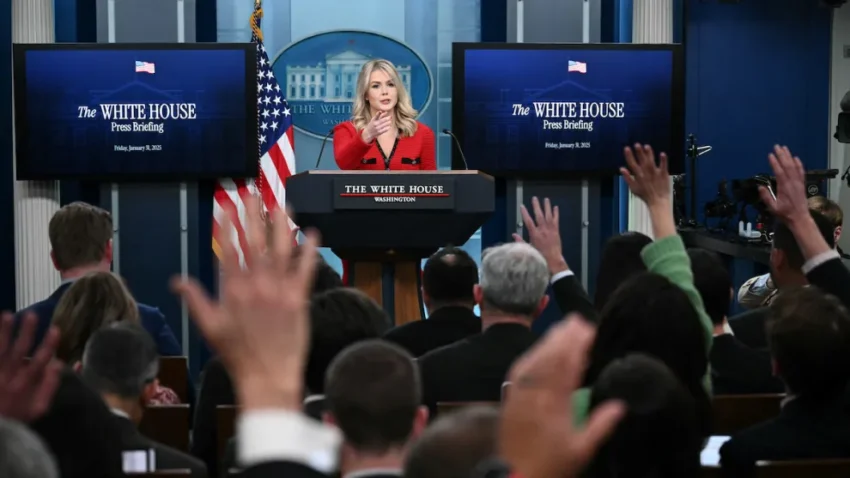
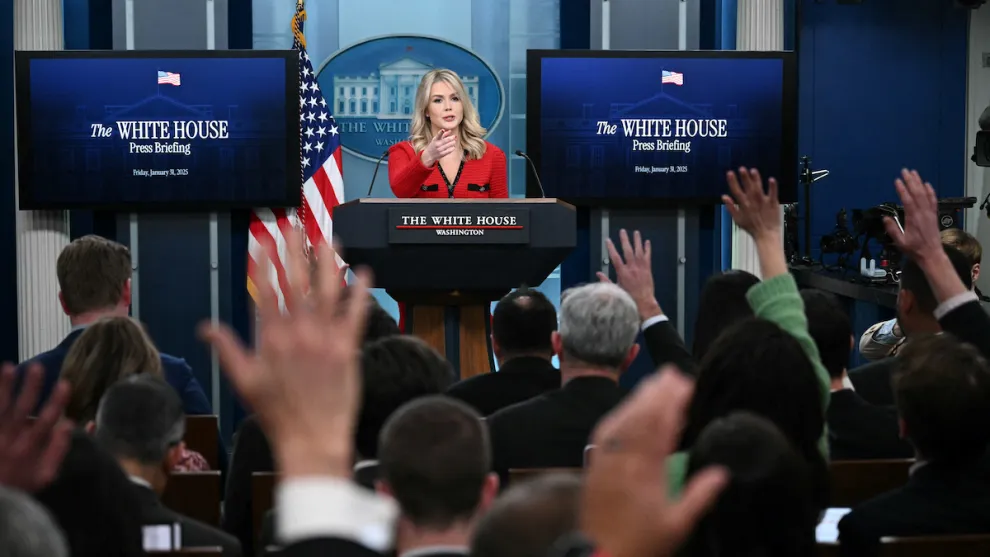
White House Press Secretary Karoline Leavitt, one of the most dynamic figures in the administration, has become a target for left-leaning journalists desperate to manufacture controversy. Sources confirm that several mainstream reporters were caught “hovering” near her office door—listening in during confidential cabinet meetings.
Cheung posted on X, formerly Twitter, that some of these reporters had even taken unauthorized photos of classified briefing materials. “We’ve had to chase reporters down who started strolling into restricted areas towards the Oval. Total absence of boundaries,” he wrote.
This isn’t a crackdown on the free press—it’s a defense against a press that’s gone rogue. For too long, major outlets like CNN, The Washington Post, and The New York Times have blurred the line between journalism and sabotage. Trump’s team is drawing that line again.
The new restrictions apply only to the Upper Press, the area adjacent to the Oval Office and Press Secretary Leavitt’s workspace. Journalists will still have full access to the Lower Press section near the briefing room. That means legitimate reporting isn’t being silenced—it’s being held to professional standards.
The decision follows other necessary reforms implemented by the Trump administration to restore order and discipline in government communication. Earlier this month, several outlets—including AFP—refused to comply with updated Pentagon press guidelines designed to protect classified material.
Rather than adapt, these same outlets are now crying “censorship.” But the reality is simpler: President Trump is putting national security above media theatrics.
For years, legacy media have operated like a political class of their own—waltzing through restricted areas, pestering staff, and mining private conversations for clickbait. When Trump first took office in 2017, he promised to expose the rot in Washington. Now, with his return to the White House, he’s making good on that promise once again.
Insiders say that the National Security Council’s new structure, which Trump placed under the leadership of Secretary of State Marco Rubio, has increased the sensitivity of information handled in the West Wing. The need for tighter access is both logical and overdue.
The incident that triggered this move reportedly occurred after reporters were caught eavesdropping during a closed-door meeting with Leavitt and a visiting cabinet member. Witnesses claim the individuals were literally pressing their ears to the door—an act that would be unthinkable under any prior administration.
“This isn’t journalism; it’s espionage,” one senior official remarked privately. “If any conservative reporter had pulled something like that during the Obama years, they’d have been escorted out in handcuffs.”
The media’s meltdown over the new rule only exposes their arrogance. For decades, they’ve acted as though the White House was their playground. But under Trump, the people’s house is once again being protected for the people—not the pundits.
Leavitt herself has taken the attacks in stride. A rising star within Trump’s circle, she has faced relentless harassment from leftist journalists since stepping into the role. Despite that, she continues to deliver sharp, confident briefings that highlight the administration’s achievements—from freeing American hostages to restoring order on the southern border.
Many conservatives have applauded the move, saying it’s about time the White House stopped rewarding bad behavior. “If you can’t respect basic security rules, you don’t belong anywhere near the President’s staff,” one commentator said on Truth Social.
Meanwhile, liberal reporters are crying foul, framing their restriction as an “attack on democracy.” But Americans aren’t buying it. Polls show record-low trust in mainstream media, with many citizens agreeing that the press has become little more than a propaganda arm for the left.
Trump supporters see this as another victory in the fight to drain the swamp—not just in government, but in journalism. As one viral post put it: “They spied, they lied, and now they’ve been denied.”
CNN’s “Inside Politics,” host Dana Bash pushed House Minority Leader Hakeem Jeffries aggressively on the ongoing government shutdown and questioned his party’s role in resolving the impasse.
Bash repeatedly challenged Jeffries’s narrative that Democrats were ready to negotiate, suggesting instead that the real paralysis lay within Democratic leadership’s own demands.
At one point, Bash pressed Jeffries: “You say you want to talk, but Speaker Johnson apparently hasn’t been given permission to meet with you — have you tried knocking on his door, walking down the hall?”
Jeffries responded that Republicans had cut off communication, arguing that informal meetings would not be fruitful without willingness on the part of congressional leadership.
But Bash would not let the exchange end there.
She pressed whether the Democratic proposal — which included extending Affordable Care Act subsidies and reversing GOP healthcare cuts — was negotiable, or whether it was a nonstarter.
Jeffries maintained that Democrats remained open to bipartisan solutions but insisted Republicans had gone “radio silent.”
The tension escalated when Bash framed a question in a blunt, almost confrontational tone: “You could probably take a few steps… have you tried that?”
At several junctures, Bash’s questioning seemed designed to corner Jeffries into accountability, undermining his attempt to shift blame entirely to Republicans.
She also raised the inconsistency of Jeffries’s position, pointing out that what he called “negotiable” may not actually be open to compromise if Democrats hold firm on all their demands.
Jeffries attempted to shift the blame back, saying Republicans had repeatedly tried to repeal the ACA and were unwilling to extend subsidies without structural changes.
Bash followed up by asking whether he would support a one-year extension of those subsidies if Republicans would allow it.
Jeffries demurred, saying he was not ready to accept that narrow fix without broader action.
Through the interview, Bash adopted a skeptical posture toward Jeffries’s narrative — something that conservatives seized on as evidence that even legacy media are now pushing back harder on Democratic talking points.
Conservatives applauded Bash’s refusal to act as a passive conduit for official messaging. One commentator called the moment a turning point in media deference.
Social media users echoed the sentiment: “Even leftist CNN’s Bash shuts down Jeffries’ shutdown whine — caught off guard with brutal challenge.”
The exchange also undercut Jeffries’s argument that Democrats were trying to negotiate in good faith.
Bash sought to expose whether those overtures were real or rhetorical cover.
From a conservative vantage, this marked a welcome line of questioning from mainstream media — one that forces Democratic leaders to defend their posture rather than allowing them to dominate the narrative unchallenged.
The interview ended without a clear breakthrough, but the dynamic was telling: more pressure on Jeffries, less room for him to stick to the standard talking points.
In the coming days, this exchange may be referenced by Republicans as evidence that Democratic leaders aren’t being upfront about what they’re willing or unwilling to give up in negotiations.
Authorities Raid Soros-Backed Groups in India Over Foreign Funding Scandal
In a major enforcement action, India’s Enforcement Directorate (ED) launched raids on eight premises in Bengaluru, including offices associated with George Soros’ Open Society Foundations (OSF) and its investment arm, the Soros Economic Development Fund (SEDF), over alleged violations of the Foreign Exchange Management Act (FEMA).
Scope of the Investigation
The ED is investigating claims that these entities channeled foreign funding into Indian NGOs and companies through unlawful means. Authorities have alleged the usage of FDI and consultancy fee structures to bypass restrictions imposed by the Ministry of Home Affairs since 2016, which required prior approval for foreign contributions.
One source indicated that the funding was funneled via Indian subsidiary firms and service-fee mechanisms without adequate provisioning of actual services, raising suspicion of disguised donations.
Targeted Entities
Among the entities under scrutiny are several NGOs and M/s Aspada Investments Pvt Ltd, an Bengaluru-based company reportedly tied to the investment advisory role for SEDF’s Indian operations.
Investigators have reportedly traced millions of rupees in funding to various Indian companies between 2020 and 2024, including funds given under labels such as commission agent services and service fees—even where the delivery of such services remains unsubstantiated.
Examples include transfers of ₹2.7 crore and ₹2.9 crore to separate firms, suspected to have served as conduits for NGO funding, rather than genuine service fees.
Legal and Political Context
The ED’s actions reflect heightened scrutiny of foreign-funded NGOs and civil society organisations in India. The Prior Reference Category status imposed on OSF in 2016 has been highlighted as a legal basis for the investigation, suggesting non-compliance with prior home ministry approvals.
Opposition parties and civil society observers may raise concerns over transparency in enforcement and potential political motivations, as past controversies have included allegations by the ruling party regarding foreign entities exerting influence over national political narratives.
Next Steps
The ED is reportedly investigating the end use of FDI and foreign funds, assessing whether the FEMA provisions were violated by multiple intermediary companies and NGOs.
As the investigation unfolds, stakeholders—including NGOs, regulatory agencies, and political entities—are expected to respond to the findings. OSF and SEDF have not publicly commented at the time of reporting.
In a gripping Senate hearing that felt more like a high-stakes duel, Senator John Kennedy of Louisiana faced off against former First Lady Michelle Obama, who mocked his law degree and questioned his relevance in today’s fast-paced political landscape. What began as a pointed attack quickly turned into a masterclass in composure and authority as Kennedy delivered a response that left the room—and viewers—captivated.
The tension in the Senate chamber was palpable as Michelle, known for her eloquence, leaned into her critique. “I find it curious that someone with your, shall we say, dated law degree thinks they can lecture us on the complexities of modern policy,” she challenged, her words designed to provoke. The atmosphere crackled with anticipation as reporters and aides leaned in, ready to document what many expected to be a decisive moment in the hearing.
However, Kennedy’s calm demeanor and strategic silence spoke volumes. Instead of reacting with anger or defensiveness, he took a measured approach. He calmly recounted a poignant story about a small-town case that showcased his dedication to serving others, emphasizing that it was not the age of his degree that mattered, but the impact of his work. “It’s not the age of a degree that matters, but what you do with it,” he stated, shifting the focus from personal attacks to the broader theme of service and results.
As Michelle attempted to regain momentum, Kennedy introduced a video clip of her own words from a recent fundraiser, where she praised hardworking individuals who earned their success through grit and determination. “Now, ma’am, that sounds an awful lot like the kind of story you were praising, doesn’t it?” he quipped, exposing the irony in her earlier critique. The room erupted in murmurs as the crowd processed the contradiction, and Kennedy’s ability to turn the tables became evident.
With each exchange, Kennedy’s quiet strength and preparation shone through. He articulated that true leadership isn’t defined by credentials but by the genuine work done for the community. “Big ideas are only as good as the folks they help,” he said, reminding everyone that listening and understanding the needs of the people are paramount.
The atmosphere shifted dramatically as Kennedy’s narrative resonated with the audience, transforming the hearing from a personal clash into a broader discussion on integrity and service. Reporters, initially poised to crown Michelle the victor, began to scribble notes about Kennedy’s composed responses, framing him as a man who had proven himself time and again in the courtroom and beyond.
As the hearing progressed, it became clear that Kennedy had not only defended his position but had also redefined the conversation around leadership in a way that left a lasting impact. The room buzzed with a newfound respect for the senator, a testament to the power of experience, resilience, and the ability to turn challenges into opportunities.
In the end, this Senate showdown was not just about a law degree or political ideologies; it was a powerful reminder that true leadership lies in the work done for others, the stories shared, and the integrity upheld. As the world watched, Senator John Kennedy emerged not just as a contender in a political debate, but as a symbol of enduring strength and commitment to service.