House Speaker Mike Johnson revealed on Tuesday that Democrats are demanding billions in wasteful and ideological spending, including $3.9 million for LGBTQI+ democracy grants in the Western Balkans, as part of their conditions to reopen the government.
Speaking on the 14th day of what he called the Democrat government shutdown, Johnson said the American people are suffering because Democrats have chosen politics over responsibility.
“Welcome to day 14 of the Democrat government shutdown,” Johnson said during his press briefing. “It’s two weeks of Democrats in Congress inflicting untold pain on the American people for nothing other than pure politics.”
Johnson explained that House Republicans had already offered a clean continuing resolution to keep the government funded, but Democrats repeatedly rejected it.
Instead, he said, Democrats are tying unrelated left-wing priorities to essential government operations in an attempt to strong-arm Republicans into approving radical spending measures.
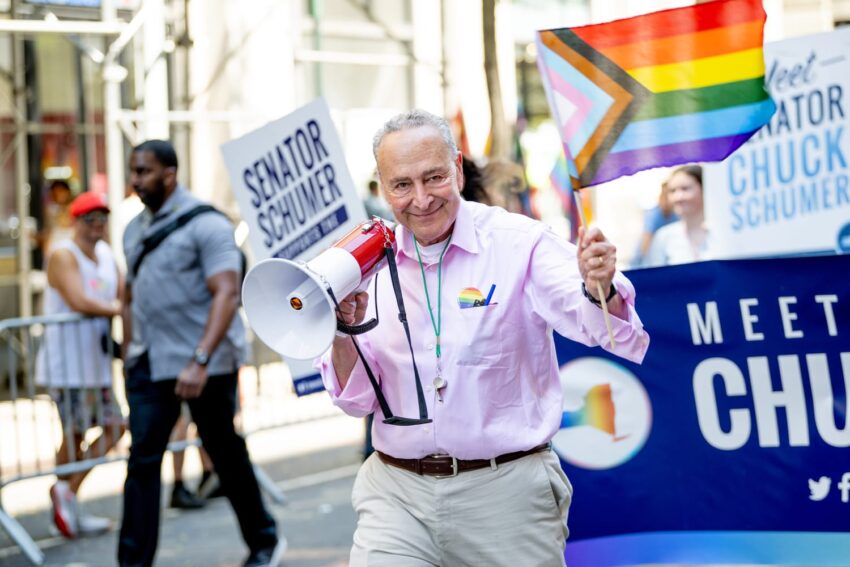
He accused Senate Minority Leader Chuck Schumer of catering to what he described as the party’s “Marxist base.”
The Speaker laid out details from the Democrats’ counterproposal, calling it a $1.5 trillion wish list of reckless spending that would send taxpayer money to liberal causes and foreign projects that have nothing to do with running the U.S. government.
Among the examples he cited were $24.6 million for climate resilience programs in Honduras.
Another $13.4 million would go to civic engagement programs in Zimbabwe.
An additional $2.9 million is earmarked for desert locust risk reduction in the Horn of Africa.
The Democrats’ plan also calls for $2 million to fund “organizing for feminist democratic principles” in Africa, according to Johnson.
Johnson highlighted the $3.9 million in LGBTQI+ democracy grants for the Western Balkans as an example of Democrats’ misplaced priorities.
“They want to spend 3.9 million of your hard-earned dollars for LGBTQI+ democracy grants in the Western Balkans,” Johnson said. “We are not doing that.”
He argued that Democrats are also trying to undo common-sense reforms enacted by Republicans that prevent illegal immigrants from accessing taxpayer-funded healthcare.
“This is a fact,” he said. “They would add illegal aliens and non-citizens back to taxpayer-funded benefits. It would cost taxpayers nearly $200 billion.”
Johnson further warned that Democrats want to roll back modest work requirements placed on able-bodied young men without dependents.
At the same time, Democrats are pushing to make COVID-era Obamacare subsidies permanent, with no income limits or meaningful reforms.
Johnson said this approach would not only punish working Americans but also reward dependency and mismanagement.
The Speaker accused Democrats of prioritizing ideological projects over the immediate needs of the American people.
He said their proposal exposes how out of touch the party has become, highlighting spending for causes abroad while Americans face uncertainty at home.
“This is not about keeping the lights on,” Johnson said. “This is about Democrats trying to use the shutdown as leverage to fund their far-left agenda.”
Johnson reminded reporters that Republicans have already passed legislation to reopen the government responsibly, without any of the unrelated political riders Democrats insist on including.
The Republican plan, he said, would maintain government operations, protect taxpayers, and prevent wasteful spending abroad.
Johnson also pointed out that the Democrats’ proposal would restore funding to the Corporation for Public Broadcasting, sending a half-billion dollars to what he described as liberal media outlets that have long benefited from taxpayer subsidies.
He described it as another example of Democrats using government funding to reward their political allies rather than serving the public good.
“These are not the priorities of the American people,” Johnson said firmly. “They are the priorities of a radical political class that has forgotten who they work for.”
The Speaker ended his remarks by calling on Democrats to stop the political games and join Republicans in reopening the government immediately.
“We have a clean bill ready to go,” he said. “It keeps the government open, pays our troops, secures the border, and protects hardworking taxpayers. Democrats need to stop holding America hostage.”
Johnson’s comments reflect growing frustration among House Republicans who say Democrats are using the shutdown to push through spending on social experiments, foreign projects, and activist groups under the guise of government funding.
He warned that such spending will only deepen America’s fiscal crisis and fuel public anger toward Washington’s political class.
“This is a moment for leadership,” Johnson concluded. “It’s time to put the American people first and end this shutdown—not by giving in to woke demands, but by standing firm for fiscal sanity and common sense.”
It started as a routine interview between Transportation Secretary Pete
Buttigieg and Senator John Kennedy.
The topic was mundane enough — infrastructure, spending, policy priorities.
“Maybe you should do your homework, Senator.”
The room chuckled. Even the CNN panel laughed nervously, thinking it was a harmless
quip. But viewers at home knew – that was a big mistake.
Kennedy didn’t react right away. He didn’t raise his voice, didn’t flinch.
He simply looked at Buttigieg- calm, expressionless and waited.
Then, just seconds later, he delivered the line.
“YOU PICKED THE WRONG SENATOR TO MESS WITH.”
The laughter stopped. The room fell dead silent.
And in that silence – Kennedy’s words hit like a thunderclap.
The cold, calculated comeback
Kennedy didn’t stop there. He started listing his record – steady, confident, word
by word.
His years as a prosecutor. His decades in public service. The bills he authored.
The reforms he pushed through.
Each line was a dagger wrapped in politeness.
Each fact – a reminder that he wasn’t someone you could mock without consequence.
Jake Tapper glanced at his notes, visibly thrown off. Buttigieg tried to smile, but the
air had shifted.
The once-smug energy vanished, replaced by an unmistakable tension.
And then Kennedy delivered the finishing blow:
“Facts don’t care about clever lines.”
No yelling. No theatrics. Just truth delivered like a punch in slow motion.
That’s when the Internet erupted.
The viral moment that shook social media
Within minutes, the clip flooded every platform. #KennedyClapback trended on X
(Twitter).
YouTube shorts replayed the “mic-drop moment” millions of times.
Reddit threads dissected the exchange frame by frame.
etirement
One user wrote:
“Kennedy didn’t even raise his voice. That’s how you destroy someone —
with class.”
Another commented:
“That’s not politics. That’s art.”
By the next morning, the clip had over 10 million views, making it one of the
most-watched political exchanges of the year.
Some called it “the best political comeback in recent memory.” Others said,
“Buttigieg walked into a fight he couldn’t win.”
But everyone agreed — Кепnedy had just given a masterclass in calm retaliation.
Kennedy’s art of composure
What made this moment powerful wasn’t just what Kennedy said — it was how he said
it.
No anger. No rush. Just composure so steady it felt dangerous.
In an era where politicians shout to dominate airtime, Kennedy proved that silence
— paired with precision — is deadlier.
His demeanor reminded everyone of an old-school statesman — someone who didn’t
need to perform to make a point.
He let his record, and his timing, do the talking.
It wasn’t arrogance. It was control.
And that’s what truly unnerved everyone watching.
As one commentator put it:
“Kennedy doesn’t fight noise with noise. He fights chaos with calm — and
that’s terrifying.”
The reactions — praise, criticism, and awe
Major outlets picked up the story within hours. The Hill called it “a masterclass in political composure.” Politico ran the headline:
“Pete Buttigieg took a shot — but Kennedy turned it into his moment.”
Even Kennedy’s critics couldn’t deny it: the senator had owned the room. He didn’t just win the exchange; he owned the narrative. Political strategist Emma Vance wrote on X:
“Thats how you win the optics game. Don’t yell. Don’t defend. Just flip the frame and make the other guy look like he lost control.”
And that’s exactly what Kennedy did.
The anatomy of a viral clapback
In today’s media landscape, where attention spans are measured in seconds, Kennedy’s response hit every mark. It was:
Short.
Memorable.
Sharable.
Emotionally satisfying.
He didn’t deliver a speech — he dropped a soundbite that could live on its own. And that’s why it went viral.
For millions of people scrolling through feeds, Kennedy’s line became the embodiment of “cool power.” It wasn’t about party lines anymore — it was about confidence.
People love a moment when someone stands their ground without losing their calm. Kennedy gave them exactly that
Politics as performance
Let’s face it: politics today is as much about moments as it is about policy.
Every debate, every interview, every hearing — it’s all content waiting to go viral.
And Kennedy knows how to play that game better than most.
While Buttigieg tried to go witty, Kennedy went surgical.
He didn’t aim to win the argument – he aimed to own the moment.
And he did. By the time the segment ended, nobody remembered the original
question.
All they remembered was that one chilling line — and the stunned silence that
followed.
In the theater of modern politics, Kennedy had just delivered a performance for the
ages.
Why it worked
Kennedy’s words worked because they carried truth, ego control, and timing.
He didn’t let emotion take over — he used restraint as a weapon.
It’s something few politicians manage to do in front of live cameras.
That’s why people shared it.
It wasn’t just entertainment — it was a demonstration of poise and dominance.
When asked later about the exchange, a Kennedy staffer reportedly said:
“The Senator doesn’t do viral. He just tells the truth — and people decide
what to do with it.”
Whether planned or instinctive, that’s exactly what the world saw: a calm man
dismantling arrogance in real time.
The legacy of a line
By the end of the week, “You picked the wrong senator to mess with” had become
more than just a comeback – it became a quote.
Printed on memes. Used in edits. Turned into headlines.
A symbol of sharp composure in a noisy world.
What Kennedy showed wasn’t just quick wit – it was discipline under pressure.
He turned a potential embarrassment into a defining moment.
And he did it without losing control of his tone, or his temper.
In the end, that’s what makes the line unforgettable.
It wasn’t just a retort – it was a statement of dominance.
One sentence. One silent pause.
And the whole Internet lit up.