In the ebb and flow of American politics, few institutions stand as tall—or as contested—as the United States Supreme Court. Over the years, it has been both a guardian of constitutional rights and a lightning rod for political controversy. Its rulings have reshaped social norms, redrawn the boundaries of federal power, and defined the limits of presidential authority. But in recent months, the Court has found itself thrust into a new storm of criticism, this time not from the usual chorus of partisan pundits, but from the highest levels of Democratic Party leadership.
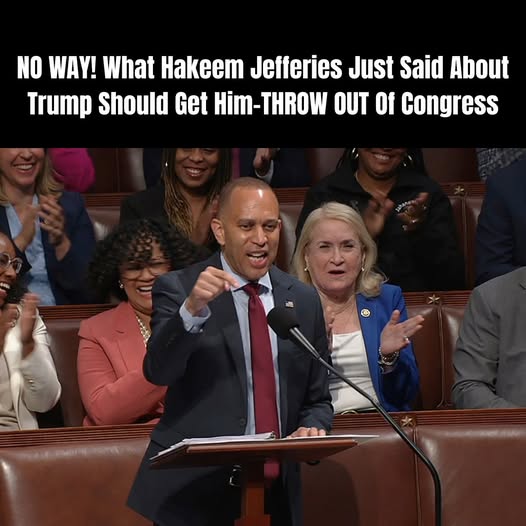
On Monday evening, during a live interview on CNN’s The Situation Room, House Minority Leader Hakeem Jeffries (D-N.Y.) delivered one of his sharpest rebukes yet of the Court’s conservative majority. His words reflected not only his personal frustration but also a growing unease within the Democratic caucus about what they see as a judiciary increasingly aligned with former President Donald Trump.
Jeffries accused the Supreme Court of having “enabled” Trump to behave like a monarch, granting him broad immunities that, in Jeffries’ view, stand in stark contradiction to the vision of the nation’s founders. His remarks sparked a flurry of reactions, highlighting once again how the nation’s political and judicial branches are locked in a tense and consequential struggle.
Jeffries’ Explosive Remarks
Speaking with CNN host Wolf Blitzer, Jeffries did not mince words. He argued that the Supreme Court’s recent decisions had effectively given Trump what the framers of the Constitution most feared: unchecked power.
“You know, one thing to understand,” Jeffries said, “is that for those who are flirting with the Trump administration, or doing its bidding, or engaging in its pay-to-play schemes, the statute of limitations is five years. Donald Trump and this toxic administration will eventually be gone. But accountability will remain. That process begins now but will not be complete until there is truly independent oversight, whether through the Department of Justice or a Democratic-controlled House of Representatives.”
The statement was not merely an attack on Trump. It was also a critique of the system that, in Jeffries’ view, has shielded him. Jeffries specifically pointed to the Supreme Court’s decision granting Trump partial presidential immunity, a ruling that has divided legal scholars and fueled political debate.
“The Department of Justice has historically stood as one of the great institutions of law enforcement in our country,” Jeffries continued. “But Donald Trump and his extremist allies have worked to erode its credibility. And let’s be clear: we must also hold the conservative justices of the Supreme Court accountable. They gave this president blanket presidential immunity in a nation where our founders explicitly rejected kingship. They’ve allowed Donald Trump to act like a king. Shame on them for what they’ve done to this country.”
The Context: Presidential Immunity and the Court’s Role
To understand the weight of Jeffries’ comments, it is important to revisit the recent history of the Supreme Court’s engagement with Trump-era legal questions.
The most controversial decision in this area came earlier this year, when the Court ruled in a landmark case that former presidents are entitled to a degree of presidential immunity for official acts taken while in office. While the ruling did not grant absolute immunity, critics—including Jeffries—argue that it created a shield broad enough to embolden Trump and discourage accountability.
The Court’s majority opinion stressed the need to preserve the independence of the executive branch, warning that subjecting presidents to endless lawsuits after leaving office could paralyze the institution. But dissenting voices, including Justice Sonia Sotomayor, warned that the decision risked turning presidents into “kings above the law.”
Jeffries seized on this dissent to underscore his point. For him and many Democrats, the Court has not simply interpreted the law—it has restructured the balance of power in Trump’s favor.
The Historical Tension Between Presidents and Kingship
Jeffries’ reference to America’s founders rejecting kingship is more than a rhetorical flourish. The framers of the Constitution were deeply concerned with the dangers of concentrated power. Having broken away from Britain’s monarchy, they sought to create a system of checks and balances that would prevent any single branch of government from dominating.
The presidency was designed to be powerful but accountable, constrained by Congress and the courts. For Jeffries, the Supreme Court’s decisions in recent years have eroded this balance, tilting power toward the executive in ways that echo the monarchy America once rejected.
A Broader Pattern of Criticism
Jeffries’ critique is not an isolated moment. It fits into a broader Democratic narrative that has taken shape since Trump’s return to the political stage. Many Democrats argue that the Court’s conservative majority—anchored by justices appointed by Trump himself—has too often sided with executive authority, voter suppression laws, or corporate interests at the expense of democratic accountability.
Consider the Court’s decisions on:
Election Law: Rulings that upheld restrictive voting measures in several states, which Democrats say disproportionately impact minority communities.
Campaign Finance: The expansion of corporate influence in politics through decisions like Citizens United v. FEC.
Abortion Rights: The overturning of Roe v. Wade, which Democrats cite as evidence of judicial activism aligned with conservative political goals.
For Jeffries, these rulings form a pattern—one in which the Court, rather than standing above politics, has become entangled in them.
Trump, the DOJ, and Allegations of Corruption
Jeffries also used the CNN interview to emphasize his belief that accountability for Trump will come, even if delayed. His comments about the “five-year statute of limitations” were a direct signal to those who may have cooperated with Trump’s administration in what Democrats describe as corrupt or self-serving schemes.
The Minority Leader suggested that once political winds shift—whether through a Democratic House majority or a change at the Department of Justice—those individuals could face consequences.
This is not an empty threat. History has shown that political accountability often lags behind the events themselves. Investigations can take years, and statutes of limitations create a ticking clock. By highlighting this timeline, Jeffries was reminding both Trump’s allies and the public that the story is far from over.
Conservative Pushback
Predictably, Jeffries’ comments drew immediate criticism from Republicans and conservative commentators. Many pointed out that even liberal justices have occasionally sided with the Trump administration on legal questions, complicating the narrative that the Court is uniformly pro-Trump.
Others argued that Jeffries’ rhetoric risks undermining public confidence in the judiciary at a time when trust in democratic institutions is already fragile. To conservatives, the accusation that the Court is enabling authoritarianism smacks of partisan sour grapes, particularly given the Court’s occasional rulings against Trump’s interests during his presidency.
Still, Jeffries’ remarks resonate with a Democratic base that views the Court as deeply compromised.
Public Reaction and the Larger Debate
The broader public reaction has mirrored the nation’s political divisions. On social media, clips of Jeffries’ interview spread rapidly, with Democrats applauding his candor and Republicans denouncing his attack on the Court. Legal scholars offered more nuanced takes, debating the long-term implications of the immunity ruling and whether it truly represented a dangerous expansion of executive power.
For many ordinary Americans, however, the issue boils down to a simpler question: Should presidents be held accountable like everyone else, or does the office require special protections? Jeffries’ forceful critique brings that question into sharp relief.
A Fight Over the Future of Democracy
At its core, Jeffries’ attack on the Supreme Court reflects a larger struggle over how democracy itself is defined in the 21st century. Is democracy simply the will of the voters expressed through elections, or does it require ongoing checks on power, even after a president leaves office?
For Jeffries and his Democratic colleagues, the latter view is essential. They argue that without robust oversight, presidents—especially one as polarizing as Trump—can exploit their office to the detriment of the republic. For Republicans, by contrast, the Court’s rulings are seen as necessary to prevent endless legal harassment of presidents, which could deter future leaders from making bold decisions.
Conclusion: A Warning and a Challenge
Hakeem Jeffries’ comments on CNN were not merely an outburst of frustration. They were a warning—that unchecked power, enabled by judicial decisions, could push the United States closer to the kind of authoritarianism its founders fought to escape.
Whether one agrees with Jeffries or not, his remarks highlight the stakes of the current political moment. The debate over Trump, presidential immunity, and the role of the Supreme Court is not just about one man or one administration. It is about the future balance of power in America and whether the nation can sustain its commitment to the principle that no one—not even a president—is above the law.
As Jeffries put it, “Shame on them for what they’ve done to this country.” His words may divide opinion, but they also ensure that the conversation about the Court, Trump, and accountability is far from over.
Sen. John Fetterman (D-PA) delivered a brutal criticism of his colleagues who have embraced socialism with open arms, referring to them as “morons” after conversations in Croatia shone a light on the failures of Communist regimes.
In a short interview with Fox News, Fetterman’s statement is a significant departure from his previously held progressive stances, which, at one time, aligned him closely with colleagues like Rep. Alexandria Ocasio-Cortez (D-NY). Political experts say his comments reflect a trend in which members of the Democratic Party, concerned about border security and economic issues, have put distance between themselves and more radical members of the party.
“I was in a former communist nation and I said, some lefties in my party are talking about socialism now, what do you think? He said, ‘That is the worst thing ever!’” Fetterman said. “You will need a reality check if you adopt any of those things. You are MORONS!”
PLAY:
Fetterman’s remarks come amid deepening divisions within the Democratic Party. His relationship with Rep. Alexandria Ocasio-Cortez (D-N.Y.) has been complicated. During his 2022 Senate campaign, Ocasio-Cortez endorsed him, viewing Fetterman as a potential ally on progressive priorities such as raising the minimum wage and advancing universal health care.
Fetterman’s backing of measures such as the Laken Riley Act signals a shift in his policy priorities. The law, signed by President Donald Trump in January, mandates the detention of undocumented immigrants accused of certain crimes — a stance more in line with Republican positions than traditional Democratic ones.
In recent years, the Pennsylvania senator has criticized open borders and voiced strong support for Israel, positions that have drawn praise from Republicans but alienated some on the left. Critics within his party accuse him of abandoning the progressive values that once defined his political brand.
Others argue Fetterman’s shift reflects a broader effort to find common ground. With political divisions running deep, they say Fetterman and other Democrats may be seeking to bridge the gap with Republicans in hopes of fostering unity at a time they see as critical.