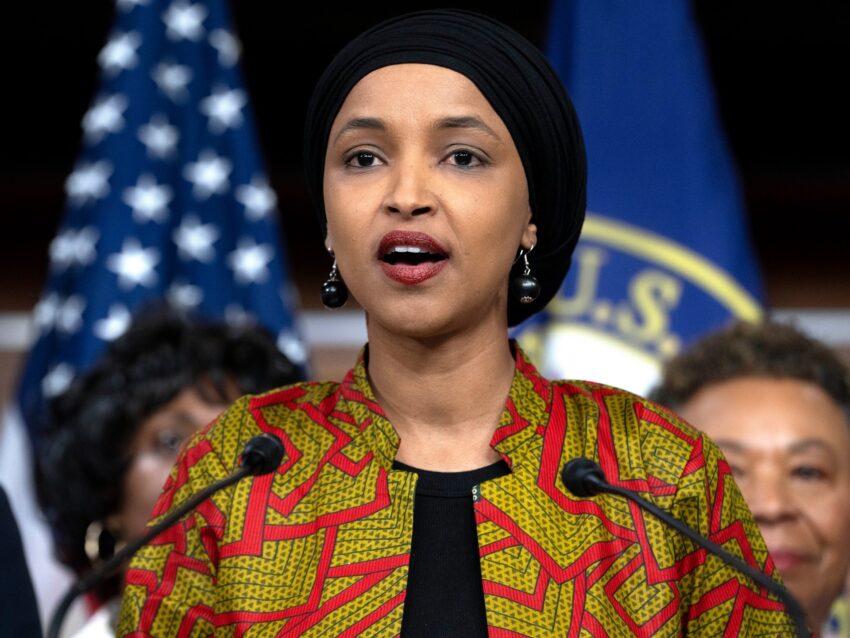
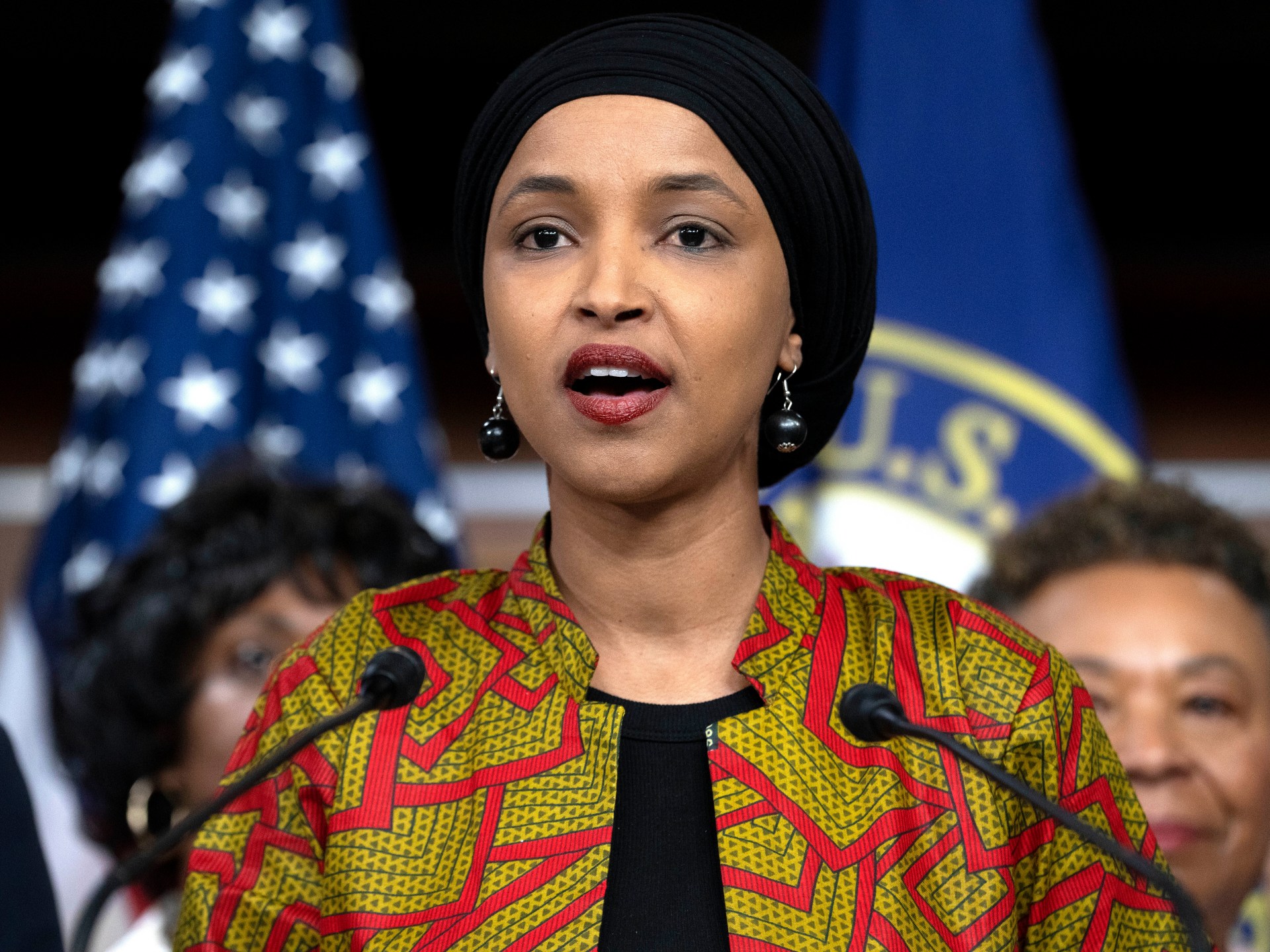
Far-left Congresswoman Ilhan Omar is once again facing intense scrutiny, this time for a campaign payment linked to a Washington, D.C.–based organization known for its close ideological alignment with pro-Hamas groups and anti-Israel activism.According to new Federal Election Commission (FEC) filings reviewed this week, Omar’s campaign disbursed $1,559.25 in September to the “Palestine House of Freedom,” a nonprofit operating under the Arabic name “Dar Alhurriya,” which describes itself as an advocacy group dedicated to the “liberation of Palestine.
”The revelation has reignited long-standing controversy surrounding Omar’s ties to extremist organizations and her vocal criticism of Israel, which has frequently drawn bipartisan condemnation.The payment, listed on Omar’s campaign expenditure report as “event tickets,” has raised questions about the purpose of the transaction and whether the congresswoman attended an event hosted by the group.The Palestine House of Freedom, located just blocks away from the U.S. Capitol, promotes itself as a hub for Palestinian activism in America. On its website, the organization openly declares its mission to “dismantle apartheid in Palestine” and “establish a free, democratic state from the river to the sea.”That final phrase—“from the river to the sea”—has become one of the most incendiary political slogans associated with anti-Israel movements, widely recognized as a call for the eradication of the State of Israel and its replacement with a single Palestinian-controlled state.The group’s public statements go even further. The organization’s social media pages are filled with rhetoric accusing Israel of “apartheid,” “ethnic cleansing,” and “systemic terrorism,” while expressing solidarity with “resistance movements.” The Palestine House of Freedom pledges to launch what it calls an “aggressive educational campaign targeting lawmakers, staffers, the media, and the general public” to advance its goal of creating “a free, democratic Palestine from the River to the Sea.”
Critics argue this campaign represents an effort to normalize extremist talking points within Washington’s policymaking and media circles under the guise of human rights advocacy.The timing and nature of Omar’s payment have also drawn scrutiny because of the organization’s recent affiliations. Earlier this year, the Palestine House of Freedom hosted a high-profile fundraiser for Birzeit University, a Palestinian university in the West Bank long associated with Hamas-aligned student groups.The university’s student council elections have routinely been dominated by the Al-Wafaa Islamic Bloc, a faction linked to Hamas.
These student factions have hosted rallies celebrating terror attacks, glorified suicide bombers, and held parades mimicking acts of violence against Israelis.The disturbing scenes earned Birzeit the informal nickname “Terrorist University” among critics.A review of the university’s history shows that Hamas-linked student blocs have consistently won campus elections at Birzeit since the 1990s. Their dominance continued in 2022 and 2023, with Hamas leader Ismail Haniyeh publicly congratulating the student group for its victories.Speaking to the Middle East Monitor following the 2023 election, Haniyeh hailed the results as an “extension of the resistance movement” and proof that Hamas’s ideology “remains unbreakable.”He framed the student bloc’s success as validation of Hamas’s ability to “adapt to changes, overcome complexities, and fill the void created by arrests, martyrdom, or deportation.”Haniyeh’s comments sent a chilling message: that Birzeit University remained a breeding ground for Hamas sympathizers. “The victory at Birzeit represents the continuity of the resistance,” he declared
“It confirms that the movement’s roots are deeply embedded among the youth who are ready to confront the occupier.” Months later, Haniyeh was killed in an Israeli airstrike in Tehran after a career spent directing Hamas’s military and political operations, but his earlier remarks underscored the ideological link between Hamas’s leadership and its international supporters.
The Palestine House of Freedom’s close relationship with Birzeit University has raised eyebrows in Congress and beyond. Lawmakers across party lines are beginning to question whether U.S.-based organizations that funnel funds or host events benefiting such entities should continue to operate without federal scrutiny.Rep. Elise Stefanik (R-NY) and Education and Workforce Committee Chair Tim Walberg (R-MI) sent a strongly worded letter to Harvard University on September 29, criticizing the institution for failing to distance itself from partnerships or exchanges involving Birzeit.Their letter described Birzeit as “an institution whose student body overwhelmingly supports Hamas and which explicitly endorses a U.S.-designated terrorist organization.”Now, with Ilhan Omar’s campaign payment to the Palestine House of Freedom on the record, the issue has reached the halls of Congress in a new and alarming way.Lawmakers are demanding answers about why a sitting member of the House of Representatives, already known for making inflammatory remarks about Israel and Jewish donors, would direct campaign funds to an organization openly aligned with Hamas-linked institutions.Omar has not publicly commented on the payment or the nature of her interaction with the organization. Her office has remained silent even as political observers and watchdog groups raise the alarm about what they see as a pattern of sympathy toward anti-Israel and pro-Palestinian extremist groups.Critics argue that this latest revelation fits into a broader narrative of Omar’s conduct in Congress. Since taking office in 2019, she has faced repeated backlash for her comments about Jewish influence in U.S. politics, once infamously claiming that “it’s all about the Benjamins” when discussing pro-Israel lobbying.
She later apologized under pressure but has continued to accuse Israel of “ethnic cleansing” and “apartheid,” sparking outrage from both Democrats and Republicans.This latest controversy threatens to reignite bipartisan frustration with Omar’s rhetoric and actions. Congressional aides familiar with the situation said her payment to the Palestine House of Freedom could trigger an inquiry by the Federal Election Commission or even prompt congressional ethics complaints.“When a sitting member of Congress gives money to an organization that publicly praises Hamas and aligns itself with groups that glorify terrorism, that’s a national security concern,” one senior GOP aide said.
“At the very least, it’s a moral and ethical disgrace.”Advocacy organizations have also weighed in. Pro-Israel groups have condemned the payment, calling it a dangerous signal at a time when anti-Semitic rhetoric and violence have surged globally.“It’s unconscionable for a U.S. lawmaker to financially support or associate with any organization that embraces terrorist movements or uses genocidal slogans,” said one policy director for a Jewish civil rights group. “It legitimizes extremism and undermines America’s standing as a defender of democracy and human rights.”Meanwhile, Omar’s defenders have attempted to downplay the controversy, claiming the payment was likely an oversight or part of a routine campaign expenditure.However, given Omar’s history of inflammatory statements and her long association with anti-Israel movements, those explanations have failed to convince many observers.The optics of a congresswoman’s campaign writing a check—no matter how small—to a group that proudly uses Hamas’s slogans are politically toxic.
The episode comes at a particularly sensitive moment in U.S. politics, with debates over foreign policy, Middle East peace efforts, and rising global anti-Semitism intensifying.President Trump’s renewed push for stricter oversight of foreign-linked nonprofits and increased scrutiny of groups accused of harboring ties to designated terrorist organizations has already set the tone for the 2025 legislative agenda.
The controversy surrounding Omar may accelerate calls for broader investigations into U.S.-based organizations that operate under the banner of Palestinian liberation but engage in messaging that aligns with extremist movements.In Congress, pressure is building for Omar to explain her actions. Several Republican lawmakers are reportedly preparing letters demanding that the House Ethics Committee review whether Omar’s payment violated campaign finance rules or represented a conflict of interest.While Democrats have remained largely silent so far, some moderates within the party are privately acknowledging that the situation could become a liability for their caucus if Omar does not provide clarification soon.
This is not the first time Omar has been linked to questionable financial dealings within her campaign. Past reports have detailed extensive payments from her campaign to consulting firms tied to individuals within her inner circle, prompting repeated calls for reform and transparency.The new revelations about her payment to the Palestine House of Freedom are likely to add more fuel to the fire, reinforcing critics’ claims that she has a pattern of poor judgment and questionable associations.As the controversy unfolds, observers say it will test whether the Democratic leadership is willing to hold one of its most outspoken progressive members accountable.
For years, Omar has benefited from the party’s reluctance to confront her over her statements on Israel and Jewish Americans, but this situation could mark a turning point.As one senior congressional aide put it, “Cutting a check to a pro-Hamas organization is a red line. If that doesn’t get a response from leadership, then nothing will.”Whether this incident leads to formal consequences or fades into another controversy remains to be seen. But one thing is certain: Ilhan Omar’s name, once again, is at the center of a storm that raises fundamental questions about loyalty, judgment, and the limits of acceptable political activism for a sitting member of the United States Congress.
The Senate voted on Wednesday to pass the $895 billion Defense Authorization Bill, despite a provision on transgender care that caused concern among some Democrats, sending it to President Biden’s desk for final approval.
The National Defense Authorization Act (NDAA) was approved 85 to 14 by senators, surpassing the 60 votes needed in the 100-member chamber. The bill moved forward even with the inclusion of a controversial measure that would ban certain gender-affirming care for transgender children of service members, The Hill reported.
“Today, for the 64th consecutive year, the Senate passes a bipartisan National Defense Authorization Act to protect the American people and strengthen our security,” Senate Majority Leader Chuck Schumer (D-N.Y.) said in a floor speech ahead of the vote. “The NDAA is not perfect, but it still makes several important advances Democrats fought for to secure America’s national defense and take a strong stand against the Chinese Communist Party.”
The measure, which establishes Defense Department policy and priorities for the year, passed the House last week 281-140.
The must-pass legislation, which usually receives broad bipartisan support, faced opposition this time after Speaker Mike Johnson (R-La.) added last-minute language restricting the use of TRICARE funds — the health care program for active-duty service members — for gender-affirming care for children 18 and under of military members.
This change prompted a handful of Democrats to vote against the bill, including Sens. Tammy Baldwin (Wis.), Elizabeth Warren (Mass.), and Ed Markey (Mass.).
But the fact that a transgender provision was included in a defense bill in the first place reinforces President-elect Donald Trump’s choice of former Fox News host Pete Hegseth to lead the department. Hegseth has repeatedly said that transgenderism has no place in the U.S. military because gender-affirming care is ongoing and essentially makes trans troops non-deployable.
Also, both Trump and Hegseth have said they want the Pentagon and the various U.S. military academies laser-focused on lethality and winning the nation’s wars, not cultural and social issues that distract from producing such a force, especially as global threats from China and other nations grow.
A group of 21 Democratic senators attempted to block the provision at the last minute, introducing an amendment on Monday to remove Johnson’s language. However, the effort failed to pass. Baldwin, who had led the push to eliminate the controversial provision, urged her colleagues to reject the NDAA, arguing that lawmakers’ commitment to U.S. service members had been “broken.”
But other Democratic senators threw their support behind it, arguing it was too important to national security to not pass.
“This is a strong, forward-looking bill that we can all be proud of,” Senate Armed Services Committee Chair Jack Reed (D-R.I.) said ahead of the vote, though he acknowledged there are “concerns that some of my colleagues have” about the legislation, The Hill noted.
“I share many of my colleagues’ frustration that the bill includes a provision that would prohibit gender-affirming health care for minors in certain circumstances,” Reed said. “Ultimately, though, we have before us a very strong National Defense Authorization Act. I am confident it will provide the Department of Defense and our military men and women with the resources they need to meet and defeat the national security threats we face.”
The fiscal 2025 NDAA, a massive 1,800-page document, authorizes $895 billion in Pentagon spending and outlines key policy objectives. Among the provisions are a 14.5 percent pay raise for junior enlisted troops and a 4.5 percent increase for all other service members, along with funding to strengthen the U.S. presence in the Indo-Pacific and support the development of new warships, aircraft, and vehicles, the outlet said.
The bill also includes language that prevents the Defense Department from supporting critical race theory — an academic framework examining U.S. history through the lens of racism, which has become a political catch-all term for any race-related teaching.
Additionally, it imposes a yearlong hiring freeze on positions related to DEI — diversity, equity, and inclusion — programs within the military.