The 34-year-old socialist’s plan to lower the cost-of-living in New York City through city-owned grocery stores, universal childcare and free buses requires raising taxes on the wealthiest New Yorkers, but any tax hike would require New York state approval, and Gov. Kathy Hochul, D-N.Y., has rejected raising taxes.
Mamdani campaigned on creating a 2% New York City income tax for anyone making more than $1 million a year and raising the top state corporate tax rate to 11.5% to match New Jersey’s in order to pay for his campaign promises.
But the mayor of New York City does not have the authority to raise taxes. Under New York state law — and consistent with Article XVI of the New York State Constitution — only the state legislature holds the power to tax, meaning the city cannot create new taxes or change existing rates without approval from the legislature and governor in Albany.
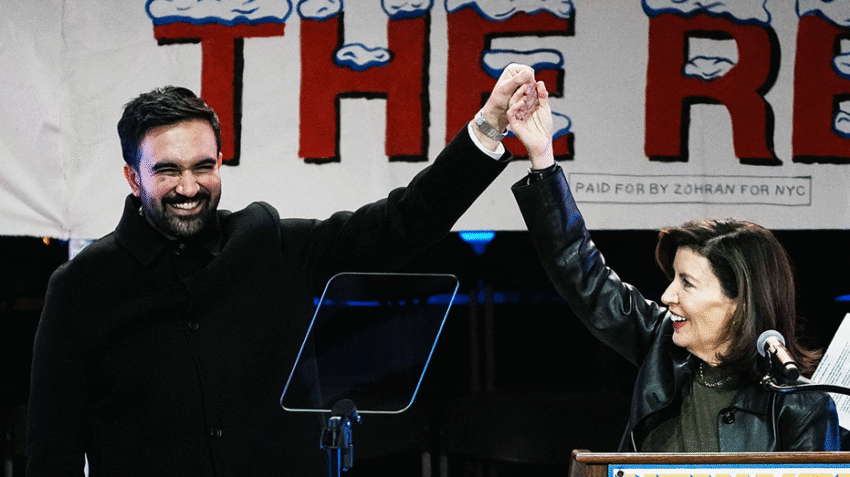
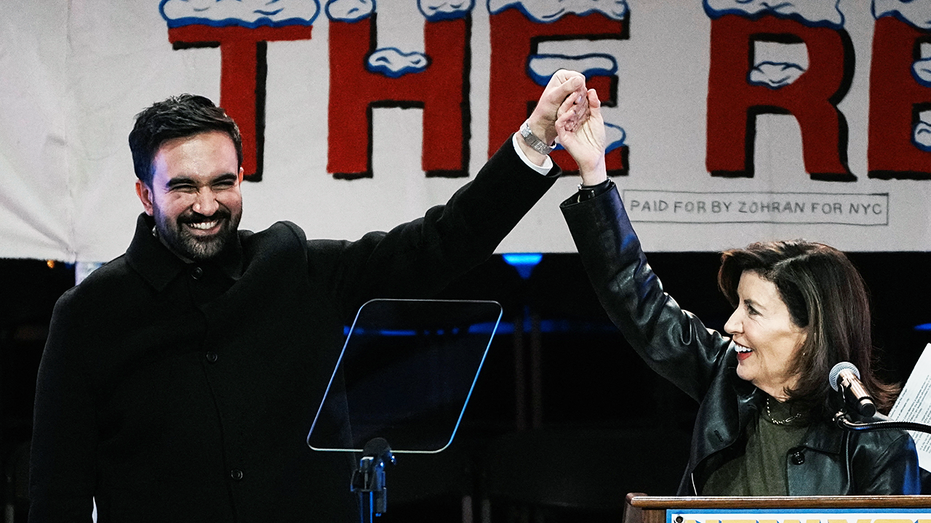
New York City mayoral candidate Zohran Mamdani and Gov. Kathy Hochul hold hands on stage as they attend a “New York is Not For Sale” rally at Forest Hills Stadium, in the Queens borough of New York City, on Oct. 26, 2025. (Reuters/Eduardo Munoz / Reuters)
Hochul did not respond to Fox News Digital’s inquiry on Wednesday about whether she is considering a tax hike now that Mamdani is set to become the next mayor of New York City.
During Mamdani’s election night party in Brooklyn on Tuesday, the New York City crowd began chanting, “Tax the rich!” when Hochul’s photo appeared on the big screen during NY1’s election night broadcast.
It was the latest example of the growing pressure on Hochul to raise taxes, so Mamdani can deliver on his campaign agenda.
Last week, Hochul told Fox News host Jessica Tarlov on her podcast, “Raging Moderates,” that “one energetic rally” would not influence her to change her position. She said he has to protect the New Yorkers who already fund the state’s budget.
“I cannot make up for that with middle-class tax increases. I cannot do that to the middle class and the struggling New Yorkers,” Hochul said.
Zohran Mamdani arrives for an election night event at The Brooklyn Paramount Theater in the Brooklyn borough of New York City on Tuesday, Nov. 4, 2025. (Adam Gray/Bloomberg/Getty Images / Getty Images)
Mamdani defended Hochul last week after his supporters drowned her out with chants of “Tax the rich!” while she delivered remarks during the high-profile “New York is not for sale” rally in Forest Hills, Queens, with Rep. Alexandria Ocasio-Cortez, D-N.Y., and Sen. Bernie Sanders, I-Vt.
“Whenever I speak with the governor, it always comes back to affordability, and we have both made clear that that is the defining purpose of our politics, and that’s what we’re going to deliver,” Mamdani told reporters.
But Mamdani’s supporters, knowing Hochul had been unwilling to budge on raising taxes, disrupted her remarks, shouting, “Tax the rich!” The chants forced Mamdani to walk out on stage early and take her hand in his to affirm his support for the governor.
“I can hear you,” Hochul responded as the stadium erupted with the chant.
Hochul told reporters last week that she knows there is “passion” to raise taxes on corporations and the top 1% of New Yorkers.
When pressed by a reporter if she would be willing to change her mind about raising taxes, Hochul said, “I’m having a lot of conversations about everything.”
“They want to know my timeline. I said let’s get through this election. Let’s let the focus be on your race,” Hochul added, explaining that she wanted to attend Sunday’s rally as the leader of a diverse Democratic Party.
New York City Mayor-elect Zohran Mamdani holds a press conference at the Unisphere in the Queens borough of New York City on Nov. 5, 2025. (Kylie Cooper/Reuters / Reuters)
She also said she wasn’t sure what the hecklers were saying. “I couldn’t hear what they were chanting. I thought they were saying, ‘Let’s go, Bills.’ I wasn’t sure,” Hochul said.
“I appreciated the governor speaking at yesterday’s rally,” Mamdani said when asked about the chants. “I appreciated her remarks. I appreciate her support for universal childcare, which is something that’s been a longstanding priority for her.”
Hochul was initially reluctant to endorse Mamdani but later embraced him and joined him on the campaign trail.
Mamdani has yet to endorse Hochul for re-election, where she is likely to face off against Rep. Elise Stefanik, R-N.Y., who has been floating a gubernatorial bid for months.
“Kathy Hochul and her endorsed Commie Mamdani are literally destroying New York,” Stefanik said Tuesday night after Mamdani won the mayoral election.
The Mamdani campaign did not immediately respond to Fox News Digital’s inquiry.
In recent years, historian and political commentator Victor Davis Hanson has argued that the Democratic Party is undergoing a profound collapse—one that, if not reversed, could bring devastating consequences for the American middle class. According to Hanson, the party that once claimed to represent working people has transformed into an alliance of global elites, coastal professionals, and ideological activists, leaving behind the very group that built and sustained the nation.
Hanson traces this shift to the Democratic embrace of globalization and technocratic economics. For decades, party leaders supported trade deals and environmental policies that encouraged the outsourcing of manufacturing jobs and the decline of industrial communities. While global corporations, Wall Street financiers, and Silicon Valley innovators profited immensely, traditional working- and middle-class Americans—especially those in the Midwest and South—saw their livelihoods evaporate. Hanson argues that the party’s new priorities created a “two-tiered America,” one in which elites thrive on information and finance, while millions of workers face economic insecurity and social decay.
Compounding this divide, Hanson believes, is the party’s growing commitment to identity politics and cultural radicalism. Rather than uniting Americans around shared values of citizenship and hard work, the Democratic Party increasingly emphasizes race, gender, and sexuality as the primary markers of social identity. In Hanson’s view, this shift alienates the middle class, which values stability, meritocracy, and community over ideological crusades. He warns that the obsession with “diversity, equity, and inclusion” has replaced practical governance with moral signaling, further eroding trust between ordinary citizens and political elites.
Immigration policy, too, serves as a flashpoint in Hanson’s analysis. He argues that the Democrats’ support for open borders and mass immigration has driven down wages for low- and middle-income workers while straining public resources such as housing, healthcare, and education. The traditional Democratic voter—the construction worker, factory employee, or small business owner—now finds himself competing with an influx of cheap labor, while party leaders dismiss his concerns as xenophobic or outdated. This, Hanson claims, represents a fundamental betrayal of the middle-class social contract.
The collapse of the Democratic Party, Hanson concludes, is not merely a partisan event but a national crisis. Without a major party championing middle-class interests—affordable energy, domestic industry, strong families, and secure borders—the economic and cultural foundations of America could unravel. Inflation, housing shortages, and rising crime rates are symptoms, he says, of a deeper sickness: the abandonment of common sense and working-class values in favor of elite ideology.
Ultimately, Hanson’s warning is both historical and moral. Great civilizations, he reminds us, collapse not because they are conquered from without, but because they rot from within. If the Democratic Party continues down its current path—favoring globalism over nationalism, ideology over pragmatism, and elites over the everyday citizen—the American middle class may cease to exist as the stabilizing force it once was. The fate of the nation, Hanson argues, depends on whether a new political movement can restore faith in hard work, fairness, and national unity before it is too late.