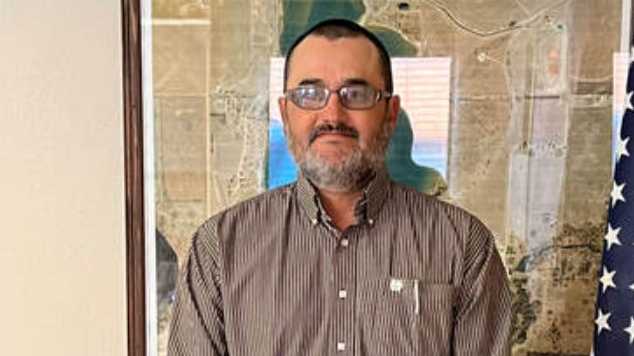
Kansas Attorney General Kris Kobach dropped a bombshell Wednesday, announcing election fraud charges against Coldwater Mayor Jose (Joe) Ceballos, just one day after voters handed him another term in office.Ceballos, 54, was charged in Comanche County with three counts of voting without being qualified and three counts of election perjury, non-person felonies that could land him behind bars for more than five years.
“In large part, our system right now is based on trust. Trust that when the person signed the registration or signs the pollbooks saying that he’s a qualified elector or that he is a United States citizen, that the person is telling the truth,” Kobach said. “In this case, we allege that Mr. Ceballos violated that trust.”
Kobach said Ceballos is a legal permanent resident but not a U.S. citizen — calling him a citizen of Mexico who never should have been voting in American elections, let alone leading a Kansas town.
Jose Ceballos. (Coldwater, Kansas)
Kansas Secretary of State Scott Schwab said new tools from the Trump administration helped uncover the alleged fraud. “We now have tools, thanks to the current White House, that we haven’t had in over 10 years,” Schwab said. “That we can check through the SAVE program, to find out if folks end up on our voter rolls. And they could be a legal resident, but they’re not a citizen. We want to make sure that gets clarified.”
The SAVE program — run by U.S. Citizenship and Immigration Services under the Department of Homeland Security — lets government agencies verify immigration and citizenship status for things like licenses or voter rolls.
Locals expressed frustration, accusing state leadership of misleading them — including Republican gubernatorial candidate Philip Sarnecki, who shared his reaction on X.
Kansas is one of eight states requiring proof of citizenship to register to vote, a law Kobach helped pioneer years ago.
In Coldwater, city leaders scrambled to contain the fallout. City Council President Britt Lenertz said Ceballos called an emergency meeting on Wednesday to address the charges
“At this time, our focus remains on ensuring that city operations continue to run smoothly and that the needs of our community are met,” Lenertz said. “While the recent allegations involving the mayor are understandably concerning, we will allow the proper legal process to take its course before making any further comments. It’s important that we respect both due process and the integrity of our local government.”
Coldwater officials later confirmed Ceballos would need to prove his citizenship to keep his seat. City Attorney Skip Herd said Ceballos is a green card holder who’s been registered to vote since 1990 — despite never being a U.S. citizen.
“He’s been a registered voter since 1990. He applied for citizenship in February of this year, and through that, raised the issue of whether he was a legal citizen,” Herd said.
Under Kansas law, candidates for city office must be eligible voters and residents, though home rule gives cities some leeway. But as the case unfolds, the small Kansas town finds itself at the center of a national flashpoint over election integrity.
Supreme Court Justice Elena Kagan, considered one of the Court’s liberal voices, denied an emergency appeal from a Mexican family facing deportation, siding with the Trump administration.
The family, who fled cartel threats in Guerrero, Mexico in 2021, claimed they risk death if forced to return. Despite detailed evidence of cartel violence, immigration courts denied their asylum claim. Kagan declined to block their removal, choosing not to refer the case to the full Court.
Meanwhile, legal analyst Kerri Urbahn criticized Chief Judge James Boasberg’s handling of another deportation case, calling his actions “desperate” after the Supreme Court vacated his order. The case involved a deported MS-13 gang member whose return Boasberg demanded despite the Court ruling it belonged in Texas, not Washington, D.C.
SE E MO RE
In a highly anticipated legal move, President Donald Trump has filed a powerhouse appeal to New York’s Appellate Division, challenging his conviction in the Manhattan District Attorney Alvin Bragg’s case.The appeal comes after months of legal battles and millions in taxpayer dollars spent on prosecuting Trump over thirty-four felony charges related to “falsifying business records,” a case that legal experts from across the political spectrum have repeatedly criticized as weak and politically motivated.Now,
Trump is determined to turn the tables, calling Bragg’s case “the most politically charged prosecution in our Nation’s history.” The appeal, which spans an impressive 111 pages (some reports list it at 96 pages), blasts Bragg’s case as nothing more than “Radical Democrat Lawfare.”Trump’s legal team argues that the entire case, which centers on alleged hush-money payments to a former adult film star, is built on a flawed legal foundation.In the filing, Trump’s legal team insists that the charges should be dismissed, citing the U.S. Supreme Court’s decision on presidential immunity, federal and state constitutional protections, and established legal precedent. The appeal is a direct response to what Trump’s team describes as a politically motivated assault on the President.
“The Supreme Court’s historic decision on Immunity, the Federal and New York State Constitutions, and other established legal precedent mandate that this meritless hoax be immediately overturned and dismissed,” a spokesman for Trump’s legal team said in a statement to Fox News Digital.“President Trump will keep defeating Democrat weaponization at every turn as he focused on his singular mission to Make America Great Again.” The Manhattan DA’s case, which was launched over a year ago, hinges on the payments made during Trump’s 2016 presidential campaign to silence allegations from Stormy Daniels, the adult film actress.
The case, however, has been widely criticized as weak because such financial transactions—while controversial—are far from unusual in the corporate world.Non-disclosure agreements (NDAs) are commonly used in various industries to protect privacy and silence accusations, making it difficult for prosecutors to argue that Trump’s actions were criminal.Despite these facts, Bragg and his office pressed forward, framing the case as one of felony-level criminal conduct. The charges involve accusations that Trump falsified business records related to these payments, with Bragg asserting that the records were altered to conceal the true nature of the transactions.
In New York, falsifying business records is typically classified as a misdemeanor, but Bragg argued that the charges should be elevated to felonies because they allegedly were part of a broader crime, one that remains unspecified. The court, however, ruled that this approach was valid, leading to Trump’s conviction.Yet, even legal experts who are not aligned with Trump have voiced skepticism about the case. Many have pointed out that Bragg’s case fails to meet the legal threshold for felony charges and is built largely on speculative claims.It is rare for such corporate transactions to be elevated to felony offenses, and many legal analysts believe Bragg’s case is based on a broad and unsubstantiated interpretation of the law.
For Trump’s supporters, the charges are simply a tool to undermine his political influence and distract from his successes during his presidency.“Bragg’s case was shaky from the very beginning,” said Rep. Claudia Tenney (R-NY), who has been a vocal critic of the prosecution. “This is about weaponizing the justice system to target a political opponent.These payments are not inherently illegal. They happen in corporate America every day.” Tenney’s comments reflect widespread Republican sentiment that the charges against Trump are politically motivated, an extension of the larger effort by Democrats to weaken his influence and prevent his return to power.