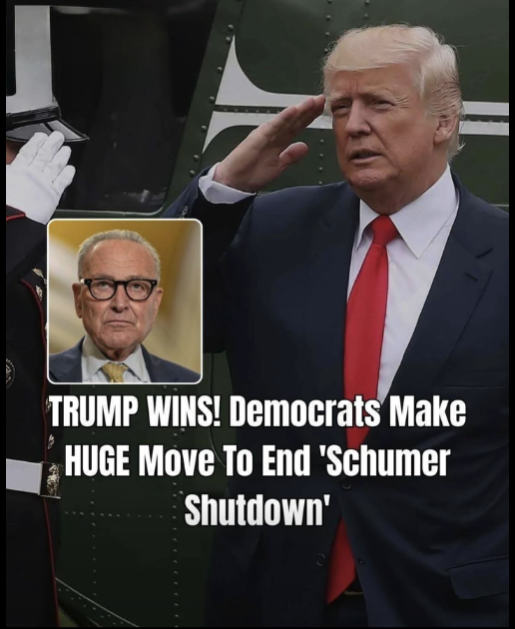
As the federal government shutdown approaches its fourth week, pressure is mounting inside the Democratic Party to find a way out of the impasse that has left hundreds of thousands of federal employees unpaid and key social programs at risk of disruption.
The shutdown — now widely referred to by critics as the “Schumer Shutdown” — began after negotiations between congressional Democrats and Republicans collapsed over spending levels and border policy. What initially appeared to be a short-term standoff has turned into a prolonged test of endurance that is beginning to take a toll on both the economy and public opinion.
Mounting Pressure on Senate Democrats
According to a report from The Hill, Senate Democrats have quietly begun exploring off-ramps to end the stalemate without appearing to capitulate to Republican demands. Lawmakers and aides say the Democratic caucus is feeling the squeeze from multiple directions — federal workers, unions, and vulnerable constituents who are beginning to feel the economic strain.
One of the ideas under discussion involves supporting a Republican proposal to ensure federal employees — both essential and furloughed — receive paychecks while the government remains closed. While Democrats initially resisted piecemeal funding bills, the worsening political optics are forcing them to reconsider.
At the same time, Democratic leaders are drafting legislation to extend funding for critical social safety net programs, including the Supplemental Nutrition Assistance Program (SNAP) and the Special Supplemental Nutrition Program for Women, Infants, and Children (WIC). Without renewed funding, millions of low-income families could face interruptions in benefits within weeks.
A Senate Democratic aide told The Hill,
“We’re trying to make sure that the most vulnerable Americans don’t bear the brunt of Washington’s dysfunction. But we also need to protect the integrity of the broader funding negotiations.”
The Political Tide Turns
What makes this shutdown different from past ones is the shifting political perception among voters. In previous standoffs, Democrats often managed to frame the narrative around Republican obstruction. This time, however, polling data suggests the public is holding Democrats responsible for the gridlock.
A recent Rasmussen survey found that 54% of likely voters blame Senate Democrats for the ongoing shutdown, compared to 39% who fault Republicans. Independent voters, a key political bloc, also appear to be breaking against the majority party in the Senate.
Political analyst Caroline Bixby noted,
“In 2018 and 2019, Democrats successfully branded the shutdown as a result of President Trump’s immigration policies. This time, they control the Senate, and the public expects them to lead. It’s harder to point fingers when you’re the one steering the chamber.”
Republicans, meanwhile, have seized the opportunity to portray the standoff as a failure of leadership by Senate Majority Leader Chuck Schumer (D-NY). House Speaker Mike Johnson (R-LA) accused Democrats of “playing politics with paychecks,” saying his party had already passed multiple funding bills that Democrats refused to consider.
“We’ve done our job,” Johnson told reporters on Monday. “We’ve passed targeted funding measures for veterans, border security, and federal workers. The Senate could end this shutdown today if they chose to.”
Growing Frustration Among Federal Workers
Beyond Washington’s political posturing, the human cost of the shutdown is becoming increasingly visible. Tens of thousands of federal employees across the country are now entering their fourth week without pay, forcing some to turn to food banks, community organizations, and short-term loans.
The American Federation of Government Employees (AFGE), the largest federal workers’ union in the U.S., has been urging both parties to reach a compromise but has recently directed its frustration squarely at Senate Democrats.
AFGE National President Everett Kelley said in a statement,
“Federal workers are not bargaining chips. Our members deserve to be paid for the work they do, and this shutdown must end now. We are calling on Senate leadership to pass a clean continuing resolution.”
According to union data, nearly 800,000 workers have been affected by the shutdown, including employees at the Transportation Security Administration (TSA), Environmental Protection Agency (EPA), and Department of Agriculture (USDA). With back pay uncertain, morale is plummeting across agencies.
Programs for Families and Children at Risk
The economic ripple effects extend beyond federal employees. Programs like SNAP and WIC, which provide essential nutrition assistance to millions of Americans, are now on the verge of running out of funds.
A USDA official told reporters that benefit payments could be disrupted within two weeks if Congress fails to act. That could affect more than 7 million low-income women, infants, and children who rely on monthly food vouchers.
Senate Democrats are reportedly drafting legislation to extend funding for those programs, along with emergency provisions to keep school lunch programs operational. However, Republicans have argued that such targeted bills only prolong the broader stalemate.
“Democrats want to patch up their political problem with temporary fixes,” said Sen. John Thune (R-SD). “The responsible approach is to reopen the government completely and negotiate a full-year budget that controls spending.”
Schumer’s Balancing Act
For Majority Leader Schumer, the political calculus is complex. He faces competing pressures — from progressives urging him to hold firm on social spending and border policy, and from moderates anxious about the growing political fallout.
Behind closed doors, Senate aides describe a divided Democratic caucus. Some senators representing swing states, such as Jon Tester (D-MT) and Sherrod Brown (D-OH), have privately expressed concern that the shutdown could damage their reelection prospects if it continues into November.
One Democratic strategist, speaking anonymously, admitted:
“The polling is bad, and the narrative is slipping away. The longer this goes on, the harder it will be to recover politically. Schumer needs a win — or at least an exit ramp that doesn’t look like surrender.”
Republicans Sensing Momentum
Republicans, sensing political momentum, are showing little appetite to compromise. They have framed the shutdown as part of a broader debate over government spending and fiscal discipline, emphasizing the need to reduce the deficit and secure the border.
Senate Minority Leader Mitch McConnell (R-KY) said,
“Democrats created this crisis by refusing to accept even modest spending reforms. They’re trying to spend their way out of every problem, and the American people are tired of it.”
House Republicans, meanwhile, have continued to pass smaller funding packages that would reopen parts of the government, effectively forcing Democrats to vote against measures to pay federal employees, veterans, and active-duty military personnel — votes that have been used to paint Democrats as obstructionist.
Economic Costs Rising
Economists warn that if the shutdown extends into next month, it could begin to slow GDP growth and undermine investor confidence. A report by Moody’s Analytics estimated that each week of the shutdown could shave 0.1% off quarterly economic output.
With holiday travel approaching, disruptions in air traffic control, passport processing, and national park operations are likely to intensify. Small businesses dependent on federal contracts or tourism have already reported financial losses.
“Every day this continues, the pain spreads,” said economist Diane Swonk. “Shutdowns don’t just affect Washington — they ripple across local economies and household budgets.”
Looking Ahead
As the shutdown nears the one-month mark, Washington’s political theater shows no sign of resolution. Democrats are increasingly eager to change the narrative, but doing so without appearing to fold remains a delicate balancing act.
Insiders say behind-the-scenes discussions are ongoing, with both parties testing possible compromise frameworks — including short-term continuing resolutions or agreements on specific budget caps.
Still, without a breakthrough, Americans may be facing a second missed paycheck for federal employees and an increasingly frustrated electorate heading into the holiday season.
Political veteran Larry Sabato summed up the situation bluntly:
“Shutdowns are a political gamble. This one has gone on long enough that everyone’s losing — but some are losing faster than others.”
The Federal Bureau of Investigation has released new, higher-quality surveillance footage showing the individual who placed pipe bombs near the headquarters of the Democratic National Committee (DNC) and Republican National Committee (RNC) in Washington, D.C., on January 5, 2021.
The release marks the latest effort by the FBI to solve one of the longest-running unsolved cases connected to the January 6 events.
Authorities confirmed that the reward for information leading to the suspect’s identification, arrest, and conviction has been increased to $500,000.
“The FBI is still offering a $500,000 reward for information that helps identify the person who placed pipe bombs at the offices of the Democratic National Committee and Republican National Committee on January 5, 2021,” the Bureau announced.
The suspect is seen in the video wearing a gray hooded sweatshirt, gloves, and a mask, carrying a backpack that investigators believe contained the devices.
The person was captured walking through several Capitol Hill neighborhoods between 7:30 p.m. and 8:30 p.m. on the evening of January 5.
Both pipe bombs were found the following day outside the DNC and RNC headquarters. They were safely neutralized before they could detonate, and no injuries occurred.
FBI analysts determined that the devices were constructed with the chemical components of black powder and equipped with kitchen timers
Even after reviewing thousands of leads and interviewing hundreds of witnesses, investigators have yet to identify the suspect responsible.
Deputy Director of the FBI Dan Bongino reaffirmed the Bureau’s commitment to finding the individual behind the attempted attack.
“If you have information regarding this critical investigation, please call 1-800-CALL-FBI,” Bongino said. “Even the smallest tip could be the key to closing this case.”
The FBI says it has processed over 1,000 interviews and reviewed more than 43,000 video files tied to the ongoing investigation.
In recent weeks, new information has emerged after FBI Director Kash Patel transmitted laboratory analyses and key witness interviews to Congress.
Those documents, obtained by Just the News, show that both bombs contained explosive components but did not include the term “viable” in the FBI’s laboratory report.
This detail has raised new questions about whether the devices were capable of detonating or if they served another purpose that night.
The timeline has also come under scrutiny, as both bombs were found roughly 16 hours after the FBI claimed they had been planted outside party headquarters.
Director Patel confirmed that all materials related to the case have been turned over to congressional oversight committees for further review.
Deputy Director Bongino said the Bureau would continue pursuing every lead until the case is solved. “This investigation remains active, and our agents are committed to following the evidence wherever it leads,” he stated.
The enhanced footage, now circulating on social media and the FBI’s official website, gives the public the clearest view yet of the suspect’s route through Washington.
Officials hope that viewers may recognize the person’s movements, clothing, or backpack and come forward with identifying information.
Security experts note that the case stands as one of the most complex domestic investigations in recent FBI history.
The renewed attention, combined with the $500,000 reward, could finally generate the tip that has eluded investigators for nearly five years.
The FBI continues to urge anyone with information to contact 1-800-CALL-FBI or submit a confidential tip online at tips.fbi.gov.