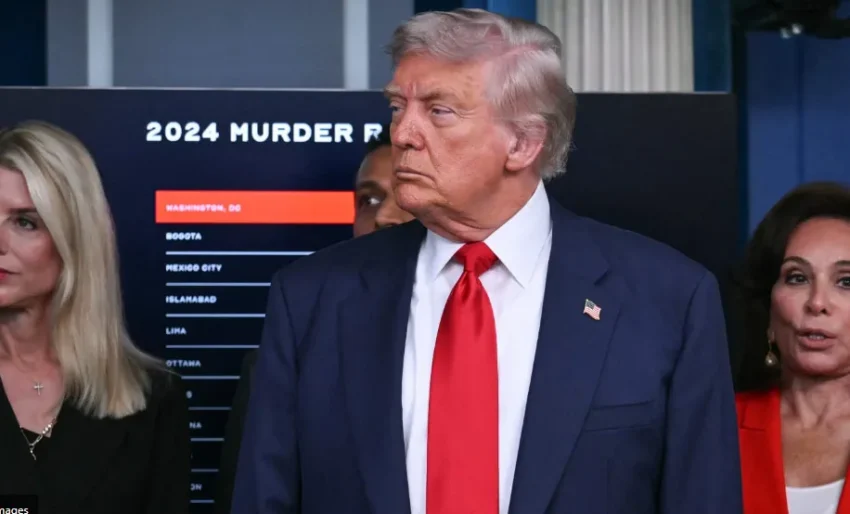
In the first week after the White House assumed control of Washington, D.C.’s police force and deployed federal agents and National Guard troops, the city recorded a modest drop in reported crime but a sharp increase in immigration-related arrests, according to a CNN analysis of government data.
For the week beginning August 12 — the first full week under federal control — property crimes fell by about 19 percent compared to the week prior, while violent crime dropped 17 percent, based on the most recent Metropolitan Police Department statistics.
The trends varied by category. Robberies and car break-ins fell by more than 40 percent, while thefts remained flat. Burglary cases rose 6 percent, and assaults with a dangerous weapon increased 14 percent. Two homicides occurred during the period, consistent with recent weeks, though none have been reported since August 13.
Federal agencies have embedded with local police, assisting in arrests, searches, and warrant executions while patrolling the city in unmarked vehicles, CNN noted further.At the same time, immigration enforcement surged. Since August 7, federal officials have arrested about 300 individuals in the district without legal immigration status — more than ten times the typical weekly number of ICE arrests in the city,
During the first six months of Trump’s current term, ICE averaged about 12 arrests per week in Washington, according to data from the Deportation Data Project at the University of California, Berkeley, School of Law.
Officials told CNN that ICE agents have been accompanying MPD officers and intervening when individuals stopped or questioned are found to be in the country unlawfully.
In response to CNN’s findings, White House spokeswoman Abigail Jackson stated that the media was attempting to dismiss the “exceptional results” of Trump’s efforts in Washington, D.C.
“The drops in crime are not ‘moderate,’ they are life-changing for the countless of DC residents and visitors who have not been murdered, robbed, carjacked, or victims of overall violent crime in the last week,” Jackson said. “The priority of this operation remains getting violent criminals off the streets — regardless of immigration status.”
The administration said those taken into custody include individuals arrested for committing crimes or wanted on outstanding warrants, including some for serious offenses. CNN noted it could not independently confirm the details of the arrests or determine what share involved non-immigration-related charges.
The sharp increase in immigration arrests has also fueled concerns among Democratic leaders in D.C., including Mayor
Muriel Bowser, who argue that the true aim of Trump’s federal takeover may be targeting illegal immigrants.
Last week, Bowser told reporters that an order from U.S. Attorney General Pam Bondi “almost exclusively focused on immigration enforcement and homeless encampment enforcement.”
The District of Columbia’s attorney general has filed a lawsuit challenging Attorney General Pam Bondi’s order directing police to disregard the city’s sanctuary laws, which had limited cooperation with Immigration and Customs Enforcement in immigration cases.
During a hearing last week, however, the federal judge overseeing the case suggested that Trump’s authority under the Home Rule Act likely gives him the power to require local police to assist ICE.
Viral videos circulating in Washington this week show Immigration and Customs Enforcement agents tackling immigrants, including food delivery workers, and in one case breaking car windows to detain two men.
During one evening of heightened police activity, CNN observed officers responding to reports of shootings, drug and firearm possession, and a stolen vehicle. Federal agents were heard communicating over local police channels as they carried out stops, searches, and crime responses, at times warning each other about the city’s speed cameras.
Over the past week, the Metropolitan Police Department and federal agencies have also set up traffic checkpoints — a practice rarely used in the district — including one large operation with dozens of officers and agents along a major highway leaving the city, CNN said.
Officers were seen pulling over vehicles and conducting searches, though it was not immediately clear what criteria were being used to determine which vehicles were stopped, said the outlet.
Maxine Waters Tried to Humiliate Sen. John Kennedy — His Comeback Shut Her Down Instantly
In a dramatic Senate Banking Committee hearing that captivated the nation, Senator John Kennedy of Louisiana confronted Congresswoman Maxine Waters with a series of pointed questions and damning evidence, leaving her visibly shaken and struggling to maintain her composure. What was intended to be a routine discussion on financial regulations quickly escalated into a high-stakes showdown that exposed the fragility of unchecked political power.
The hearing began with Waters, a seasoned lawmaker known for her fierce advocacy and commanding presence, entering the room with the confidence of a queen. For over three decades, she had been a titan of Washington’s financial policy, adept at dismantling opponents with her sharp rhetoric. However, unbeknownst to her, Kennedy had spent weeks preparing for this moment, armed with a deep understanding of constitutional law and a folder filled with evidence that would soon turn the tide.
As the hearing commenced, Waters attempted to assert her dominance by questioning Kennedy’s qualifications. “Did your time in law school cover banking policy or were you too busy chasing folksy anecdotes?” she asked, her tone dripping with condescension. This calculated move was designed to put him on the defensive, but Kennedy remained unfazed, a faint smile playing on his lips.
Kennedy responded not with indignation but with a measured inquiry that would set the tone for the rest of the hearing. He pulled out his well-worn pocket Constitution and posed a critical question: “What specific constitutional authority gives Congress the power to regulate every corner of American banking?” This question landed like a grenade, momentarily cracking Waters’s confident facade.
As the tension in the room escalated, Kennedy continued to press Waters on the limits of federal power. He challenged her to justify the existence of agencies like the Consumer Financial Protection Bureau (CFPB), which she had long championed. His calm demeanor contrasted sharply with Waters’s increasingly defensive responses, revealing a vulnerability she had not anticipated.
With the audience on the edge of their seats, Kennedy shifted gears, opening his folder to reveal evidence of potential conflicts of interest involving Waters and OneUnited Bank. He disclosed that Waters had arranged a meeting with Treasury officials to discuss the bank during a time when her husband held a significant stake in it. “Your husband owned $350,000 worth of stock in OneUnited Bank. After that meeting, the bank received $12 million in taxpayer bailout funds,” Kennedy stated, his tone steady but laced with accusation.
Waters’s expression changed as she realized the implications of Kennedy’s revelations. She attempted to deflect, insisting that her actions were aimed at helping minority-owned banks, but Kennedy was relentless. He pointed out the stark contrast between her professed commitment to public service and the financial benefits her family had reaped from her political influence.As the hearing progressed, it became clear that Waters was losing control of the narrative. Kennedy’s methodical approach and mastery of constitutional principles dismantled her authority piece by piece. He highlighted the CFPB’s structure and its implications for the separation of powers, questioning how an unelected agency could wield such authority without accountability.