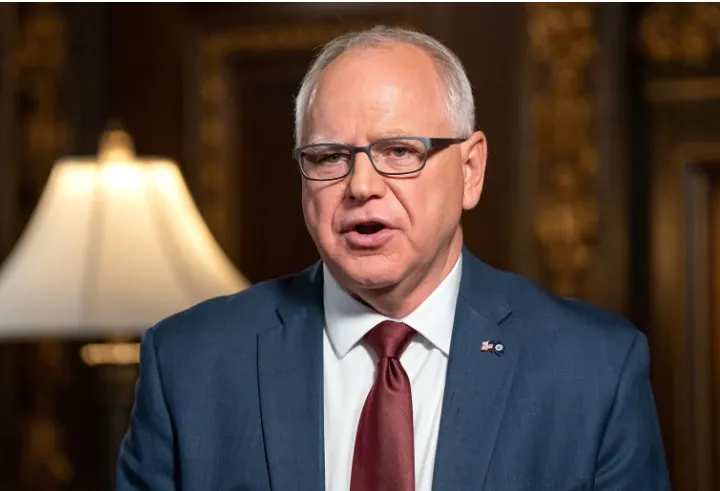
In the wake of a horrific school shooting at a Minneapolis Catholic school, questions are now being raised about Minnesota Governor Tim Walz’s response to earlier warnings regarding school safety.Catholic leaders and school advocates had voiced concerns years before the tragedy, calling attention to the urgent need for enhanced security in Minnesota’s nonpublic schools, including Catholic, Jewish, and Muslim institutions.Yet, despite multiple calls for action, these warnings were largely ignored, and the tragic events that unfolded only serve to underscore the critical need for better protection in schools across the state.In an April 14, 2023 letter, Jason Adkins, Executive Director of the Minnesota Catholic Conference, and Tim Benz, President of MINNDEPENDENT, raised alarms about the safety of private schools in the state.The letter, which was published by the Daily Wire and remains accessible on the Minnesota Catholic Conference’s website, highlighted an alarming trend of rising threats against schools, particularly those that are nonpublic.The letter emphasized that “our schools are under attack,” citing the mass shooting at Covenant Christian School in Nashville just one week earlier, a tragedy that demonstrated the very real danger that nonpublic schools face.The letter pleaded with Governor Walz to take immediate action and ensure that nonpublic schools in Minnesota were included in the state’s safety initiatives. The leaders specifically requested $50 million in the final Education Finance bill, asking that nonpublic schools be allowed to apply for funding under the Building and Cyber Security Grant Program, which was designed to provide security upgrades, emergency response training, and mental health services to public schools.
This program, however, had excluded nonpublic schools, leaving institutions like Catholic, Jewish, Christian, and Muslim schools in Minnesota with no means of accessing these crucial safety resources.Despite these repeated requests, the situation was left unresolved, and two years later, tragedy struck. A shooter opened fire at a Minneapolis Catholic school during Mass, killing two individuals and injuring seventeen others.The horror of this event brought to life the concerns that had been so frequently and earnestly expressed by Catholic leaders. The shooting is a stark reminder that the risks to nonpublic schools were never fully addressed, despite the explicit warnings from those who work directly with these communities.The tragic event has sparked outrage and renewed calls for Governor Walz to take responsibility for the failure to act on these safety concerns. The fact that Catholic and other nonpublic schools were excluded from state funding initiatives designed to protect students seems even more egregious in hindsight.The shooting has made it clear that the state’s safety measures were inadequate and that the exclusion of nonpublic schools from critical funding programs put thousands of students in jeopardy.The letter from Adkins and Benz, which was first sent in 2023, made several key points about the growing danger facing nonpublic schools. “The latest school shooting at a nonpublic Christian school in Tennessee sadly confirms what we already know – our schools are under attack,” the letter stated.The leaders also pointed out that nonpublic schools in Minnesota, particularly Jewish and Muslim institutions, had experienced an increase in threats, which should have been a cause for concern for the state government.In addition to the growing threats, the leaders highlighted the fact that Minnesota’s nonpublic schools had been excluded from the state’s $50 million Building and Cyber Security Grant Program, which had been established to provide security upgrades, emergency response training, and other vital resources for public schools.These programs were vital for ensuring that schools were prepared to respond to and prevent attacks, and yet nonpublic schools were left without the resources they desperately needed.The letter also pointed out that the state’s Safe Schools Program, which provides resources like mental health services and violence prevention programs, had also failed to include nonpublic schools.The exclusion of these schools from the state’s safety programs meant that students in private schools, including Catholic schools, were left vulnerable and without the protections that other students in public schools were receiving.In addition to these concerns, the leaders expressed their fears that the lack of support for nonpublic schools could lead to even greater consequences.“An attack on any school, whether it is a public, nonpublic, charter or another school site, cannot be tolerated or allowed to happen in Minnesota,” the letter read.It is clear that these leaders were deeply concerned about the safety of their students, and their warnings went unheeded by the governor and state lawmakers.Despite these concerns, Walz’s office claimed that private schools do receive state funding and are eligible for school safety center resources, including trainings.However, this statement seems to disregard the fact that these schools were still excluded from the vital funding programs that could have provided the necessary security upgrades and resources to protect their students.
Without access to these resources, nonpublic schools were left scrambling to find alternative ways to ensure their students’ safety.Governor Walz’s response to the issue of school safety has been met with criticism. Archbishop Bernard Hebda of St. Paul-Minneapolis had previously urged the governor to call a special session of the state legislature to approve a bill that would provide all schools, including nonpublic ones, with permanent funding streams for mental health, violence prevention, and security improvements.Yet, this request, like many others, was ignored. In the wake of the shooting, it is impossible to ignore the fact that the failure to take action on these issues has led directly to the tragic loss of life.It is not just the failure to address the security concerns that is causing outrage but also the sense that the state’s priorities are misaligned. The exclusion of nonpublic schools from the Building and Cyber Security Grant Program and other vital funding programs speaks to a broader issue of how Minnesota’s education system treats private institutions.The safety of all students should be a priority, yet it seems that the needs of nonpublic schools have been sidelined in favor of public institutions.The events that unfolded in Minneapolis have also shone a spotlight on the broader issue of school violence and the need for comprehensive safety measures in all schools, regardless of their public or private status.While many school shootings have occurred in public schools, the reality is that no institution is immune to the threat of violence. In an age where threats to school safety are increasing, it is essential that all schools are adequately prepared to protect their students and staff.The shooting in Minneapolis has brought to light the critical need for action, and it is now time for Governor Walz to step up and address the concerns that were raised long before the tragedy.The failure to act on these concerns has cost lives, and the state must now take immediate action to ensure that such a tragedy never happens again.This includes providing nonpublic schools with the resources and funding they need to protect their students and ensuring that all schools, regardless of their status, are included in the state’s school safety initiatives.As the investigation into the shooting continues, it is clear that the failure to address school safety concerns in a timely manner has had devastating consequences.It is time for Governor Walz and state lawmakers to acknowledge their role in this tragedy and take concrete steps to prevent future violence in schools.The safety of students should always be the top priority, and the governor must act now to ensure that all schools in Minnesota are fully prepared to protect their students and staff from harm.
The roar of Chicago’s downtown bus terminal was constant—horns, engines, hurried footsteps, and the endless shuffle of commuters. It was a place where no one lingered, where most people kept their eyes down, focused on their phones or the ground in front of them. But above the noise, one voice managed to break through.
“Sir, please. Just a dollar.”
The words were trembling, fragile, and raw. They came from a woman bundled in layers of soiled clothing, her hair peeking from beneath a threadbare beanie, her hands cracked and trembling. She looked less like someone asking for a handout and more like someone asking to be seen.
Michael Jordan stopped. Not the polite half-pause that celebrities sometimes give when they’re recognized, not the automatic shake of the head as they keep walking. He stopped completely, his frame towering above the sea of rushing bodies. The terminal kept moving around him, but in that moment, the air shifted.
The woman blinked, startled. She hadn’t expected him to even look her way, much less stop. His eyes locked onto hers—not with pity, not with annoyance, but with something she hadn’t experienced in months: recognition.
“What’s your name?” he asked.
The question stunned her. Strangers rarely looked past the surface. Famous people, if they noticed her at all, dropped a few coins and vanished quickly. But this man—the most recognizable athlete in Chicago—was standing still, asking her to define herself not by circumstance, but by identity.
“My name’s Taylor,” she stammered, her voice small but clear. “Taylor Winslow.”
“How long have you been on the streets, Taylor?” he asked.
The sound of her name spoken with respect made her throat tighten. “Eight months,” she whispered, tears beginning to well. “Since I lost everything.”
“What did you do before?” Jordan pressed gently.
Her chest clenched at the question. That part of her life felt like another world, one she didn’t dare talk about anymore. “I was a nurse,” she said softly, avoiding his eyes. “Twelve years in the ICU at Northwestern Memorial.” She swallowed, her voice breaking. “I saved lives.”
The noise of the terminal seemed to fade as people slowed to watch. A few commuters whispered, pointing, phones already in hand to record what was happening.
Jordan didn’t flinch. “What happened?” he asked, his tone not prying, but sincere.
Taylor’s tears spilled freely now. “I had a breakdown. During the pandemic, I lost too many patients. I couldn’t handle it anymore. I lost the job, then my apartment, and then…” She gestured weakly at herself, at the layers of grime and fabric, the shell of who she once was.
Jordan was silent for a long moment, absorbing her words. Then he asked something no one else had ever bothered to. “Do you still have your nursing license?”
The question caught her off guard. Most people only focused on the fall—the tragedy, the loss. No one had ever asked about what might still remain.
“Yes,” she said quickly, almost too quickly, a spark of pride flickering in her eyes. “It’s valid for another six months. I tried to keep up with my continuing education courses, whenever I could use a computer at the library.”
Jordan tilted his head, curiosity in his voice. “Why did you keep it up?”
Taylor hesitated, then drew in a shaky breath. “Because I still hope to go back one day. Being a nurse wasn’t just a job. It was who I was. It’s still who I am, even if nobody can see it right now. But…” She gestured down at her stained coat, her worn shoes. “Even if I got an interview, one look at me and they’d know something’s wrong. Who would hire me like this?”
Jordan studied her for a moment longer, his expression unreadable. Around them, the crowd thickened, the curiosity of bystanders mixing with the hum of the terminal. But the conversation remained just between the two of them—an icon and a forgotten woman, one who had once carried life and death in her hands, now reduced to asking for a dollar.
What Taylor didn’t yet know was that this moment would not end the way it had so many times before—with a coin, a nod, and footsteps fading away. Jordan wasn’t just hearing her story; he was considering her future.
For months, she had lived in shadows, invisible to the city she once served. But in this instant, under the harsh fluorescent lights of a bus terminal, she was seen—fully and completely. Not as a homeless woman, not as a statistic, but as Taylor Winslow, nurse, survivor, human being.
And Michael Jordan, whose name symbolized resilience and greatness across the world, was about to prove that true greatness wasn’t only measured on a basketball court. It was measured in moments like this—moments when one person chose to stop, to look, and to listen.
As the 2028 presidential race looms on the horizon, California Governor Gavin Newsom’s name is frequently mentioned as a potential contender.Known for his polished political persona, charismatic public speaking, and progressive achievements as the leader of the nation’s most populous state, Newsom has built a reputation as a formidable political force.However, as his presidential ambitions gain momentum, one of his most infamous scandals from the past is making a resurgence in the media.
In 2007, while serving as mayor of San Francisco, Newsom found himself embroiled in a scandal that would nearly destroy his career. Newsom admitted to having an affair with Ruby Rippey Gibney, the wife of his close friend and campaign manager, Alex Tourk.This revelation shocked the Bay Area political world and ignited a media frenzy. The affair not only damaged personal relationships but also called into question Newsom’s character and judgment.At the time, Newsom was a rising star in California politics. Having become mayor in 2004 at the age of 36, he had quickly gained recognition for his leadership, particularly in his advocacy for same-sex marriage rights.However, the scandal shattered the image he had carefully crafted as a responsible, trustworthy public figure. The fallout was swift and intense. Tourk, who had been a key figure in Newsom’s political rise, resigned from his post as the mayor’s chief of staff. The affair dominated the news cycle, with local and national outlets giving it constant coverage. Political opponents seized on the controversy to question Newsom’s fitness for office, and late-night comedians made him a target for jokes.In a public statement, Newsom admitted to the affair and offered a sincere apology. “I want to make it clear that everything you’ve heard and read is true,” Newsom said, visibly emotional.“I am deeply sorry about that. I’ve hurt someone I care deeply about, Alex Tourk and his friends and family. That is something I have to live with.” He went on to apologize to the people of San Francisco, acknowledging that his actions had damaged the public trust and promising to work hard to restore that trust in the coming months. Despite this apology, the damage had already been done.While Newsom’s political career survived the scandal, the affair left a stain on his record that has lingered over the years. Despite his eventual success in becoming California’s governor in 2019, the affair remains an enduring part of Newsom’s story.As speculation grows about his potential run for the White House in 2028, questions about his past and the impact of the scandal on his future prospects have resurfaced.In the years since the scandal, the political discourse surrounding issues of personal conduct and workplace dynamics has evolved significantly, particularly with the rise of the #MeToo movement.As discussions of workplace misconduct and the abuse of power have become central to political debates, questions have emerged about whether Newsom’s relationship with a subordinate could be considered a form of workplace misconduct.Critics argue that, given Newsom’s position of power, the affair could be seen as a betrayal of professional boundaries, raising concerns about his judgment and integrity.However, Gibney herself has defended Newsom in the years following the scandal. In a Facebook post, she acknowledged that she was a subordinate but emphasized that the responsibility for the affair lay with her as well.“To be clear, I fully support the Me Too movement,” Gibney wrote. “In this particular instance, however, I am doubtful that it applies.” She expressed her belief that the relationship had been mutual and consensual, pointing out that both she and Newsom had made choices that led to the affair.By doing so, she attempted to shield Newsom from the harsher allegations that had surfaced at the time.Despite this defense, the controversy surrounding Newsom’s past continues to haunt him. As he prepares for the possibility of a 2028 presidential run, Newsom will have to confront this scandal head-on.The national stage is a far more unforgiving environment than the one he faced as mayor of San Francisco. While California voters may have forgiven Newsom for his past mistakes, a presidential campaign would thrust his personal history into the spotlight once again.The timing of the renewed focus on the scandal could not be more significant. As Newsom’s profile continues to rise on the national stage, particularly among progressive Democrats, his record as governor is often highlighted as evidence of his political capabilities.Newsom has been lauded for his leadership during the COVID-19 pandemic, his aggressive climate change policies, and his efforts to address homelessness in California. His progressive stance on issues such as healthcare, climate action, and gun control has earned him praise from many in the Democratic Party.However, Newsom’s opponents are likely to seize upon his past as a point of attack, questioning his integrity and trustworthiness. For those who view the affair as a sign of poor judgment, the idea of him becoming the leader of the free world may seem unthinkable.The scandal will be revisited frequently, especially if Newsom becomes a serious contender in the race. While Newsom’s charm and political acumen may help him weather these attacks, the personal nature of the scandal means that it will be difficult to fully escape.The legacy of the affair also serves as a reminder of the challenges faced by public figures who have lived their lives in the spotlight. For many, Newsom’s scandal may seem like a minor lapse in judgment from an otherwise capable leader.However, for others, it represents a deeper issue about character and integrity. In a time when political leaders are held to higher standards than ever before, Newsom’s past may continue to shape how voters view him, both in California and nationally.In addition to the scandal, Newsom must also navigate the shifting political dynamics in the United States. While he enjoys strong support among progressives, the broader electorate may be less forgiving.The country’s political landscape has evolved since Newsom’s time as mayor of San Francisco, and the issues that once defined his career may not be as relevant to voters in 2028.For example, the focus on climate change, healthcare, and social justice that defined Newsom’s tenure in California may resonate less with moderate and independent voters, who are likely to have different priorities in the coming years.As Newsom weighs the possibility of running for president, he will need to consider how to balance his progressive values with the broader appeal necessary to win a national election.The scandal may complicate that process, but it also presents an opportunity for Newsom to demonstrate growth and maturity as a leader. If he can effectively address his past while continuing to push forward with a compelling vision for the future, he may be able to overcome the stigma associated with the affair.For now, Newsom’s political future remains uncertain. While he has not yet officially announced his candidacy for the 2028 election, the speculation surrounding his potential run continues to build.As he navigates the complexities of his past and the challenges of the future, Newsom will need to confront his past mistakes head-on, all while proving to voters that he is the right choice to lead the nation.In a political landscape where personal character is as important as policy, the resolution of Newsom’s scandal will be a key factor in determining whether he can rise to the occasion and secure a place in the presidential race.