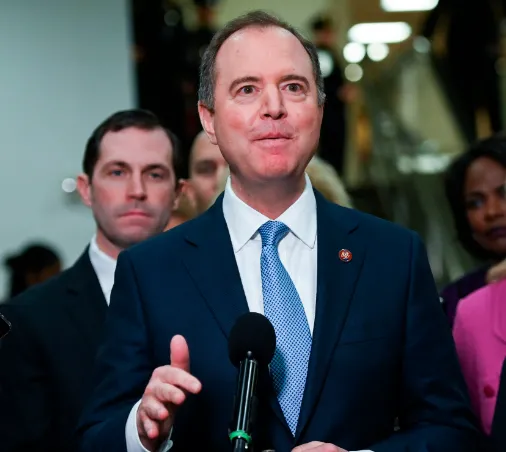
A Democrat whistleblower’s allegations, backed by newly declassified FBI interview reports, are now threatening to upend the political career of Sen. Adam Schiff (D-CA).
If the whistleblower’s account is accurate and prosecutors pursue the case, Schiff could face not only career-ending political consequences but also staggering financial penalties and lengthy prison terms.
As Tolman noted, the legal exposure could multiply quickly: “It depends on the counts in the indictment… The fine is up to $250,000 for every leak that’s charged.”
The claims date back to Schiff’s time in the U.S. House, when he served as the ranking member — and later chairman — of the House Intelligence Committee during the Trump–Russia investigation.
The whistleblower, who worked for Democrats on the committee for more than a decade, repeatedly told the FBI starting in 2017 that Schiff had authorized leaking classified intelligence to the media to damage then-President Donald Trump.
The whistleblower said that in an all-staff meeting, Schiff declared that “the group would leak classified information which was derogatory to President of the United States Donald J. Trump” and that the leaks “would be used to indict President Trump.”
The whistleblower claimed he immediately objected, telling Schiff the plan was “unethical and possibly treasonous,” but was assured by others that “we would not be caught leaking classified information.”
The source informed federal agents that Schiff believed he had received a promise to become the CIA Director should Hillary Clinton win the 2016 election. The whistleblower identified Rep. Eric Swalwell (D-CA) as a likely conduit for the leaks and said he was abruptly fired after raising the issue with the FBI.
Despite the seriousness of the allegations, the whistleblower says FBI leadership, including Director Christopher Wray, did nothing. He claims to have repeated the same account to agents from the bureau’s St. Louis office in 2023, again with no action taken.
Now, former U.S. Attorney Brett Tolman is warning of the potential penalties Schiff could face if prosecutors were to bring charges. In a conversation with political commentator
Benny Johnson, Tolman explained that leaking classified information carries steep financial and criminal penalties.
“Yeah. I mean, the fine is up to $250,000 for every leak that’s charged, so it depends on the counts in the indictment,” Tolman told Johnson. “Also, keep in mind, some of the punishment hinges on the purpose of the classified leak or the possession of classified documentation illegally. The purpose becomes very important.”
Tolman said the context of the leak could prove decisive in determining punishment.
“I believe this was, in essence, the beginning of a conspiracy to take down a president, to impact his ability to lead,” he said. “There are other statutes — conspiracy statutes, interference with official proceedings, et cetera. A lot of people have a question about treason — ‘Is it treason?’ You probably don’t satisfy the elements for treason, but there are some related crimes that could come into play.”
Tolman added that if prosecutors found an intent “to undermine the United States,” the penalties could reach “up to 20 years in federal prison.”
The FBI’s inaction on the allegations fits into what critics describe as a pattern under Director Wray of shielding politically connected figures. Kash Patel, a former Trump administration official, has accused the bureau of ignoring serious misconduct while aggressively targeting political opponents.
Patel has pointed to the FBI’s use of confidential informants ahead of the Jan. 6 protests as proof that the agency had foreknowledge of events but failed to act appropriately.
Schiff has not yet issued a public response to the newly surfaced allegations. In the past, he has denied leaking classified material and characterized such claims as partisan attacks meant to discredit his oversight work.
A nationwide redistricting battle is unfolding, largely encouraged by President Donald Trump, as Republican-led legislatures across several states face growing pressure from the former president and his allies to create additional GOP-leaning congressional districts and solidify the party’s House majority.
In North Carolina, Republican lawmakers advanced a new congressional map, joining a series of states—including Texas and Missouri—undertaking aggressive redistricting efforts ahead of next year’s midterm elections. The proposed map would target the district currently represented by Democratic Rep. Don Davis and give Republicans a likely advantage in 11 of the state’s 14 House seats, up from the current 10.
Once enacted, North Carolina’s new map would bring the number of newly drawn, Republican-favored districts nationwide this year to seven.
Meanwhile, in California, likely 2028 Democratic presidential contender and current Gov. Gavin Newsom is seeking to redistrict his state in a bid to counter the GOP-led effort throughout the country. A ballot issue set for a vote in November will determine whether the state assembly will be able to temporarily sideline California’s independent redistricting commission so that they can add five Democrat-leaning districts.
North Carolina has become the latest GOP-controlled state to launch a mid-decade redistricting effort — a process that has historically been uncommon, CNN reported.
North Carolina Sen. Ralph Hise, a Republican involved in overseeing the redistricting process, emphasized the high stakes of the effort in blunt terms.
“The motivation behind this redraw is simple and singular: draw a new map that will bring an additional Republican seat to the congressional delegation,” he said.
If Democrats take control of the House, they will “torpedo President Trump’s agenda,” Hise noted further, per CNN.
State lawmakers convened their first public meeting on the new congressional map Monday morning and approved the proposal in the state Senate the following day, despite strong opposition from Democrats and protesters who gathered at the Capitol in Raleigh.
The measure now heads to the state House for consideration.
Under North Carolina law, Democratic Gov. Josh Stein does not have the authority to veto redistricting plans, CNN said.
North Carolina remains a battleground state, with Democrats such as Stein and former Gov. Roy Cooper winning statewide elections in recent years. However, Republican leaders this week defended the newly drawn congressional map’s partisan tilt, arguing that it reflects Trump’s continued electoral successes there.
“This new map respects the will of the North Carolina voters who sent President Trump to the White House three times,” the state Sen. Phil Berger, the top Republican in the Senate, said in a statement, according to CNN.
Republican lawmakers in Texas initiated the latest round of redistricting earlier this year with a map designed to create five additional GOP-leaning congressional districts. In Missouri, Republicans approved new district boundaries aimed at adding one more Republican seat to the state’s delegation.
Both maps face ongoing legal challenges, and in Missouri, activists have launched a petition drive seeking to overturn the new plan.
Republicans currently hold a structural advantage in the redistricting process, controlling the governor’s office and both legislative chambers in 23 states, compared with 15 under full Democratic control.
Several other GOP-led states are also considering new congressional maps. In Kansas, lawmakers have allocated $460,000 to fund a potential special session aimed at redrawing district boundaries that could affect the state’s lone Democratic member of Congress, four-term Rep. Sharice Davids.
Calling such a session would require approval from two-thirds of both the state House and Senate.
In Indiana, where Republicans currently hold a 7–2 advantage in the U.S. House delegation, the White House has reportedly encouraged GOP lawmakers in the state legislature to pursue an additional seat held by Democrats. Vice President J.D. Vance has made two visits to the state to discuss the effort with legislators.
Meanwhile, Ohio and Utah—both under Republican control—remain engaged in ongoing redistricting disputes that began prior to Trump’s return to office.