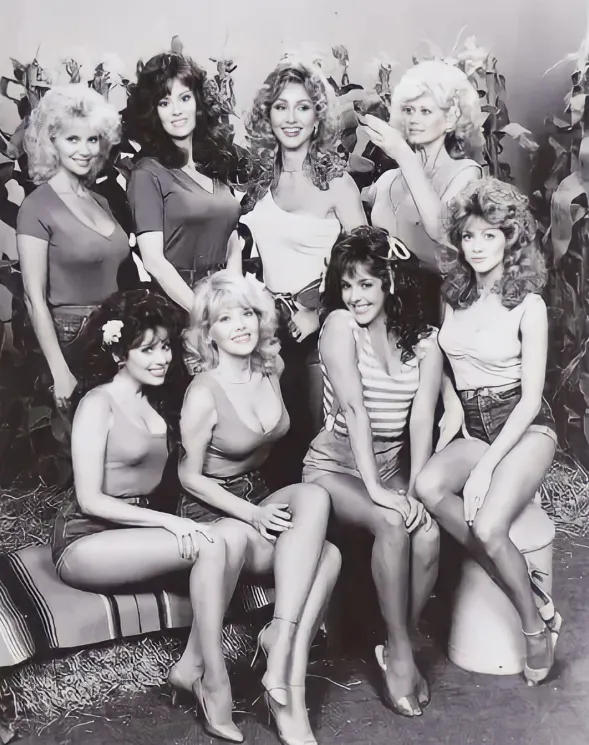
“Hee Haw,” one of television’s most enduring variety shows, remains a vivid memory in the hearts of millions who grew up with its unique blend of humor, country music, and down-home charm. Premiering in 1969, the show arrived at a time when American entertainment was beginning to shift toward more urban and fast-paced programming. Yet, against all odds, “Hee Haw” carved out its own joyful space — a place where laughter came easy, music told stories, and rural life was celebrated rather than mocked.
For those who tuned in every week, “Hee Haw” wasn’t just a TV show; it was a ritual. Families would gather in living rooms across America — often with the aroma of dinner still lingering in the air — to enjoy a program that felt like visiting friends on the porch. The jokes were corny, the gags were simple, and the sets were painted barns and hay bales, but the warmth was real. At a time before high-tech visuals and digital polish, the show’s simplicity became its strength. It radiated sincerity.
The brainchild of Canadian producers Frank Peppiatt and John Aylesworth, “Hee Haw” was often described as a “country cousin” to “Rowan & Martin’s Laugh-In.” It took the variety show format and gave it a Southern twist — replacing Hollywood satire with barnyard humor, and city sophistication with small-town wit. Viewers loved it immediately. Its mix of music, comedy sketches, and catchy one-liners struck a chord with audiences who saw themselves represented on screen.
Hosts Buck Owens and Roy Clark were the heart of the show. With their natural rapport and quick wit, they guided viewers through each episode’s playful chaos. Owens’ dry humor balanced Clark’s charm and musical virtuosity, creating an easy camaraderie that felt entirely genuine. Surrounding them was a cast that became household names — Minnie Pearl with her iconic price-tag hat, Grandpa Jones with his infectious laugh, and the stunning “Hee Haw Honeys” who brought both glamour and humor to the mix.
The musical performances were another cornerstone of “Hee Haw.” Country legends like Dolly Parton, Johnny Cash, Loretta Lynn, Conway Twitty, and George Jones all graced the stage, often performing their latest hits in the same segment where a comedian might pop up from a cornfield to deliver a one-liner. This seamless blending of laughter and song gave “Hee Haw” its unmistakable rhythm — a show that could make you chuckle one moment and hum along the next.
Some of the program’s most beloved recurring bits have since entered television folklore. “Kornfield Jokes,” where cast members popped up among cornstalks to swap puns, showcased the humor of simplicity — clean, clever, and often self-deprecating. “Pfft! You Was Gone,” a recurring singalong sketch, turned heartbreak into hilarity with witty lyrics and audience participation. Meanwhile, “Gloom, Despair, and Agony on Me” exaggerated the blues of everyday life into musical comedy gold, its over-the-top lamentations becoming one of the show’s defining trademarks.
But perhaps the most remarkable thing about “Hee Haw” was how authentic it felt. Unlike many shows of its time, it didn’t rely on scripts polished to perfection or jokes designed by committee. Mistakes stayed in, laughter was often real, and guests were treated more like family than celebrities. The cast’s genuine affection for one another translated directly through the screen, giving audiences a sense of inclusion.
Even after CBS canceled the show in 1971 during what became known as the “rural purge” — a network effort to move away from country-themed programs — “Hee Haw” refused to fade. It thrived in syndication, finding an even larger audience and proving that rural America’s love for the show was more powerful than the shifting trends of television executives. For nearly
two decades, “Hee Haw” remained a Saturday night staple, outlasting many of its flashier competitors.
The show’s influence also extended far beyond entertainment. It helped solidify the role of
country music in mainstream American culture, paving the way for future crossover success stories. “Hee Haw” treated country artists as stars, giving them a national platform long before the Country Music Awards became household events. In doing so, it bridged a cultural gap between city and country, uniting audiences through laughter and song.
For many fans, “Hee Haw” represents more than nostalgia — it embodies a gentler era of entertainment. It recalls a time when television felt communal rather than competitive, when humor was family-friendly without losing its wit, and when artists could laugh at themselves without fear of losing credibility.
Today, clips of “Hee Haw” circulate widely online, finding new generations who appreciate its old-fashioned humor and musical soul. Streaming services have reintroduced the show to younger audiences, many of whom are discovering that its laughter — and its kindness — haven’t aged a day.
“Hee Haw” endures because it reminds viewers of something television rarely offers anymore: a sense of connection. Its world of corny jokes, cheerful songs, and simple pleasures stands as a time capsule of what made American entertainment so deeply human. Long after the lights faded on its stage, its spirit continues to echo — a laughter-filled reminder that sincerity, heart, and a good sense of humor never go out of style.
TV’s political talk landscape exploded last night as Bill Maher, well known for his biting wit and liberal leanings, publicly roasted Congressman Adam Schiff in a segment that left both the studio and the internet in stunned silence.
For years, Adam Schiff has been a darling of progressive cable news, spearheading “Russiagate,” leading impeachment hearings, and transforming himself into both a political lightning rod and late-night punchline. But on Maher’s show, the tables turned in a way even Schiff’s fiercest critics didn’t see coming.
Schiff confidently strode onto Maher’s set, ready to talk policy and defend his record. At first, he was all soundbites: “Trump attack, MAGA threat, democracy at risk.” But Maher, tired of the familiar script, wasn’t content to play along.
“Adam, I see you everywhere talking about Russia,” Maher deadpanned. “But I have no idea what you think about healthcare, or what you’d actually do to make people’s lives better. Are you for Medicare for All, an improved Obamacare, or just giving everyone a chicken and calling it dinner?”
The crowd snickered. Schiff tried to pivot, but Maher cut him off.
.
.
.
Maher went for the jugular. “You spent three years convincing the country that Russia had Trump in its pocket. But when the Mueller Report fizzled, where was the apology? Where was the accountability? All I heard was silence.”
Schiff bristled. “The facts speak for themselves,” he insisted, trying to recapture the upper hand. “Trump’s actions endangered democracy.”
“But Adam,” Maher pressed, “wasn’t all that a massive distraction? Wasn’t Congress obsessed with impeachment hearings when the country was hurtling towards a pandemic? Didn’t your endless investigations cost us time and credibility when Americans needed straight answers?”
No scripted answer was forthcoming. The audience sensed the shift. This wasn’t the typical blue-on-blue softball. Maher was calling him out—in front of millions.
As if Maher’s cross-examination wasn’t enough, Fox News host Greg Gutfeld joined via satellite for a rare TV tag-team. Known for his sarcasm, Gutfeld didn’t hold back.
“You know what I remember, Adam? The endless cable news marathons of you hyping up Russian collusion while real crises were ignored. We were in green rooms talking about a looming virus. The country was about to get walloped by COVID, but you were still running victory laps over impeachment.”
He delivered the knockout: “Who deceives an entire nation for personal revenge? Adam Schiff. And what do we have to show for it? Nothing. No results. Just burned trust and years wasted.”
The live audience was hushed, as if witnessing a public trial rather than a late-night comedy segment.
Maher circled back. “People want real answers, Adam, not just vibes. You’re running for Senate now, but where do you stand on key issues?”
Schiff responded with platitudes and evasions. Maher pounced. “See, that’s the problem. Americans aren’t blind. They’re sick of politicians who can’t give a straight answer—so what’s your plan for healthcare, crime, immigration?”
No direct answer came. The awkward silence stretched, and the crowd felt the weight of political pretense crumbling.
The show turned razor-sharp as Maher asked Schiff about a judge arrested for helping an illegal immigrant evade ICE. Schiff dodged: “I’m not going to comment without more information.” Maher snapped, “Funny how you always have something to say when the script fits—but not when it doesn’t.”
He summed it up: “Outrage for your team, silence for the rest. No wonder trust in government’s shot.”
The climax came with a public reminder: The House had recently censured Schiff, only the 26th time in history, for promoting unfounded claims in the Russia probe. Schiff tried to laugh it off, but the moment echoed the episode’s theme—consequences for deception.
Gutfeld cracked again: “He’s got the only 12-inch neck in Congress but not enough backbone for an honest apology.”
The camera cut to Schiff’s new Senate campaign ad—slick, expensive, and packed with the same vague promises and alarmist rhetoric that Maher had just dismantled. Even liberal Californians, Maher noted, are growing wary of politicians who talk woke but never deliver clarity.
Schiff’s legacy, as Maher and Gutfeld hammered, was years of headlines, hollow claims, and little meaningful progress—a performance, not leadership.
Clips of the segment hit TikTok and X (Twitter) before the show’s credits rolled. Hashtags trended: #MaherDestroysSchiff, #SchiffRoasted, #AccountabilityMatters. Viewers from all sides of the political spectrum called it the moment Schiff “finally faced the music.”
Calls for Schiff to apologize or even step down echoed in the comments. “You fooled America—and the bill just came due,” one tweet read.
As Maher signed off, he declared: “Enough theater. America doesn’t need more actors in Congress. We need leaders with real solutions and the guts to own their mistakes.”
Adam Schiff left the studio quieter and clearly shaken—exposed not by wild conspiracies, but by direct, unrelenting questions and a demand for truth.
And for one night, at least, the crowd in the studio and on the internet agreed: the era of political performance without substance is running out of time.