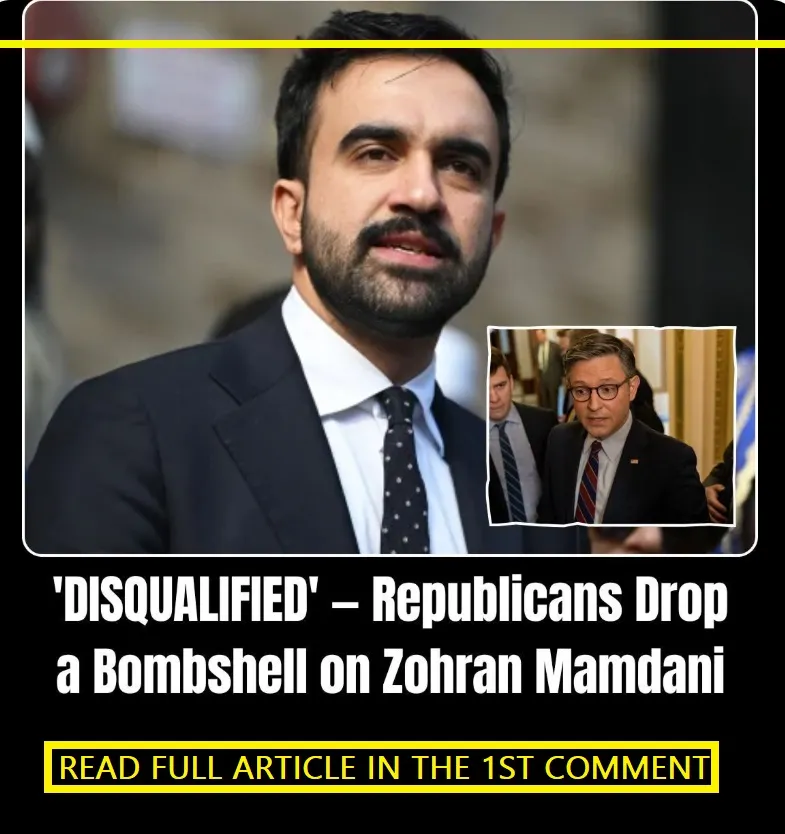
A House Republican lawmaker is moving to cut off federal funding to New York City for the duration of Zohran Mamdani’s tenure as mayor.The proposal, spearheaded by Rep. Buddy Carter (R-Ga.), is titled the Moving American Money Distant from Anti-National Interests Act — or, pointedly, the “MAMDANI Act.”
The bill, which is only two pages, states that “notwithstanding any other provision of law, during any period in which Zohran Mamdani is mayor of New York, New York” that “any unobligated Federal funds available” for the city “are hereby rescinded” and that “no Federal funds may be obligated or expended for any purpose to New York, New York.”
Fox News Digital reported that Carter was expected to introduce the legislation on Friday.The 34-year-old socialist clinched victory in Tuesday’s New York City mayoral race, defeating independent candidate and former Gov. Andrew Cuomo, as well as Republican contender Curtis Sliwa.The outcome came as little surprise to political observers — after all, New York City hasn’t elected a Republican mayor since Michael Bloomberg secured a second term back in 2005.While Carter’s bill stands little chance of advancing in the House, it underscores how sharply focused Republicans have become on Mamdani’s rise. GOP leaders are already framing the newly elected socialist mayor as the face — and future — of the Democratic Party, the New York Post noted.-A House Republican campaign strategist told Fox News Digital on Wednesday that the GOP plans to link vulnerable Democrats nationwide to Mamdani and his far-left agenda.
Carter, who is running for the U.S. Senate in Georgia, added that taxpayer money from his state “should not be wasted on programs that will bankrupt the financial capital of the world.”
“If New Yorkers want communism, we should let them have their wish and not artificially prop them up with our successful capitalist system,” Carter said. “Any New Yorker with common sense is welcome to move to the great, FREE state of Georgia.”
CBF Carousel
Mamdani is already facing backlash over the video he released following his victory over former New York Gov. Andrew Cuomo and Republican Curtis Sliwa.
Following his victory, Mamdani shared a video on X outlining his plans for the transition period, emphasizing that “a lot of work lies ahead.”
The newly elected New York City mayor thanked his supporters and explained that, while he had previously asked them to stop sending campaign donations, he was now encouraging contributions from “working class” residents to help fund the transition. Mamdani said the funds would be used to hire policy experts, strengthen infrastructure, and support the early stages of his administration.
Along with the video, Mamdani wrote, “Thank you, New York City. Together we made history. Now let’s get to work.”
His demand for donations immediately after his election victory sparked backlash online.
“It’s been less than 24 hours since Mamdani won the election & he’s already asking for money. Congratulations New York City, bravo,” one user wrote.
Another added, “Islamist and Communist Mamdani promises ‘free’ stuff. Now he begs for donations?” Yet another person commented, “Already begging for money. What a joke.”
Liberal commentator Van Jones was among those raising alarm at Democratic socialist mayor-elect Zohran Mamdani’s fiery victory speech, noting what he called an instant “character switch” as soon as the election was called.
Jones told CNN that the 34-year-old’s tone was a stark departure from the calm and collected image he showed on the campaign trail.
“I think he missed an opportunity. I think the Mamdani that we saw in the campaign trail, who was a lot more calm, who was a lot warmer, who was a lot more embracing, was not present in that speech,” Jones said on a post-election panel.
“I think his tone was sharp. I think he was using the microphone in a way that he was almost yelling. That’s not the Mamdani that we’ve seen on TikTok and the great interviews and stuff like that.”
The room glowed dimly under a small nightlight, casting soft shadows on the walls. Only the officers’ footsteps broke the silence as they approached the bed. The girl’s parents lay motionless, their faces serene yet unnaturally pale. A faint, unsettling scent lingered in the air.
The first officer stepped closer, checking for signs of life. There were none. He felt a pang of empathy for the little girl standing quietly at the doorway, clutching a worn-out teddy bear. Meanwhile, his partner scanned the room for clues.
The space was neat and orderly. Nothing seemed out of place. No overturned furniture. No broken glass. No signs of struggle. It was as if the couple had gone to sleep—and simply never woke up.
“Ma’am,” the first officer asked gently, “do you remember if your parents felt sick or if anything unusual happened today?”
The girl shook her head, eyes wide. “No… we just watched TV, had dinner, and went to bed. Mom kissed me goodnight, like always.”
The officers exchanged glances, searching for answers. Then, one noticed small, unusual details: two half-full coffee mugs on the bedside table and a tiny pill bottle rolled under the dresser.
“Do you know if your parents took any medication?” the second officer asked softly.
The girl paused. “Sometimes Mom takes something for a headache. Daddy doesn’t like medicine.”
The officers retrieved the pill bottle. It contained a strong sedative and was nearly empty. This discovery suggested a possible accidental overdose—a tragic mistake that changed the direction of their investigation.
“Is there someone you can stay with tonight? A relative or a neighbor?” the first officer asked, crouching to her level.
“My aunt lives nearby,” the girl replied, voice small but steady. “She can come.”
With her permission, the officers called her aunt, ensuring the girl went safely into loving hands. Once the child was secure, they returned to the solemn task of investigating the couple’s untimely deaths.
As a team of investigators arrived for a thorough examination, the officers reflected on the night’s events. The call from a brave little girl revealed the fragility of life and the value of cherishing each moment.
While the full story would eventually emerge, the memory of that night lingered—a poignant reminder of the human stories behind their duty to serve and protect.
In the heart of America’s third-largest city, a political firestorm is raging—and it’s not just the wind that’s making headlines in Chicago. The city’s police force, once the backbone of local order, has openly rebelled against Mayor Brandon Johnson, refusing to comply with his controversial, arguably illegal, executive orders. With National Guard troops rolling in from Texas and the city administration locked in a battle with the federal government, Chicago has become ground zero for the nation’s immigration crisis and a stunning case study in municipal dysfunction.The drama began with a simple, explosive premise: Mayor Johnson, whose approval rating has plummeted into the single digits, signed an executive order creating “ICE-free zones” across Chicago. City property, and even private businesses, were suddenly off-limits to federal immigration agents. The mayor’s message was clear—Chicago police would not cooperate with ICE, and the city would stand as a sanctuary, even if it meant defying federal law. For Johnson, this was a bold declaration of values. For the city’s police, it was an untenable demand that threatened their oath, their safety, and the very rule of law.
The first cracks in Johnson’s authority appeared during a violent weekend of ICE activity. Federal agents, responding to a series of incidents, found themselves boxed in by protesters and vehicles, fearing ambush and forced to deploy tear gas. In one incident, a woman was shot by federal agents after their car was rammed by suspects—a chaotic, dangerous scene that left 27 Chicago police officers caught in the crossfire of chemical agents. The mayor’s office tried to spin the narrative, blaming ICE for “teargassing our police officers,” but Superintendent Larry Snelling quickly set the record straight.
Snelling, a veteran cop with deep Chicago roots, refused to toe the mayor’s line. In a fiery press conference, he dismantled Johnson’s rhetoric point by point. “If you box them in with vehicles, it is reasonable for them to believe they are being ambushed and that this could end in a deadly situation,” Snelling declared, emphasizing that federal agents have the right to use force when threatened. The superintendent’s message was direct: don’t attack law enforcement, don’t interfere with federal agents, and don’t expect Chicago police to arrest ICE officers, no matter what City Hall says.
The audio dispatch from that fateful weekend revealed even deeper divisions. As federal agents called for backup, the chief of patrol ordered Chicago officers to “hold tight for instruction,” then abruptly cleared everyone out. “We’re not responding over there. We’re going to clear out as soon as we can.” The message was unmistakable: Chicago police would not intervene in federal operations, nor would they enforce the mayor’s anti-ICE agenda. Snelling backed his chief, stating, “We do not arrest and cannot arrest federal agents because someone deems what they’re doing is illegal or unlawful.”
The mayor’s ICE-free zones, hailed by progressive activists, became a flashpoint for legal and political conflict. Governor JB Pritzker joined Johnson in condemning the federal deployment of National Guard troops, calling it “unlawful and unconstitutional.” But a federal judge refused to block the deployment, greenlighting the arrival of hundreds of National Guard members from Texas and Illinois. Their mission: protect federal property and personnel from escalating violence and local resistance.
As National Guard convoys rolled into Chicago, the city’s administration scrambled to maintain control. Lawsuits flew back and forth, with state attorneys arguing that federalizing the National Guard was a dangerous overreach. But the federal memo was clear—up to 300 troops would be stationed in Chicago, and local officials had no authority to stop them. The city’s welcoming ordinances and Trust Act, which prohibit police from cooperating with ICE or asking about immigration status, were suddenly at odds with the reality on the ground.
Superintendent Snelling, caught between city hall and the federal government, explained the impossible position his officers faced. “We abide by the law. We don’t make the laws, we uphold them. But let me explain how difficult it is for our officers at times… You’re damned if you do and damned if you don’t.” Snelling’s candor struck a chord with rank-and-file cops, many of whom felt betrayed by an administration more interested in ideology than public safety. The superintendent made it clear: “Although we do not engage in immigration enforcement, we are going to enforce the law when the laws are violated.”
The tension reached a boiling point as protesters clashed with federal agents, barricades were moved, and tear gas filled the air. Chicago police, ordered to stand down, watched as federal agents struggled to control the chaos. Some officers were injured by thrown objects, others by the chemical agents deployed by ICE. The city’s leadership tried to blame the violence on federal overreach, but the facts told a different story. The police were caught in the middle—unable to enforce federal law, forbidden from cooperating with ICE, and increasingly unwilling to follow orders they viewed as illegal or dangerous.
The rebellion within the ranks was no secret. Chicago police had already turned their backs on Johnson at public events, refusing to let him attend officers’ funerals after a series of anti-police remarks and policy blunders. The superintendent’s public statements only fueled the sense of mutiny. “We do not interfere with the duties and responsibilities of federal agents. We don’t have to agree with it. We do not interfere with their orders.” For many officers, this was a matter of principle—the law is the law, and no mayor can rewrite it with a stroke of a pen.
Just as the world slumbered, the ground beneath suddenly roared to life.
Without a hint of warning, the earth convulsed and cracked, sending shockwaves through sleeping towns. Buildings shuddered violently, some giving way entirely.
Barefoot and disoriented, people poured into the streets, their faces etched with fear. What began as a subtle tremor rapidly escalated into one of the most powerful earthquakes the region has seen in years—a terrifying ordeal that had only just begun.
In the early morning hours of Monday, a massive 7.7-magnitude earthquake struck near the China–Myanmar borde
The quake’s epicenter lay a mere 10 kilometers beneath the surface, according to the U.S. Geological Survey, unleashing violent shaking felt across southern China, northern Thailand, and parts of Myanmar.
Tragically, initial reports confirm dozens of lives lost and hundreds more injured, with countless others feared trapped under collapsed structures.
The quake’s reach extended far beyond its epicenter, rattling major northern Thai cities such as Chiang Rai and Chiang Mai, where panicked residents evacuated buildings en masse.
Rescue teams are battling immense challenges—damaged infrastructure, power failures, and broken communication networks—to deliver urgent aid.
Around the clock, emergency responders strive to provide shelter, medical attention, and relief to those caught in the disaster’s wake.
In Summary
As the devastation becomes clearer, the race to save lives intensifies. This powerful quake has left a wide swath of destruction across several countries, underscoring the critical need for swift international cooperation and humanitarian assistance. The hours ahead will be crucial in determining how many can be rescued and cared for…