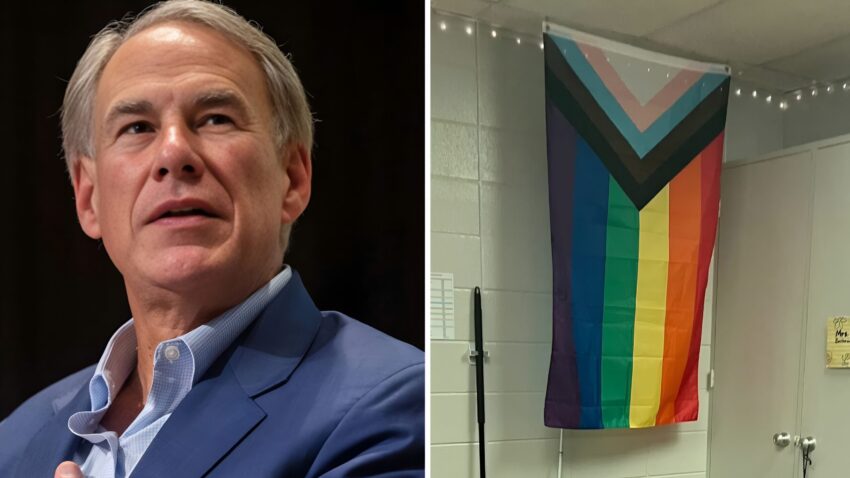
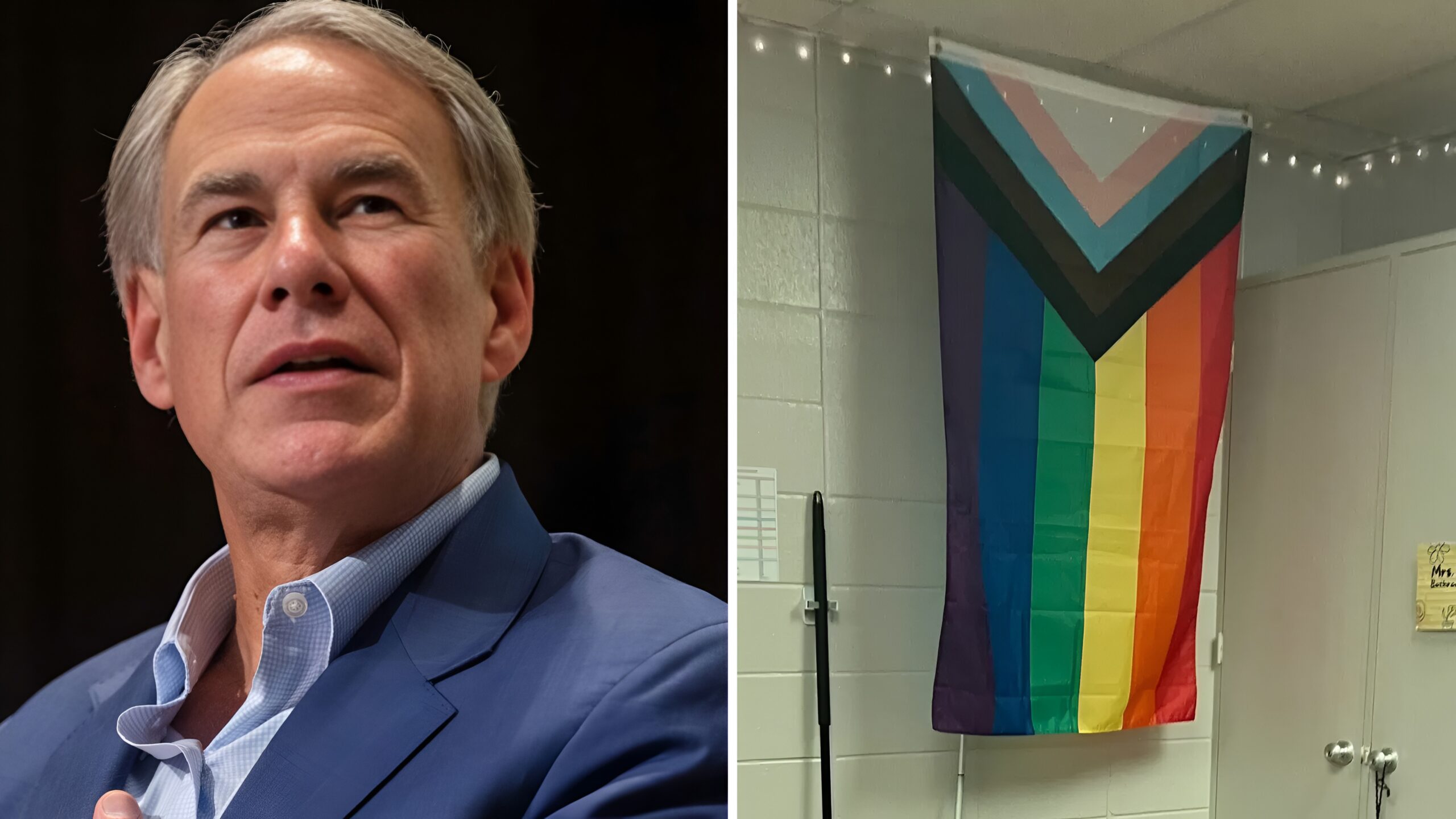
In a move that surprised approximately zero people but still managed to dominate headlines, Texas Governor Greg Abbott held a press conference Wednesday morning to announce his latest crusade: a full statewide ban on Pride flags in public schools.
Standing at a podium flanked by a giant Texas state flag and, curiously, a framed photo of Charlie Kirk, Abbott declared:
“This is Texas, not TikTok. And as long as I’m Governor, the only flags we recognize are the American flag, the Texas flag, and that oversized Dallas Cowboys banner Jerry Jones sent me last Christmas.”
The order comes just days after Utah enacted a similar policy, creating what conservative commentators are gleefully calling the “No Rainbow Coalition.”
Under Abbott’s new directive, classrooms across the Lone Star State will be stripped of rainbow banners, inclusive posters, and anything resembling a unicorn sticker with too much glitter. Schools will instead be encouraged to decorate with “real Texan symbols,” which according to Abbott include oil rigs, steakhouse coupons, and faded portraits of Ronald Reagan.
Teachers, already scrambling to adjust to constant changes, now face yet another set of guidelines. “We just finished removing books from the library,” sighed one Houston English teacher. “Now I’ve gotta tell little Emma she can’t put a rainbow on her art project because it looks too woke? At this point, I’m gonna start teaching kids with finger puppets made out of H-E-B receipts.”
Parents across Texas reacted with a predictable mix of outrage and applause.
Conservative parent groups flooded Facebook with celebratory memes of eagles holding Bibles while stepping on rainbow flags. “Finally, our children can grow up free from indoctrination and go back to learning important things,” one father wrote, “like how to field dress a deer by age 9.”
On the other side, progressive parents expressed concern. “My son just wanted to wear a rainbow pin to show support for his sister,” said a mom in Austin. “Now the school says if he does, they’ll replace it with a pin that says ‘Howdy.’ Like… what exactly is the lesson here?”
To enforce the new policy, Abbott announced the creation of a “Wokeness Patrol,” a special task force of self-described patriots who will wander schools ensuring no rainbows slip through the cracks. Their uniform? Cowboy hats, mirrored sunglasses, and cargo shorts filled with citation slips.
“These are highly trained volunteers,” Abbott explained. “If a child draws a rainbow, they’ll immediately hand them a Texas-themed coloring sheet. Maybe a brisket. Maybe a picture of a pickup truck. Whatever it takes to steer them back to tradition.”
Early reports indicate the patrol has already cited one middle school for allowing rainbow sprinkles on cupcakes during a bake sale. The cupcakes have since been replaced with plain cornbread muffins, described by students as “sad but compliant.”
Utah’s own ban on Pride flags, passed just a week earlier, served as the inspiration for Abbott’s crusade. “When I saw Utah do it, I said to myself, ‘Hold my Shiner Bock,’” Abbott told reporters.
Conservative news outlets are already speculating which state will follow next. Florida’s Ron DeSantis reportedly texted Abbott a congratulatory message reading, “Bro, we’re already banning rainbow fish books down here. Respect.”
Critics argue Abbott’s move is less about protecting kids and more about scoring easy points in the culture wars.
“Greg Abbott banning Pride flags is about as shocking as Greg Abbott eating barbecue,” said one political analyst. “He’s trying to shore up his base by turning classrooms into battlegrounds. But what’s next? Banning Skittles? Outlawing sunsets? Arresting Lucky Charms mascots?”
Satirists online quickly piled on. One viral meme featured Abbott pointing at a child’s drawing with the caption: “No rainbows, Timmy. Only tumbleweeds.” Another quipped, “Texas students now required to pledge allegiance to brisket.”
Unsurprisingly, students themselves are not taking the ban quietly. Across Dallas, San Antonio, and Austin, teenagers staged small walkouts, waving rainbow shoelaces, phone cases, and in one case, a life-sized inflatable unicorn.
One high school sophomore declared, “If they ban flags, fine. We’ll just become the flags. What are they gonna do, suspend us for being colorful?”
The Wokeness Patrol responded swiftly, but their cowboy hats were no match for the swarm of TikTok livestreams broadcasting the protests to millions.
Reaction to Abbott’s announcement rippled across the country.
Former President Donald Trump praised the move, saying, “I love Texas. Great state. They love me. No rainbows, only red, white, and blue, and maybe gold, because I like gold.”
Meanwhile, President Joe Biden chuckled awkwardly when asked by reporters, muttering something about how rainbows were “created by God, man, c’mon.”
Elon Musk, never one to miss a headline, tweeted: “Pride flags banned in Texas schools. Maybe now we can paint Charlie Kirk murals instead. Just saying.” The tweet received 500,000 likes and exactly three angry replies from Mark Cuban.
When pressed about whether his administration would stop at Pride flags, Abbott smirked. “We’ll see. Texas is about tradition. If we have to protect our children from rainbow Goldfish crackers next, we’ll do it. No hesitation.”
His spokesperson later clarified that rainbow-themed cereals, candies, and crayons were still “under review.”
Analysts predict this latest move will boost Abbott’s approval among conservatives while intensifying the cultural divide nationwide. In the meantime, schools are bracing for confusion as they figure out how to handle everything from rainbow graphs in math class to the occasional multicolored umbrella on rainy days.
Texas, never shy about planting its cowboy boot firmly on America’s cultural fault lines, has once again delivered a headline that writes itself.
For some, Abbott is defending children from the terrifying sight of multicolored fabric. For others, he’s turning classrooms into political theater. But for most students? It’s just another day of watching grownups argue about flags while they sneak rainbow bracelets under their hoodies.
Because here’s the truth Abbott forgot: kids are always five steps ahead. Ban the flags, and they’ll turn TikTok into a rainbow flood so massive even the Wokeness Patrol won’t be able to lasso it back.
Until then, Texas will continue to lead the “No Rainbow Coalition,” proving once again that in the culture wars, nothing is too small—or too colorful—to ban.
The 11th U.S. Circuit Court of Appeals handed the Trump administration and Florida Governor Ron DeSantis a political victory this week by halting a lower court ruling that sought to shut down the controversial Alligator Alcatraz detention center in the Florida Everglades.
The case, which pits immigration enforcement priorities against environmental concerns, has become a flashpoint in the broader political battle over border security and federal authority.
Alligator Alcatraz, the nickname given to the detention center, was built on the site of a former airstrip in the Big Cypress Reserve near the Everglades. The Trump administration and Florida leaders authorized the conversion of the airport into a detention site to house migrants facing deportation.
Supporters argue that the location was chosen because it was already heavily developed, with more than 28,000 landings and takeoffs in just six months before the conversion.
Critics, however, claimed the detention center introduced harmful levels of noise, light, and pollution into a delicate ecosystem and violated federal environmental laws because no formal environmental impact statement was conducted before construction.
Last month, U.S. District Judge Kathleen Williams — an appointee of former President Barack Obama — ruled in favor of environmentalists and the Miccosukee Tribe, ordering the closure of the facility.
Her order mandated that detainees be transferred within 60 days and that infrastructure such as fencing, generators, and lighting be dismantled.
Williams cited “light pollution affecting members’ ability to observe the night skies” and “noise pollution impacting members’ ability to interact with wildlife.” She emphasized the absence of environmental reviews and said the state could not continue operating the facility under those circumstances.
On Wednesday, the 11th Circuit Court of Appeals issued a 2-1 decision granting the government’s request to pause Williams’ order. The panel criticized the district court’s reasoning, noting that the site had long operated as a working airport and had significant levels of noise and light pollution even before becoming a detention center.
“In reaching this conclusion, the district court did not mention that, although located in the Big Cypress Reserve near the Everglades, the site was a working airport with close to 28,000 landings and takeoffs in the prior six months alone, bright lights kept on ’24/7,’ and a lack of noise abatement requirements before the site’s conversion to a detention center,” the appeals judges wrote.
The decision effectively allows the detention facility to remain open while the legal battle continues.
The Department of Homeland Security (DHS) welcomed the ruling, calling the lawsuit a smokescreen for open-borders activism.
“This lawsuit was never about the environmental impacts of turning a developed airport into a detention facility,” DHS said in a statement. “It has and will always be about open borders activists and judges trying to keep law enforcement from removing dangerous criminal aliens from our communities, full stop.”
Governor Ron DeSantis immediately framed the ruling as a political win, blasting Judge Williams for judicial overreach.
“Some leftist judge ruled implausibly that somehow Florida wasn’t allowed to use our own property to help the federal government in this important mission because they didn’t do an environmental impact statement,” DeSantis said.
He argued the appeals court’s decision vindicated his administration’s position. “We told people from the very beginning that this was not shutting down — and now the court has affirmed that we were right,” DeSantis said. “So Alligator Alcatraz is, in fact, open for business.”
DeSantis emphasized that the detention center remains a critical part of the state’s and the federal government’s immigration enforcement strategy. “The mission continues on immigration enforcement,” he declared.
The Alligator Alcatraz case has become symbolic of broader political divides. For Trump and his allies, the legal victory represents a rejection of what they call activist judges standing in the way of immigration enforcement.
For Democrats and environmental advocates, it highlights the risks of prioritizing detention expansion over environmental protection and tribal sovereignty.
The appeals court’s ruling also feeds into Trump’s narrative that liberal judges obstruct his administration’s ability to protect Americans from illegal immigration. By contrast, Democrats argue that the administration is using national security as a pretext to sidestep environmental laws and trample on local communities.
The Miccosukee Tribe and environmental groups who filed the lawsuit argue that the detention center endangers the Everglades’ fragile ecosystem. They maintain that the facility’s noise and light pollution disrupt wildlife and tribal traditions tied to observing the night skies.
Despite the appeals court ruling, these groups remain committed to continuing their fight. The case is far from over, and future hearings could still bring new challenges to the detention facility’s long-term operation.
The case illustrates how immigration enforcement has become a battleground for broader issues of law, politics, and governance. On one hand, there are legal arguments over environmental statutes and judicial oversight.
On the other, there are political calculations by Trump and DeSantis, who frame the issue as a fight against liberal judges and activist groups undermining border security.
As the case moves forward, the appeals court’s ruling signals that higher courts may be less sympathetic to arguments based on environmental impact when weighed against federal authority in immigration enforcement.
The Alligator Alcatraz detention facility will remain operational for the foreseeable future, thanks to the 11th Circuit Court of Appeals’ decision to block Judge Kathleen Williams’ order.
The ruling represents not just a procedural win for Trump and DeSantis but a political victory in their broader struggle against what they see as activist interference.
With immigration enforcement still at the center of national politics, the battle over Alligator Alcatraz is likely to continue — but for now, Trump’s agenda and Florida’s priorities remain intact.
Senator Adam Schiff (D-CA), long a prominent Democratic voice on intelligence and national security issues, is facing renewed scrutiny after the emergence of whistleblower allegations that accuse him of authorizing leaks of classified information during his tenure in the House of Representatives.
If substantiated, the claims could expose Schiff to steep financial penalties and potential prison time, threatening to derail his political career and tarnish a reputation built on years of high-profile oversight work.
The controversy arises from newly declassified FBI interview reports and testimony from a Democratic staff whistleblower who served more than a decade on the House Intelligence Committee.
According to these reports, Schiff is alleged to have orchestrated deliberate leaks of classified materials aimed at undermining former President Donald Trump during the height of the Trump–Russia investigation.
The whistleblower claims the events trace back to 2017, when Schiff, then the ranking member of the House Intelligence Committee, addressed an all-staff meeting.
During that gathering, Schiff allegedly declared that committee staff “would leak classified information which was derogatory to President of the United States Donald J. Trump.”
According to the account, Schiff indicated that the leaked material would be used to fuel an indictment against Trump.
The whistleblower said he objected immediately, warning that such a plan was “unethical and possibly treasonous.” However, he recounted being brushed aside by colleagues who assured him that the committee would not be caught leaking.
The whistleblower further claimed that Schiff harbored ambitions of being named CIA Director if Hillary Clinton had won the 2016 election, adding another layer of political motivation to the alleged leaks.
Rep. Eric Swalwell (D-CA), another member of the committee, was identified by the whistleblower as a likely conduit for transmitting the classified information to the media. The whistleblower said that after raising concerns with the FBI, he was abruptly dismissed from his role, a move he interpreted as retaliation.
The whistleblower’s allegations were reportedly delivered to the FBI on multiple occasions. According to Just The News, the first contacts occurred in 2017.
Despite the gravity of the claims, FBI leadership — including Director Christopher Wray — allegedly failed to take action. The whistleblower said he repeated his testimony in 2023 to agents from the FBI’s St. Louis office, but once again, no visible action followed.
This pattern has fueled criticism that the bureau has shielded politically connected individuals while aggressively investigating others. Supporters of this view point to other controversies involving FBI handling of politically sensitive cases, including the bureau’s use of informants in the lead-up to the January 6 Capitol riot.
Kash Patel, a former Trump administration official and frequent critic of the FBI, has argued that the agency has consistently downplayed allegations of misconduct involving prominent Democrats while targeting Trump and his allies. “It fits a pattern,” Patel has said, pointing to what he describes as selective enforcement.
Former U.S. Attorney Brett Tolman has outlined the serious legal risks Schiff could face if prosecutors were to pursue charges. In an interview with political commentator Benny Johnson, Tolman noted that each instance of leaking classified information could carry fines of up to $250,000.
“Yeah. I mean, the fine is up to $250,000 for every leak that’s charged, so it depends on the counts in the indictment,” Tolman said.
Tolman also highlighted the potential for criminal charges beyond the leaks themselves. “I believe this was, in essence, the beginning of a conspiracy to take down a president, to impact his ability to lead,” he explained. In such a case, conspiracy statutes or laws addressing interference with official proceedings could come into play.
Although Tolman cautioned that the elements of treason would likely not be met, he said related offenses could still yield harsh penalties. If prosecutors determined the leaks were intended “to undermine the United States,” potential sentences could stretch to “up to 20 years in federal prison.”
The severity of punishment, he added, would hinge on the context of the alleged leaks — specifically, whether they were meant to influence political outcomes or damage national security interests.
Adam Schiff rose to national prominence through his work on the House Intelligence Committee, first as ranking member and later as chairman. He became one of the Democratic Party’s leading figures during the Trump presidency, particularly in connection with the Russia investigation and the first impeachment inquiry into Trump’s dealings with Ukraine.
Schiff frequently clashed with Republican lawmakers and with Trump himself, who accused him of dishonesty and partisan overreach. Supporters viewed Schiff as a tireless advocate for oversight and accountability, while critics portrayed him as politically motivated and willing to stretch evidence to fit a narrative.
Allegations of leaking classified information are not new to Schiff. For years, opponents have accused him of selectively releasing or framing intelligence to advance Democratic priorities. Schiff has consistently denied those accusations, calling them partisan attacks.
In response to the latest whistleblower claims, Schiff has so far remained publicly silent. He has not issued a statement addressing the declassified reports or the whistleblower’s renewed account. In the past, Schiff has dismissed similar accusations as unfounded political smears aimed at undermining his credibility.
Given the gravity of the allegations — which now come with backing from FBI interview reports — Schiff is likely to face mounting pressure to respond. The claims threaten to overshadow his current role in the Senate and could cast a shadow over any future political ambitions.
The controversy comes at a sensitive moment for Democrats, as questions of government transparency and accountability remain at the forefront of public debate.
For Republicans, the allegations against Schiff provide ammunition to challenge Democratic credibility on issues of national security and intelligence oversight.
If prosecutors were to pursue charges, it would mark a stunning reversal for Schiff, who built much of his political career on calls for accountability and legal scrutiny of political opponents.
The optics of a once-powerful lawmaker facing accusations of conspiring to undermine a sitting president could reshape partisan narratives heading into future elections.
At the same time, the FBI’s alleged failure to act raises questions about the bureau’s impartiality and internal decision-making. Critics argue that if the roles were reversed — with a Republican lawmaker accused of leaking classified materials — the bureau would have acted swiftly.
Whether Congress takes up the issue with renewed investigations remains to be seen.The allegations against Schiff also reopen a broader debate about leaks of classified information, which have become a recurring issue in American politics.
Supporters of whistleblowers often argue that leaks expose government misconduct and promote accountability. Critics counter that unauthorized disclosures can compromise national security and undermine trust in institutions.
During the Trump presidency, a steady stream of leaks dominated headlines, many of them painting the administration in a negative light. While some saw this as necessary transparency, others saw it as evidence of a “deep state” working to sabotage a democratically elected president.
If Schiff is shown to have sanctioned or encouraged such leaks, it would represent a dramatic twist: a lawmaker entrusted with safeguarding sensitive information accused of weaponizing it for partisan gain.
Legal experts caution that even with the declassified FBI reports, moving from allegations to prosecution would require substantial evidence. Prosecutors would need to establish not only that leaks occurred, but also that Schiff directly authorized or facilitated them.
The whistleblower’s testimony, while serious, may not be sufficient without corroborating documentation or additional witnesses.
Still, the possibility of charges cannot be dismissed, particularly given the political climate and renewed focus on accountability for government officials. If prosecutors were to bring a case, it could set a precedent with far-reaching consequences for how lawmakers handle sensitive information.
Congress may also revisit oversight mechanisms, particularly within the Intelligence Committees, to ensure that classified materials are safeguarded and not used for political ends. The episode could spark bipartisan calls for reform, though partisan divides may complicate efforts.
Senator Adam Schiff is confronting one of the most serious controversies of his political career, as whistleblower allegations and declassified FBI reports suggest he may have authorized leaks of classified information to damage President Trump.
While Schiff has yet to respond publicly, the claims carry the potential for devastating legal and political consequences, including massive fines and prison time if proven in court.
Former U.S. Attorney Brett Tolman’s assessment underscores the stakes: each leak could bring a fine of $250,000, and conspiracy-related charges could carry sentences of up to 20 years. The outcome will depend on whether prosecutors view the allegations as credible and whether further evidence emerges.
For Schiff, a figure once central to Democratic oversight of the Trump administration, the irony of facing similar accusations himself is stark. For the broader political system, the episode raises troubling questions about the use of classified information, the impartiality of federal law enforcement, and the line between oversight and partisanship.
As the controversy unfolds, Schiff’s silence will likely give way to mounting calls for accountability. Whether the allegations lead to prosecution, political fallout, or both, they underscore the fragility of public trust in institutions tasked with protecting national security.