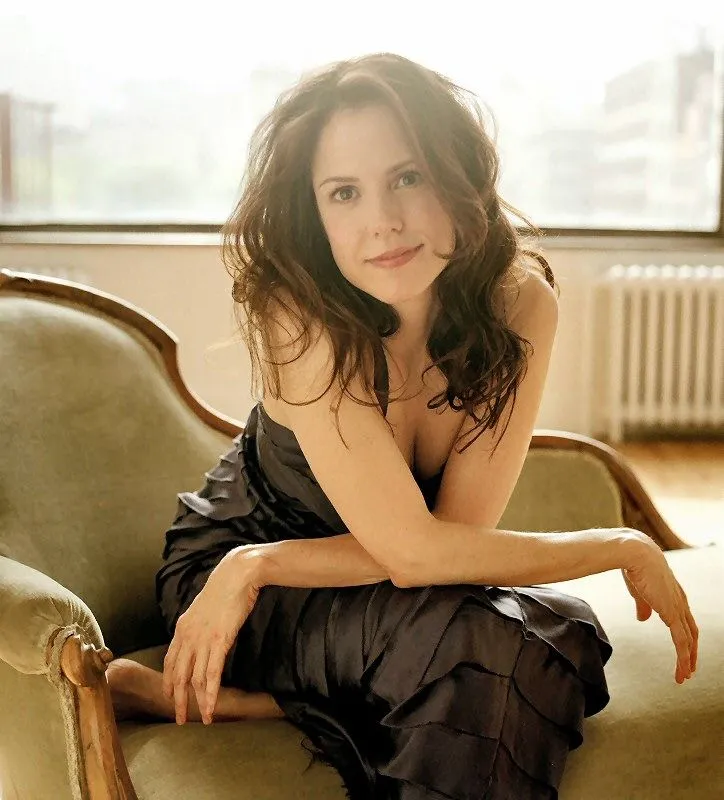
Few performers in modern American entertainment embody both intellect and vulnerability quite like
Born on August 2, 1964, in Fort Jackson, South Carolina, Parker grew up in a military family that moved frequently, giving her a lifelong sense of observation and adaptability. Those qualities would later become her trademarks — the quiet intensity, the subtle intelligence, and the emotional precision that defined her most unforgettable roles.
After studying acting at the University of North Carolina School of the Arts, she moved to New York City and began performing on stage. It didn’t take long for her to stand out. In the late 1980s and early ’90s, she became a fixture of the Broadway and off-Broadway scene, praised for performances that were both raw and cerebral.
Her breakthrough came with the 1990 play “Prelude to a Kiss”, in which she played a young woman whose spirit mysteriously switches bodies with an elderly man. The role showcased Parker’s uncanny ability to blend emotional honesty with surreal circumstances — a quality that would come to define her career. The play earned her a
Hollywood soon followed. In films like “Fried Green Tomatoes” (1991) and “The Client” (1994), Parker brought nuance to supporting roles that might have felt thin in lesser hands. She could communicate a lifetime of feeling with a single look. But while she appeared in numerous films throughout the 1990s, it was on television and the stage that she truly found her artistic home.
One of her early standout television roles came in “The West Wing”, where she played Amy Gardner, a quick-witted political strategist whose intelligence and self-assurance matched — and often outsmarted — the men around her. In a show known for its razor-sharp dialogue, Parker’s delivery was masterful: playful, precise, and laced with a subtle bite. She brought warmth and depth to what could have been a purely intellectual role, turning Amy into a fan favorite.
Then came “Angels in America” (2003) — the monumental HBO miniseries adaptation of Tony Kushner’s Pulitzer Prize–winning play. Parker portrayed Harper Pitt, a fragile Mormon housewife whose addiction to Valium becomes a poetic metaphor for disillusionment and denial. It was a performance of breathtaking sensitivity — alternately funny, heartbreaking, and hallucinatory. She captured both the surrealism and the tragedy of Harper’s journey, earning her a
Critics hailed her as one of the most fearless actresses of her generation. “Mary-Louise Parker doesn’t act,” one reviewer wrote. “She inhabits — not the character’s skin, but her mind.”
A few years later, Parker found an even broader audience — and another unforgettable role — as Nancy Botwin in Showtime’s Weeds (2005–2012). On paper, the premise was outrageous: a suburban mom who turns to selling marijuana after her husband’s death. But in Parker’s hands, Nancy became something more than a comedic antihero — she was a portrait of survival, desire, and contradiction.
Parker gave Nancy complexity: a mother who was both nurturing and reckless, a businesswoman driven by desperation, a woman constantly teetering between control and chaos. Her performance turned Weeds into one of the defining dramedies of the 2000s and earned her a
While television brought her global fame, Parker never abandoned the stage. In fact, Broadway remained the place where she most fearlessly reinvented herself. In
Nearly two decades later, she would return to Broadway and win her second Tony, for “The Sound Inside” (2020), proving that her power had only deepened with time. Critics praised her ability to hold an audience with quiet intensity, describing her performance as “a master class in emotional economy.” Few actors can command a stage by doing so little — or make stillness feel so alive.
But Parker’s artistry doesn’t stop at acting. She’s also an accomplished writer. In 2015, she published Dear Mr. You, a memoir told through a series of lyrical letters addressed to the men who have shaped her life — from her father to past lovers to imagined strangers. The book was met with critical acclaim for its introspective honesty and literary craft. It revealed the same qualities that define her acting: wit, vulnerability, and the courage to explore emotion without sentimentality.
Parker wrote,
“I like to think I live somewhere between the poem and the punchline.”
That line could easily describe her entire career.
Offscreen, Parker is famously private — a rarity in today’s celebrity landscape. She has raised two children, including one with actor Billy Crudup, and speaks openly about the challenges of balancing creativity, motherhood, and solitude. Despite her fame, she’s never courted the spotlight; she’s courted the work.
Her performances, whether on stage or screen, share a common thread: they pulse with intelligence. Not the cold, cerebral kind — but the kind that burns, questions, and aches. Whether she’s crafting lines on the page or delivering them under bright lights, Parker radiates an emotional truth that makes her impossible to look away from.
Today, Mary-Louise Parker stands as one of the few actresses to have earned television’s Emmy, film’s Golden Globe, and theater’s Tony — a rare trifecta of talent that underscores her extraordinary range. But accolades have never seemed to define her. What defines her instead is a restless curiosity — a hunger to keep discovering new corners of humanity through her art.
The image of a Secret Service agent asleep in public while on duty at the U.N. General Assembly, leaving a fully automatic rifle unattended, became a symbol of the agency’s DEI-driven decline under the Biden administration. This agent, overweight and unable to meet fitness standards, had been retained due to politically motivated quotas rather than merit, raising questions about the agency’s ability to protect President Trump.
When Sean Curran took over as director of the Secret Service, he faced an agency undermined by years of cronyism, mismanagement, and DEI priorities that had placed optics over operational readiness.
Curran, a veteran from Trump’s campaign detail, immediately set out to restore the agency’s elite status, focusing on accountability, merit-based promotions, and core mission priorities.
Two assassination attempts on Trump’s life, followed by evasive explanations from the previous leadership, exposed the vulnerabilities created by DEI policies and a lax culture.
Under former director Kimberly Cheatle, initiatives like “30×30” prioritized hiring women to meet quotas, sometimes at the expense of physical fitness and protective experience. Overweight agents who could not pass standard fitness tests were retained, creating obvious security risks.
Curran has shifted the Office of Equity and Employee Support Services back to its original Equal Employment Opportunity mission, eliminating DEI mandates while still addressing legitimate workplace grievances.
Critics, however, continue to scrutinize Curran’s decision to retain DEI advocates like Darnelly De Jesus, who oversee disciplinary actions, citing potential conflicts of interest and lingering influence from prior leadership.
Despite these challenges, the agency has made tangible improvements, creating the Aviation and Airspace Security Division to monitor drones and reallocating resources to ensure threats are prioritized effectively.
Curran has banned uniformed officers from wearing rainbow-colored pride pins or patches and emphasized strict adherence to professional standards, reflecting Trump’s executive order eliminating DEI programs across federal agencies.
Senior agents note that the Secret Service previously accepted underqualified recruits, including those without prior law enforcement experience, leading to weakened operational capability.
Last year, amid fallout from the Butler assassination attempt, the agency attempted to retain agents with bonuses up to 25% of their salaries, but the real problem had been systemic: DEI policies that undermined morale and mission focus.
Veterans like Rashid Ellis publicly blame DEI for the near-assassination of Trump, arguing that gender quotas and diversity initiatives distorted promotions and assignments.
Curran has countered these issues by emphasizing merit-based assignments, ensuring the right person is in the right position, and focusing on protective readiness above all else.
Critics of the prior DEI-focused leadership point to incidents such as the Secret Service sending agents to LGBTQI+ conferences overseas during peak campaign periods, distracting from protective duties.
Curran’s reforms also include reestablishing rigorous fitness standards and restoring the traditional pathway to leadership through presidential protective assignments.
While Curran has kept some former Cheatle deputies in leadership, their roles are being recalibrated to align with operational priorities rather than political quotas.
The agency has successfully thwarted threats against Trump and other officials, including arrests for assassination plots and the discovery of a suspicious hunting stand near Air Force One.
Nevertheless, some embarrassing incidents persist, such as missing firearms during security checks or internal disputes among officers, reflecting the legacy of DEI-driven mismanagement.
Sen. Marsha Blackburn has criticized prior DEI policies for diverting focus from the Secret Service’s essential mission: protecting those under threat.
Under Trump and Curran, the Secret Service is now undergoing a transformation similar to reforms in the U.S. military under Secretary of War Pete Hegseth, who eliminated woke initiatives and restored a warrior ethos.
Hegseth’s reforms, emphasizing physical fitness and meritocracy, have revitalized military recruitment and retention — a model that Curran seeks to replicate within the Secret Service.
Trump’s administration has made clear that identity-based hiring, diversity quotas, and politically correct displays have no place in agencies charged with protecting the president.
Curran’s quiet, disciplined approach has focused on tangible results rather than media appearances, reinforcing operational excellence and morale within the ranks.
Agents on Trump and Vice President JD Vance’s details face some of the longest hours and toughest schedules, but Curran’s reforms aim to ensure they are properly trained, supported, and assigned based on skill rather than DEI metrics.