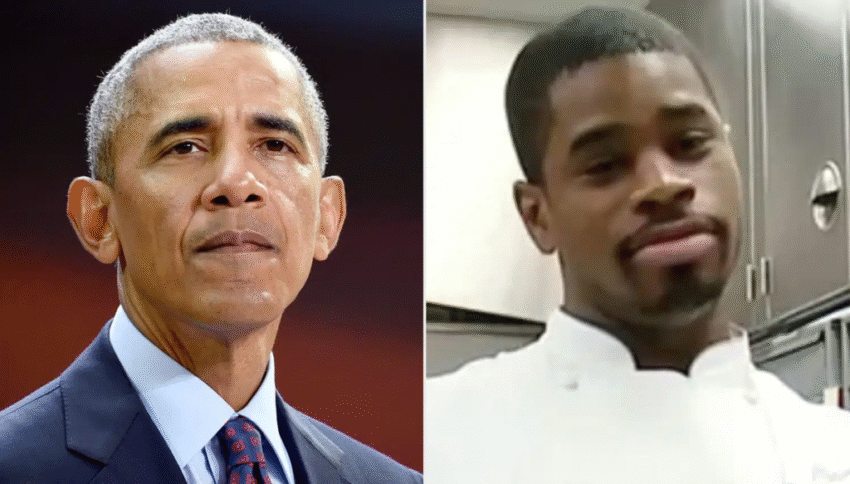
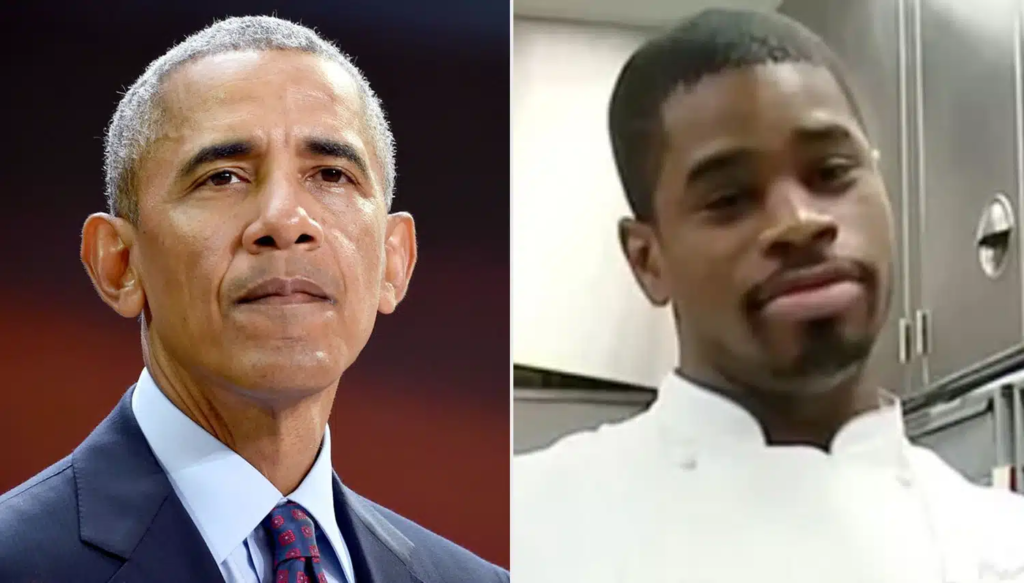
Former President Barack Obama is at the center of potentially damning new details uncovered by a government watchdog organization that will no doubt create new questions surrounding the death of the former first couple’s chef earlier this fall.
The findings, which Judicial Watch discovered through Freedom of Information Act filings, also involved Secret Service agents assigned to the Obamas’ Martha’s Vineyard residence, according to Fox News host Jesse Watters.
“And now we are finding out the Secret Service did not perform well the day Obama’s chef drowned in Martha’s Vineyard,” Watters began. “Judicial Watch got its hands on documents that revealed the female companion that was paddle-boarding with [chef] Tafari Campbell when he died, goes by Ms. Taylor.
“And when Ms. Taylor tried to get Secret Service’s help to find Tafari right after he went under, two agents tried to start one of the boats, but had difficulties lowering the motor, so another agent went to get the keys for their Secret Service boat, and then when they got them, the boat wasn’t working either,” Watters revealed, citing the Judicial Watch materials.
“So they wasted precious time on boats that didn’t work. Until they commandeered the groundskeeper’s boat, and by that time, there was no sign of Tafari Campbell,” the host continued before tying the former president to the new findings.
“Another interesting nugget from those documents was that when Ms. Taylor sat for her interview with the police, it was conducted in Barack Obama’s office. It appears that he sat in on their interview,” Watters claimed. “That is not proper procedure. Your boss sits in the room and watches you during your police interrogation?
“Your boss, Barack Obama, sits next to the one person who witnesses the other employee’s death? Wait. Maybe they do things differently in the Vineyard. We definitely know Secret Service does things differently,” he added
Watters has been all over this story since Campbell tragically drowned near the Obama’s home over the summer.
In mid-October, then-newly released documents obtained through a FOIA request revealed that, while more information about Campbell’s death, they have also led to additional questions.
“According to the report, Obama was on the scene shortly after Campbell went missing,” Watters said. “The report also states an unnamed female staffer jumped into the water when Tafari fell off his board, but it was already too late. He disappeared.”
“We also now know that Secret Service has surveillance footage of Campbell from Obama’s compound moments before he entered the water,” the host said.
“So we’re going to see if we can get that, and we may have that for you. Again, we’re very, very sorry for Tafari’s family. That was a serious, serious tragedy,” he said.
That information was also obtained by Judicial Watch and posted to the organization’s website. Many of the key figures and places in the report were redacted, however.
“The documents were produced to Judicial Watch in response to a July 25, 2003, Massachusetts Public Records Law request for all records relating to the death of Campbell,” the group said.
“The documents show Campbell’s family told police that he had taken swimming lessons in 2019 but described his ability as ‘not a great swimmer.’ The drowning occurred in Edgartown Great Pond, which Massachusetts Environmental Police estimated ‘to be approximately seven to eight feet deep,’” it said.
“The records also show a female eyewitness, an Obama employee whose name is redacted, told state police that she saw Campbell ‘fall off his paddleboard, began splashing and became extremely panicked, yelling for help and subsequently went underwater very quickly.’ By the time she reached his paddleboard, the witness said Campbell had ‘disappeared into the extremely murky’ water,” Judicial Watch added.
The group also said that, according to the records, “Barack Obama arrived at the emergency response scene via motorcade.”
“The next morning, the eyewitness was interviewed in the Obama residence, seemingly with Barack Obama again present,” Judicial Watch noted.
For years, one name haunted the political establishment — a man once praised as incorruptible, later accused of weaponizing the highest law enforcement agency in the nation.
Now, that same man faces a criminal indictment.
And in the hours after the news broke, a powerful message echoed across Fox News: “The weaponization of the legal system has ended.”
Those words came from Attorney General Pam Bondi
, who appeared on Hannity Friday night — a segment that instantly went viral, not only for her fiery tone but for what it symbolized.
A turning point. A reckoning. The end of an era that had once placed former FBI Director
James Comey at the center of American politics.
When the Justice Department confirmed the indictment Thursday afternoon, it sent shockwaves through Washington.
Comey — the man whose public image once rested on a reputation for integrity — now stood accused of
lying to Congress and obstructing an investigation.
Two felony counts.
One fallen icon.
And a nation watching.
For many Americans, especially those who had followed the saga of the Russia probe from the beginning, the moment felt surreal.
How had the country gone from lionizing James Comey as a defender of democracy to seeing him booked on federal charges?
Bondi’s answer was blunt.
“You shouldn’t be nervous any longer,” she told Sean Hannity. “Because Donald Trump is in office — and the weaponization has ended.”
Her words cut through the noise.
Bondi’s statement wasn’t just a soundbite — it was a declaration.
For years, conservatives had accused the FBI and DOJ of becoming political weapons, targeting Trump and his allies while protecting the Washington elite.
Comey, who once led the FBI during some of the most divisive political investigations in modern history, had become a symbol of that imbalance.
Now, Bondi was promising accountability.
“Whether you’re a former FBI director, whether you’re a former head of an intel community, whether you’re a current state or local elected official, whether you’re a billionaire funding organizations to try to keep Donald Trump out of office — everything is on the table,” she said.
Her message was clear: no one, not even a man who once ran the FBI, would be above the law.
It’s been almost a decade since Comey first dominated national headlines.
In 2016, he was the man who publicly reopened the investigation into Hillary Clinton’s private email server just days before the presidential election — a move that infuriated Democrats and stunned the media.
Months later, he became the man who helped ignite the Russia investigation, authorizing the use of the Steele dossier, a collection of unverified claims about then-candidate Donald Trump’s alleged ties to Moscow.
That dossier, now widely discredited, became the backbone of Crossfire Hurricane, the FBI’s 2016 probe into Trump’s campaign.
The investigation dragged on for years, damaging public trust and deepening the partisan divide.
When Trump fired Comey in May 2017, the political world erupted. His dismissal became the catalyst for the appointment of Special Counsel Robert Mueller, whose two-year investigation ended without charging Trump or any of his aides with collusion.
But the damage was done — and Comey’s name became forever linked to one of the most controversial chapters in U.S. political history.
According to the indictment filed Thursday, Comey faces two federal charges:
One count of making a false statement within the jurisdiction of Congress
One count of obstruction of a congressional investigation
Prosecutors allege that Comey lied under oath when he claimed during a 2020 Senate Judiciary Committee hearing that he had not authorized anyone at the FBI to act as an anonymous source for media leaks.
They also accuse him of obstructing a congressional inquiry into the origins of the Russia investigation by concealing evidence and misleading lawmakers about the FBI’s use of the Steele dossier.
If convicted, Comey could face up to 10 years in federal prison.
But beyond the legal implications, the indictment has reignited a national debate — one that stretches far beyond the courtroom.
When news broke that Michelle Obama, former First Lady and global icon, was suing Senator John Kennedy of Louisiana for defamation, Washington’s political ground seemed to quake. No longer was this a matter of partisan sniping or social media feuds. This was a real legal filing, with Michelle’s name stamped at the top, dragging a seasoned Republican senator into court over words she claimed crossed the line.
Cable networks scrambled for coverage; courthouse steps filled with protesters and supporters from both camps. The stakes were clear: if Michelle won, she would set a new precedent for protecting public figures from reckless public statements. If Kennedy prevailed, the case would reinforce the power of elected officials to question even the most untouchable icons.
But as the trial unfolded, it became apparent that this was not just a legal battle—it was a collision of legacies.
The New Orleans courthouse was electric with anticipation. Michelle Obama arrived with her trademark poise, surrounded by a team of high-powered attorneys. Her composure was legendary, her public image carefully curated over years of advocacy and diplomacy.
Across the aisle, Senator Kennedy sat with a calm resolve. Known for his blunt honesty, Kennedy had built his career on speaking uncomfortable truths, often ruffling feathers on both sides of the aisle. His defense was simple: his comments about Michelle were not slander, but questions—questions he argued were necessary for transparency in public life.
As the clerk called the case, every eye turned toward the front. This was not just another lawsuit. It was a test of reputations, a duel between two radically different philosophies on power and accountability.
Michelle’s legal team painted Kennedy as reckless, a man whose words blurred the line between truth and fiction. “This is not about politics,” her lead attorney declared. “It is about accountability. It is about protecting the integrity of a public figure.”
Kennedy’s defense, led by attorney Marcus Hail, countered with fire. “This case is not about protecting dignity. It’s about silencing a voice—a voice that has asked tough questions about influence and power. Senator Kennedy did not invent anything. He said what millions of Americans were already asking.”
The tension was palpable. Legal experts debated the burden of proof for defamation, while journalists dissected every gesture, every whispered aside between attorneys. The outcome would not only decide the fate of two powerful individuals but would serve as a referendum on the limits of free speech in American politics.
For weeks, the trial seemed locked in a stalemate. Michelle’s team presented evidence of Kennedy’s remarks, arguing they were calculated to inflict harm. Kennedy’s defense hammered home the importance of scrutiny and transparency, claiming that punishing public criticism would weaken democracy itself.
But everything changed when Marcus Hail called an unexpected witness to the stand: Thomas Riley, a former adviser involved in several high-profile charitable initiatives.
Riley’s testimony lasted less than ten seconds, but its impact was seismic.
“Yes,” Riley said, when asked if Michelle Obama had been directly involved in negotiations that were later shielded from public scrutiny. “She was present during several closed-door meetings. She didn’t just sit silently. She spoke. She advised. In some cases, she pushed deals forward.”
The courtroom fell silent. Reporters scrambled to file stories. Even the jury seemed stunned by the revelation. For years, Michelle’s image had been one of graceful detachment from Washington’s chaos. Riley’s words shattered that narrative, suggesting a level of involvement—and influence—that her team had long denied.
Within minutes, Riley’s nine-second testimony was clipped, subtitled, and broadcast across every major news outlet. Cable anchors replayed it in slow motion; commentators dissected every syllable. Hashtags tied to the trial trended worldwide.
Outside the courthouse, chaos reigned. Protesters surged against barricades, chanting louder than ever. Police presence doubled to keep tempers from boiling over. Inside, Kennedy’s team celebrated quietly, knowing Riley’s words had flipped the narrative.
For Michelle Obama, the impact was devastating. Her attorneys scrambled to discredit Riley, calling him a disgruntled ex-associate. But the damage was done. The image of the former First Lady as uninvolved and above the fray had been irrevocably cracked.
The public reaction was immediate and intense. Some rushed to Michelle’s defense, arguing that Riley’s testimony was unreliable. Others hailed Kennedy as a champion of free speech, praising his courage to stand up to power.
On social media, videos of Kennedy walking confidently down the courthouse steps went viral, paired with captions like “fearless” and “unbowed.” Clips of Michelle leaving under heavy security circulated with hashtags suggesting secrecy and scandal.
Even late-night television weighed in. One host quipped, “When your 9-second cameo in a courtroom destroys a defamation case, you deserve a medal—or at least a Netflix special.”
After days of deliberation, the jury returned its verdict: in favor of Senator John Kennedy. The courtroom erupted in muffled cheers. Michelle Obama sat frozen, her composure unbroken, but her eyes flickered with the recognition that her case—and her gamble—had collapsed.
Kennedy did not gloat. He simply closed his eyes for a moment, as if to say, “I held the line.”
Outside, he addressed the crowd briefly. “This wasn’t about me,” he said, his voice echoing through the microphones. “This was about the right to speak, the right to ask hard questions, and the responsibility we all have to demand honesty from those in power. If we give that up, we give up our democracy.”
His words traveled far beyond New Orleans. Editorials praised his courage; even critics admitted Kennedy stood firm under pressure. Michelle Obama stayed silent, but the public had already judged in Kennedy’s favor.
The trial was no longer just about defamation. It was about truth, perception, and the price of trying to use the courts as a weapon. The lesson was clear: words matter. They can wound or heal, but silencing them is more dangerous than facing them.
Kennedy’s calm exit symbolized victory not just for him, but for the principle of free speech itself. He had stood against power—and power blinked first.
As the dust settles, America is left grappling with the fragile balance between reputation and expression. The echoes of those nine seconds will reverberate for years, shaping debates about truth, accountability, and the right to speak freely.
Michelle Obama’s legacy may have been cracked, but the conversation she sparked will endure. And for John Kennedy, the trial was more than a legal victory—it was a reaffirmation of the power of fearless speech in a democracy that depends on it.
Mike Johnson’s confirmation ends weeks of political deadlock and opens a new chapter for congressional leadership. His narrow approval followed tense negotiations, with lawmakers and citizens alike hoping it signals renewed stability in Washington.
A disciplined and methodical figure, Johnson is praised by supporters as a steady hand focused on fiscal responsibility and national defense. Critics, however, warn that his conservative approach may deepen divides rather than bridge them. His leadership will immediately be tested by urgent fiscal debates and policy decisions affecting millions of Americans.
Reactions nationwide reflect both hope and caution. Many see Johnson’s rise as an opportunity to restore purpose and cooperation in government, while others fear renewed partisanship. Whether his tenure brings unity or further division will depend on his ability to balance principle with pragmatism in the challenging months ahead.
The official confirmation of Mike Johnson marks a defining moment in the evolving story of American politics. Rising from relative obscurity to one of the most powerful positions in Washington, Johnson now faces the monumental challenge of leading a deeply divided nation through an era of political tension, economic uncertainty, and shifting global power dynamics.
A Leader Shaped by Conviction and Faith
Mike Johnson has long been known for his deeply rooted conservative beliefs and his unwavering commitment to constitutional principles. His career reflects a consistent focus on defending what he views as traditional American values — faith, family, and freedom. Supporters see him as a principled leader with a moral compass that could bring integrity and discipline back to Washington politics. Critics, however, question whether his rigid ideology might limit his ability to reach across the aisle and find bipartisan solutions.
Johnson’s background as a constitutional lawyer and his long-standing advocacy for religious freedom are expected to influence his legislative agenda. He has often spoken about America’s need to return to its founding ideals — emphasizing limited government, fiscal restraint, and respect for individual liberties.
Economic and Fiscal Challenges Ahead
At the forefront of Johnson’s new role lies one of America’s most pressing issues: the economy. With rising national debt, inflation concerns, and ongoing debates over government spending, Johnson has vowed to restore fiscal discipline. His approach is expected to include reducing federal expenditures, promoting economic efficiency, and encouraging private-sector growth.
However, achieving these goals won’t be easy. He will need to navigate complex negotiations with both parties to pass a sustainable budget plan while avoiding further government shutdowns — a test that will likely define the early months of his tenure.
Rebuilding Trust in Government
In an era where public confidence in government institutions is at an all-time low, Johnson’s ability to restore credibility and transparency could shape his legacy. He has promised to increase accountability in Congress and prioritize legislation that directly benefits working-class Americans.
His challenge will be to demonstrate that leadership grounded in faith and principle can also be pragmatic and inclusive — capable of addressing issues such as healthcare reform, border security, and education without alienating moderate voters.
A Divided Nation Looks for Direction
Perhaps the greatest test of Mike Johnson’s leadership will be his capacity to unite a fractured political landscape. With the 2024 presidential election on the horizon, partisanship in Washington remains fierce. Johnson must find a way to balance the expectations of his party’s conservative base with the broader demands of a diverse electorate seeking stability and progress.
If he succeeds, he could emerge as a transformative figure who bridges divides and restores order to a gridlocked system. If he fails, his tenure could deepen America’s political polarization — a risk that many observers are watching closely.
The Global Dimension
Beyond domestic policy, Johnson will also have to assert his leadership on the global stage. America’s relationships with China, Russia, and its NATO allies are in flux, and the country’s role in global security is being redefined. His stance on foreign policy, trade, and defense spending will reveal whether he intends to pursue a more isolationist or interventionist path.
Looking Ahead
Mike Johnson’s confirmation symbolizes both renewal and uncertainty. It represents a chance for change — a promise to bring faith, discipline, and a new vision to the heart of American governance. But it also raises critical questions about the balance between ideology and practicality, conviction and compromise.
As America watches his first major moves in office, one thing is certain: Mike Johnson’s leadership will play a pivotal role in shaping the future of the United States — not just for his term, but for a generation to come.
Rep. Tim Burchett drops a MOAB—mother of all bombs—confirming that Biden staffers were taking payoffs in exchange for autopen pardons.
I think we’re on safe ground to say that we now know former President Joe Biden was not in any sort of fit mental state during his final year in office, and likely long before that. This is beyond dispute.
On Friday, we had the audio from Biden’s interview with special counsel Robert Hur leak; if you haven’t listened to it, it’s devastating, since it depicts a man much farther gone mentally than the transcripts of the interview did, and the transcripts were already bad.
On Tuesday, the most thorough look into Biden’s mental deterioration — “Original Sin: President Biden’s Decline, Its Cover-up, and His Disastrous Choice to Run Again,” by CNN’s Jake Tapper and Axios’ Alex Thompson — was released, confirming that even before his 2020 presidential run, serious questions about his mental capacity existed, and an inner circle of trusted staffers not only protected him but effectively made important decisions for him.
This all raises the question, then: What about everything signed with the autopen — the electronic device used to affix the president’s signature to documents he’s approved but will not personally put his John Hancock on — during the final years of Biden’s presidency?
Tennessee GOP Rep. Tim Burchett would certainly like some answers about that, particularly health.
Promoted Content BREAKING / CHUCK SCHUMER CALLS FOR “FORCEFUL UPRISING” AGAINST TRUMP ADMINISTRATION
CHUCK SCHUMER CALLS FOR “FORCEFUL UPRISING” AGAINST TRUMP ADMINISTRATION — YES, REALLY 
The same man who spent the past four years weaponizing the justice system, cheering lawfare, hoaxes, and political prosecutions… is now crying “tyranny.”
In a wild rant, Senate Minority Leader Chuck Schumer called on Americans to literally “forcefully rise up” against the Trump administration:
Schumer: “It is now just a hallmark of tyrannical, autocratic dictatorship societies that they use the prosecutorial department as a political weapon. It is a disgrace and every American… should be forcefully rising up against this.”
You can’t make this up.The party that:
Launched two fake impeachments 
Spied on a sitting president
Censored citizens on social media
Jailed political opponents
And shut down the government to fund healthcare for illegal aliens
…is now pretending to be the victim of “authoritarianism.”
Schumer doesn’t want accountability — he wants an uprising because Trump is finally draining the swamp and enforcing the law equally.
If a Republican said what Schumer just did, the FBI would already be knocking on their door.
The Democratic Party has become a criminal enterprise, and Chuck Schumer just gave America the proof — on camera.
Kentucky Sen. Rand Paul Commits Ultimate Betrayal Of President Donald Trump – PRIMARY This RINO
Sen. Rand Paul (R-Ky.) announced that he will support his fellow libertarian-leaning colleague, Rep. Thomas Massie (R-Ky.), in his upcoming primary race against a challenger endorsed by President Donald Trump.Trump threw his support last week behind Ed Gallrein, a former Navy SEAL and outspoken loyalist, after calling for a 2026 primary challenge to Massie. The congressman has repeatedly pressed the administration to release all remaining files related to the Jeffrey Epstein investigation, Fox News reported.
Tens of thousands of pages of Epstein files have been released, however.Massie has frequently broken with Trump and GOP leadership on key issues, including voting against the president’s summer spending bill and asserting that Trump must obtain congressional authorization before engaging in military action.
Paul, who has taken similar positions, also opposed the spending measure in the Senate and has criticized the administration for conducting military strikes without approval from Congress.
Paul is now endorsing Massie’s re-election campaign and is committed to helping him retain his House seat.
“Thomas Massie is going to win,” Paul told POLITICO. “I’m going to help him. I’m going to be with him every step of the way.”
Paul described Massie as an “independent voice” within the Republican Party, noting his frequent breaks with GOP leadership. However, he emphasized that both he and Massie still back President Trump’s agenda “significantly more” than many other Republicans who have sought to align themselves closely with the president.
“The people who’ve gotten close to him who want regime change in Venezuela and want to send more advanced weaponry to Ukraine, those are the interventionists from the interventionist wing of the party who have never been the ones really closely allied,” Paul said. “These are the people who have always opposed Donald Trump.”
Paul said he and Massie will continue to push for “enumerated powers” as well as “balanced budgets, low taxes and less foreign war.”
The Kentucky senator warned that Trump’s decision to single out Massie should concern all Republican lawmakers, emphasizing that taking positions contrary to the president’s agenda could carry political repercussions.
“It’s a warning sign,” he said. “‘Oppose me or any of my policies, and I’ll come after you.’ And I don’t think that’s good for the Republican Party, nor do I think it’s good for the country.”
The senator added that he is frustrated with being treated as the Republican Party’s “whipping boy,” saying many of his colleagues rely on him “to do their job for them” when they are unwilling to tell Trump that his nominees lack sufficient support in the Senate, Fox News reported.
“They say, ‘Oh, well, you’re not afraid of the president. You go tell him his nominee can’t make it,’” Paul said. “So, I’m just tired of always being the whipping boy. I’m tired of [being] the only one that has any guts to stand up and tell the president the truth.”
Paul has also faced criticism from President Trump in recent months but has continued to stand his ground. Most recently, he has spoken out against the administration’s military strikes on boats it claims—based on intelligence—were carrying narco-terrorists.
The senator expressed concern over the lack of due process and the potential for innocent people to be killed in such operations. He pointed to Coast Guard data indicating that a significant percentage of vessels boarded on suspicion of drug trafficking turn out to be innocent.
Earlier this week, Paul disclosed that he had not been invited to a White House luncheon with other Republican senators, reportedly due to his ongoing disagreements with President Trump. He noted, however, that he already had a “Liberty Caucus Lunch” scheduled with Rep. Thomas Massie at the same time.
Paul recently campaigned alongside Massie and said he intends to join him again on the campaign trail in the near future, Fox added.