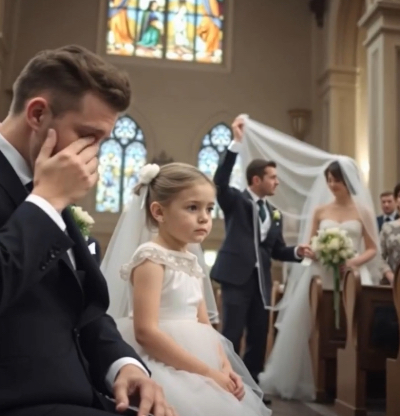
 The face beneath the veil was that of Emily, my late wife—at least that’s how it appeared to me. Her eyes, the same shade of deep blue, held an expression I hadn’t seen in years, an expression I thought I’d never see again. My mind fought against the logic of it all. Emily was gone, and I knew that, so who was this woman standing before my best friend, about to pledge her life to him?
As I sat there frozen, a flurry of emotions flooded through me—joy, disbelief, confusion, and an overwhelming sense of longing. My heart raced, each beat a question unanswered. Was this some sort of cruel trick my mind was playing on me? Was this grief manifesting itself in the most tangible of illusions?
I looked around, wondering if anyone else saw what I did. But the guests were smiling, oblivious to the storm raging within me. Daniel’s family and friends beamed with happiness, their eyes fixed on the couple at the altar. Lily, still tugging at my sleeve, sensed my turmoil but couldn’t comprehend its cause.
I knew I had to pull myself together for her sake, for Daniel’s sake. Yet, the resemblance was uncanny. Maybe it was a relative of Emily’s that I had never met, a cousin perhaps, or a distant family member. But why hadn’t Daniel mentioned anything? Why hadn’t I noticed before?
As the ceremony proceeded, I struggled to keep my composure. Each vow exchanged was a reminder of the vows I had once taken. Each glance the couple shared was a reflection of the love Emily and I had known. I was trapped in a surreal moment where time seemed to both stand still and rush past me like a river of memories.
After the ceremony, I managed to approach Daniel during the reception. I tried to mask my turmoil with a congratulatory smile, but my voice betrayed me when I spoke. “Daniel, the resemblance… it’s remarkable. Who is she?”
Daniel laughed, misunderstanding my question. “She’s Mary, my Mary,” he said, his eyes twinkling with the joy of a man who had just married the love of his life. “Why, do you think she looks like someone?”
I hesitated, unsure of how to voice what was on my mind. Finally, I simply nodded. “She looks so much like Emily.”
Daniel’s expression softened, and for a moment, he looked at me with a mix of sympathy and understanding. “I see it now,” he said quietly. “You know, when I first met her, I thought the same thing. But she’s her own person, unique in so many ways.”
Suddenly, the truth of his words hit me. Mary was not Emily, but perhaps she was a reminder—a gentle nudge from the universe that life continues, that love can find a new form, even amidst loss. As I watched Lily dance with other children at the reception, her laughter like a balm to my aching heart, I realized that this moment was not about clinging to the past, but about embracing the present.
In that realization, I found a strange sense of peace. My world had been shaken, yes, but it had also been given a chance to heal in unexpected ways. As I looked at Mary again, this time through clearer eyes, I saw not the ghost of a love lost, but the beauty of a new beginning—for Daniel, for Mary, and perhaps, in some small way, for Lily and me as well.
They told her she’d never make it as a lead. Her accent was too strong, her heritage too specific, her presence too unconventional for a system that, for decades, boxed Latina women into one-dimensional roles. But Salma Hayek refused to accept those limits. With ambition as fierce as her screen presence, she fought battles few could see, broke barriers many believed unbreakable, and in the process, redefined what it meant to be a Latina in Hollywood.
Born in Coatzacoalcos, Mexico, Hayek was the daughter of a Lebanese-Mexican oil executive father and an opera-singing mother. From an early age, she gravitated toward performance, and she carried with her the self-assurance of someone who knew she was meant to command an audience. She first rose to fame in Mexico with the wildly successful telenovela
When she arrived in Los Angeles in the early 1990s, Hayek encountered an industry that offered actresses like her little more than stereotypes. Casting directors suggested she could audition as the “spicy sidekick” or the maid, and she was repeatedly told that a woman with her accent could never be the star of a major Hollywood film. For many, these obstacles would have meant defeat. For Hayek, they became fuel.
Her breakthrough came in 1995 with Robert Rodriguez’s Desperado. Opposite Antonio Banderas, she lit up the screen with a combination of strength, vulnerability, and undeniable magnetism. The role proved not only that she could carry a film, but also that audiences were hungry for a Latina heroine who was more than a cliché. In the years that followed, she expanded her repertoire, appearing in comedies like
But Hayek’s greatest triumph came in 2002, when she produced and starred in
Behind the scenes, Hayek’s path was even more challenging than the public realized. Years later, she revealed the harassment and intimidation she endured from Harvey Weinstein during the making of
While acting remains at the core of her career, Hayek has also emerged as a powerful producer and entrepreneur. Through her production company, Ventanarosa, she has championed stories centered on Latinx experiences, from
Her influence extends beyond the screen. As one of the most visible Latina stars in Hollywood, Hayek has consistently used her platform to advocate for immigrant rights, gender equality, and the empowerment of women. She has spoken at the United Nations on behalf of UNICEF, campaigned against domestic violence, and championed initiatives to improve maternal healthcare worldwide. To her, success has never been solely personal — it has always been a tool to uplift others.
Today, Hayek stands as one of the few actresses of her generation who has managed to defy typecasting, build a sustainable career, and remain relevant in an industry that is notorious for sidelining women as they age. She continues to take on major roles — from Marvel’s
Perhaps most importantly, she has created space for others. The Latina actresses who followed — from Penélope Cruz and Sofia Vergara to emerging talents like Ana de Armas and Jenna Ortega — work in an industry more open to their presence partly because Hayek refused to accept invisibility. She was told she’d never make it as a lead. Instead, she became the lead others would point to as proof that change was possible.
Hayek’s story is one of resilience and reinvention, but also of vision. She did not simply want to succeed within Hollywood’s rules — she wanted to change them. And by building a legacy on her own terms, she ensured that her career is more than just film credits. It is history.
In 1971, Hammer Films released Lust for a Vampire, a gothic horror tale that would prove to be both a product of its time and a curiosity for the decades that followed. By then, Hammer had built a reputation as the studio of blood-red capes, candlelit castles, and unforgettable vampires, but audiences were beginning to change. The late 1960s had brought a wave of freer, more daring cinema, and Hammer responded with the Karnstein Trilogy, a series loosely inspired by Sheridan Le Fanu’s Carmilla. At the center of the trilogy’s second film was a young actress from Denmark named Yutte Stensgaard, whose performance remains one of the film’s lasting legacies.
Born in 1946 in Denmark, Stensgaard moved to London in her early twenties, hoping to find a career in entertainment. She began modestly, appearing in television shows and small film roles, while also working as a model. With her striking blonde looks and natural screen presence, she quickly caught the attention of casting directors. Hammer, known for discovering and spotlighting actresses who could blend allure with danger, offered her the role of Mircalla Karnstein, a vampire resurrected to haunt the halls of a secluded finishing school.
Lust for a Vampire was envisioned as a sequel to The Vampire Lovers (1970), which had already startled audiences with its unapologetic mixture of gothic atmosphere and overt sensuality. Hammer’s gamble was clear: in order to compete with a changing industry, they leaned into themes of eroticism while still wrapping their stories in the trappings of fog-shrouded castles and aristocratic decadence. Stensgaard stepped into this world with both freshness and confidence.
The story unfolds in a finishing school for young women, located in a grand castle surrounded by shadow and silence. Mircalla is resurrected from the grave in a ritual sequence — one of Hammer’s most memorable moments of gothic theater — and introduced under a false identity to the unsuspecting teachers and students. There she mingles, charms, and seduces, all the while concealing her predatory nature. Her beauty is disarming, her innocence convincing, yet behind her gaze lies the hunger of a vampire. It is this duality that made Stensgaard’s performance so striking. She played Mircalla not as a one-dimensional monster, but as a tragic figure suspended between desire and doom.
The film complicates its gothic horror with a romance subplot. Ralph Bates plays novelist Richard LeStrange, who arrives at the school with literary ambitions but soon finds himself enthralled by Mircalla. His obsession blurs the line between dream and nightmare, as the audience watches him spiral deeper into danger. Their relationship embodies one of Hammer’s favorite motifs: the fatal attraction, where love and death become inseparable.
Behind the scenes, however, the film was troubled. Veteran Hammer director Terence Fisher was originally set to helm the project, but an accident forced him to withdraw, leaving Jimmy Sangster to step in. Budgetary constraints and shifting creative decisions gave the production an uneven tone. At times it reached heights of gothic beauty; at others, it veered into camp. The inclusion of a contemporary ballad, “Strange Love,” performed during a romantic sequence, has long divided viewers. For some, it undercuts the horror; for others, it adds to the surreal, dreamlike quality that makes the film unforgettable.
Despite these flaws, Stensgaard emerged as its centerpiece. Her Mircalla was both angelic and sinister, a figure who captured the contradictions of Hammer horror in the 1970s. Unlike Ingrid Pitt’s ferocious Carmilla in The Vampire Lovers, Stensgaard offered a softer menace. Her vulnerability made her character’s violence all the more jarring, while her screen presence lingered long after the final scene.
For Yutte Stensgaard herself, Lust for a Vampire was the highlight of a short-lived career. She appeared in a handful of other films and television shows but gradually drifted away from acting in the mid-1970s. By the end of the decade, she had left the industry altogether, moving on to other pursuits. Her absence from the screen only added to her mystique, turning her into something of a cult figure among Hammer aficionados. Fans of the studio often regard her as a hidden gem, a performer who embodied the strange, intoxicating blend of glamour and horror that Hammer specialized in.
Over time, Lust for a Vampire developed a cult following. Critics at the time were often dismissive, calling it campy or melodramatic, but reappraisal has been kinder. Modern audiences view it as an artifact of transition, caught between the classic gothic horrors of the 1950s and ’60s and the looser, more experimental horror films that would dominate the 1970s. Its lush castle settings, velvet-draped interiors, and candlelit rituals create an atmosphere that remains uniquely Hammer. For horror enthusiasts, it represents the moment when gothic cinema flirted openly with sensuality, pushing boundaries that were previously only hinted at.
Yutte Stensgaard’s portrayal of Mircalla Karnstein has become central to the film’s enduring reputation. She embodies the allure of the vampire myth itself: beautiful, dangerous, and unforgettable. In her hands, Mircalla is not just a monster but a symbol of desire and fear entwined, a character who lingers in memory like a half-remembered dream.
So who was Yutte Stensgaard, really? To most audiences, she remains a mystery: a Danish actress who lit up the screen for a brief moment before vanishing into private life. To Hammer fans, she is a legend, forever immortalized in the role of the vampire who haunts a finishing school and turns love into death. Lust for a Vampire may not have been a critical triumph, but it endures because of her. Behind velvet curtains and within the shadowed castle halls, Stensgaard gave a performance that still sparks fascination more than fifty years later.
What really happened at the castle? The film leaves that answer veiled in secrecy, drenched in atmosphere, and punctuated by blood and desire. What remains clear is that Yutte Stensgaard’s Mircalla has outlasted the film’s flaws, securing her a place in horror history. Sometimes legends are born not from perfection but from presence — and hers, even in a single defining role, continues to cast a spell.