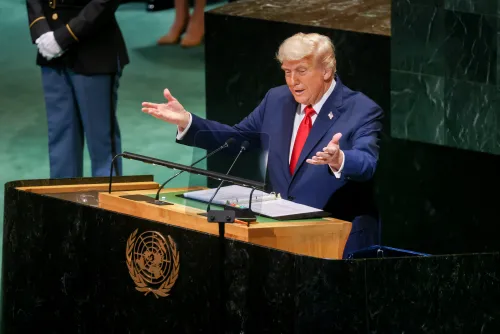
President Donald J. Trump electrified the 80th United Nations General Assembly on September 23, 2025, with a fiery speech that cut through the globalist noise and reminded world leaders that America will not bend to failed ideologies.
“Your countries are going to hell,” Trump declared bluntly, shocking the assembly hall but thrilling millions of Americans who have long demanded honesty from their leaders.
Trump made migration his central theme, hammering nations that have embraced open borders. “It’s time to end the failed experiment of open borders,” he told the gathering, pointing to rising crime and social decay across Europe and beyond. His words were not diplomatic niceties — they were a clear call for nations to put their citizens first.
The President warned that the flood of migrants was destroying cultures and eroding stability. “Your countries are being ruined,” he said, challenging leaders who have treated mass migration as a humanitarian cause rather than a national security threat. His remarks stood in stark contrast to global elites who continue to push for borderless societies.
Trump ridiculed the United Nations itself, questioning its effectiveness. “What is the purpose of the United Nations? … All they seem to do is write a really strongly worded letter and then never follow that letter up,” he quipped. The crowd reacted uneasily, but his words underscored a reality many member states quietly acknowledge.
Despite the stinging critique, Trump assured allies that America was not abandoning the institution entirely. “We are behind the United Nations 100%,” he said, but stressed that the body must stop serving as a paper tiger and start delivering real solutions. This balance of tough love and continued engagement reflected his strategy of reform rather than retreat.
Perhaps the most headline-grabbing line of the day came when Trump dismantled the climate agenda. “Climate change is the greatest con job ever perpetrated on the world,” he thundered. By exposing the global climate push as a scam, Trump challenged leaders who have crippled their economies with green mandates while allowing countries like China to pollute freely.
“If you don’t get away from this green scam, your country is going to fail,” he warned, highlighting the economic suicide of chasing unrealistic energy goals. For Trump, prosperity and strength come from energy independence and common-sense policies, not ideological experiments.
The President also demanded an end to the war in Gaza, cutting through years of diplomatic dithering. “We have to stop the war in Gaza immediately,” Trump said. His call was direct, uncompromising, and urgent. Unlike bureaucrats who hide behind committees, Trump demanded action that would protect lives on all sides.
He pressed for the release of hostages taken during the conflict. “The hostages must be released immediately,” Trump emphasized, making it clear that peace could not exist while innocent people remained in captivity. His clarity drew praise even from leaders who rarely support him.
On Russia’s war in Ukraine, Trump warned of tougher measures unless Moscow reversed course. “We will increase economic pressure until this war ends,” he declared, holding European nations accountable for undermining sanctions by continuing to buy Russian energy. His statement revealed the hypocrisy of nations condemning Russia publicly while funding its war machine privately.
Even as he clashed with global elites, Trump’s America First message struck a chord with ordinary citizens watching worldwide. They heard a leader unafraid to speak truth to power. “Your countries are being ruined,” he repeated, reminding the world that weakness and appeasement always carry consequences.
In a lighter moment, Trump joked about the technical glitches during his appearance. “The teleprompter is not working … whoever is operating this teleprompter is in big trouble,” he said, earning laughter from the audience. The remark showed his trademark ability to blend humor with seriousness, disarming critics while driving home his point.
Later, he mocked the UN’s internal problems by pointing to a broken escalator in the building. “This is the United Nations — and even the escalators don’t work,” he joked, using the malfunction as a metaphor for institutional dysfunction. His ability to turn mishaps into meaningful commentary drew both laughs and nods.
Trump’s tough talk about sovereignty resonated most strongly. “It’s time to end the failed experiment of open borders,” he reminded, calling on leaders to defend their citizens instead of surrendering to ideology. The message cut especially deep for European nations facing political upheaval from mass migration.
He did not shy away from naming the stakes. “Your countries are going to hell,” Trump repeated, drawing gasps but also underscoring the urgency of the crisis. His critics called the language harsh, but his supporters praised it as the blunt truth.
The President’s stance on the UN itself remained clear. “All they seem to do is write a really strongly worded letter and then never follow that letter up,” he said again, exposing the hollowness of empty resolutions. His call for accountability challenged a culture of inaction that has defined the UN for decades.
Still, Trump balanced critique with support: “We are behind the United Nations 100%.” The line revealed his willingness to work with allies — but only on terms that serve peace, not bureaucracy. For the President, America’s leadership means results, not empty promises.
The message on climate change was equally uncompromising. “The greatest con job ever perpetrated on the world” resonated as a rallying cry for leaders tired of strangling their economies with green policies that enrich global elites. It was a declaration of energy freedom.
For Trump, truth was more important than diplomacy. “If you don’t get away from this green scam, your country is going to fail,” he repeated, leaving no room for misinterpretation. His words were a warning and a roadmap all at once.
On Gaza, his bluntness cut through layers of international hesitation. “We have to stop the war in Gaza immediately,” Trump demanded. Unlike career diplomats, he was not afraid to call for swift action, knowing the human cost of delay.
He reinforced the moral imperative of freeing hostages. “The hostages must be released immediately,” he said again, making their plight central to any resolution. His demand carried moral clarity often missing in UN debates.
Trump’s message to Russia was direct: “We will increase economic pressure until this war ends.” No hedging, no qualifiers, just a straight demand for accountability. This was leadership the world could not ignore.
effects on Trump’s ability to maintain support within his own party.
However, it’s worth noting that Trump has shown remarkable resilience throughout his political career, often bouncing back from periods of low approval ratings. His base of support has historically remained loyal even during challenging periods.
The decline in Trump’s approval ratings across multiple policy areas suggests several potential implications for his administration’s approach going forward.
The fact that Trump is losing ground on immigration – traditionally his strongest issue – may force a recalibration of his enforcement strategy. The visual of military forces being deployed to handle immigration protests may be creating negative associations with his immigration agenda, even among supporters who favor tough enforcement.
The decline in support for Trump’s trade policies comes at a time when the administration is pursuing an aggressive tariff strategy. If public support continues to erode, it may become more difficult to maintain these policies, particularly if they begin to show negative economic effects.
The internal Republican criticism of Trump’s “Big Beautiful Bill,” combined with the Musk controversy, suggests that the administration may need to adopt a more collaborative approach with Congress, even with members of its own party.
The breakdown of the Trump-Musk relationship offers important insights into the challenges of managing high-profile political alliances in the social media age.
Sources familiar with the Trump-Musk relationship identified four key factors that led to Musk’s criticism of Trump: the elimination of electric vehicle tax credits that benefit Tesla, Musk’s inability to extend his government role beyond statutory limits, his failure to secure FAA adoption of his Starlink system for air traffic control, and the withdrawal of his ally Jared Isaacman’s NASA nomination.
The feud has been particularly damaging because it has played out so publicly, with both men using social media to air their grievances. This public nature of their conflict has created uncertainty about the administration’s relationship with the technology sector and raised questions about Trump’s ability to maintain key alliances.
As Trump moves into the second half of his first year back in office, several scenarios could emerge based on these approval ratings:
If the administration can achieve significant policy victories – particularly on economic issues – Trump could see his approval ratings rebound. Historical precedent suggests that presidents can recover from approval rating declines if they deliver tangible results for voters.
If the downward trend continues, it could have significant implications for the 2026 midterm elections and Trump’s ability to advance his agenda. A prolonged feud with Musk could make it harder for Republicans to keep control of Congress in next year’s midterm elections if Musk withholds financial support.
Trump’s approval ratings could stabilize around current levels, creating a challenging but manageable political environment. This scenario would likely require the administration to focus more heavily on maintaining its base while finding ways to appeal to independent voters.
It’s important to note that Trump’s declining approval ratings are occurring in a context where the Democratic Party is also struggling with public opinion. Only 21 percent of voters approve of the way Democrats in Congress are handling their job, while 70 percent disapprove. This suggests that American voters are broadly dissatisfied with both parties, creating an uncertain political environment.
Trump’s declining approval ratings, particularly on foreign policy issues, could have implications for America’s international relationships. Allies may be less willing to invest in long-term partnerships with an administration that appears to be losing domestic support, while adversaries may see an opportunity to challenge American leadership.
The particularly low approval ratings on the Ukraine-Russia conflict could limit Trump’s options for diplomatic initiatives and may encourage other international actors to take more assertive positions.
The administration’s response to these polling numbers will be crucial. Historically, Trump has been most effective when he can frame political challenges as battles against established interests or media bias. However, the fact that his decline in approval spans multiple policy areas and includes issues that were traditionally strengths suggests that a more comprehensive strategic response may be needed.
Five months into his second term, Donald Trump faces approval ratings that reveal significant challenges across the full spectrum of his policy agenda. From immigration to the economy, from foreign policy to his relationships with key allies like Elon Musk, the president is grappling with declining public support that could have far-reaching implications for his presidency.
The 38 percent approval rating represents more than just a number – it reflects a broad pattern of public dissatisfaction that spans traditional party lines and policy areas. While Trump has shown remarkable political resilience throughout his career, these numbers suggest that his second term is facing challenges that may be more fundamental and comprehensive than previous political obstacles.
The path forward will likely require the administration to reassess its approach across multiple policy areas, rebuild damaged relationships with key allies, and find ways to reconnect with American voters who appear increasingly skeptical of the president’s leadership.
As political strategist James Carville suggested, there may be those who believe that simply waiting for the Trump administration to “collapse” under the weight of these challenges will be sufficient. However, the complex nature of American politics and Trump’s proven ability to defy conventional political wisdom suggest that the ultimate implications of these approval ratings will depend largely on how both the administration and its opponents respond to this new political reality.
One thing is certain: with approval ratings at their lowest point of his second term and challenges mounting across multiple fronts, Trump’s presidency has reached a critical juncture that will likely define the trajectory of his remaining time in office. The coming months will reveal whether these numbers represent a temporary setback or a more fundamental shift in American public opinion about the 45th and 47th president.