
A Silent Presence…
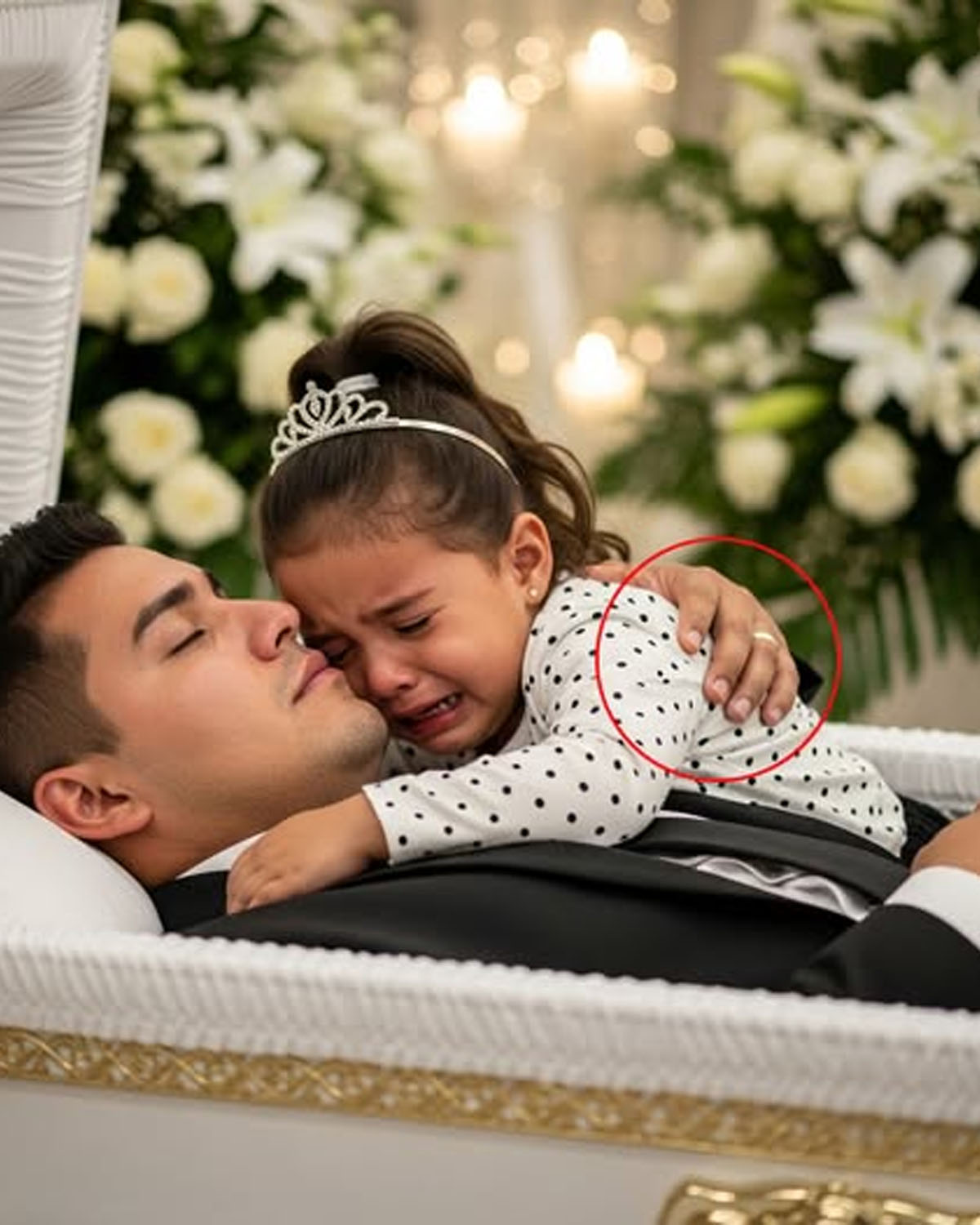
A girl hugged her father in the chilling coffin.
Camila was 8 years old and stood next to the coffin, motionless.
They had been at the wake for hours, and she hadn’t moved an inch.
Her mother tried to take her away several times, but she refused to leave.
She said she wanted to stay with her dad and didn’t cry, just looked at him in silence.
People passed by to offer their condolences, and some looked at her with pity, but she didn’t respond; she just remained standing there, with her hands resting on the edge of the coffin.
Julián’s body was dressed in a white shirt that he liked, and his arms were crossed over his chest.
He looked pale but peaceful.
Grandma’s house was full of people.
Some spoke softly, others cried, and the children ran around the yard without fully understanding what was happening.
But Camila did not move.
Since they arrived, she refused to eat anything and did not sit down.
She only asked for a chair so she could reach her dad better and be close to him.
Some thought she was in shock, but the grandmother said to leave her alone, that everyone has their own way of saying goodbye.
The mother did not want to argue and ended up accepting.
Although she looked tired and had swollen eyes, she did not insist further.
Hours passed and the atmosphere became increasingly tense.
It was already night, and there was still time before taking the coffin to the cemetery.
The adults began to notice that something was wrong, not with the body, but with the girl.
She had stopped speaking, just sitting in the chair with her arms crossed over the edge, staring intently at her dad.
Some tried to talk to her, but she didn’t respond.
She neither cried nor made any gestures.
It seemed as if she were waiting for something.
And although no one said it out loud, many began to feel a kind of discomfort they couldn’t explain.
As if that calmness in the girl was too strange, as if something was about to happen.
That night, no one slept.
Some stayed on the porch talking quietly, while others came in and out of the living room to see how everything was going.
Camila remained by the coffin without moving.
She looked tired, but she didn’t want to lie down or walk away.
Then her grandmother brought her a blanket and draped it over her shoulders.
No one insisted further.
A long while passed, and most began to distract themselves.
Some went out to smoke, others went to the kitchen for coffee, and her mother sat in a corner with her head back and her eyes closed.
At that moment, Camila climbed onto the chair, rested one knee on the edge of the coffin, and carefully climbed in.
She did it slowly, as if she had already thought it through.
No one noticed until she was already inside, lying on top of her dad’s body, holding him tightly.
When one of the aunts turned around and saw her there, she screamed without thinking, and everyone ran.
It was chaos.
At first, they thought he had fainted or was having a seizure, but when they got closer, they saw something that left them speechless.
Julián’s hand was resting on Camila’s back, as if he were also hugging her.
Some were frozen in place while others started saying that the girl had moved him, but that didn’t make sense because his hand was not in a forced position; it was resting naturally with his arm slightly raised.
One of the men wanted to move her away, but the grandmother wouldn’t allow it.
She said to wait, that something strange was happening.
Camila wasn’t moving, but she didn’t seem unconscious.
Camila was not moving, but she did not seem unconscious. Her breathing was soft and even, as if she were peacefully sleeping, cradled by her father’s cold embrace. Julián’s hand, the same hand that had held hers so many times during walks in the park, now rested on her back. It was a gesture of protection, a goodbye that defied all logic. The aunt who had shouted broke down in tears, not out of fear, but from a deep and painful tenderness. The mother, who had remained in a state of lethargy, suddenly sat up, her eyes filled with a mix of horror and astonishment.
Silence took over the room, a silence much heavier and denser than before. There were no more whispers, no cries, no sounds of children. All eyes were fixed on the coffin, on the sleeping girl and the father who, in some way, was comforting her. The air felt thick, laden with an energy that no one could understand. The grandmother, the only one who seemed to remain calm, knelt beside the coffin and gently stroked her granddaughter’s hair.
“Déjala”, susurró con voz temblorosa. “Está bien”.
Nadie se atrevió a contradecirla. La escena era demasiado sagrada, demasiado inexplicable. Los minutos se estiraron en una eternidad. La luz de la luna se filtraba por la ventana, bañando la sala en un resplandor fantasmal que hacía que todo pareciera un sueño. De repente, Camila soltó un suspiro largo y profundo. La mano de su padre, lentamente, se deslizó de su espalda y volvió a su posición original, sobre su pecho.
Camila opened her eyes. She looked around as if waking from a very long dream. Her gaze met her mother’s, who was looking at her with desperation. Camila got up from the coffin, with the help of her grandmother, and walked towards her mother. She gave her a hug so tight that her mom felt a shiver. In that embrace, there was no weight of grief, but a peace and tranquility that filled her heart.
“It’s okay, mommy,” Camila whispered in her mother’s ear. “Dad went to sleep, but he told me not to worry, that he will always be with me.”
And after saying that, she finally cried. She cried with all the pain and sadness she had been holding back for hours. She cried for the loss, for the love, for the goodbye. And her mom hugged her tightly, not letting go, while everyone else in the room felt the air become a little lighter, as if an invisible weight had been lifted from their shoulders. The farewell had finally come.
In a pivotal moment of accountability, the U.S. House of Representatives voted to remove Representative Ilhan Omar (D-MN) from the prestigious House Foreign Affairs Committee. This action culminated years of controversy surrounding her rhetoric, which critics repeatedly labeled as anti-Semitic and anti-American.
The highly charged vote followed a series of impassioned speeches, most notably from Representative Lee Zeldin (R-NY), who delivered a scathing indictment of Omar’s past comments and accused Democratic leadership of applying a blatant double standard regarding congressional discipline. For many of Omar’s critics, the vote was a long-overdue measure to ensure that America’s global interests are represented by members with unequivocal loyalty to the nation and its allies.
Representative Lee Zeldin’s floor speech was widely lauded by conservative commentators for its directness and refusal to accept what he called “political theater” (5:38). Zeldin argued that the entire debate was necessary “because of anti-Semitic rhetoric from one member of this chamber said again and again and again” (1:59–2:08).
He systematically laid out the pattern of Omar’s controversial statements that, he argued, disqualified her from the committee:
Hypnosis/Influence: Zeldin reminded the chamber that Omar had to apologize for talking about a “hypnosis of Israel that they have over the entire world” (2:26–2:29).
Bought Off/Dual Loyalty: She also apologized for suggesting that support for Israel was because representatives were “bought off by Jews” (2:30–2:36).
Pledging Allegiance: The final tipping point, according to Zeldin, was Omar’s statement that supporters of the U.S.-Israel relationship “must have pledged allegiance to a foreign government” (2:42–2:48).
Zeldin’s main point was the issue of double standards (3:39). He argued unequivocally that if a Republican member had made just one of these comments, “That member’s name would be in this resolution and this resolution would be all about condemning anti-Semitism and it would be done so forcefully” (2:13–2:22). He pointed to the example of a Republican member who was named and removed from his committees following condemnations of white supremacy, a standard he demanded be applied to anti-Semitism as well (3:42–4:03).
A key part of the debate centered on whether Omar’s comments were made out of ignorance or deliberate malice. While some may have suggested naiveté, Zeldin dismissed this notion, stating firmly that he gave Omar “more credit” than that: “I don’t believe she is naive. I believe that she knows exactly what she’s doing” (3:05–3:13).
This view reflects a consensus among critics that Omar’s use of classic anti-Semitic tropes—such as those suggesting excessive Jewish financial influence or dual loyalty—was calculated, making the comments fundamentally “pointed, bigoted, unreasonable, illegitimate, anti-Semitic” (4:07–4:11).
Beyond the specific anti-Semitic comments, critics cited a broader pattern of rhetoric they viewed as dismissive of American values and tragedy. The host specifically highlighted Omar’s infamous comment regarding the 9/11 terror attacks, where she referred to the event by saying “some people did something” (5:54–5:56).
The host condemned this phrase as “deeply disrespectful” and a reduction of a national tragedy where “Thousands of innocent Americans were murdered” (6:01–6:06). This comment, critics argue, demonstrated a “shocking disconnect from the American experience” (6:20–6:22) and was cited as further evidence of her unsuitability for a key foreign policy role.
The core argument for removing Omar from the Foreign Affairs Committee was not about punishing her free speech, but about protecting the integrity of U.S. governance and foreign relations (1:28–1:31).
The House Foreign Affairs Committee holds immense responsibility: its members handle classified information, shape the nation’s foreign policy, and directly influence global alliances (7:17–7:26).
The consensus among Republicans and like-minded commentators was that membership on such a sensitive committee requires “100% for America” loyalty (7:29–7:31). Zeldin stressed that while “reasonable legitimate criticism of a government” is an American value, “hurling anti-Semitic rhetoric” is not (3:15–3:27).
The host summarized the action as a necessary principle-based move: “Removing her from that committee wasn’t about revenge. It was about protecting America’s interests and making it clear that this kind of rhetoric has no place in Congress” (7:50–7:57).
The final vote, which passed despite vocal opposition from Democratic members who defended Omar and accused the action of being motivated by racism, was a significant political victory for the Republican majority and a powerful symbolic assertion of their zero-tolerance stance on rhetoric deemed harmful to international relationships and American values.