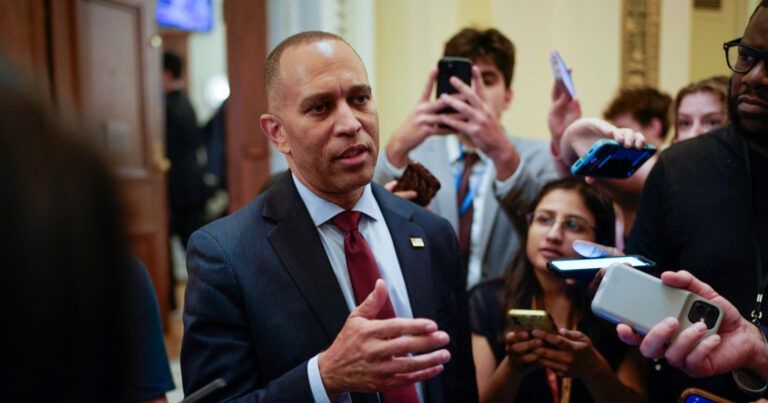
Dozens of Democratic candidates running for U.S. House seats nationwide told Axios they either would not support House Minority Leader Hakeem Jeffries (D-N.Y.) for party leader or were not prepared to commit to voting for him.
The responses suggest growing unease within some parts of the Democratic Party about its current leadership as the 2026 election cycle approaches, the outlet reported this week.
Since assuming the role of Democratic leader in 2022, Hakeem Jeffries has maintained unanimous support within his caucus. That unity, however, may be tested in the next Congress amid rising frustration from grassroots activists, particularly on the party’s left flank.
While Senate Minority Leader Chuck Schumer (D-N.Y.) has drawn much of the criticism from progressive circles this year, Jeffries is increasingly becoming a focal point of dissatisfaction as well, Axios noted.
Axios contacted nearly every Democrat running for a U.S. House seat considered potentially winnable for the party in 2026, receiving responses from 113 candidates through phone interviews or written statements.
Of those surveyed, 20 said they would not vote for Hakeem Jeffries as speaker or minority leader, while another five indicated they were likely to oppose him. Fifty-seven candidates declined to commit to supporting Jeffries, describing it as too early to decide or citing concerns over ideology, strategy, messaging, or leadership style.
Only 24 respondents said they would definitely back Jeffries, and seven more said they were likely to do so, the outlet said.
However, his office pushed back on the narrative that he’s lost support.
“Leader Jeffries is focused on battling Donald Trump, ending the Republican shutdown of the federal government and addressing the crushing GOP health care crisis,” Jeffries spokesperson Justin Chermol told Axios.
Many of the Democrats expressing skepticism toward Hakeem Jeffries are political outsiders or long-shot candidates, while several front-runners in key battleground races declined to respond to Axios’ inquiries. Still, a number of Jeffries’ critics and noncommittal candidates have credible paths to winning seats in Congress.
Among them are Daniel Biss and Kat Abughazaleh, two leading contenders in the Democratic primary to replace retiring Rep. Jan Schakowsky (D-Ill.), both of whom stopped short of pledging to support Jeffries.
Other prominent challengers — including Luke Bronin, Donavan McKinney, Mai Vang, Saikat Chakrabarti, and Patrick Roath — have also withheld their support. Each is running well-funded campaigns aimed at unseating long-serving Democratic incumbents.
Heath Howard, a New Hampshire state representative running for an open U.S. House seat, told Axios regarding the Democratic leader: “I think we need to have a new type of leadership that’s … going to fight back significantly harder against the Trump administration.”
Abughazaleh, meanwhile, told Axios she will support a leader who is “taking actual action against this administration” and that the left should use “our leverage to demand progressive change.”
“We’ve got to see improvement, without question,” Amanda Edwards, who was a member of the Houston city council and is now running in a Texas special election, told the outlet.
Harry Jarin, a firefighter mounting a primary challenge to former House Majority Leader Steny Hoyer (D-Md.), told Axios: “The anger of the base right now is not being matched by Democratic leadership … and that is going to have to change one way or another.”
A recurring theme among candidates who declined to back Jeffries was his refusal to endorse socialist New York City mayoral candidate Zohran Mamdani — a decision that has also become a source of frustration among left-wing members of Congress.
“His refusal to endorse Zohran makes me nervous that, if I were to become the nominee in my race, he and the party would not support me,” noted Jacob Lawrence, who is set to challenged Rep. Chuck Edwards (R-N.C.).
Chakrabarti, when asked whether he would support for Jeffries, quipped: “What is it that Hakeem said about endorsing Zohran? ‘I’ll have conversations with him and see where it goes.’”
The political tensions surrounding Representative Ilhan Omar reached a boiling point during the recent Minneapolis mayoral race, revealing deep, entrenched clan divisions within the city’s Somali-American electorate. Omar’s preferred candidate, Omar Fateh, was defeated, a loss critics attribute to the deliberate mobilization of rival Somali clan factions who voted for the winning candidate, Mayor Jacob Frey.
The electoral result has exposed the pervasive role of “tribal politics” in local U.S. governance and triggered a raw public confrontation where Omar was verbally attacked by a Somali rival who questioned her loyalty and identity.
The recent Minneapolis mayoral election has brought to light the internal fragmentation within the city’s significant Somali-American community, where political alignment appears to follow traditional tribal loyalties rather than simple party lines.
Reports suggest that the victory of incumbent Mayor Jacob Frey was achieved by strategically exploiting existing rivalries within the Somali electorate.
Political Fragmentation: The core issue is the breakdown of the Somali vote, with reports indicating that different Somali clans actively campaigned for opposing candidates. As one commentator noted, this is a clear case where “Somali clans wouldn’t vote for that Omar guy because he was from a different clan,” underscoring the dominance of kinship ties over ideological unity.
The Outcome: The defeat of Omar Fateh, the candidate favored by Representative Omar’s faction, illustrates how the continuation of “Somalian tribal politics” is actively influencing and fragmenting the Democratic-leaning vote in Minneapolis.
The frustration over this political division boiled over in a public confrontation where Representative Omar was attacked by a Somali rival.
The Direct Challenge: A woman, speaking in Somali (with English phrases interspersed), directly challenged Omar’s status and influence, shouting, “Who the f* is she?”** and demanding, “You have to show who you are.” This attack went viral, revealing the deep lack of respect and animosity directed at Omar from within her own community bloc.
A Self-Admitted Problem: This internal discord aligns with a common observation among some members of the Somali community: “Our people is the most divided people in the world. We are bringing this kabilist [clan-based] thing to America. The same thing that killed our country, the tribalism.”
The revelation of this divisive political strategy underscores the challenges of integrating diverse immigrant populations whose political allegiances are dictated by historical and ethnic ties that often override American political norms.
Representative Omar, who is often a vocal proponent of immigrant rights and anti-deportation policies, recently gave a controversial answer regarding her own potential deportation, which critics swiftly deemed hypocritical.
When asked in an interview about the persistent threats from conservative figures to strip her of American citizenship and deport her, Omar adopted a dismissive posture: “I don’t even care. I don’t know how they take away my citizenship and like deport me. But it’s… I don’t even know like why that’s like a such a scary threat.”
She emphasized her adulthood and financial stability: “I’m not the eight-year-old who escaped war anymore. I’m grown. My kids are grown. Like I can go live wherever I want if I wanted to.”
Critics immediately seized on this statement, pointing out the hypocrisy inherent in minimizing the severity of deportation:
Contradiction: Omar is a leading voice for policies that treat deportation as a profound human rights tragedy and a life-destroying event. Yet, when applied to her own situation, she makes deportation sound like “it’s not that big of a deal,” suggesting she “can go live wherever I want.”
The Privilege Gap: The criticism highlights a vast privilege gap. For most immigrants, deportation means losing everything—jobs, homes, and family structures—and being sent back to an uncertain or dangerous future. Omar’s comment suggests that her wealth and prominence shield her from the reality of the very policies she advocates against, exposing a significant disconnect between her political rhetoric and her personal circumstances.
The segment concluded with a brief note on the political chaos impacting other Democratic aspirants, referencing the federal indictment of a Chicago congressional candidate, Kate Abba Gazali.
The Charges: Gazali, who was running for Congress in Chicago, was federally indicted for allegedly preventing ICE (Immigration and Customs Enforcement) officers from doing their job while protesting deportations.
The Visuals: The visual evidence presented showed Gazali and a crowd protesting deportations, chanting “Down with deportation” and “We save our siblings,” directly confronting federal officers.
The reference to this incident, which led to a federal indictment, serves as a final example of the legal and ethical boundaries being tested by radical progressive activists who are attempting to translate activism into congressional power, often resulting in direct confrontations with the law.