
The death of a political figure is never just a private matter. When tragedy strikes in front of thousands, it becomes both a moment of national reckoning and a deeply personal story of loss. A week has now passed since the assassination of
What began as a rally meant to launch his “American Comeback Tour” at Utah Valley University has instead become a case study in political violence, personal grief, and the fragility of life lived under the spotlight. And among the most heart-wrenching accounts is the revelation of what happened in the chaotic minutes after the fatal shot rang out — a frantic journey to the hospital that underscored both the desperation of his allies and the inevitability of his fate.
On September 10, Kirk stood before a crowd of more than 3,000 attendees. Known for his sharp debating style and confrontational exchanges with students, he was in the midst of fielding a question about gun violence when the unthinkable happened.
A single bullet, allegedly fired by 22-year-old Tyler Robinson from a rooftop perch, struck him in the neck. The wound severed critical arteries, and the activist who had built a career on amplifying his voice fell silent in an instant.
The scene descended into chaos. Attendees screamed, security rushed the stage, and within seconds Kirk was being carried toward a waiting vehicle. From that moment, every decision — every second — mattered.
Since that day, officials, family members, and witnesses have revealed new details that continue to paint a fuller picture of Kirk’s final hours.
Kristi Noem
, the Secretary of Homeland Security, disclosed that Kirk had sent her a private text the day before his death — a message now being parsed for meaning by supporters who see it as a final reflection of his mission.
Derek Van Schaik, a neuropsychologist, analyzed the viral footage of the shooting and suggested Kirk likely had no awareness of what had happened to him, losing consciousness in less than half a second.
And now, perhaps the most poignant account comes from Frank Turek, a close friend, Christian apologist, and author, who was present that day and rode with Kirk in the desperate dash to the hospital.
Turek, 63, has long been part of Kirk’s spiritual and intellectual circle. Speaking on his podcast Cross Examined, he recounted the moments immediately following the shooting — moments that have left him shaken but determined to honor his friend’s legacy.
“Charlie Kirk was literally a son to me,” Turek said, his voice breaking. “So, if your son got hit, what would you do? You get in that car. You do everything you can, no matter what.”
And so he did. As Kirk’s limp body was rushed into the vehicle, Turek climbed in alongside him. What followed was a ride unlike any other — a battle against time, blood loss, and fate.
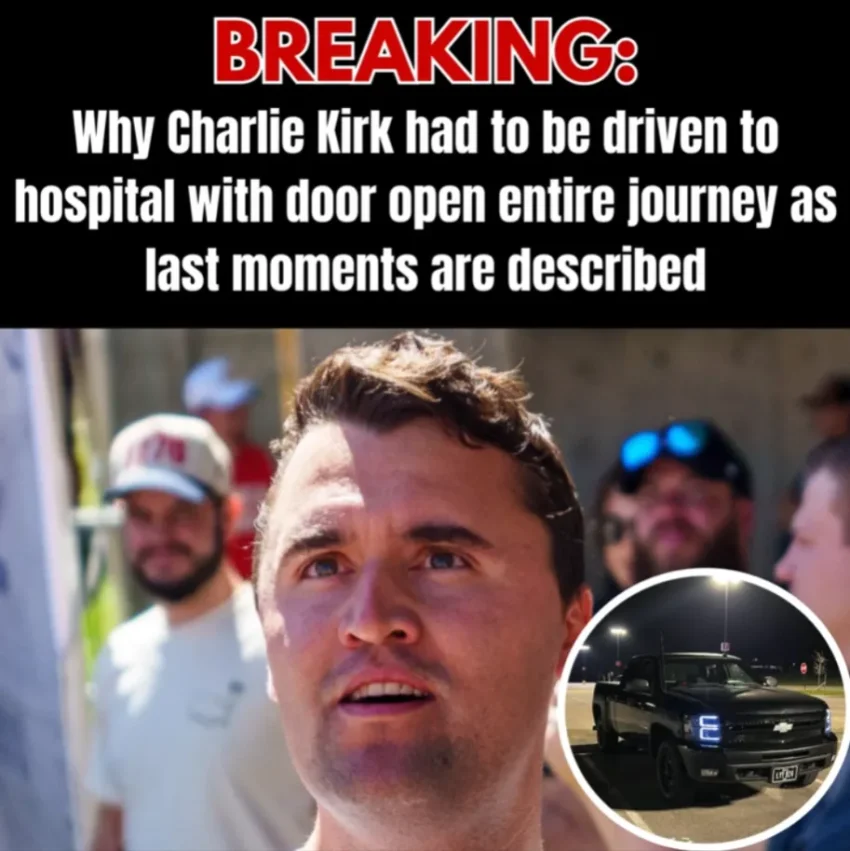
It was during this retelling that Turek revealed one haunting detail: the car door could not be closed for the entire journey.
Kirk, tall and broad-shouldered, had been laid across the back seat. His frame was so long that it protruded beyond the interior, forcing the rescuers to leave the door ajar as they sped toward Timpanogos Regional Hospital.
“Charlie is laid out right in front of me, and Charlie’s so tall we can’t close the door,” Turek explained.
The image is both tragic and symbolic: a leader too large for the confines of the car, his body hanging between life and death as the vehicle raced through city streets with one door flung open.
Inside the car, Turek alternated between performing CPR and urging his friend to hold on.
“Come on Charlie, come on, come on,” he repeated, pressing on his chest, willing him back.
Meanwhile, Kirk’s security team acted swiftly and calmly, applying pressure to the wound, attempting to slow the bleeding. Trained for emergencies, they worked without panic — but the damage was catastrophic.
By the time the vehicle reached the hospital, it was already too late.
“Charlie wasn’t there,” Turek said. “His eyes were fixed. He wasn’t looking at me, he was looking past me, right into eternity. He was with Jesus already.”
Turek’s testimony reflects not only the clinical reality of Kirk’s death but also the spiritual framework through which many of his allies interpret it.
“There was nothing any of us could do about it,” he admitted. “It wasn’t like if we had better first aid or we had better medical facilities or we were faster to the hospital, we could have saved him. We couldn’t.”
For Turek, the comfort lies in his faith:
“Absent from the body, present with the Lord. That’s where Charlie is. He didn’t suffer. He didn’t even know. He was gone in an instant.”
That faith-based interpretation is echoed, in a different way, by neuroscience. Van Schaik’s analysis concluded that Kirk would have been conscious for no more than four-tenths of a second after impact.
“When someone suffers a catastrophic wound to the neck that destroys a carotid artery and jugular vein, the mind only has a fleeting window to possibly register what happened,” he explained.
“No panic, no dread, no realization that he was about to die. Only an abrupt blackout. It was neurologically impossible for him to psychologically realize anything was wrong at all.”
In this way, both science and faith converge on one point: Kirk did not suffer.
For his supporters, the tragedy is made even more poignant by the context of Kirk’s final moments on stage. He had been answering a question about gun violence when violence claimed him. He had been addressing a crowd of students, his core audience, when his voice was silenced.
The symbolism is heavy. His critics saw him as a polarizing figure; his followers saw him as a warrior for conservative values. Either way, his assassination at a university podium crystallized the very tensions that have defined American politics in recent years.
In the days since his death, tributes have poured in. President Trump praised him as “an American hero.” His wife, Erika Kirk, delivered a defiant statement vowing to carry forward his mission: “The movement my husband built will not die. It will grow stronger, louder, bolder.”
For Frank Turek, the loss is personal and irreparable. Yet his testimony about that car ride — the open door, the CPR, the final gaze — ensures that Kirk’s last moments are not remembered only as a headline, but as a deeply human story of love, loss, and loyalty.
A week on, the details of Charlie Kirk’s assassination remain raw, each revelation reopening wounds. But the story of his last ride to the hospital — with the door flung open, a friend giving CPR, and a team of protectors fighting against fate — stands out as a defining image.
It is an image of desperation, but also of devotion. It captures the human side of a political tragedy, reminding us that behind every headline are friends, families, and final moments lived in the space between hope and heartbreak.
And it leaves a final, haunting truth: Charlie Kirk may have been silenced in an instant, but the story of his life — and the manner of his death — will echo far longer.
Eight Senate Democrats broke ranks with their party and sided with Republicans in a crucial procedural vote to advance a continuing resolution (CR) aimed at keeping the government open. This move has sent shockwaves through the Democratic establishment and sparked speculation about deep fractures forming within the liberal ranks.
The vote, described by insiders as a pivotal moment in the fiscal showdown, revealed an undeniable truth: the Democrat agenda is wearing thin, even among its own foot soldiers. While party leaders pushed a radical spending plan filled with climate boondoggles and social engineering, these eight senators chose fiscal responsibility over left-wing dogma.
According to CBS News, the resolution advanced with bipartisan support, clearing the first major hurdle in the Senate. The Democrats who crossed over did so in the face of immense pressure from party leadership, signaling a revolt brewing beneath the surface of Chuck Schumer’s caucus.
Among those Democrats were Senators Jeanne Shaheen, Tim Kaine, Maggie Hassan, and Catherine Cortez Masto. These lawmakers likely saw the writing on the wall: supporting reckless spending could cost them their seats in battleground states come 2026.
Independent Angus King, who caucuses with the Democrats, also joined the Republicans. His defection further highlights the growing discomfort with the party’s fiscal extremism. Democrats no longer speak for all Americans. Increasingly, they only speak for the fringe.
Republicans, led by Senate conservatives and emboldened by House Freedom Caucus support, have made it clear they will not rubber-stamp socialist wishlists disguised as funding bills. The CR vote was a victory for responsible governance and a blow to unchecked liberal overreach.
For years, Democrats have used government shutdown threats to ram through bloated budgets. This time, their fear tactics fell flat. Americans are fed up with being held hostage by a party that treats taxpayer dollars like Monopoly money.
The CR includes critical provisions for national security, border enforcement, and curbing runaway domestic spending. In short, it reflects priorities long championed by America First conservatives. The fact that eight Democrats supported it is a tacit admission that the Republican platform is resonating beyond party lines.
It also signals a new dynamic in Washington. With razor-thin margins in both chambers, Democrats cannot govern without unity. And clearly, that unity is crumbling. The party that once marched in lockstep behind Joe Biden is now splintering under the weight of its own radicalism.
This rebellion is just the latest in a series of setbacks for the left. From failed green energy mandates to rising inflation and border chaos, Democrat policies are collapsing under scrutiny. Voters are noticing. And so are their elected officials.
Expect these eight Senators to be vilified by their own party. The Democrat playbook demands absolute loyalty, even when it means torching the economy. But for once, principle triumphed over partisanship. That deserves recognition.
Senator Tim Kaine, often portrayed as a moderate, is now under attack from progressives for daring to support a bill that doesn’t give handouts to every special interest. It’s clear: moderation is a crime in today’s Democrat Party.
Republican leadership, by contrast, welcomed the bipartisan support. Senate GOP leaders noted that the vote reflects growing awareness that America cannot continue down the path of endless spending and spiraling debt.
Conservative watchdog groups hailed the development as a breakthrough. “This is what leadership looks like,” said a spokesperson for the Heritage Foundation. “We need more Democrats willing to put country over party.”
Make no mistake: this vote is a bellwether. It reveals that even in Washington’s swamp, truth can surface. Fiscal sanity is making a comeback, and not a moment too soon.