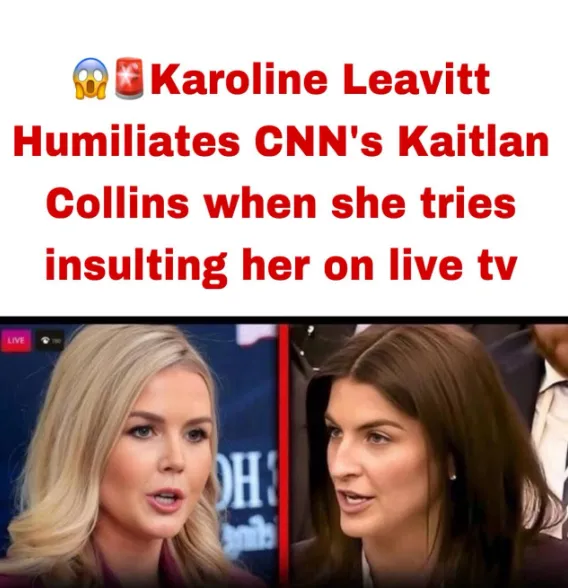
Washington, D.C. — White House Press Secretary Karoline Leavitt has once again found herself at the center of headlines after a tense exchange with reporters during a recent press gaggle. The incident underscored the continuing friction between the Trump administration and members of the press while also highlighting the administration’s renewed push on immigration enforcement.
The confrontation unfolded at the Stakeout Location outside the White House, where reporters had assembled to question Middle East envoy Steve Witkoff and National Security Advisor Michael Waltz on a series of foreign policy developments. As the officials attempted to field questions, the scene quickly grew chaotic, with multiple reporters shouting over one another.
Stepping forward to restore order, Leavitt admonished the group:
“Guys, please. Let’s act like adults here. They are generously offering their time to answer your questions. You don’t need to scream at them like a bunch of school children.”
The moment was brief but pointed, encapsulating Leavitt’s trademark style — firm, direct, and unapologetic. It also drew immediate reactions across the political spectrum, with supporters praising her no-nonsense approach and critics accusing her of trying to silence a free press.
A Rising Figure in Trump’s Inner Circle
Leavitt, at just 27 years old when she assumed the role of Press Secretary, is one of the youngest individuals ever to hold the position. Her rise has been rapid, propelled by her sharp communication skills, deep loyalty to Trump, and her willingness to spar with the press corps in ways that echo the combative style of her predecessors, such as Sarah Huckabee Sanders and Kayleigh McEnany.
Supporters within the administration describe her as a “fighter” who understands that in the Trump era, the press briefing room is not merely a venue for information but a stage for political messaging.
“She has a way of cutting through the noise,” one senior official remarked. “The president trusts her because she doesn’t flinch when the media goes on the offensive. She’s tough, and that’s exactly what this role requires.”
For her critics, however, Leavitt embodies what they see as a troubling trend of dismissing legitimate journalism as hostility. They argue that her sharp rebukes undermine the role of the press in holding the government accountable.
Immigration Flights to Guantanamo Bay
The gaggle scolding was not Leavitt’s only headline of the week. Earlier, she confirmed that the administration had begun transporting illegal immigrants to Guantanamo Bay, a move that sparked both applause and outrage.
During an appearance on Fox Business, Leavitt described the flights as part of Trump’s broader effort to “restore law and order” on the border and throughout the interior of the country.
“He’s no longer going to allow America to be a dumping ground for illegal criminals from nations all over this world,” Leavitt told host Stuart Varney.
She revealed that Venezuela and Colombia had agreed to cooperate with the repatriation process, sending back their citizens who were found to be in the U.S. illegally and convicted of crimes. According to her, the flights had already begun and represented a “new phase” in immigration enforcement.
The policy has divided opinion sharply. Supporters argue it sends a powerful message that the U.S. will no longer tolerate what Trump has repeatedly called “catch and release.” Critics, however, contend that sending detainees to Guantanamo Bay is heavy-handed and risks international condemnation.
Responding to Political Rivals
Leavitt also took aim at New Jersey Governor Phil Murphy, who recently walked back comments suggesting that he would be willing to house an undocumented immigrant in his own home.
“I will say that this administration will hold Democrat governors and leaders across the country accountable if they break the law, if they harbor illegal aliens, or if they are not abiding by the federal immigration laws,” Leavitt declared.
Her remarks reflect a broader communications strategy — painting Democratic governors as out of touch with everyday Americans while portraying Trump’s administration as the defender of law, order, and sovereignty.
Tensions With the Press: A Recurring Theme
The sharp exchange with reporters fits into a larger pattern of confrontations that have defined Trump-era press relations. From Trump’s frequent denunciations of “fake news” to now Leavitt’s no-nonsense policing of press behavior, the administration has consistently framed itself as embattled by a hostile media establishment.
Historians point out that tension between presidents and the press is nothing new. Richard Nixon famously maintained an enemies list of journalists; Ronald Reagan bypassed traditional media by using carefully staged television events; and Barack Obama drew criticism for aggressively pursuing leakers within the government.
Yet Trump’s White House has taken that tension to a new level, with daily briefings often serving as political theater. Leavitt has embraced that role, stepping into the spotlight as both spokesperson and defender of the president.
Political Stakes Ahead
The timing of Leavitt’s confrontations is critical. As Trump seeks to solidify support for his second-term agenda, immigration remains one of the most potent issues with his base. Policies like the Guantanamo Bay flights are designed not just as enforcement tools but as political signals, reinforcing Trump’s brand as a leader who delivers on tough promises.
At the same time, Democrats are seeking to frame the administration’s approach as excessive and authoritarian. By leaning into the image of toughness, Leavitt risks alienating moderates who may prefer a more measured tone on immigration and press relations.
But within Trump’s circle, there is little doubt that Leavitt is doing precisely what is expected of her. Her willingness to clash with reporters plays well among supporters who see the press as biased, while her defense of controversial policies strengthens her standing as one of Trump’s most loyal communicators.
A Balancing Act for the Future
The question now is whether Leavitt can maintain her combative style without burning bridges that the administration may need in moments of crisis. Press secretaries, after all, often serve as the face of the White House during national emergencies, where credibility and calm delivery are paramount.
For now, however, Leavitt seems content to continue her role as a fighter in the daily battles that define Washington. Whether addressing policy, challenging reporters, or amplifying Trump’s message, she has cemented herself as a central figure in the administration’s communications machine.
Conclusion
Karoline Leavitt’s scolding of reporters may have been a small moment in an otherwise busy news cycle, but it reflected something much larger: the Trump administration’s approach to media, politics, and governance. It was about asserting control in a chaotic setting, defending controversial policies, and reminding the press — and the public — that this White House intends to play by its own rules.
For Leavitt, the week demonstrated both the opportunities and challenges of her role. She is not merely a spokesperson; she is a combatant in the political arena, wielding words as weapons and using confrontation as a tool. As immigration policy and media relations continue to dominate the national conversation, her voice will remain one of the loudest and most contentious in Washington.
In an era where outrage seems to be the currency of public discourse, J.K. Rowling—author, activist, and frequent lightning rod—has once again thrust herself into the center of a global debate. This time, her target is not a government, a movement, or even her own critics, but the creeping hypocrisy surrounding the concept of free speech. In a series of pointed remarks, Rowling laid out a framework that slices through the noise and exposes the dangers of illiberalism, fundamentalism, totalitarianism, and political violence.
“If you want opponents dead, you’re not a liberal—you’re a terrorist,” Rowling declared. The words are stark, unambiguous, and, in today’s climate, profoundly necessary.
But what does it mean to defend free speech in a time when every utterance can spark a firestorm? How did we arrive at a moment where the principles of liberal democracy—once cherished across the political spectrum—are now up for debate? And why is Rowling’s intervention so critical, not only for writers and thinkers, but for anyone who values the fragile fabric of civil society?
The Anatomy of a Statement
Rowling’s remarks, delivered via social media and amplified across newspapers and talk shows, are more than just soundbites. They are a manifesto against the erosion of liberal ideals. “If you believe free speech is for you but not your political opponents, you’re illiberal,” she wrote. “If no contrary evidence could change your beliefs, you’re a fundamentalist. If you believe the state should punish those with contrary views, you’re a totalitarian. If you believe political opponents should be punished with violence or death, you’re a terrorist.”
Each sentence is a scalpel, dissecting the layers of modern political identity. They are not just definitions—they are warnings.
Rowling’s words come at a time when the boundaries of acceptable speech are being redrawn by activists, politicians, and corporations alike. From college campuses to online platforms, the battle over who can speak—and what they can say—has become a proxy war for deeper ideological divides.
The Rise of Illiberalism
To understand the urgency behind Rowling’s statements, one must first grapple with the concept of illiberalism. Liberalism, at its core, is the belief that individuals should be free to express their ideas, challenge orthodoxy, and pursue truth without fear of censorship or reprisal. Illiberalism, by contrast, is the impulse to restrict those freedoms, often in the name of “protecting” society from harm.
Rowling’s critique is directed at those who claim to champion liberty while seeking to silence dissent. In recent years, this contradiction has become increasingly visible. Progressive activists have called for the deplatforming of speakers whose views they find offensive. Conservative lawmakers have pushed for bans on books and curricula that challenge their worldview. Each side claims to be defending “freedom,” but the reality is a narrowing of the public square.
The hypocrisy is not lost on Rowling. Her own experience—being vilified for her views on gender and sex—has made her acutely aware of the dangers of selective free speech. “If free speech is only for those who agree with you,” she warns, “then it is not free speech at all.”
Fundamentalism and the Death of Debate
Rowling’s second charge—that the refusal to accept contrary evidence is a form of fundamentalism—cuts to the heart of modern polarization. In a world awash with information, the temptation to retreat into ideological bunkers is strong. Social media algorithms feed us what we want to hear. Cable news channels reinforce our biases. The result is a culture where debate is replaced by dogma.
Fundamentalism, in this sense, is not merely religious. It is the elevation of belief over reason, certainty over curiosity. Rowling’s warning is clear: when we close ourselves off to new evidence, we become prisoners of our own convictions.
This phenomenon is especially dangerous in politics, where the stakes are high and compromise is rare. The refusal to engage with opposing views leads to gridlock, resentment, and, ultimately, the breakdown of democratic norms.
Totalitarian Temptations
“If you believe the state should punish those with contrary views, you’re a totalitarian.” With this line, Rowling draws a straight line from censorship to tyranny. History is littered with examples of governments that sought to control thought—Stalin’s Soviet Union, Mao’s China, the theocracies of the Middle East. Each began with the suppression of dissent and ended with the destruction of freedom.
In the West, the threat is less overt but no less real. Laws against “hate speech,” while well-intentioned, can be weaponized to silence legitimate criticism. Corporate censorship, driven by fear of backlash, can erase voices from the digital public square. The line between protecting citizens and policing thought is perilously thin.
Rowling’s intervention is a reminder that the defense of free speech is not just about individual rights—it is about preserving the conditions for democracy itself. When the state becomes the arbiter of acceptable opinion, liberty dies.
The Logic of Violence
Rowling’s final warning is the most chilling: “If you believe political opponents should be punished with violence or death, you’re a terrorist.” The escalation from rhetoric to violence is not theoretical—it is a reality that has played out on streets and campuses across the world.
From the attack on the offices of Charlie Hebdo in Paris to the riots in Charlottesville, Virginia, the willingness to use force against those with opposing views is a cancer on civil society. It is the antithesis of liberal democracy, which depends on the peaceful resolution of conflict.
Rowling’s words are a call to reject the logic of violence, to reaffirm the principle that disagreement is not a crime, and that the solution to bad ideas is better ideas—not bullets or bombs.
The Price of Speaking Out
Rowling herself is no stranger to the consequences of controversial speech. Since voicing her opinions on gender and sex, she has faced boycotts, threats, and relentless harassment. Critics accuse her of bigotry; supporters hail her as a defender of women’s rights. The intensity of the backlash is a testament to the power of words—and the risks of challenging orthodoxy.
Yet Rowling refuses to be cowed. Her insistence on engaging with critics, debating ideas, and defending the right to disagree is a model for public discourse. In a time when many retreat from controversy, she stands firm.
Her experience is a microcosm of a broader trend: the shrinking space for honest conversation. Writers, academics, and activists across the spectrum report self-censorship, fear of reprisal, and pressure to conform. The chilling effect is real—and it threatens the vitality of democratic life.
Free Speech in the Digital Age
The debate over free speech is not new, but the digital revolution has transformed its contours. Social media platforms are now the primary arena for public debate, but they are also private companies with their own rules and incentives.
Twitter, Facebook, and YouTube have all grappled with the challenge of balancing open expression with the need to combat hate, misinformation, and abuse. The result is a patchwork of policies that often seem arbitrary and inconsistent.
Rowling’s critique applies here as well. When platforms silence voices based on political pressure or popular outrage, they risk becoming gatekeepers of thought. The danger is not just censorship—it is the erosion of trust in the institutions that shape our public life.
The Global Context
Rowling’s remarks resonate beyond the borders of Britain or the United States. Around the world, the struggle over free speech is playing out in different forms. In Hungary and Poland, populist governments have cracked down on independent media. In China, dissent is ruthlessly suppressed. In Russia, critics of the regime are jailed or exiled.
Even in democracies, the impulse to silence opposition is growing. Laws against “fake news” and “extremism” are used to target journalists and activists. The line between protecting society and controlling it is blurring.
Rowling’s intervention is a reminder that the defense of free speech is a global imperative. It is the foundation of liberty, the safeguard of minority rights, and the engine of progress.
The Moral Case for Free Speech
At its core, Rowling’s argument is not just political—it is moral. Free speech is the mechanism by which societies test ideas, expose injustice, and pursue truth. It is the right of the dissenter, the whistleblower, the artist, and the reformer.
When we abandon free speech, we abandon the possibility of change. We lock ourselves into systems of power and privilege, unable to challenge the status quo. The result is stagnation, resentment, and, ultimately, revolt.
Rowling’s words are a plea for humility—the recognition that no one has a monopoly on truth, and that progress depends on the clash of ideas. It is a call to listen, to debate, and to disagree without fear.
The Limits of Tolerance
Of course, free speech is not absolute. Societies have always drawn lines—against incitement, libel, and threats. The challenge is to distinguish between genuine harm and mere offense.
Rowling acknowledges this complexity, but insists that the answer is not to silence dissent. “If you want opponents dead, you’re not a liberal—you’re a terrorist.” The line is clear: violence is never justified, and the defense of free speech must be unwavering.
The test of a society’s commitment to liberty is not how it treats popular ideas, but how it handles unpopular ones. The willingness to defend the rights of those we disagree with is the measure of true liberalism.
The Way Forward
So where do we go from here? Rowling’s intervention is a challenge—to activists, politicians, and ordinary citizens alike. It is a call to rebuild the foundations of civil society, to restore the norms of debate, and to reject the temptations of censorship and violence.
This requires courage. It means standing up for principles even when they are unpopular. It means engaging with opponents rather than dismissing them. It means defending the right to speak, even when the words are uncomfortable.
It also requires humility—the recognition that we might be wrong, that others have something to teach us, and that the pursuit of truth is a collective enterprise.
Conclusion: A Fragile Freedom
J.K. Rowling’s words are a reminder that freedom is fragile, and that the defense of free speech is the responsibility of every generation. In a time of polarization, outrage, and fear, the temptation to silence dissent is strong. But the cost is too high.
If we want to preserve the possibility of progress—if we want to build societies that are just, vibrant, and free—we must defend the right to speak, to challenge, and to disagree. We must reject the logic of violence, the lure of totalitarianism, and the comfort of fundamentalism.
Rowling’s intervention is not just a defense of her own rights—it is a defense of ours. The question is whether we will rise to the challenge.