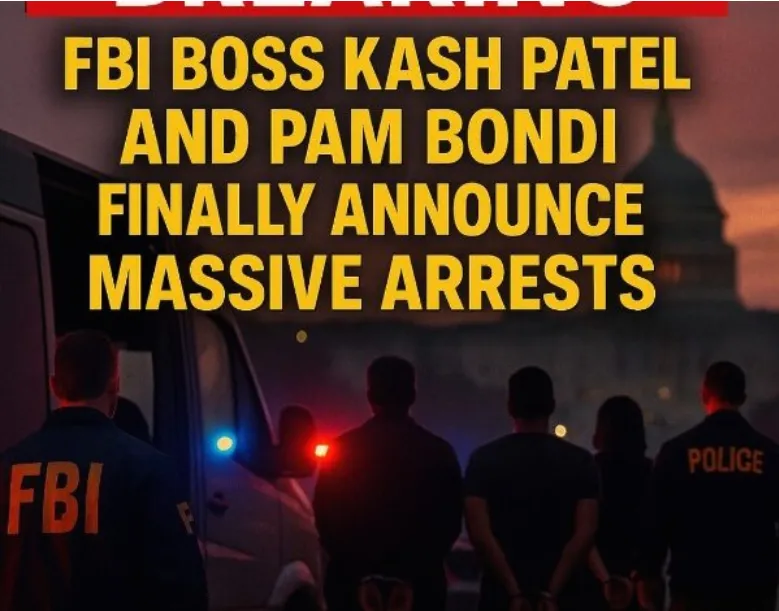
What the White House promoted as a decisive crackdown on violent crime in Washington, D.C., has turned into a far more complicated—and controversial—story. Branded by President Donald Trump as a “monthlong federal crime emergency,” the operation was touted as a high-stakes offensive against gangs, drugs, and gun violence in the nation’s capital. But newly released data tells a different tale: nearly half of those swept up weren’t violent offenders at all—they were immigrants.
According to figures compiled by the Associated Press, more than 40% of the 2,300 arrests made during the surge were tied to immigration violations, not violent crime. Out of the total arrests, about 940 people were taken into custody by federal authorities for immigration-related offenses, and only a small portion of them had any criminal record.
The operation was announced with much fanfare. Flanked by Attorney General Pam Bondi and senior Homeland Security officials, Trump invoked Section 740 of the Home Rule Act, declaring a “crime emergency” that gave his administration expanded control over D.C.’s policing. The move allowed federal agencies—from the FBI and ATF to ICE and DHS—to operate with sweeping authority. The president promised the initiative would restore safety, reduce murders, and get illegal guns off the street.
On paper, some successes were undeniable. Federal officials reported the arrest of over a dozen homicide suspects, the takedown of at least 20 alleged gang members, and the seizure of more than 220 illegal firearms. For a city struggling with rising shootings and carjackings, those victories seemed like the kind of results residents were desperate to see.
But buried within the statistics was a different story. Immigration enforcement had quietly become the centerpiece of the operation. The arrest of nearly 1,000 immigrants—most for administrative or status-related violations—shifted the focus from violent crime to deportation. Reports indicate only 22% of those picked up on immigration charges had criminal records, and many of those crimes were decades old or non-violent in nature.
For immigrant communities in D.C., the results have been devastating. “The federal takeover has been a cover to do immigration enforcement,” said Austin Rose of the Amica Center for Immigrant Rights. “This wasn’t about crime. This was about deportations. Families are terrified, workers are avoiding jobs, and entire neighborhoods are living in fear.”
Trump’s administration framed the campaign differently. On social media, DHS boasted about removing “drug dealers, gang members, and criminal aliens” from D.C. streets, painting the surge as a victory for public safety. Yet the gap between rhetoric and reality has fueled intense criticism.
Attorney General Bondi doubled down on the strategy, insisting that D.C.’s sanctuary city protections were to blame for violent crime. In one fiery press conference, she claimed that “policies shielding undocumented immigrants multiplied gang activity and allowed criminals to slip through the cracks.” As part of the crackdown, her office ordered local police to revoke cooperation limits with immigration enforcement, forcing D.C. officers to work directly with federal immigration agents.
The deployment of National Guard troops across the city has only heightened tensions. Military vehicles and uniformed soldiers became a visible presence in neighborhoods, meant to symbolize a firm grip on safety. For some residents, it reassured them. For others, it was a chilling reminder of martial oversight in a city that already struggles with questions of autonomy.
Community advocates argue that the surge has created more harm than good. In immigrant-heavy areas of Columbia Heights, Petworth, and Mount Pleasant, many residents now avoid traveling at night, skip medical appointments, and even refuse to take their children to school for fear of being detained. “It’s created unimaginable fear,” said Rose. “People who had nothing to do with gangs or violence are living like fugitives.”
Meanwhile, the ripple effects have spread beyond immigrant communities. Legal experts warn that the precedent of overriding D.C.’s local government and policing decisions could open the door to future federal interventions in other Democratic-led cities. “This isn’t just about Washington,” said one constitutional law professor. “If the executive branch can declare a crime emergency, override local law, and repurpose resources to fit its agenda, what stops it from happening in Chicago, Los Angeles, or New York?”
Critics also point to the opportunity costs. While immigration arrests spiked, many of D.C.’s pressing crime problems remained unsolved. Homicide rates have not significantly declined, and carjackings continue to rise. Local police officers, stretched thin and forced to assist with immigration operations, have had fewer resources to respond to neighborhood calls and community policing efforts.
The debate now sits at the intersection of politics and public safety. Supporters of the surge argue that removing undocumented immigrants with any criminal history, however minor, is inherently a victory. Opponents counter that the operation was a bait-and-switch—sold as a crime-fighting initiative but executed as a deportation dragnet.
For residents, the lived reality is one of uncertainty. In Anacostia, a mother of three described how her children no longer walk alone to school, fearing the military patrols. In Adams Morgan, small businesses report a drop in sales as immigrant customers stay home. And across the city, families wait anxiously for news of detained relatives, unsure whether they’ll ever return.
The long-term implications remain unclear. Will Trump’s D.C. surge serve as a template for future cities, expanding federal control over local policing in the name of “crime emergencies”? Or will it be remembered as an overreach—an operation that traded community trust for political points and left lasting scars?
For now, the numbers tell their own story: of the 2,300 arrests, less than a quarter directly involved violent crime. Nearly half were immigration cases. And for a city promised relief from gunfire and gang violence, the result feels less like a solution and more like a reshuffling of priorities.
The White House continues to hail the surge as a success. But in D.C., where fear now runs deeper than safety, many residents see it differently. They see an operation that promised protection but delivered division. And they’re left wondering if the real emergency isn’t crime at all—but the erosion of trust in the very institutions meant to keep them safe.
On the morning of September 12, 2025, the offices of X — formerly known as Twitter — buzzed with the usual rhythm of deadlines, caffeine, and the endless noise of trending topics. But by nightfall, that rhythm would collapse into chaos, as Elon Musk made one of the most ruthless and shocking decisions in Silicon Valley history.
Two thousand employees — engineers, moderators, designers, and even senior executives — were abruptly cut from payroll. The reason? A “viral joke” mocking the death of 31-year-old activist Charlie Kirk, who had been assassinated just two days earlier at Utah Valley University.
What started as a private joke in a Slack thread spiraled into a full-blown PR disaster when screenshots leaked onto the platform itself. Within hours, hashtags like #FireThemAll and #DisrespectfulX
The joke itself was deceptively simple — a crude meme captioned:
For Musk, who had positioned himself as a free speech absolutist while also cultivating ties with conservative figures, the timing could not have been worse. Kirk’s death had already polarized America. To see his own employees ridiculing it was not just a PR nightmare — it was, in Musk’s words later, “a betrayal from within.”
Several insiders revealed that Musk did not even wait for HR protocols. He demanded names, departments, and access logs. By 9 p.m., termination emails began flooding inboxes. Security badges were remotely deactivated. Laptops were locked. By 10 p.m., the first wave of panic hit the office floors.
Eyewitnesses described the X headquarters in San Francisco as “a warzone without bullets.”
One engineer recalled:
“People were screaming, crying, hugging each other. Some were in shock, just staring at their screens. It didn’t feel real. One minute you’re coding, the next you’re unemployed because of a joke you didn’t even make.”
By 11 p.m., hundreds of employees gathered in the cafeteria. Some demanded answers. Others packed up quietly, fearful of making things worse. That’s when the phones began buzzing: Musk wanted to speak.
At exactly 12:03 a.m., Musk dialed into a company-wide conference line. Employees huddled around laptops and phones, desperate to hear his voice. The call, according to multiple recordings later leaked, was less than five minutes long.
And then came the 14 words that would define the night:
“If you mock death, you mock humanity itself — pack your things and leave.”
The line was delivered in Musk’s calm, almost detached tone. But its impact was volcanic. Some employees gasped aloud. Others burst into tears. A few shouted back, their voices breaking through the muted silence of the call.
“He didn’t care who was guilty or innocent,” one fired manager later told reporters. “He just nuked everyone in the blast radius.”
Behind the scenes, another name loomed large: Erika Frantzve, Charlie Kirk’s widow.
Sources close to X executives claimed that Musk received a private message from Erika hours before the firings. While the content of the message remains sealed, insiders suggest she expressed her pain at seeing her husband’s death mocked on the very platform Musk swore to protect.
“Erika’s voice carried weight,” said one former communications director. “Musk admires her strength. When he saw her grief, it lit a fire in him.”
By the next morning, leaked audio from the midnight call began spreading across Discord servers and Reddit threads. One particularly haunting clip captured the moment Musk finished his 14 words. A long silence followed, then the sound of someone sobbing audibly in the background.
The leak confirmed what employees had already whispered: Musk had bypassed HR, bypassed legal, and executed the decision himself.
By September 14, at least seven class-action lawsuits had been filed in California courts. Fired employees alleged wrongful termination, emotional distress, and violations of state labor laws. Labor attorneys predicted “a legal storm that could drag Musk into court for years.”
But Musk, true to form, responded on X itself:
“Play stupid games, win stupid prizes.”
The post racked up millions of impressions within minutes, sparking both outrage and applause. Supporters praised his no-nonsense stance. Critics accused him of authoritarianism.
The story exploded across cable news and social media. Fox News anchors hailed Musk as a defender of respect and order. MSNBC commentators blasted him as “a billionaire tyrant silencing dissent.”
Even late-night comedians jumped in. Jimmy Kimmel quipped:
“Elon Musk just invented the world’s most expensive block button — it costs you your job.”
But the most chilling reaction came from Erika herself. Appearing in a somber interview, she simply said:
“I didn’t ask for anyone to be fired. But I do believe words matter. Maybe this will remind people of that.”
For the 2,000 suddenly unemployed, the aftermath was devastating. Some shared stories of being the sole providers for their families. Others admitted they had nothing to do with the joke but were caught in the crossfire.
“I was at my daughter’s recital when my badge stopped working,” one fired employee wrote on LinkedIn. “I came back to find my desk cleared by security. No explanation, just gone.”
To Musk’s defenders, the firings were not about free speech but about morality. In his own words during a CNBC interview days later:
“Free speech doesn’t mean free cruelty. If you can’t tell the difference, you don’t belong at X.”
This framing resonated with many Americans who had watched the national mourning around Charlie Kirk spiral into political bickering. Musk, for all his controversy, had drawn a red line.
By the end of the week, polls showed a sharp divide:
48% of Americans supported Musk’s decision, calling it necessary discipline.
44% opposed it, citing free speech and corporate overreach.
8% remained undecided.
The debate raged on talk shows, podcasts, and living rooms across the country. Was Musk a ruthless leader defending dignity, or a tyrant crushing dissent?
Perhaps the most haunting element of the saga remains Musk’s midnight phrase. Why those 14 words?
Some conspiracy theorists pointed out that “mock death, mock humanity” echoed a phrase Kirk himself once used in a campus speech. Others suggested Musk had rehearsed the line, knowing it would become part of history.
Whatever the case, the words have already entered the cultural lexicon, printed on protest signs and scrawled across office whiteboards.
As lawsuits mount, as morale at X plummets, and as the nation debates the ethics of power, one thing is clear: Elon Musk’s midnight phone call will be remembered as one of the most brutal corporate decisions of the decade.
And yet, the central question lingers — not about the firings, not about the lawsuits, but about the whispered truth behind that midnight call.
Who really pushed Musk to act? Was it Erika’s pain? Public pressure? Or Musk’s own moral compass?
Until those answers emerge, America remains suspended in the shadow of 14 words.
It began with a video clip that should never have been released. A shaky frame, a sudden fall, and a sequence of details so bizarre that millions of viewers now believe they have seen not just a tragedy, but the unraveling of something far more sinister.
The footage, released in fragments before spreading across every major platform, has become one of the most dissected pieces of media in recent memory. On its surface, it shows what appears to be the shocking shooting of political figure Charlie Kirk.
But buried inside those frames are details that refuse to sit quietly. Chief among them: the inexplicable movement of his ring — after the moment he went down.
At first, few noticed it. Reactions centered on the collapse, the cries from those nearby, the hurried scramble of security. But then came the freeze-frames, the replays, the amateur analysts with high-definition screenshots.
There it was. Clear as day. Kirk’s ring, a simple band he had worn for years, seemed to shift. Not once. Not subtly. But in a way that defied explanation.
Viewers noted that the hand bearing the ring was motionless, lifeless. And yet, the ring itself appeared to slide — not as if falling naturally, but as if nudged by an unseen force. Some claimed it glinted differently in one frame, as though repositioned. Others insisted they saw it rotate fully, a movement impossible without muscle contraction.
This detail, overlooked in the chaos, became the spark for a firestorm. “The ring moved,” one viral post declared, racking up millions of views. From there, the theories poured in: Was it evidence of tampering? A glitch in the footage? Or was it, as many now whisper, the slip that proves the entire event was staged?
If the moving ring raised eyebrows, it was what followed that made jaws drop.
Seventeen seconds of silence. No screams. No shouts. No rush of medical intervention. Just silence — thick, heavy, and unnatural. The cameras kept rolling, and yet it was as though the entire room had been frozen in time.
Those who rewatched the footage again and again described it as “impossible.” In real life, chaos erupts instantly. People run, security tackles, staff scream for help. But here? For seventeen chilling seconds, nothing. Only a still frame of confusion, punctuated by the quiet whir of background machinery.
It was this silence that fueled the darkest suspicions. “This wasn’t a reaction,” one commenter wrote. “It was a pause. Like a director yelling ‘hold.’”
Another aspect viewers cannot shake: Kirk himself. In the critical moments before and during the shooting, he makes no attempt to resist, shield, or flee. His body language is eerily passive. His arms don’t rise in reflex. His eyes, some claim, almost anticipate the fall.
To many, this is the strongest sign yet that something about the footage doesn’t add up. Ordinary instinct demands self-preservation. But here, there is none. The absence of natural reaction has become one of the loudest alarm bells in the debate.
Then there’s the camera. In situations like this, chaos usually disrupts everything: shaky frames, dropped feeds, sudden cuts. But in this footage, the camera remains steady. It doesn’t flinch. It doesn’t look away. It follows the moment with almost cinematic precision.
Why? Who was controlling the shot? And why did it capture the ring detail so perfectly — the very detail now fueling false flag theories across the internet?
These questions, and the eerie silence, have led even skeptics to admit: something here doesn’t smell right.
It didn’t take long for internet sleuths to draw parallels to another infamous case: the so-called “Ukraine Girl in North Carolina.”
For those who don’t recall, this was the viral scandal in which a young woman appeared in footage that was later accused of being staged propaganda. She wept, she pleaded, she painted a picture of tragedy. But inconsistencies in her accent, her surroundings, and her impossible timeline left many to suspect the entire scene had been engineered for maximum emotional impact.
The connection to Charlie Kirk’s footage may seem tenuous at first glance. But online observers argue the parallels are too sharp to ignore:
Unnatural pauses. Just as the Ukraine Girl video showed moments of silence that seemed “directed,” Kirk’s 17-second gap feels staged.
Objects that behave unnaturally. Where the Ukraine clip had props that seemed misplaced, Kirk’s video has the ring — a small but powerful symbol of manipulation.
Cameras that never blink. Both cases involve angles too smooth, too focused, too suspiciously “perfect” for the chaos they supposedly captured.
Soon, hashtags like #StagedRing and #FalseFlagKirk trended alongside throwbacks to #UkraineGirl. The theory grew legs: if it happened once, could it be happening again?
Mainstream networks were cautious at first, barely acknowledging the footage. But as the public frenzy grew, analysts were forced to weigh in.
Forensic video experts dissected the frames, attempting to explain the ring’s movement. Some suggested lighting illusions, others claimed compression artifacts. Yet none could fully explain why the band appeared to shift position between frames without visible hand movement.
Body language specialists were invited onto talk shows. Their verdict was equally unsettling: Kirk’s lack of resistance was “highly atypical.” One expert, off-record, admitted, “If this were authentic, the absence of natural reflex is deeply troubling. It reads as if the body already knew what was coming.”
Security consultants were no better. They questioned why 17 full seconds elapsed before any protective response. “That’s not a delay,” one insisted. “That’s choreography.”
And yet, when pressed, most experts backtracked. None wanted to be the first to officially label the footage staged. Careers, reputations, and contracts hung in the balance. Their hesitation only deepened public suspicion.
If television experts were timid, the online world was not.
Twitter, TikTok, and Reddit exploded with frame-by-frame breakdowns. Amateur analysts circled the ring in red, slowed down the silence, looped the fall. “Look at this,” one user captioned, “and tell me it’s real.”
Threads ballooned into thousands of comments. Some users swore they saw a hand in the background signaling “cut.” Others claimed the camera angle matched setups used in live-action drills. Still more pointed to inconsistencies in lighting — a shadow that appeared and vanished between frames.
Memes, inevitably, followed. “The Ring of Power” trended for a full day, mocking the mysterious band that seemed to move on its own.
But alongside the mockery was genuine fear. “If this is fake,” one widely shared post read, “then we are being lied to on a scale we can’t even imagine.”
The most haunting detail remained those 17 seconds. Videos analyzing only the silence gathered millions of views. TikTok creators uploaded clips where they sat in silence for the same duration — showing just how unbearably long it felt.
“Try it,” one viral caption urged. “Sit in silence for 17 seconds. That’s what the footage gave us. Does that feel real to you?”
The answer, for most, was no.
Camp One: The False Flag Believers.
This group argues the entire incident was a carefully orchestrated false flag. The moving ring was no accident but a prop error. The silence was not shock but direction. The steady camera was not coincidence but control. In their eyes, the footage was a staged performance designed to manipulate public sentiment, shift political narratives, or cover a darker agenda.
Camp Two: The Skeptics.
These voices insist that conspiracy theories are reaching too far. They argue that stress alters perception, that video compression tricks the eye, that shock explains the silence. “You can’t expect a clean reaction in chaos,” one skeptic wrote. “Sometimes the absence of sound is the sound of people frozen in fear.”
But even the skeptics falter when pressed about one thing: the 17 seconds. No counter-theory has yet explained why such a vacuum of action existed in a moment where urgency should have ruled.
As the debate spread, one detail became glaring: the silence from official sources.
News outlets skirted the footage, reporting only in vague terms. Politicians who would normally rush to issue statements remained quiet. Even Kirk’s own affiliates offered no clarity — only brief remarks urging “patience” and “respect.”
For many, this silence was as telling as the footage itself. “If it were simple, they’d explain it,” one viral post declared. “The fact they won’t means we’ve hit something bigger than they want us to see.”
Protests followed. Small groups gathered outside news stations demanding transparency. Livestreamers camped online, replaying the clip on endless loops, narrating each frame like sports commentators. The footage had ceased being just a video. It had become a symbol.
Every conspiracy gains traction not because of certainty but because of unanswered questions. And here, the unanswered questions piled up like bricks:
Why did the ring move when the body didn’t?
Why did silence reign for 17 long seconds?
Why did the cameras remain steady, almost professional, in the midst of chaos?
Why does no official body dare to offer a concrete explanation?
The result is a vacuum — and vacuums breed suspicion.
One analyst summed it up bluntly: “In a world drowning in information, silence is the loudest noise.”
Where does this leave us? With a public divided, institutions silent, and a video that refuses to fade.
For many, the footage has already rewritten their perception of truth. Whether staged or authentic, it has left scars on trust — scars that will not heal easily.
And then there’s the human side: Charlie Kirk himself. His absence from the public stage since the footage emerged only adds more layers to the mystery. Was he silenced? Is he recovering? Or, as the more extreme voices whisper, was the man in the footage even Kirk at all?
Unlikely? Perhaps. But in a world where a ring moves without a hand, where silence stretches for seventeen unbearable seconds, and where cameras behave less like observers and more like participants — is anything truly impossible?