Despite brokering ‘peace in the Middle East’, US president is overlooked for accolade he has so openly coveted
Donald Trump has lost out on the Nobel Peace Prize despite heavy-handed lobbying to clinch one of the goals he most desires.
The Norwegian Nobel Committee handed the award to María Corina Machado, a Venezuelan opposition politician, on Friday.
Ms Machado was honoured “for her tireless work promoting democratic rights for the people of Venezuela and for her struggle to achieve a just and peaceful transition from dictatorship to democracy,” said Jorgen Watne Frydnes, the chairman of the committee, in Oslo.
Nicknamed Venezuela’s “Iron Lady”, Mr Frydnes added that she was a “unifying figure” in the country’s deeply divided political opposition and showed unmatched “courage” in the face of threats and intimidation.
The committee’s role is to award the peace prize to the figure, or group, that has done the most to “promote fraternity between nations”, in accordance with the will of Alfred Nobel.
Two days before the committee announced a winner, the US president declared he had secured “peace in the Middle East” after brokering the agreement between Israel and Hamas to end the two-year conflict.
At the 11th hour, Mr Trump’s campaign received a spate of late backers, and his allies went into overdrive to help win him the award he has openly coveted for years.
But despite claiming to have brokered the elusive peace deal and ended “seven unendable wars”, it was not enough.
Ms Machado has emerged as one of the strongest and most critical voices denouncing Nicolás Maduro’s regime and its campaign of repression. She was banned from standing against Maduro in the presidential elections last July.
Edmundo González Urrutia, a relatively unknown opposition candidate, won about 70 per cent of the vote, but Maduro declared victory and refused to hand over power.
Mr González fled into exile in Spain, while Ms Machado went into hiding in Venezuela. She has only left her refuge on a handful of occasions and has not seen her three children in months.
In an interview with The Telegraph in May, she advocated for Britain to join America and other allies in maximising the pressure on Maduro.
“The regime is in the weakest position ever and this is a historic opportunity that comes once in a lifetime. We want the UK to be a part of it,” she said.
“I can only dream of a Venezuela that is free.”
Mr Trump has been outspoken about his desire for a prize won by four of his predecessors – Barack Obama in 2009, Jimmy Carter in 2002, Woodrow Wilson in 1919, and Theodore Roosevelt in 1906.
All but Carter won the award while in office, with Mr Obama honoured less than eight months after taking office.
In his first term in office, Mr Trump brokered what are known as the Abraham Accords, normalisation deals between Israel and Bahrain, the United Arab Emirates, Morocco and Sudan.
Ultimately, the five-strong committee would have probably chosen its winner long before the Gaza ceasefire agreement, after months of deliberations. It held its final meeting on Monday – two days before Mr Trump announced that the first phase of the peace deal had been agreed.
Experienced Nobel-watchers had said that a Trump win was extremely unlikely, citing what they saw as his efforts to dismantle the post-Second World War international world order the Nobel committee cherishes.
Nina Graeger, head of the Peace Research Institute Oslo, said Mr Trump’s withdrawal from the World Health Organisation and the 2015 Paris climate accords, and his trade war with allies, went against the spirit of Nobel’s 1895 will.
“If you look at Alfred Nobel’s will, it emphasises three areas: one is the achievements regarding peace – brokering a peace deal,” she said. “The other is to work and promote disarmament and the third is to promote international cooperation.”
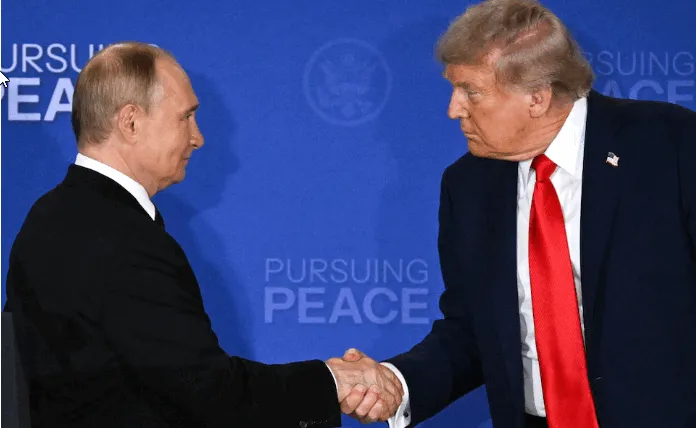
Asle Sveen, a historian of the award, cited Mr Trump’s attempted rapprochement with Vladimir Putin, the Russian president, among other reasons.
“His admiration of dictators also counts against him,” Sveen said. “This goes against Alfred Nobel’s will.”
Kristian Berg Harpviken, the committee secretary, who participates in all the deliberations of the five-strong panel but does not vote, said the award was not intended for last-minute achievements.
“This is a prize primarily for work done in 2024 and prior years, it’s not a prize for the work done in the most recent weeks or months,” Mr Harpviken told broadcaster NRK early on Friday.
Insiders say the award follows a year-long, deliberative process, during which candidates’ strengths and weaknesses are debated by the five-strong committee.
Nominations for the prize must reach the committee by Jan 31. Committee members can also make nominations, but they have to be made by the committee’s first meeting in February. Thereafter, the committee meets about once a month. The decision tends to be taken in August or in September.
The Nobel committee says it is used to working under pressure from people, or their supporters, who say they deserve the prize. Jørgen Watne Frydnes, the leader of the Nobel committee, told Reuters: “All politicians want to win the Nobel Peace Prize.”