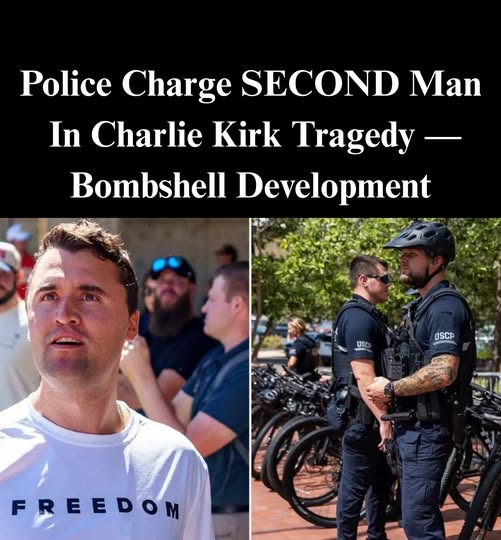
The aftermath of the shocking killing of conservative activist Charlie Kirk has grown even more complex, as court documents now reveal the involvement of another man who attempted to mislead authorities in the chaotic moments following the shooting.
According to police reports reviewed by Fox 13 Utah, George Zinn, a 71-year-old political activist known locally as a “gadfly,” falsely confessed to shooting Kirk in an effort to draw attention away from the real killer.
Zinn’s dramatic outburst not only startled onlookers but also slowed down the investigation at a critical stage, according to officials. He is now facing felony charges.
The tragedy unfolded last Wednesday at
Amid the confusion, Zinn approached officers and shouted:
“I shot him, now shoot me!”
He was quickly detained. Officers found no firearm on him, but his words caused significant disruption. Videos from the scene show Zinn being dragged away by police as stunned bystanders shouted and cursed at him, believing they had just witnessed the arrest of the shooter.
One officer was even heard saying: “He said he shot him, but I don’t know.”
For a short time, Zinn’s false confession added to the chaos and fueled misinformation among those present.
Once in custody, Zinn admitted that he had not shot Kirk. Instead, according to court documents, he told investigators that his goal had been to “draw attention away from the real shooter.”
Zinn further claimed that he wanted to be a “martyr for the person who was shot,” according to reports from his hospital interview. Authorities say that his interference distracted resources and delayed their response as they pursued the real suspect.
As a result, Zinn has been charged with obstruction of justice, a second-degree felony in Utah.
George Zinn’s name is not new to Utah law enforcement or the political community. For years, he has been known as a persistent presence at local events—sometimes disruptive, sometimes eccentric, but rarely ignored.
“Almost every political event you can think of, there was always George somewhere in the background, listening,” Salt Lake County District Attorney
Gill described him as someone with “odd behavior challenges,” adding: “By and large, he’s more of a gadfly than anything else.”
His decision to insert himself into Kirk’s murder investigation, however, elevated him from nuisance to felon in the eyes of law enforcement.
While Zinn attempted to distract authorities, the true suspect—Tyler Robinson, 28, of Provo—was on the run.
Robinson evaded capture for 33 hours before eventually turning himself in, following an emotional intervention by his father.
According to law enforcement sources, Robinson’s father recognized his son in surveillance images released by the FBI during the manhunt. When he confronted Tyler, the younger man reportedly confessed his involvement and told his father he planned to take his own life.
Instead, his father persuaded him to surrender, after consulting with a family preacher. Robinson was taken into custody and is now facing multiple charges, including first-degree murder.
Federal authorities have released striking evidence that ties Robinson to the crime.
Robinson is currently being held under special watch while awaiting a mental health evaluation. Utah Governor Brian Cox confirmed on Sunday that Robinson has not been cooperating with investigators.
Authorities have not uncovered any connection between Robinson and George Zinn, despite Zinn’s attempt to insert himself into the case.
Robinson’s family members and romantic partner—a man who is transitioning from male to female—are cooperating with investigators. Sources have indicated that those close to him described him as struggling deeply with ideology and mental health issues.
The FBI continues to piece together Robinson’s path to violence, while prosecutors prepare for what is expected to be a high-profile trial.
For investigators, Zinn’s false confession was more than just an odd sideshow. His actions caused real delays at a moment when every second mattered.
“His first words slowed down the investigation into Kirk’s death and wasted police time and energy at a crucial point in the case,” police wrote in their report.
Though Zinn has long been considered a local eccentric, authorities say this time his behavior crossed into dangerous territory. His decision to claim responsibility for a murder he did not commit undermined the urgent search for a very real killer.
The killing of Charlie Kirk has already left the nation stunned and divided. The addition of George Zinn’s bizarre false confession adds another layer of confusion to an already tragic event.
What began as a shocking act of violence quickly spiraled into chaos, with police forced to sort truth from lies in real time. While Zinn’s motives remain muddled—part performance, part misdirect—what is clear is that his actions delayed justice when it mattered most.
As Tyler Robinson awaits trial, and as Utah authorities continue to investigate the circumstances that led to Kirk’s death, Zinn’s case serves as a stark reminder: in moments of crisis, spreading falsehoods is not only irresponsible, it is criminal.
During the 2024 Hamptons International Film Festival on October 13, Demi Moore received the Career Achievement in Acting Award and took a moment to give an emotional update on her ex-husband Bruce Willis’ health. The 61-year-old actress shared that Willis, now 69, remains “stable” as he continues to battle frontotemporal dementia (FTD), a degenerative brain condition he was diagnosed with following an earlier diagnosis of aphasia.
Moore spoke candidly about the reality of living with such a diagnosis in the family, emphasizing the importance of acceptance. “The disease is what the disease is, and you have to deeply accept that,” she said. She noted that while the situation is difficult, there is beauty in choosing to focus on the present moment and appreciating the time they still have together.
She also shared a personal moment, mentioning that she had recently visited Willis with her granddaughter Louetta, Rumer Willis’ daughter. That visit reminded her of the importance of being present and treasuring even the smallest moments: “Being able to share with whatever we have, for however long we have it,” Moore reflected.
Demi Moore and Bruce Willis, who divorced in 2000 but have remained close over the years, share three daughters—Rumer, Scout, and Tallulah. Moore has often been seen supporting Willis and his family as they navigate his illness together, showing a deep bond and mutual respect that has lasted long after their marriage ended.
While accepting her award, Moore also reflected on her long and varied career in Hollywood, expressing sincere gratitude for the journey. “It feels like lifetimes,” she said. “Thank God I kept getting opportunities to get better.”
Her words were a touching reminder of resilience—not only in her professional life but also in how she continues to face personal challenges with grace and strength.
When a guy discovered a hornet’s nest in his loft, he was taken aback to learn that it was the largest nest they had “ever seen” when he called pest control to come and remove it.
The “biggest she’s ever seen” hornet’s colony was discovered in the attic of a terrified man, according to a pest control specialist.
While trying to wash his car, Les Stagg observed a few hornets hovering about the outside of his house, but he didn’t give it much mind.
He quickly discovered a “bit of a nest” on the roof and called pest control to come investigate. He had no idea what they would discover, though.
According to the Liverpool ECHO, she called the man over to let him know the real scope of the problem after the expert entered Les’s loft to investigate it.
Les had believed the flying insects may be wasps, but the woman told him that because of their size, they were “definitely” hornets.
She also told him it was the
“biggest she’s ever seen” nest in his loft.
Les said, “I was telling her that I only saw the hornets flying around the house on Sunday, so I thought it might be a new, small nest.”
“When she went up to have a look, she came straight back down and told me that I might want to have a look at it. She said it’s the biggest she’s ever seen.”
“Thankfully she was able to spray it and then waited an hour before taking the nest out.”
She told Les that because of the weather, hornet season has “gone crazy”
and that the issue might last until November and December.
According to Independent Pest Control, they typically receive calls for this kind of issue once a week, but right now, they receive calls on a daily basis.
Les said: “I really hate wasps and hornets. I only saw about six or seven outside the roof, but they were always there, and they had started to come in through the bathroom window.”
Fortunately, they have vanished entirely. Although the woman that came to help was extremely wonderful, she did mention that I might need to get my roof inspected right away.
“It was lucky I spotted them. We only go into the attic three or four times a year to do things like get the Christmas tree down so they could have ended up being there a lot longer.”
“The woman had to have a protective suit on, but they were swarming around her. One of them still managed to sting her through the suit on her shoulder.”
“I was completely shocked when I saw the size of it. I couldn’t believe it. We have had hornets and nests in the past, but never one as big as this.”
It had been years since the Benghazi attack faded from daily headlines, but today the ghosts returned — not quietly, not politely, not politically sanitized.
At 9:42 a.m., Senator James Kellerman (R-LA) strode to the lectern, slammed a leather-bound folder onto the marble, and delivered a speech that instantly detonated across the nation.
“Former Secretary of State Helena Carver should not have immunity for this,”
His voice echoed beneath the sandstone arches, shaking the chamber into stunned silence.
For the first time in years, the Senate was forced to confront the darkest chapter of modern foreign policy — one that many believed had been buried under committees, redaction, and political fatigue.
But Kellerman wasn’t there to rehash.
He was there to accuse.
And in his binder, he claimed, were newly declassified documents revealing a chain of decisions — covert, catastrophic, and treacherous — that culminated in the fictional Benghazi disaster of 2012.
According to Kellerman’s presentation, the story began in 2011, when then–Secretary of State Helena Carver authorized off-ledger arms transfers to anti-regime forces in Libya — bypassing congressional approval and diverting through the covert “Lighthouse Program,” a shadow network known only within intelligence circles.
Carver’s alleged liaison was Ambassador Christopher Stanton, a respected diplomat stationed in Tripoli and later Benghazi.
Her alleged arms broker: private dealer Marcus Trill, a man with a decade of black-market footprints in Eastern Europe and North Africa.
The scheme, as Kellerman laid out, was chilling:
U.S.-manufactured Stinger-class missiles
routed through Qatar’s defense ministry
funneled to Carver-approved Libyan rebel groups
under the pretense of “supporting democratic resistance”
But the fictional documents Kellerman cited painted a different story:
Some missiles vanished.
Some were sold.
And others ended up in the hands of Ansar al-Sharia, the extremist group that later attacked the Benghazi compound.
A CIA cable from 2012 — one Kellerman read aloud — contained a single, knife-sharp line:
“We can no longer verify the chain of custody.”
The room fell silent.
For many watching, that line carried the weight of a verdict.
What came next changed the tone of the chamber completely.
Kellerman recounted the now-infamous 2012 incident in fictional Kunar Province, Afghanistan, where a U.S. CH-47 transport helicopter was struck by a missile that — according to Kellerman — bore a serial number linked to the Carver-Trill shipments.
The missile failed to detonate due to a defective fuse.
The helicopter survived.
And its safe landing allowed military investigators to recover the launcher, track the serial, and trace the weapon back through Qatar to Libya — straight into the Lighthouse Program’s supply list.
Kellerman lifted a page from the binder and read:
“Recovered missile serial 0538-K9 confirms origin: U.S. manufacture. Qatar transfer. Unverified recipient group.”
His conclusion:
“Secretary Carver’s weapons ended up in the hands of militants who not only attacked our consulate, but were used against our troops abroad.”
According to Kellerman’s speech, once the serial number surfaced, alarm rippled through State Department leadership.
The alleged operation was at risk of exposure.
And Ambassador Stanton — the man who oversaw the Libya channels — was reportedly tasked with a “retrieval mission,” a phrase Kellerman repeated with bitterness.
“Helena Carver sent him to clean up her mess.
The senator described internal documents referencing:
“sensitive materials requiring secure recovery,”
“urgent retrieval of misplaced shipments,”
and “unauthorized arms transfers posing administrative risk.”
This mission placed Stanton in Benghazi during one of the most volatile weeks of the Libyan civil war.
And when militants surrounded the compound on September 11, 2012, Stanton’s repeated calls for assistance were allegedly met with chaos, conflicting orders, and — most chilling — silence.
Kellerman claimed:
“The stand-down order wasn’t incompetence.
It was self-preservation.”
Again, the chamber went silent.
A key figure in Kellerman’s narrative was General David Pierce
, then-director of the fictional National Intelligence Command.
According to Kellerman, Pierce pushed back on two key actions:
Approving additional arms shipments through Lighthouse
Supporting the administration’s public claim that the attack was spontaneous
Pierce allegedly refused to sign off on any cover story.
Within weeks, he resigned — officially for “health and family reasons,” but Kellerman called that explanation laughable.
“General Pierce didn’t leave. He was removed.”
The senator held up a copy of Pierce’s private deposition from 2018, now declassified.
In it, Pierce reportedly stated:
“I would not participate in a narrative designed to obscure the truth.
Kellerman then pivoted to one of the most controversial chapters in Carver’s political history:
Her private communications server.
But instead of describing it as “a matter of convenience,” Kellerman labeled it:
“A custom-built erasure machine.”
He claimed that over 33,000 emails tied to the Lighthouse Program, Benghazi communications, and foreign weapons transfers were deleted during ongoing inquiries.
His voice hardened:
“The server wasn’t about privacy.
It was about obstruction.”
He then cited an internal memo — fictional, newly released — that read:
“All Lighthouse-associated communications must be purged prior to oversight review.”
Democratic senators objected vocally.
The presiding officer banged the gavel repeatedly.
C-SPAN cameras caught the chaos.
But Kellerman pressed on.
The chamber leaned in as Kellerman described one of the most explosive allegations in his narrative.
According to a classified cable decrypted in 2021 (fictional), the Taliban leadership had discovered serial numbers from two MQ-Stinger units in Afghanistan — numbers tied to the Lighthouse Program.
Kellerman read:
“Taliban possess documentation linking U.S. weapons to Libya channel.
Demand prisoner exchange of high-value detainees.”
His interpretation:
“The release of five extremist commanders from U.S. custody wasn’t goodwill.
He argued that the administration used the controversial prisoner-for-soldier exchange — involving POW Aaron Bergson — as a public cover story for a far more dangerous negotiation.
“It wasn’t diplomacy.
It was blackmail.”
The room erupted.
Reporters typed furiously.
X (formerly Twitter) went into meltdown.
Kellerman ended with a tribute to the four Americans killed in the fictional Benghazi attack:
Ambassador Christopher Stanton
Information Officer Sean Miles
Security contractors Tyron Gates and Liam Wood
and the dozens wounded in the siege’s aftermath.
He held up their photographs — four men frozen in history.
“These men didn’t die from chaos,” he said.
“They died from decisions.”
Then he closed his binder with a final thunderous declaration:
“Treason has no expiration date.
And neither should justice.”
Within an hour:
#CarverFiles hit #1 nationwide (fictional).
Media outlets cut into regular programming.
Congressional leaders scrambled for responses.
The Carver Foundation issued a statement calling Kellerman’s claims “deranged fiction.”
But millions of Americans demanded a new investigation.
Even some centrists called for a bipartisan panel to examine the newly released documents.
Political analysts said:
“This is the most explosive Senate speech in two decades.”
“If even 10% is true, it rewrites modern foreign policy history.”
“Carver will have to testify.”
The Justice Department offered “no comment.”
The White House communications office canceled its afternoon briefing.
Phone lines on Capitol Hill lit up — and stayed lit.
Senator Kellerman’s speech marks a turning point in this fictional political landscape — a collision of secrecy, power, and accountability that threatens to reshape public trust for years.
The nation now faces a choice:
Investigate
Ignore
Or relive the battle all over again
But one truth lingers:
In Kellerman’s words, echoed across the country:
“History does not forget betrayal —
Only people do.”