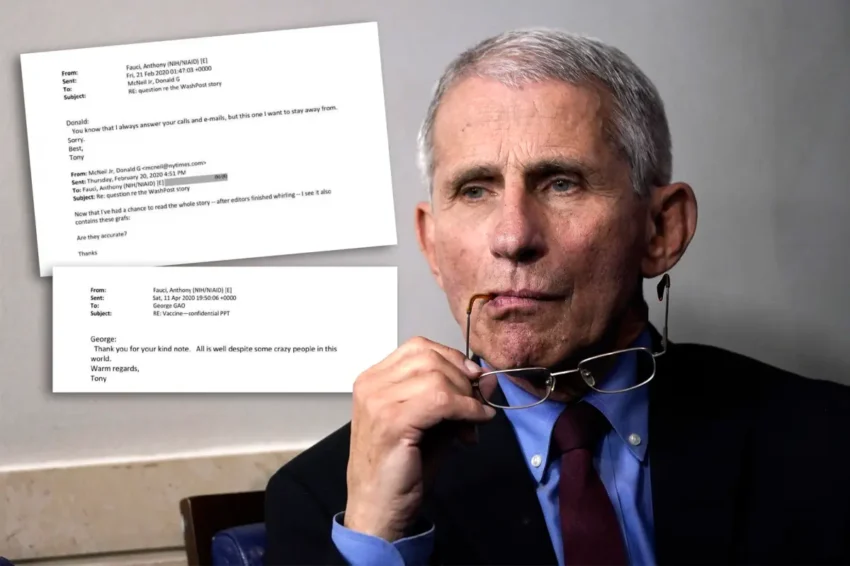
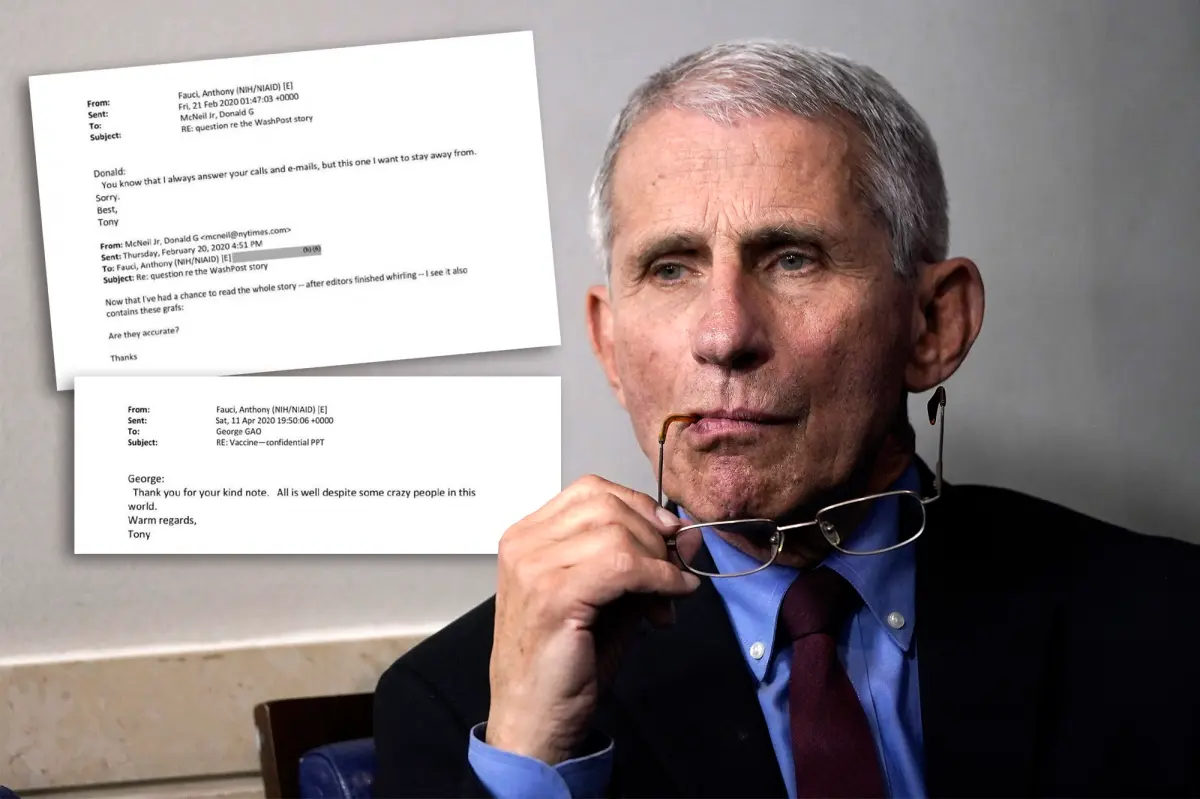
New emails have surfaced suggesting that Dr. Anthony Fauci, the longtime head of the National Institute of Allergy and Infectious Diseases (NIAID), encouraged federal employees to destroy government records related to the origins of COVID-19.
The revelations come from a series of emails obtained by congressional investigators and highlighted by Senator Rand Paul, who has long pressed for transparency regarding Fauci’s handling of the pandemic.
“We now have clear evidence that Dr. Fauci instructed federal employees to delete official records,” Senator Paul told the New York Post. “This is a violation of federal law and contradicts his sworn testimony.”
One email from February 2020 was particularly damning. It came shortly after a high-level call with virologists about the origins of COVID-19. According to congressional memos, the email included instructions to “delete” messages that discussed the possibility of a lab leak.
The House Select Subcommittee on the Coronavirus Pandemic released a memo describing “serious misconduct and potentially illegal actions” by Fauci’s senior adviser, Dr. David Morens.
“Dr. Morens unlawfully deleted federal COVID-19 records, used a personal email to avoid FOIA, and repeatedly acted unbecoming of a federal employee,” the subcommittee memo stated.
Emails from Morens also appear to implicate Fauci directly. In one exchange, Morens wrote that Fauci “is too smart to have things in writing,” adding that he would help keep certain discussions “off the record.”
Lawmakers say this proves Fauci was aware of efforts to destroy records. “These revelations demonstrate that Dr. Fauci was not only complicit but may have personally directed the destruction of federal records,” Rep. Brad Wenstrup, chair of the subcommittee, said in a press release.
The alleged cover-up centers around the controversial February 2020 paper, The Proximal Origin of SARS-CoV-2, which dismissed the lab leak theory as a conspiracy. Critics argue Fauci’s behind-the-scenes influence shaped that narrative while publicly denying any involvement.
“What we’re seeing now is evidence of deliberate deception,” Paul said. “Fauci told the American people one thing while working behind the scenes to suppress alternative theories.”
The emails also reveal an ongoing effort within the NIH to avoid Freedom of Information Act (FOIA) requests. Morens admitted in one exchange that he would “delete anything” that might be requested by watchdogs.
“I always try to communicate via Gmail because my NIH email is FOIA’d constantly,” Morens wrote in an email subpoenaed by Congress.
Senator Paul blasted this as a clear violation of federal transparency laws. “The law is very clear—federal employees cannot use private emails to conduct official business and then destroy records to avoid oversight,” he said.
In response, Paul sent a letter to the Department of Justice demanding a full investigation into Fauci and Morens. “The DOJ must investigate whether Dr. Fauci and his associates engaged in the unlawful destruction of records,” Paul wrote.
The New York Post reported that Fauci has been called back to Congress for further questioning. Lawmakers want him to explain the newly released emails that appear to contradict his past testimony.
“Fauci testified under oath that he never instructed anyone to delete records,” Wenstrup said. “These emails suggest otherwise, and that raises serious questions about perjury.”
The controversy is not new. In 2022, the National Archives and Records Administration (NARA) warned the NIH about potential violations of federal recordkeeping requirements.
In a letter obtained by archives.gov, NARA said NIH staff had allegedly been ordered to “shred notes and other documents” referencing its work with the Wuhan Institute of Virology.
“If proven true, these are unauthorized dispositions of federal records,” the letter from NARA stated.
Conservative lawmakers say the implications are massive. “If Fauci ordered records destroyed, that is criminal,” Rep. Jim Jordan said in a Fox News interview. “We’re talking about one of the most consequential cover-ups in U.S. history.”
Paul went further, accusing Fauci of intentionally misleading Congress. “This is about accountability,” he said. “No federal employee, no matter how powerful, is above the law.”
Fauci, however, has denied wrongdoing. In past interviews, he insisted he has always complied with federal transparency rules. “I have nothing to hide,” Fauci said in July when asked about earlier reports of email deletions.
Still, lawmakers say his denials don’t match the evidence. “He told us under oath that he never destroyed records,” Wenstrup said. “Now we see emails where his top adviser brags about deleting them on his behalf.”
The death of a political figure is rarely confined to private grief. When tragedy unfolds before thousands, it becomes both a matter of national reckoning and an intimate story of loss. One week has now passed since the assassination of Charlie Kirk, the 31-year-old founder of Turning Point USA, and the shock has yet to fade. Instead, each day brings new fragments of information — pieces that illuminate not only the violence of that afternoon, but also the desperate, ultimately futile, efforts to save his life.
What began as the launch of Kirk’s “American Comeback Tour” at Utah Valley University has instead become a grim case study in political violence, the fragility of life under the spotlight, and the anguish of those who tried to preserve it. Among the most striking accounts is the testimony of Frank Turek, Kirk’s longtime friend and mentor, who was with him in the frantic moments after the gunfire.
On September 10, Kirk stood before an audience of more than 3,000. Known for his combative debating style, he was taking a question on gun violence when a single shot rang out.
The bullet, allegedly fired by 22-year-old Tyler Robinson from a rooftop nearby, struck Kirk in the neck, severing key arteries. In an instant, the activist who built his career on amplifying his voice was rendered silent.
Panic spread through the venue. Security rushed to the stage as attendees screamed. Within seconds, Kirk’s limp body was lifted into a waiting vehicle. From that point forward, every second mattered.
In the days since, new details have surfaced, painting a fuller picture of Kirk’s final hours. Homeland Security Secretary Kristi Noem disclosed that Kirk had sent her a private text the night before his death — a message now parsed by supporters as a possible reflection of his mission. Neuropsychologist Derek Van Schaik analyzed footage of the shooting and concluded that Kirk likely never registered what had happened, losing consciousness in less than half a second.
But perhaps the most harrowing testimony has come from Frank Turek, the Christian apologist and author who described riding with Kirk during the desperate dash to the hospital.
“Charlie Kirk was literally a son to me,” Turek, 63, said on his podcast Cross Examined, his voice breaking. “So if your son got hit, what would you do? You get in that car. You do everything you can, no matter what.”
And so he did. As Kirk’s body was loaded into the vehicle, Turek climbed in beside him. What followed was a frantic race against time, blood loss, and fate.
One haunting detail still lingers: Kirk’s tall frame was too large for the back seat. His body stretched so far across that rescuers could not shut the car door. “Charlie is laid out right in front of me, and Charlie’s so tall we can’t close the door,” Turek recalled.
The image is both heartbreaking and symbolic — a leader too large for the confines of the car, straddling the threshold between life and death as the vehicle tore through the streets with one door hanging open.
Inside, Turek alternated between performing CPR and pleading with his friend to hold on. “Come on, Charlie, come on, come on,” he repeated, pressing on his chest. Members of Kirk’s security team worked calmly but urgently, applying pressure to the wound. They were trained for such moments, but the injury was catastrophic.
By the time they reached Timpanogos Regional Hospital, Turek knew the fight was over. “Charlie wasn’t there,” he said quietly. “His eyes were fixed. He wasn’t looking at me. He was looking past me, right into eternity. He was with Jesus already.”
For Turek, solace lies in faith. “Absent from the body, present with the Lord. That’s where Charlie is,” he said. “He didn’t suffer. He didn’t even know. He was gone in an instant.”
Neuroscience offers a similar conclusion. Van Schaik explained that with a wound severing both the carotid artery and jugular vein, Kirk would have lost consciousness in less than half a second. “No panic, no dread, no awareness of death,” he said. “Only an abrupt blackout.”
In that way, both faith and science converge on a single point: Charlie Kirk did not suffer.
Supporters have also noted the cruel irony of the moment. Kirk was addressing gun violence when violence silenced him. He was speaking to a crowd of students — the audience that most defined his career — when his voice was taken away.
To critics, Kirk was a polarizing figure. To allies, he was a warrior for conservative values. To both, his death at a university podium crystallized the very divisions that shape American politics today.
Since his death, tributes have poured in. Former President Donald Trump called him “an American hero.” Kirk’s widow, Erika, vowed that her husband’s mission would continue: “The movement my husband built will not die. It will grow stronger, louder, bolder.”
For Frank Turek, however, the loss remains painfully personal. His testimony — the open car door, the CPR, the last gaze — ensures that Kirk’s final moments are remembered not only as a headline, but as a deeply human story of friendship, faith, and loyalty.
One week later, the details remain raw, each revelation reopening wounds. Yet the scene described by Turek — a desperate ride to the hospital, the open door, the fight against time already lost — has emerged as the defining image of Kirk’s final moments.
It is a story of devotion and desperation, of faith colliding with mortality. It reminds us that behind every headline are the fragile threads of human life — friends who fight to the end, families who grieve, and moments suspended between hope and heartbreak.
Charlie Kirk may have been silenced in an instant, but the story of his life — and the way it ended — will echo long after.