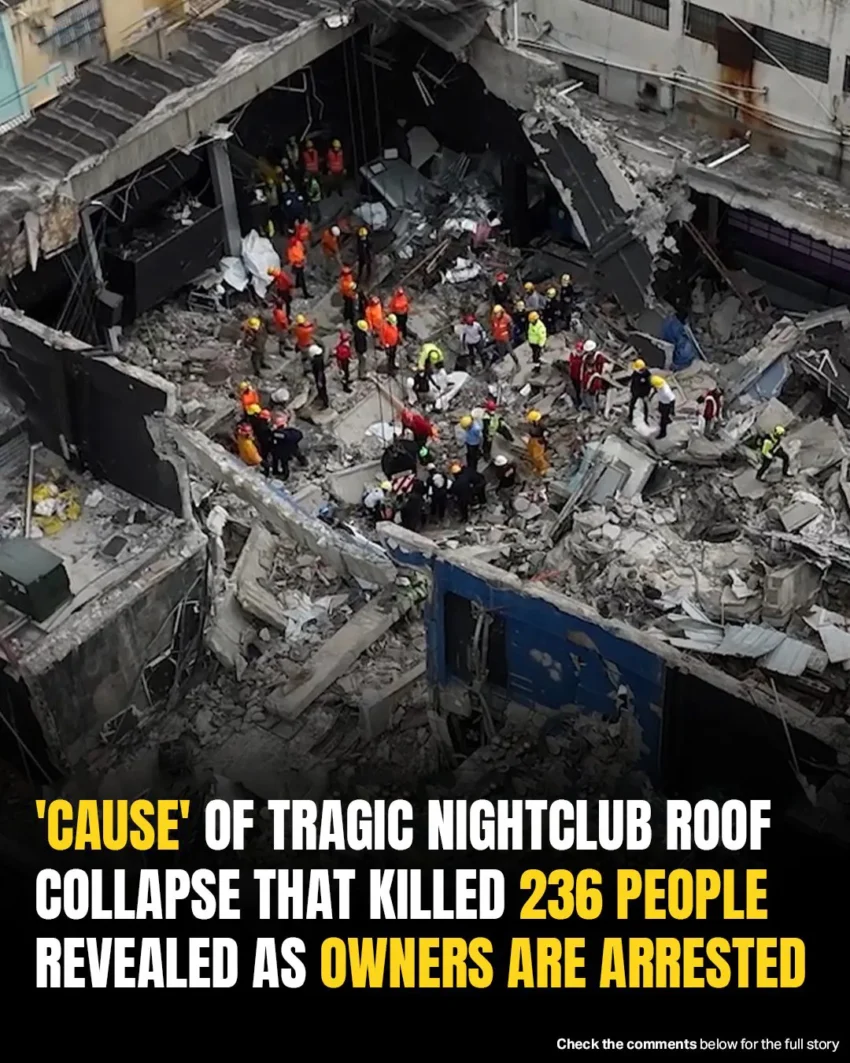
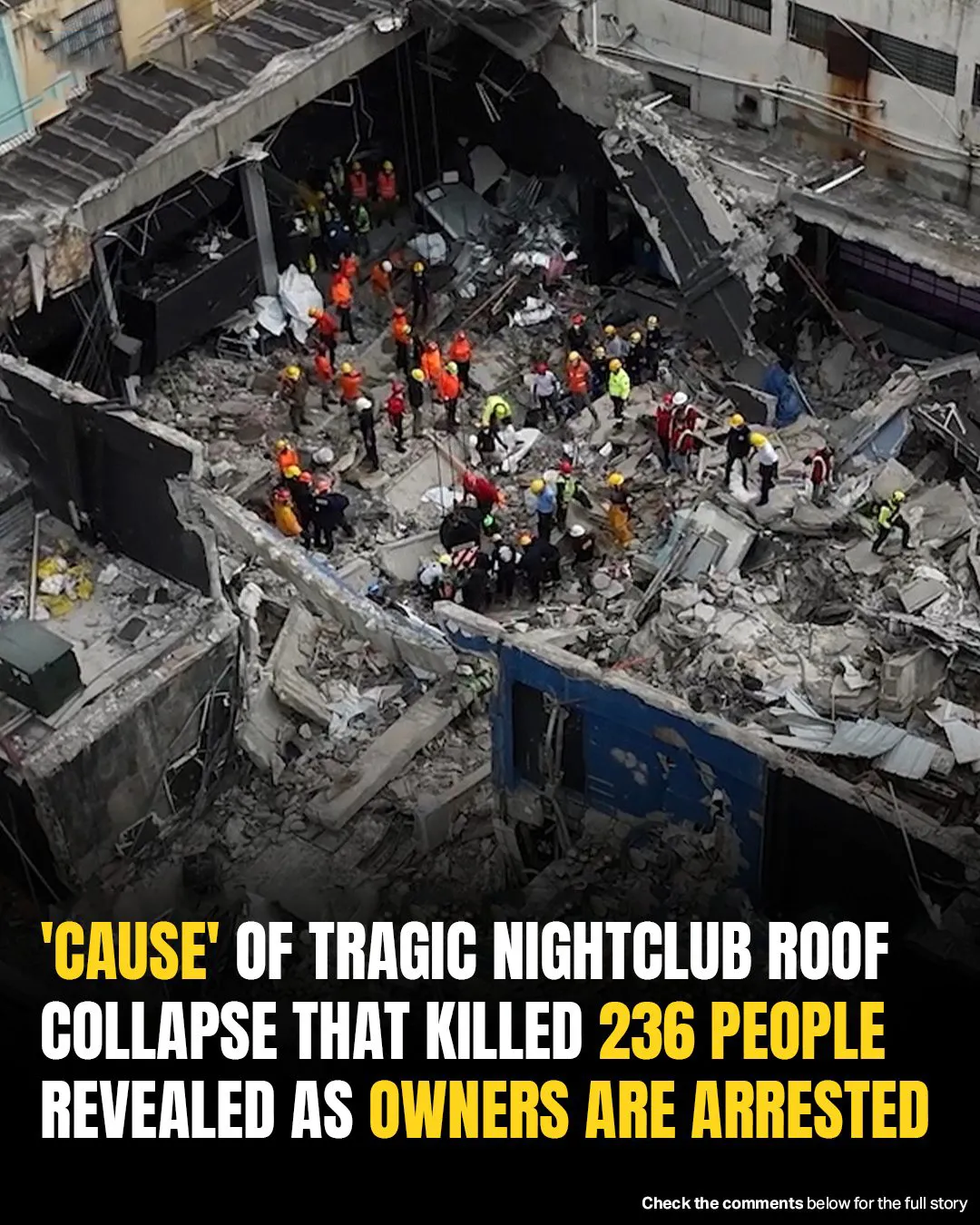
In the Dominican Republic, an investigation has been in progress since more than 200 people were killed when the roof of a nightclub collapsed.
At least 300 partygoers and employees, including two former Major League Baseball players, were impacted when the roof of the Jet Set club in Santo Domingo collapsed in early April of this year.
That particular night, Rubby Pérez was on stage. Unfortunately, the beloved Dominican merengue singer also perished in the incident.
Antonio and Maribel Espaillat, the club’s proprietors, were arrested and placed under arrest on June 12 after the Public Prosecutor’s Office conducted an inquiry into the case.
According to the New York Times, both have been charged with involuntary homicide.
“Both defendants displayed immense irresponsibility and negligence by failing to physically intervene to prevent the club’s roof from collapsing, as it ultimately did, causing 236 deaths and more than 180 injuries,”
the Attorney General’s Office of the Dominican Republic said in a statement regarding their detention.
According to Dominican Today, the club’s renovations were carried out “without obtaining the required permits or conducting the necessary structural assessments from the Ministry of Public Works and Communications (MOPC) or the Mayor’s Office of the National District.”
Prosecutors claimed that these modifications showed “a complete disregard for building and safety laws.”
They also stated, “A key column in the structure was subsequently removed, significantly affecting the roof’s stability, without any professional assessment or permit to support the modification, demonstrating high-risk behaviour.”
Heavy elements were also said to have overloaded the Jet Set Club’s roof.
The Espaillats allegedly knew of the building’s structural problems “through visual reports (photos and videos) and communications from their employees,”
yet they decided to overlook the difficulties.
Given all of this, the Public Prosecutor’s Office has maintained that if the defendants had followed the law and put life before money, the events of April 8
prosecutors continued: “The defendant, Maribel Espaillat, was aware of a falling debris incident hours before the collapse and in response to a request to suspend the activity, refused to do so, citing the absence of the defendant Antonio Espaillat López and the impossibility of stopping the party, prioritising economic gain over the safety and lives of people.”
Jimmy Kimmel has spent a lifetime under the lights. But on the night of September 23, 2025, as the cameras rolled for his long-awaited return to
Jimmy had been suspended for six long days. The controversy, the headlines, the whispers that he might not return — all of it weighed on him as he straightened his tie backstage. Molly, his wife and head writer, squeezed his hand. “Say it the way you mean it,” she whispered.
He walked out to thunderous applause, but he felt something else pressing on him: the weight of his children’s eyes. He knew Jane, 11, and Billy, 8, were at home, watching every second. So when he launched into his monologue — fierce, fiery, trembling with conviction — it wasn’t only for the crowd in front of him. It was for the two kids who had grown up hearing him read bedtime stories and learning, in small ways, what courage looked like.
In the living room, the babysitter said the air felt electric. Jane sat forward, biting her lip, whispering every time her father landed a joke. Billy clapped too soon, laughing nervously, like he was cheering his dad through a little league game.
When Jimmy raised his voice about free speech, Jane whispered, “That’s brave.” When he softened to acknowledge Erika Kirk’s act of forgiveness, Billy murmured, “That’s kind.”
And when the credits finally rolled, they both shouted in unison:
The babysitter swears she saw tears in their eyes.
That night, the children couldn’t sleep. Jane opened her notebook, crossed out her old essay title, and rewrote it:
Billy doodled a microphone in the corner of his page, scribbling: “My dad makes people laugh, but he also fights for what’s fair.” Jane added: “Mommy and Daddy work together to make the world better.”
The essay wasn’t polished. Words were misspelled. But it pulsed with sincerity. Their teacher later admitted, “No grade could ever measure the heart in that essay.”
Jimmy read the essay the next morning. He cried. Not the laughter-wrinkled tears America knows him for, but the quiet tears of a father who realized that, in the eyes of his children, he had already won.
It reminded him of other nights. The night Billy, as a toddler recovering from heart surgery, had asked if daddy could sleep on the hospital floor beside him. The afternoon Jane had stood backstage years earlier, too shy to meet a guest, and Jimmy had crouched to whisper: “You don’t have to be funny. You just have to be you.”
Moments no audience ever saw.
For Jimmy, the suspension, the backlash, even the roaring applause in the studio faded in comparison to those four words from his children.
Daddy, you did so good.
It wasn’t about ratings or contracts. It was about love measured in bedtime essays, whispered pride, and the unshakable bond between a father and his kids.
Weeks later, the essay still hangs on the fridge. Jane walks past it on her way to school. Billy taps the doodle of the microphone as he runs out the door. Jimmy sees it every morning before leaving for the studio — a reminder that the real audience, the one that matters most, sits not in a theater, but at home, waiting for him to come back through the door.
And when people ask him if the suspension was worth it, he doesn’t think of hashtags or headlines. He thinks of his children, their voices echoing in that living room, louder to him than any standing ovation.
Daddy, you did so good.
That was the review that mattered. That was the legacy that would last.