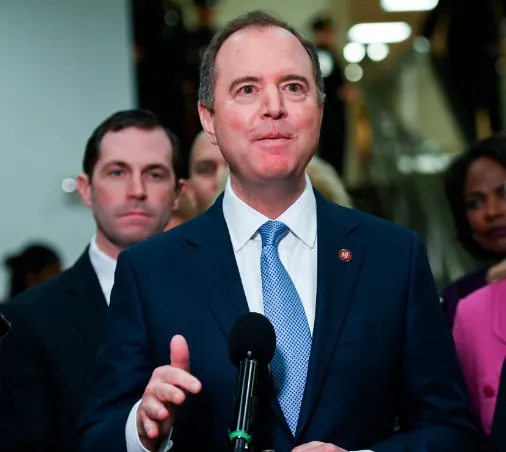
A Democrat whistleblower’s allegations, backed by newly declassified FBI interview reports, are now threatening to upend the political career of Sen. Adam Schiff (D-CA).
If the whistleblower’s account is accurate and prosecutors pursue the case, Schiff could face not only career-ending political consequences but also staggering financial penalties and lengthy prison terms.
As Tolman noted, the legal exposure could multiply quickly: “It depends on the counts in the indictment… The fine is up to $250,000 for every leak that’s charged.”
The claims date back to Schiff’s time in the U.S. House, when he served as the ranking member — and later chairman — of the House Intelligence Committee during the Trump–Russia investigation.
The whistleblower, who worked for Democrats on the committee for more than a decade, repeatedly told the FBI starting in 2017 that Schiff had authorized leaking classified intelligence to the media to damage then-President Donald Trump.
The whistleblower said that in an all-staff meeting, Schiff declared that “the group would leak classified information which was derogatory to President of the United States Donald J. Trump” and that the leaks “would be used to indict President Trump.”
The whistleblower claimed he immediately objected, telling Schiff the plan was “unethical and possibly treasonous,” but was assured by others that “we would not be caught leaking classified information.”
The source informed federal agents that Schiff believed he had received a promise to become the CIA Director should Hillary Clinton win the 2016 election. The whistleblower identified Rep. Eric Swalwell (D-CA) as a likely conduit for the leaks and said he was abruptly fired after raising the issue with the FBI.
Despite the seriousness of the allegations, the whistleblower says FBI leadership, including Director Christopher Wray, did nothing. He claims to have repeated the same account to agents from the bureau’s St. Louis office in 2023, again with no action taken.
Now, former U.S. Attorney Brett Tolman is warning of the potential penalties Schiff could face if prosecutors were to bring charges. In a conversation with political commentator
Benny Johnson, Tolman explained that leaking classified information carries steep financial and criminal penalties.
“Yeah. I mean, the fine is up to $250,000 for every leak that’s charged, so it depends on the counts in the indictment,” Tolman told Johnson. “Also, keep in mind, some of the punishment hinges on the purpose of the classified leak or the possession of classified documentation illegally. The purpose becomes very important.”
Tolman said the context of the leak could prove decisive in determining punishment.
“I believe this was, in essence, the beginning of a conspiracy to take down a president, to impact his ability to lead,” he said. “There are other statutes — conspiracy statutes, interference with official proceedings, et cetera. A lot of people have a question about treason — ‘Is it treason?’ You probably don’t satisfy the elements for treason, but there are some related crimes that could come into play.”
Tolman added that if prosecutors found an intent “to undermine the United States,” the penalties could reach “up to 20 years in federal prison.”
The FBI’s inaction on the allegations fits into what critics describe as a pattern under Director Wray of shielding politically connected figures. Kash Patel, a former Trump administration official, has accused the bureau of ignoring serious misconduct while aggressively targeting political opponents.
Patel has pointed to the FBI’s use of confidential informants ahead of the Jan. 6 protests as proof that the agency had foreknowledge of events but failed to act appropriately.
Schiff has not yet issued a public response to the newly surfaced allegations. In the past, he has denied leaking classified material and characterized such claims as partisan attacks meant to discredit his oversight work.
Former FBI Director James Comey, one of the most polarizing figures of the Trump era, is set to face arraignment in federal court in Alexandria, Virginia, on
That distinction has already drawn attention from legal scholars and political commentators. By issuing a summons rather than an arrest order, prosecutors may be attempting to strike a balance between treating Comey as a serious defendant while avoiding the optics of a high-profile arrest.
“This approach suggests the government is exercising caution,” said one legal analyst. “It avoids a spectacle while still ensuring Comey faces the full weight of the judicial process.”
The case, details of which are still emerging, is quickly shaping up to be both a
Legal experts emphasize that the absence of an arrest warrant does not mean the case is minor. An arraignment is a critical step in federal proceedings, where defendants are formally read their charges and asked to enter a plea. The legal process that follows could stretch for months, if not years, depending on the complexity of the charges.
Politically, the arraignment is certain to ignite heated debate. Conservatives are likely to seize on the case as evidence of misconduct at the highest levels of the FBI, while Democrats may frame it as another attempt to weaponize the justice system against a figure who crossed Trump.
As October 9 approaches, the spotlight will remain fixed on Alexandria’s federal courthouse. Whether the proceedings unfold quietly or spiral into another national controversy, Comey’s arraignment marks a new and unpredictable chapter in the ongoing clash between law, politics, and public perception.
Washington Bureau Report
A new political firestorm is unfolding in Washington amid revelations that former President Donald Trump’s government-issued phone was reportedly seized as part of Operation Arctic Frost, a sweeping surveillance program authorized during the Biden administration.
The disclosure has raised alarm across the political spectrum — not only because of its implications for privacy and executive privilege but also because it suggests that the Justice Department may have extended its reach well beyond traditional investigative boundaries.
The controversy centers on Special Counsel Jack Smith, whose probe initially focused on election-related matters but has since evolved into what critics are calling an unprecedented political surveillance campaign targeting Trump and his allies.
From Election Inquiry to Surveillance Operation
When Operation Arctic Frost was first launched in early 2023, the Justice Department described it as a limited effort to investigate alleged interference surrounding the 2020 presidential election. However, newly released documents and congressional testimony suggest that its scope rapidly expanded to include warrants, data seizures, and electronic monitoring of individuals with ties to conservative political circles.
According to Sen. Chuck Grassley (R-IA), one of the few lawmakers with access to classified briefings on the matter, the operation quickly crossed ethical and constitutional lines.
“What began as a targeted investigation has turned into an overreaching surveillance dragnet,” Grassley said in a statement. “We’re talking about a program that gathered communications data from elected officials, journalists, and even former members of the executive branch. That’s not oversight — that’s abuse.”
Sources familiar with the Senate investigation told The Federal Ledger that a classified subpoena signed by U.S. District Judge James Boasberg — the same judge now facing impeachment articles in Congress — authorized access to data belonging to several Republican lawmakers and former administration officials.
Among those targets, according to internal Justice Department memos, was the government-issued mobile device used by Donald Trump during his presidency.
Attorney General Pam Bondi Confirms Seizure
The most shocking development came Monday, when Attorney General Pam Bondi confirmed that the Biden administration had indeed handed over Trump’s official phone to the Special Counsel’s office in late 2023.
“This was not only irregular — it was unconstitutional,” Bondi said during a press briefing. “A former president’s communications are protected under executive privilege. The seizure of that phone without clear judicial authorization or congressional notification represents a violation of both precedent and propriety.”
Bondi added that her office is preparing a legal response and will seek the release of documentation explaining how the device was obtained and what data was accessed.
The Justice Department, in a brief statement, said the seizure was conducted “in accordance with established national security procedures” and declined to comment further on an “ongoing investigation.”
Constitutional Questions Mount
Legal experts say the revelation opens a Pandora’s box of constitutional concerns.
Dr. Angela Watkins, a professor of constitutional law at Columbia University, said that while law enforcement has some leeway in pursuing investigations, the surveillance of a former president’s communications represents “uncharted territory.”
“Even during Watergate, the line between law enforcement and political retaliation was fiercely debated,” Watkins said. “But the idea of one administration obtaining direct access to the communications of its predecessor is something that strikes at the heart of executive independence.”
Historically, presidential communications have been treated with extreme caution under the Presidential Records Act and related statutes. While those laws allow for the preservation of official materials, they also require judicial or congressional approval before access can be granted for investigative purposes.
If the Justice Department bypassed those procedures, analysts warn, the operation could represent one of the most significant breaches of executive privilege in modern history.
Bipartisan Shock — But Divided Reaction
While most Republican lawmakers expressed outrage over the seizure, some Democrats urged caution, emphasizing that details of the operation remain classified and that the Justice Department should be allowed to complete its work.
Rep. Dan Goldman (D-NY), a member of the House Judiciary Committee, said accusations of political targeting were premature.
“No one is above the law,” Goldman said. “If evidence exists that sensitive communications were used inappropriately or violated national security standards, it’s the Justice Department’s duty to investigate — regardless of who’s involved.”
Republicans, however, are calling for immediate hearings. House Oversight Committee Chair James Comer (R-KY) announced plans to subpoena documents related to Arctic Frost as early as next week.
“This isn’t about national security — this is about political control,” Comer said in a Fox News interview. “The Biden administration weaponized federal power to spy on its predecessor. That’s something we associate with authoritarian regimes, not the United States of America.”
Operation ‘Arctic Frost’: What We Know
Sources close to the investigation describe Arctic Frost as a multi-agency data collection program authorized under the Department of Justice and coordinated with the FBI and NSA.
According to leaked memos reviewed by The Federal Ledger, the operation’s stated purpose was to trace digital communications “linked to ongoing election-related threats.” However, internal reports indicate that its targets expanded to include members of Congress, political donors, journalists, and think tanks perceived as sympathetic to Trump’s policies.
The operation allegedly relied on nondisclosure orders — secret court directives preventing private companies from revealing that federal agencies had requested access to data.
That aspect of Arctic Frost is now the subject of a separate congressional investigation, after several telecommunications companies acknowledged receiving sealed orders from the DOJ between 2023 and 2024.
Impeachment Moves and Legal Fallout
The Arctic Frost revelations have already set off a chain reaction in Washington. On Monday, Rep. Brandon Gill (R-TX) introduced articles of impeachment against Judge James Boasberg, who authorized the subpoenas that enabled the surveillance effort.
Gill accused Boasberg of “abuse of power” and “betrayal of the public trust,” arguing that his actions allowed the Biden administration to engage in “domestic political espionage.”
Meanwhile, several former Justice Department officials have reportedly been subpoenaed by congressional investigators seeking to determine how far up the authorization chain the decisions went.
The Broader Political Impact
The Arctic Frost scandal comes amid an already volatile political climate, with the government partially shut down over disputes about spending and surveillance reform. For many observers, the timing is no coincidence.
“The government shutdown has exposed deep institutional mistrust,” said Mark Feldman, a political analyst at the Brookings Institution. “And now we have revelations that the Justice Department may have engaged in domestic spying. The optics are devastating — not just for the administration, but for the public’s faith in democratic accountability.”
Trump’s legal team has not commented on whether the seized phone contained classified or personal data, but sources close to the former president said they are considering legal action to compel its return.
For now, the controversy shows no sign of slowing. Lawmakers are preparing for a new round of hearings that could reveal even more about the inner workings of Arctic Frost — and whether the U.S. government’s surveillance powers have crossed a line that can’t be easily redrawn.
“This is bigger than Trump or Biden,” Grassley said. “It’s about whether the intelligence powers of this country are being used to protect liberty — or to destroy it.”
The United States Senate voted Tuesday to confirm Anne-Leigh Gaylord Moe, President Donald Trump’s nominee to serve as a U.S. District Judge for the Middle District of Florida. The confirmation passed narrowly by a vote of 53–46, marking another judicial victory for the Trump administration as it continues to shape the federal courts.
A Milestone in Trump’s Judicial Agenda
President Trump has placed a strong emphasis on judicial appointments during his time in office, continuing a strategy that began during his first term. The confirmation of Anne-Leigh Moe further solidifies his influence over the federal judiciary, particularly in a key swing state like Florida.
Trump celebrated the Senate’s decision with a post on Truth Social, describing Moe as a strong and principled advocate for law and order.
“I am pleased to announce the confirmation of Anne-Leigh Gaylord Moe to the United States District Court for the Middle District of Florida,” the president wrote. “Anne-Leigh has fiercely served the people of Florida as a Judge on the Second District Court of Appeal and as a Trial Judge in the Thirteenth Judicial Circuit. She will uphold LAW AND ORDER, unlike activist judges who put the safety of illegal criminals over the safety of Americans. Congratulations Anne-Leigh!”
The appointment was met with applause from Republican lawmakers who have championed Trump’s judicial selections as part of a broader effort to install conservative judges committed to strict constitutional interpretation and limited judicial activism.
Moe’s Legal and Judicial Background
Judge Moe brings more than two decades of experience to the federal bench. She has served on Florida’s Second District Court of Appeal since 2022 and previously spent nearly a decade as a circuit judge in Florida’s Thirteenth Judicial Circuit, which includes Hillsborough County — one of the largest and most diverse jurisdictions in the state.
Before becoming a judge, Moe worked as an Assistant State Attorney in Tampa, where she built a reputation for handling complex criminal prosecutions and advocating for victims’ rights.
Legal colleagues have described her as a fair-minded jurist with a meticulous approach to the law. Supporters within the Florida legal community noted that Moe’s courtroom demeanor and strong adherence to due process made her a respected figure in the state’s judiciary.
“Judge Moe has shown a consistent commitment to justice and integrity,” said Gregory Townsend, a former colleague who served with her on the Thirteenth Circuit. “She applies the law as written, not as she wishes it to be, and that’s exactly what the federal bench needs.”
A Narrow but Significant Senate Vote
The 53–46 Senate vote reflected the growing partisan divide over judicial nominations. All Republicans present voted in favor of the confirmation, while nearly all Democrats opposed it, citing concerns over Moe’s conservative record and her past rulings in criminal cases.
Democratic senators argued that Moe’s judicial philosophy aligns too closely with the Trump administration’s hardline approach to immigration and criminal sentencing. However, Republicans dismissed those criticisms as politically motivated.
“Judge Moe has an exemplary record,” said Senator Lindsey Graham (R-SC), a member of the Senate Judiciary Committee. “She understands the Constitution, she respects the separation of powers, and she’s committed to applying the law fairly. That’s exactly the kind of judge the American people deserve.”
The confirmation marks the fifth Trump nominee approved by the Senate since the start of his second term, reflecting the administration’s ongoing effort to fill long-standing vacancies within the federal judiciary.
A Continuing Shift in the Federal Courts
Anne-Leigh Moe’s confirmation adds to the growing number of federal judges appointed by Trump, whose selections are gradually reshaping the ideological balance of the courts.
During his first term, Trump successfully appointed three Supreme Court justices, over 50 appellate judges, and more than 200 district court judges, leaving an enduring impact on the federal judiciary. His administration has signaled that judicial appointments remain one of its highest priorities, viewing the courts as a key arena for upholding conservative legal principles.
“President Trump’s judicial nominees have been instrumental in restoring balance to the courts,” said Senator Mitch McConnell (R-KY), who praised the Senate for moving forward with the confirmation. “We’re ensuring that our judges follow the Constitution and the rule of law — not partisan ideology.”
The Middle District of Florida, where Moe will serve, handles a wide range of cases — from immigration and healthcare disputes to civil rights claims and criminal prosecutions. The district includes major cities such as Tampa, Orlando, and Jacksonville, making it one of the busiest federal courts in the country.
Reactions From Both Sides
While Republican leaders celebrated Moe’s confirmation as another victory for Trump’s judicial agenda, Democrats and progressive advocacy groups criticized the decision, warning that her appointment could shift key legal rulings in the years ahead.
“This is yet another example of the administration pushing through partisan nominees to cement its control over the courts,” said Senator Richard Blumenthal (D-CT). “Judge Moe’s record raises serious questions about her willingness to protect civil rights and uphold the Constitution for all Americans.”
Progressive organizations echoed similar concerns, citing Moe’s history of siding with law enforcement in criminal cases and her strict interpretation of procedural law.
Meanwhile, conservative groups hailed her confirmation as a win for judicial restraint. The Federalist Society, a network of conservative lawyers and legal scholars, issued a statement praising Moe’s “commitment to textualism and the rule of law.”
Trump’s Response to the Shutdown Debate
Moe’s confirmation came amid broader political tensions in Washington, with the federal government still partially shut down due to budget disputes between the White House and congressional Democrats. Despite the ongoing standoff, analysts say the confirmation vote highlights the administration’s determination to keep advancing its judicial priorities.
CNN political analyst Harry Enten noted that, unlike during the 2018–2019 shutdown, Trump’s approval ratings have remained relatively stable this time around.
“In the previous shutdown, Trump’s approval dropped three percentage points within a few weeks,” Enten said. “This time, despite the gridlock, his support appears to be holding steady — especially among Republican voters.”
Political observers believe that the steady pace of judicial confirmations is helping maintain Trump’s support base by demonstrating continued progress on campaign promises, even amid legislative stalemates.
What Comes Next
With Moe’s confirmation, the Trump administration has filled yet another key judicial vacancy — part of an effort to ensure that conservative judges are positioned across the federal bench for decades to come.
Moe is expected to assume her duties on the Middle District Court later this month, where she will preside over both civil and criminal cases. Her appointment will likely have immediate implications for ongoing disputes in Florida related to immigration enforcement, business regulation, and constitutional rights.
Legal analysts suggest that her rulings will be closely watched, not only because of her conservative judicial approach but also due to the political significance of the region she serves.
“The Middle District of Florida often sets precedents that influence other jurisdictions,” said Dr. Elaine Matthews, a legal scholar at the University of Miami. “Judge Moe’s decisions will help shape how federal law is interpreted in some of the country’s most contentious policy areas.”
Conclusion
The Senate’s confirmation of Anne-Leigh Gaylord Moe represents another defining moment in President Trump’s ongoing effort to remake the federal judiciary.
Her record as a Florida appellate and circuit judge reflects a firm commitment to law enforcement and a strict interpretation of the Constitution — traits that earned her praise from conservatives and criticism from progressives.
As Judge Moe prepares to take her seat on the federal bench, her rulings will likely influence key legal and political debates in the years ahead, reinforcing the Trump administration’s legacy of reshaping the judiciary through appointments that could define American law for a generation.